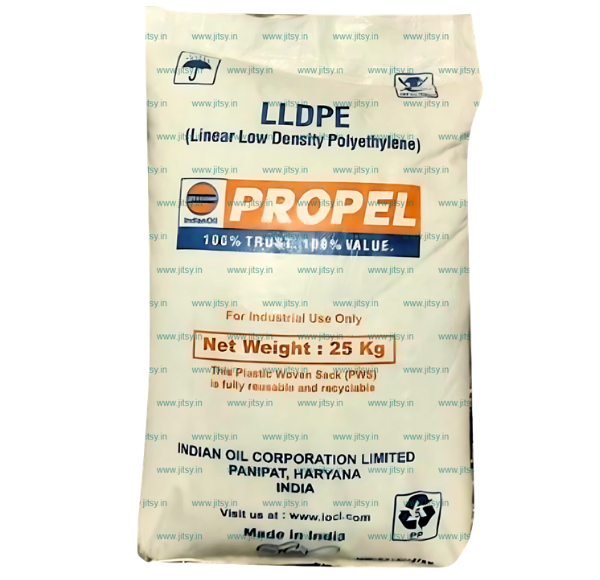
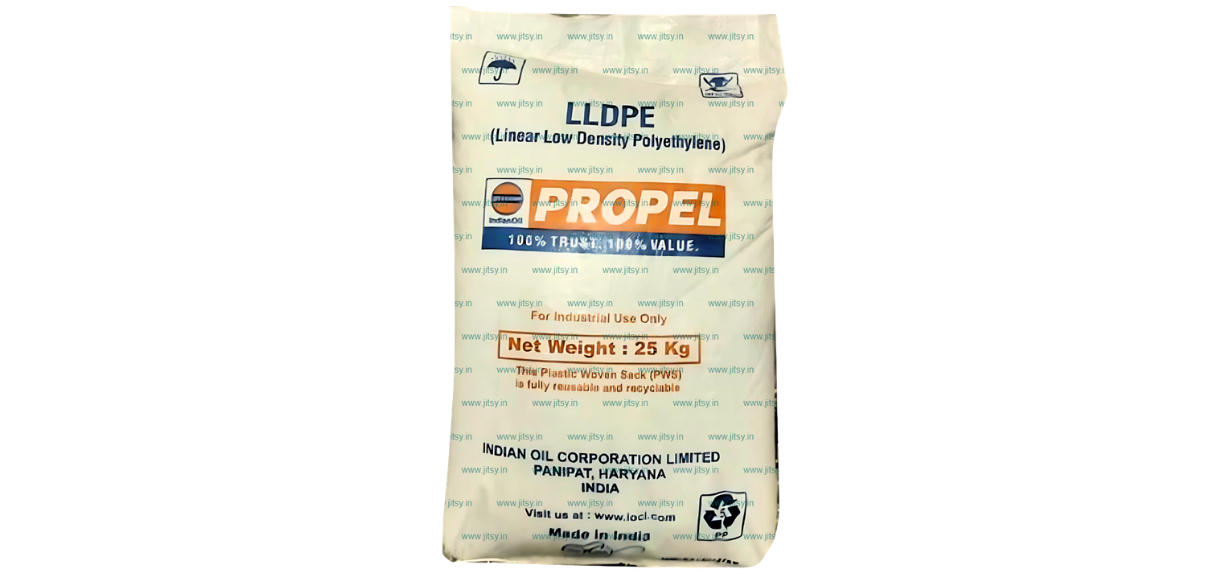
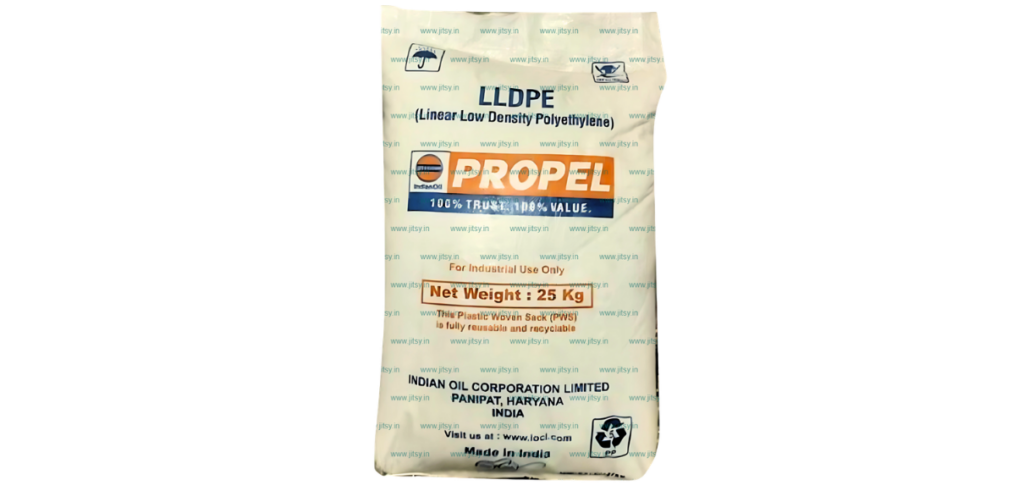
IOCL LLDPE Propel 065E24A is a linear low-density polyethylene (LLDPE) manufactured by Indian Oil Corporation Ltd (IOCL) under its PROPEL polymer brand. It is produced at IOCL’s LLDPE/HDPE swing plant in Panipat using Nova Chemicals’ Sclairtech solution polymerization technology — a process known for precise control of molecular weight distribution and comonomer incorporation, delivering consistent resin properties suitable for demanding extrusion coating applications.
With a melt flow index of 6.5 g/10 min, 065E24A has a substantially higher flow rate than IOCL’s blown film and roto moulding grades. IOCL’s grade slate describes 065E24A as having “Good processability, Low neck-in, Good adhesion on substrates” — the three characteristics that define a well-designed extrusion coating resin. Its low gel content additionally makes it suited to surface-critical applications where coating defects must be minimised. The grade is listed in IOCL’s official LLDPE extrusion coating category alongside its density of 0.924 g/cm³, confirming its classification as a prime, virgin LLDPE resin in primary granule form.
IOCL LLDPE Propel 065E24A is designed for three distinct end uses. The primary application is extrusion coating on HDPE raffia fabric and paper — depositing a thin, uniform LLDPE layer on woven or paper substrates to impart barrier properties, sealability and surface integrity. The second application is as a base resin in XLPE (cross-linked polyethylene) cable compounds, where its MFI and density profile provide a consistent starting point for cross-linking reactions. The third application is heat and press lamination, where the grade’s adhesion properties and melt behaviour allow controlled bonding of films and foils to substrates under heat and pressure.
Technical Insights
Resin Properties
- MFI: 6.5 g/10 min (ASTM D1238, 190 °C / 2.16 kg) — The defining characteristic of 065E24A. A melt flow index of 6.5 is significantly higher than film-grade LLDPE (typically 0.9–2.0 g/10 min) and roto moulding grades (3.6–4.8 g/10 min). This high flow allows the resin to spread rapidly and evenly across substrates at extrusion coating line speeds, achieving thin, uniform coat weights without inconsistent coverage. In XLPE compounding, the higher MFI also aids mixing and dispersion of cross-linking agents into the base resin.
- Density: 0.924 g/cm³ (ASTM D1505, 23 °C) — A standard LLDPE density that provides a practical balance of flexibility and adhesion strength. At 0.924 g/cm³, the coated layer remains flexible and tough enough to conform to the surface texture of HDPE raffia or paper without cracking or delaminating under handling stresses.
Mechanical Properties
- Tensile Yield Strength: 14.5 MPa (ASTM D638, 50 mm/min) — Adequate tensile performance at the yield point for coated substrates and XLPE cable compounds, where the base resin’s strength contributes to the overall mechanical integrity of the finished article before and after cross-linking.
- Ultimate Tensile Strength: 21.0 MPa (ASTM D638, 50 mm/min) — The material can absorb considerably more stress beyond yielding before rupture, reflecting the toughness characteristic of Sclairtech-produced LLDPE grades. This reserve of strength is relevant to coated woven sacks and XLPE cables subjected to mechanical loads in service.
- Elongation at Break: >950% (ASTM D638, 50 mm/min) — Exceptionally high elongation. For extrusion-coated raffia or paper, this means the LLDPE coating layer stretches extensively before failing, reducing the risk of coating splitting or delamination under flex, impact or tensile stress during filling, transport and handling of finished packages.
Thermal and Surface Properties
- Vicat Softening Point: 112 °C (ASTM D1525) — The temperature at which the resin begins to soften under load. At 112 °C, 065E24A provides sufficient thermal stability for coated packaging and XLPE cable applications in normal operating environments, while remaining well below the extrusion coating processing window, which means the coating solidifies quickly and cleanly after leaving the die.
- Coefficient of Friction (COF): 0.77 static / 0.68 dynamic (ASTM D1894) — The COF values for 065E24A are notably higher than those of slip-additive film grades (which target 0.1–0.3 range). This is expected and appropriate for an extrusion coating grade: higher friction on the coated surface helps stacked coated woven sacks and bags resist sliding during storage and transport. The grade does not contain slip or antiblock additives, which could otherwise interfere with adhesion on substrates.
Processing Temperature Window
IOCL recommends a processing temperature of 180–250 °C for LLDPE 065E24A on extrusion coating lines. This range provides sufficient melt temperature to achieve thorough wetting and adhesion to HDPE raffia or paper substrates without causing thermal degradation or excessive oxidation of the polymer. Processing below 180 °C risks incomplete melt homogeneity and poor adhesion; excessive temperatures above this range increase the risk of gel formation and oxidative degradation, both of which can compromise coating surface quality. Specific die and line conditions should be optimised by the processor based on substrate type, coat weight and line speed.
Applications of IOCL LLDPE 065E24A
Extrusion Coating on HDPE Raffia Fabric and Woven Sacks
The most widely stated application for IOCL LLDPE 065E24A is extrusion coating on HDPE woven raffia fabric — the substrate used to produce woven polypropylene and HDPE sacks, tarpaulins, FIBC liners and bulk packaging. In this process, a thin LLDPE coating is deposited on one or both sides of the woven fabric to laminate it, improve printability, add a moisture barrier and enable heat-sealing of the sack mouth and body seams. The 6.5 MFI of 065E24A allows it to flow rapidly through the coating die and spread uniformly across the high-speed moving fabric, while its low neck-in characteristic minimises edge thinning and wastage — a critical operating efficiency parameter on wide-format coating lines. The grade’s good adhesion ensures the LLDPE layer bonds reliably to the HDPE warp and weft without delamination under the mechanical stresses of filling, stacking and transport. Low gel content prevents pinholes and surface defects in the coated surface that would compromise barrier integrity.
Extrusion Coating on Paper and Paperboard
IOCL’s grade slate and datasheet also specify paper as a substrate for 065E24A extrusion coating. In this application, the LLDPE coating converts uncoated kraft or board into heat-sealable, moisture-resistant packaging material used for paper cups, food service containers, cartons, wrappers and multi-layer packaging laminates. The same high-flow and low neck-in properties that benefit raffia coating are equally valuable on paper coating lines, which typically operate at high speeds with tight coat weight tolerances. The food and drinking water contact approvals (IS 10146:1982, FDA CFR 21, 177.1520) carried by 065E24A mean coated paper articles produced from this grade can be used in direct-contact food packaging applications, subject to processing conditions and applicable regulations.
Base Resin for XLPE Cable Compounds
IOCL 065E24A serves as a base LLDPE resin in the production of cross-linked polyethylene (XLPE) cable compounds — the insulation material used in power cables, wiring and instrumentation cable systems. In XLPE compounding, the base LLDPE is blended with cross-linking agents (typically peroxides), stabilisers and fillers before being extruded and cross-linked to produce a thermoset insulation layer with improved thermal stability, electrical properties and long-term mechanical performance. Government of India procurement specifications for XLPE compound materials explicitly define the required base resin as “LLDPE resin with MFI 6–7 and density 0.921–0.927, equivalent to IOCL 065E24A grade,” confirming that 065E24A’s MFI and density profile is an established reference standard for XLPE cable compound formulation in India. The high elongation at break (>950%) of 065E24A contributes to the flexibility of the finished XLPE insulation under cable installation and service conditions.
Heat and Press Lamination
In heat and press lamination, 065E24A is used to bond plastic films, aluminium foils or other sheet materials to paper, fabric or plastic substrates under a combination of heat and pressure — without the need for a separate adhesive layer. The grade’s good adhesion on substrates and balanced melt behaviour at lamination temperatures allow reliable bonding at line speeds consistent with industrial lamination equipment. This makes it practical for producing laminated packaging films, flexible composite structures and specialty coated materials used in food packaging, industrial bags and technical laminates.
Comparable Alternative Grades for Extrusion Coating LLDPE
IOCL 065E24A occupies a defined position in the Indian LLDPE market as a high-flow, low-neck-in extrusion coating resin with documented XLPE base resin utility. Identifying direct equivalents requires care, as no Indian producer has published documentation formally confirming a grade-for-grade equivalent.
Industry equivalence per Government of India procurement specifications — The most authoritative public benchmark for 065E24A equivalence comes from GeM (Government e-Marketplace) procurement specifications for XLPE cable compound material, which define the required base resin as “LLDPE resin with MFI 6–7 and density 0.921–0.927, equivalent to IOCL 065E24A grade.” This indicates that any LLDPE in primary form meeting these MFI and density parameters is considered functionally equivalent for XLPE compounding applications by procurement teams and compound manufacturers. However, these specifications name IOCL 065E24A as the reference grade without identifying specific alternative grade codes by name. Processors and compound manufacturers seeking alternative base resins should verify MFI, density, gel content, adhesion and regulatory compliance against their specific requirements and the alternative supplier’s TDS before making a substitution.
Other domestic LLDPE producers — OPaL (ONGC Petro Additions Ltd), GAIL (India) Limited and Reliance Industries produce LLDPE grades across various MFI ranges under their respective brands. A 6–7 MFI extrusion coating LLDPE from any of these producers with density near 0.924 g/cm³ would occupy the same application space as 065E24A in raffia coating, paper coating and XLPE compounding. However, no specific OPaL, GAIL or Reliance grade code has been confirmed by its manufacturer as a direct equivalent to IOCL 065E24A in either technical datasheets or official grade comparison documentation. Equivalence at the grade-code level must be established through direct TDS comparison and processing trials before substitution in a qualified production run.
Positioning within IOCL’s own grade slate — IOCL 065E24A is the dedicated extrusion coating grade in IOCL’s LLDPE portfolio and does not have a closely positioned internal IOCL variant in the way that 042R35A and 042R35U are paired within the roto moulding family. Its 6.5 MFI and extrusion coating-specific additive and gel profile make it clearly distinct from IOCL’s film grades (MFI 0.9–2.0) and roto grades (MFI 3.6–4.8) and unsuitable as a substitute for those grades in their respective applications.
Regulatory Compliance, Food Contact and Safety Approvals
The grade meets IS 10146:1982 (Specification for Polyethylene for Safe Use in Contact with Foodstuff, Pharmaceuticals and Drinking Water) and conforms to the positive list of constituents as per IS 10141:1982 — the core BIS standards governing food and drinking water contact plastics in India. The datasheet also states that the grade and its incorporated additives comply with FDA CFR Title 21, Section 177.1520 (Olefin Polymers), the US FDA regulation for olefin-based polymers used in food-contact articles.
For extrusion coating applications, these approvals are directly relevant to paper cup liners, food packaging laminates and coated packaging that will contact food or beverages. For XLPE cable compound applications, the food contact compliance is not the primary qualification parameter, but the approvals confirm that the additive system in 065E24A meets a high standard of material purity consistent with critical industrial applications.
Alternative Names, Common Search Variants and Grade Misspellings
IOCL LLDPE Propel 065E24A is also commonly searched and referenced as: LLDPE 065E24A, IOCL 065E24A granules, Natural IOCL LLDPE Extrusion Coating 6.5 MFI 065E24A Granules, LLDPE PROPEL 065E24A, 065E24A IOCL Linear Low Density Polyethylene Granules, LL extrusion coating IOCL 065E24A, IOCL LLDPE extrusion coating 6.5 MFI, and IOCL LLDPE XLPE base resin 065E24A.
Frequent misspellings and alternate spellings include: 065 E24A, 065e24a lldpe, IOCL LLDPE Propel 065e24, extrusion coating lldpe 6.5 MFI iocl, and IOCL LLDPE roto extrusion 065E24A.












Reviews
Clear filtersThere are no reviews yet.