Packaging and assembly of new packaging products rely heavily on strong adhesion, as it provides essential product durability, structural stability, and performance. Ethylene Vinyl Acetate (EVA) is one of the advanced polymer materials that has superior flexibility and efficiency of contacting. High-quality EVA foam material solutions are more widely relied on by industries today, and are provided by trusted EVA raw material suppliers and reliable EVA manufacturers.
Why Adhesion Matters + Common Challenges
Adhesion problems may lead to packaging leakages, material separation, and diminishing product lifetime. Heat, moisture, and unequal adhesions on surfaces are also common problems for manufacturers. As a result, by selecting the right EVA foam material, it is possible to enhance consistency and reduce production faults.
Here are some typical problems with adhesion:
- Temperature fluctuations
- Surface incompatibility
- Moisture exposure
- Damage caused by transportation.
Key Properties of EVA
EVA is soft, elastic, and highly adhesive, which makes it suitable as a bonding material for industrial use. Ethylene vinyl acetate (EVA) has the advantage of high softness and impact resistance over conventional polymers.
Some significant properties of EVA are:
- Excellent bonding strength
- Very flexible and cushioned
- Good thermal stability
- Smooth processing performance
- The treatment should be compatible with additives and fillers
EVA is commonly used in combination with polyolefin elastomer or POE polyolefin elastomer materials to enhance durability and flexibility.
How EVA Improves Adhesion
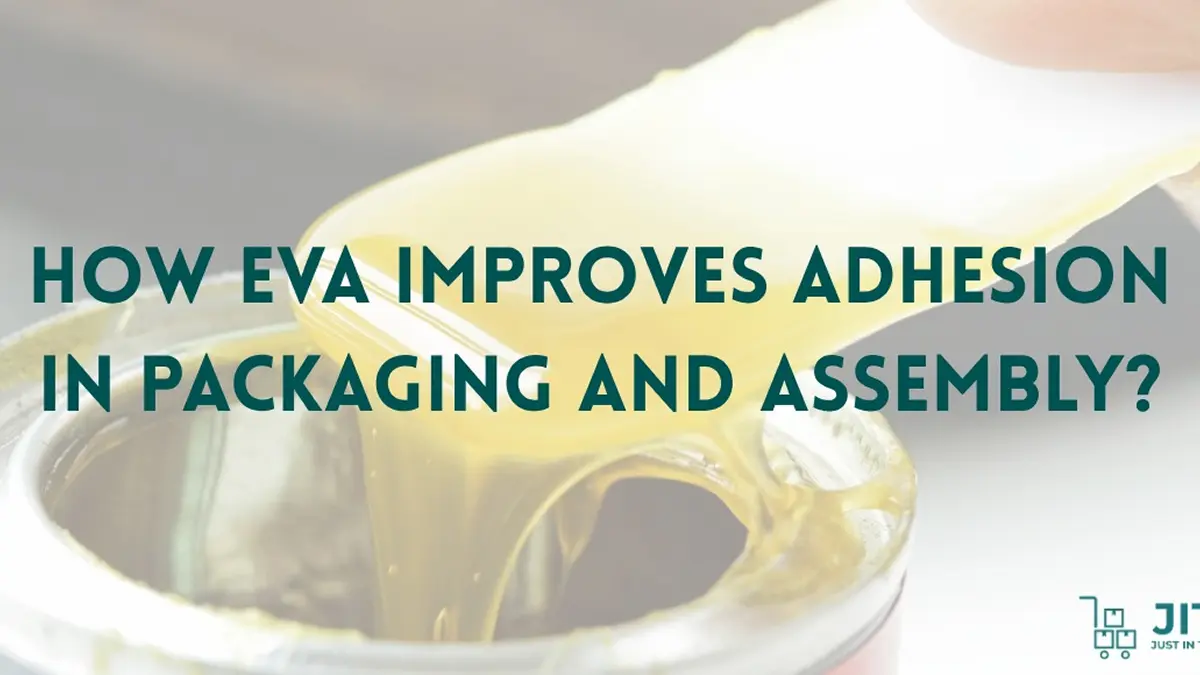
EVA’s adhesion is enhanced because of the introduction of a flexible bond layer, which has sufficient bond strength during stress and movement. Due to its enhanced compatibility with plastics, foams, textiles, and laminated surfaces, Vinyl acetate content.
There are a number of additives that improve the performance of the EVA:
- Dicumyl peroxide enhances the crosslinking strength property.
- DCP crosslinking agent EVA systems are used to increase the thermal resistance.
- The use of thermally expandable microspheres results in better foam expansion and surface contact.
- The thermo-expandable microspheres provide increased lightweight structural bonds.
EVA also provides superior melt flowing characteristics, giving producers uniform coating and lamination while creating packaging and assembling. This versatility, combined with bonding reliability, is extremely useful in industrial applications.
Applications in Packaging & Assembly
EVA is currently widely used due to its suitability for protective packaging, as well as structural joining purposes.
Common applications include:
- Flexible packaging seals
- Foam cushioning inserts
- Automotive interior bonding
- Footwear assembly
- Electronics packaging
- Hot melt adhesive systems
Manufacturers can select appropriate EVA raw material suppliers to fit their production needs and performance targets.
Selection Tips + Limitations
Manufacturers need to consider the composition of vinyl acetate content, density, and thermal requirements when choosing EVA. Generally, the more vinyl acetate there is, the more flexible and adhesive the plastic will be. In certain chemicals and highly hot conditions, however, EVA may provide limited resistance in special applications.
Conclusion
Due to its flexibility, durability, and good bonding properties, EVA foam raw material is still a popular packaging and assembly material. With the help of skilled suppliers, companies can guarantee reliable and efficient adhesion solutions.
Frequently Asked Questions (FAQs)
1. How does EVA improve adhesion in packaging applications?
The flexible structure and good bond compatibility facilitate enhanced adhesion and form a durable and stable bonding mechanism with various substrates.
2. What are the key properties of EVA foam material used in assembly?
Flexibility, impact resistance, cushioning, thermal stability, and excellent bonding capability are among the important properties.
3. Why is EVA preferred over traditional adhesive materials in packaging?
The flexibility of EVA is better compared to many traditional materials, and it can be easily processed and has a longer bonding life.
4. Which industries commonly use EVA for bonding and assembly applications?
EVA materials are widely used in a variety of industries such as automotive, footwear, electronics, construction, and packaging.
5. How do EVA manufacturers determine the right EVA grade for adhesion performance?
EVA manufacturers ensure the grade they select for industrial use is carefully tested for density, vinyl acetate content, flexibility, and temperature resistance.