Introduction
Waste generation is a serious problem throughout the value chain of basic plastic raw materials. However, within the business activities of manufacturers of EVA (Ethylene-Vinyl-Acetate)-compounds, suppliers of resins and converters, waste management is already being executed from a circular economy perspective in many cases. Used plastics are being reused as productive basic materials instead of being disposed of, which results in a reduction of the use of primary materials.
What Is the Plastic Raw Material Value Chain?
The plastic raw material value chain is a linear sequence of stages including resin synthesis, compounding, conversion, use and end-of-life management. The value chain includes EVA foam raw materials, polyolefin elastomers as well as commodity polymers. Material is recovered and recycled in the early stages of the value chain in order to reduce the demand for primary materials
What Is the Circular Economy in the Context of Plastics?
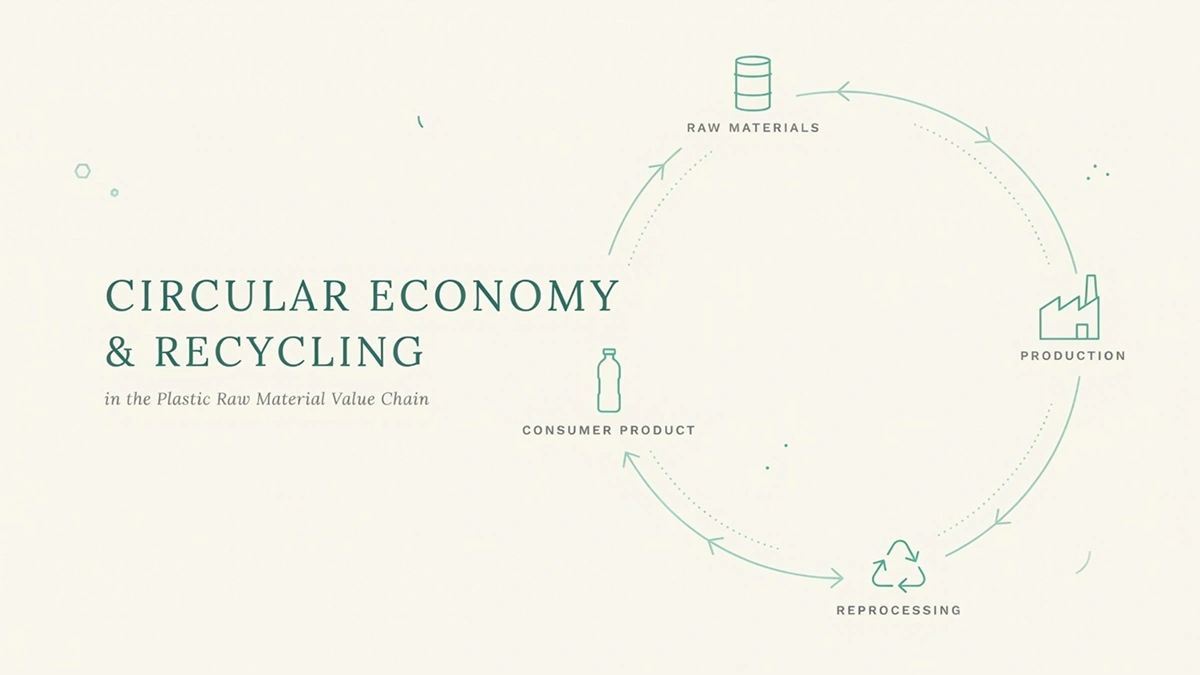
The circular economy is a production model which in its essence aims to keep products, components or materials in use as long as possible and to have them circulate as much as possible. The principle of the circular economy is in plastics applied by replacing the conventional linear ‘take-make-dispose’ model by the three Rs: Reduce, Reuse and Recycle.
- Reduce – reduce the amount of raw materials needed at the design stage.
- Reuse – keep product longer by repair or remanufacturing.
- Recycle – in the form of regrouted resin or compound recover materials such as other plastics, EVA (ethylene vinyl acetate) foam waste, post-consumer or post-industrial EVA foam waste, and POE (polyolefin elastomer) as well as other materials.
For EVA raw material suppliers the Circular Economy means recovering post-industrial waste as well as post-consumer waste from EVA foam for reprocessing into secondary raw materials and recycled compounds. In a closed-loop system costs and CO2 output are reduced throughout the entire value added chain.
What Are the Main Recycling Methods Used Across the Plastic Value Chain?
Two primary recycling pathways process plastic raw materials:
- Mechanical recycling — shredding, washing, and re-pelletising plastics like EVA foam material into secondary resin for lower-grade applications.
- Chemical recycling — depolymerising polymers (including ethylene vinyl acetate) back into monomer feedstocks for virgin-equivalent resin production.
Additives like dicumyl peroxide (DCP crosslinking agent EVA) and thermally expandable microspheres complicate recycling by altering polymer structure — a known challenge for EVA manufacturers.
Which Industries Are Driving Circularity in the Plastic Value Chain?
Three industries are leading the way in circulating plastic within the circular economy: Footwear, Packaging and Automotive.
- Footwear brands Some examples of utilization of waste EVA foam in the recovery of EVA raw material from waste and from post-consumer shoes in the production of recycled EVA material are given by some examples of production of footwear.
- Packaging producers are developing mechanical recycling concepts for packaging made of polyolefins as well as POE-polyolefin elastomers.
- Automotive manufacturers The automotive sector is recovering engineering plastics from end-of-life vehicles (ELVs) by using chemical recycling technology.
EVA raw material suppliers are introducing recycled content grades of EVA as well as implementing take-back programs for EVA waste to support the sustainability goals of brands. This is driven by EU and Asian legislation that is forcing companies to look at circularity.
What Are the Challenges in Implementing Circular Economy for Plastic Raw Materials?
Scaling circular economy for plastic raw materials faces structural barriers:
- Material complexity – All materials used, crosslinked EVA-foam (DCP / dicumylperoxide treated) as well as the foamed composite materials containing expandable microspheres, are not suitable for mechanical recycling in an appropriate quality for the respective market.
- Contamination – Contamination by mixed plastic waste of varying composition decreases the quality of recyclates and their market value.
- Infrastructure gaps -There is at global level an insufficient infrastructure to recycle waste chemically.
- Economic viability – The cost effectiveness of using “virgin” plastics as opposed to certified recycled content materials.
- Traceability -Lack of traceability in supply chains to verify recycled content claims at the EVA raw material level.
Key Advantages and Limitations
Advantages: Reduces virgin feedstock demand, lowers carbon emissions, creates secondary raw material markets.
Limitations: Crosslinked and foamed plastics like EVA foam material remain technically difficult and costly to recycle at scale.
Conclusion
Circular economy adoption in the plastic raw material value chain is accelerating — but technical and structural barriers require coordinated industry action.
Frequently Asked Questions
1. What is the plastic raw material value chain and where does recycling fit in?
The value chain for plastic raw materials consists of the synthesis of raw materials, compounding of raw materials, manufacturing of end products using the compounded materials. Recycling of plastic waste forms part of this value chain where recovered material is used as raw material and reintroduced back into the value chain at an early stage using the recovered material such as EVA foam raw material and polyolefin elastomers as alternatives to 100% virgin resins thereby reducing the amount of waste sent to landfill.
2. How does circular economy differ from traditional linear plastic manufacturing?
The production of plastic in the linear model is primarily based on the “take, make, dispose” principle and the used plastic materials (such as e.g. the ethylene-vinyl-acetate/EVA-foam and the POE polyolefin elastomer) are used once and then are disposed of on a land fill. The production of plastic in a circular economy on the other hand enables the reuse and/or the recycling of materials, also by remanufacturing, in order to keep using them in a continuous manner and, therefore, to eliminate the notion of “end-of-life waste”.
3. What are the main recycling methods used for plastic raw materials?
Secondary raw materials are produced from plastic waste by mechanical recycling (shredding, re-pelletizing). These polymers are disassembled by chemical recycling into the original monomers to produce new primary raw materials. Crosslinked materials containing dicumylperoxide or expandable microspheres are only suitable for chemical recycling, because they cannot be disassembled by mechanical recycling.
4. Which industries are leading the shift toward circular plastic value chains?
The main industries driving the transition to a circular plastic value chain are the Footwear, Packaging and Automotive industries. Currently EVA foam material recovery is active in the Footwear industry. In the Packaging industry the mechanical recycling of polyolefins is being driven above all. In the Automotive industry above all investment in chemical recycling is being made. The EVA raw material suppliers are responding with recycled-content grades as well as with supplier take-back schemes.
5. What are the biggest barriers to scaling recycling in plastic raw material supply chains?
The obstacles to increase recycling of plastic raw materials within supply chains are: 1. crosslinked products containing plastics (crosslinking agents like DCP (dicumyl peroxide) make very difficult to recycle). 2. contamination in mixed waste streams. 3. lack of chemical recycling facilities. 4. higher price of recycled materials compared to virgin materials. 5. lack of traceability systems to check the recycled content of EVA foam raw materials within supply chains.