Businesses can no longer rely on a single nation. They currently diversify risk and seek partners who are stable. Meanwhile, the increased cost of labour in China is driving consumers towards more favourable alternatives. India can well fit into this scheme.
What Is the China+1 Strategy and Why It Matters Now
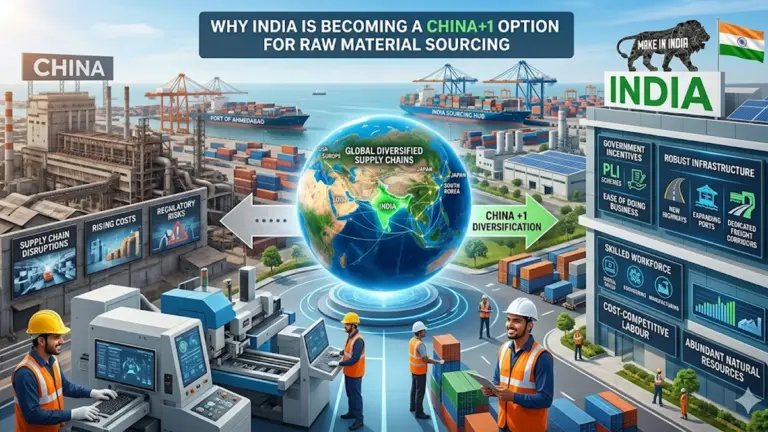
Global buyers are no longer comfortable depending on a single country for raw material sourcing. The China+1 approach implies introducing one or more alternative reliable country suppliers in addition to China, to decrease the risk without sacrificing the current relationships. Disruption of the COVID-19 crisis, increase in labour costs in China, and the ongoing trade tensions between the US and China have now taken this debate out of boardrooms and into actionable procurement choices.
Quick Snapshot Table (Why India vs China)
| Category |
India |
China |
| Labour Cost (per hour) |
~$1.40 |
~$7.20 |
| Monthly Factory Wage |
$150 – $300 |
$600+ |
| Logistics Cost (% of GDP) |
~14% |
~8% |
| Tariff Exposure (US market) |
Low |
High |
| Minimum Order Flexibility |
50 – 500 units |
500 – 1000+ units |
| Ease of Doing Business Rank |
63rd (2020) |
More established |
What Makes India a Strong Alternative
The growth of India as a sourcing destination is being catalysed by three factors.
To start with, the production of polymers and other speciality chemicals within the country is growing quickly. Buyers no longer rely on imports as Indian manufacturers make materials such as polyolefin elastomer, POE polymer, and DCP crosslinking agent EVA locally.
Second, the Make in India program plays an active role in promoting manufacturing investment by providing subsidies, PLI schemes, and developing infrastructure. This establishes more dependable domestic supply chains for materials, including dicumyl peroxide, polyolefin thermoplastic elastomer, and microspheres for lightweight shoe sole production.
Third, the logistics networks and port infrastructure in India are getting better and better. The Indian ports have a shorter route to Europe and the Middle East compared to China, which minimizes the lead times on some markets.
Industries Already Shifting Sourcing to India
Several sectors are already making the move:
- Footwear: Brands source poe polyolefin elastomer, di cumyl peroxide, and EVA compounds locally for sole manufacturing and midsole production.
- Automotive components: Manufacturers source polymer compounds and crosslinking agents, including DCP, dicumyl peroxide, from Indian DCP suppliers.
- Textiles and apparel: Global companies are sourcing more cotton-based fabrics and technical textiles, which will help decrease the East Asia dependency.
- Packaging: PE, PP and PVC raw materials are sourced locally with the help of an expanding petrochemical foundation in India.
Challenges India Still Needs to Overcome
India continues to struggle with a couple of challenges. This has an impact on buyer planning.
- Price fluctuation is experienced on raw materials such as dicumil peroxide and ethylene vinyl acetate compounds, whose domestic prices may vary randomly with crude oil cycles and importations.
- Inconsistent quality remains a concern across smaller, family-run suppliers. A dcp / dicumyl peroxide importer or dicumyl peroxide footwear suppliers can have different quality per batch without high-quality assurance programs in place.
- Documentation gaps create friction for international buyers. GST compliance, export certifications, and traceability records are not always observed at all levels of suppliers.
Conclusion
India truly stands at the brink of being a trusted China+1 sourcing partner, yet to orient with suppliers with confidence, one needs to have the right platform. JITSY links international and local purchasers with authentic Indian raw material suppliers. Register now to begin your sourcing quest.