IOCL Propel LLDPE 010F18S is a butene comonomer-based linear low-density polyethylene (LLDPE) manufactured by Indian Oil Corporation Ltd (IOCL) under its PROPEL polymer brand. It is produced using Nova Chemicals’ Sclairtech solution polymerization technology — a precision process that delivers consistent molecular structure, reliable melt behaviour and well-balanced film properties batch after batch. The grade is formulated with slip and antiblock additives, making it a ready-to-process film slip grade without the need for additional masterbatch in most standard packaging applications.
IOCL describes 010F18S as a natural-coloured polymer offering good processability, good mechanical properties and the surface slip characteristics needed for smooth film handling and bag-making. It belongs to the linear low-density polyethylene family — thermoplastic resins where short-chain branching from butene comonomer incorporation delivers significantly higher toughness, puncture resistance and tensile strength compared with conventional LDPE at the same density, making LLDPE films thinner, stronger and more cost-efficient per unit area.
According to IOCL’s product technical datasheet, LLDPE 010F18S is designed for liquid packaging films, heavy duty films, multilayer films, carrier bags and drip laterals — a broad range of blown film applications where a combination of high mechanical strength, good optical clarity and manageable film-to-film slip is essential. Its MFI of 0.90 g/10 min is specifically suited to blown film extrusion, where lower melt flow indices translate into better bubble stability and stronger film properties.
Technical Insights
Resin Properties
- MFI: 0.90 g/10 min (ASTM D1238, 190 °C / 2.16 kg) — A low MFI is characteristic of film-grade LLDPE. Lower melt flow means higher molecular weight, which directly improves film toughness, dart impact resistance and elongation. This 0.9 MFI rating places 010F18S in the mainstream of high-performance packaging film grades and ensures good bubble stability during blown film extrusion.
- Density: 0.918 g/cm³ (ASTM D1505, 23 °C) — A low density for LLDPE, this value reflects the butene comonomer content and gives the film a good balance of flexibility and strength. Lower density LLDPE films are more flexible and seal more easily at lower temperatures, both of which are valuable for liquid packaging and carrier bag applications.
Mechanical Film Properties
All mechanical values are typical, measured on 40 µm monolayer blown film at 1.8 mm die gap and 2.25 blow-up ratio (as noted in IOCL’s product technical datasheet).
- Tensile Strength at Yield – MD/TD: 13 MPa / 12 MPa (ASTM D882) — The stress level at which the film begins to stretch permanently. A yield strength of 13 MPa in the machine direction indicates the film resists deformation under the load of liquid-filled pouches and heavy sacks.
- Ultimate Tensile Strength – MD/TD: 39 MPa / 30 MPa (ASTM D882) — This is the maximum stress the film can handle before rupturing. Values of 39 MPa (MD) and 30 MPa (TD) indicate excellent structural toughness, well above the range needed for milk pouches, heavy duty shipping sacks and multilayer laminations.
- Elongation at Break – MD/TD: 700% / 850% (ASTM D882) — Exceptional stretch before rupture. Films with >700% elongation absorb sudden impacts and stress concentrations, a critical attribute when bags are dropped, stuffed or mechanically handled at high speed.
- Dart Impact Strength: 3.5 g/µm (ASTM D1709, 38 mm dart, 66 cm height) — Measures resistance to puncture from a falling object. At 3.5 g/µm, 010F18S provides strong puncture resistance for thin-gauge liquid packaging films, reducing the risk of pouch failure during filling, handling and distribution.
- Elmendorf Tear Strength – MD/TD: 3.3 g/µm / 10.2 g/µm (ASTM D1922) — Tear resistance. The high transverse direction tear strength (10.2 g/µm) is important for carrier bags and heavy duty films, where side seams and edges are subject to tearing under load. The lower MD tear (3.3 g/µm) is typical for oriented LLDPE films and is balanced by the grade’s high elongation.
Optical and Surface Properties
- Gloss (60°): 80% (ASTM D523) — High gloss indicates good optical clarity and surface finish, which is important for liquid packaging films where product visibility and presentation matter. The slip and antiblock additives in 010F18S are formulated to maintain gloss while reducing film-to-film adhesion.
- Coefficient of Friction – Static/Dynamic: 0.22 / 0.16 (ASTM D1894) — These low COF values are the result of the built-in slip additives. Films with COF below 0.3 run smoothly on high-speed packaging lines, through form-fill-seal machines and over guide rollers, reducing jams, film tension issues and wastage.
Recommended Processing Window
IOCL recommends a barrel temperature of 180–200 °C, melt temperature of 190–210 °C, blow-up ratio of 2.0–3.0 and die gap of 1.8–2.5 mm for blown film processing of 010F18S. The overall recommended processing temperature range is 170–210 °C. Operating within these parameters ensures stable bubble formation, consistent gauge, good optical properties and full development of the grade’s mechanical and surface properties. Exceeding the upper limit risks resin degradation and loss of optical clarity; processing below the lower limit may cause incomplete melting and weak seams.
All values above are typical values from IOCL’s Product Technical Datasheet for LLDPE 010F18S. They are not specification limits and may change without prior notice from the manufacturer.
Applications of IOCL LLDPE 010F18S in Films, Packaging and Drip Laterals
Liquid Packaging Films
LLDPE 010F18S is widely used for liquid packaging films, including milk pouches, edible oil sachets, water pouches and beverage packs produced on blown film lines or form-fill-seal equipment. Its low density (0.918 g/cm³), high elongation (>700%), strong dart impact (3.5 g/µm) and low coefficient of friction make it ideal for films that must be formed, filled and sealed at high speeds without breaking, leaking or jamming on machinery. The grade’s compliance with IS 10146:1982 and IS 10141:1982 for food and drinking water contact, as stated in IOCL’s product technical datasheet, ensures it meets the regulatory requirements for direct food and liquid contact packaging in India.
Heavy Duty Films and Sacks
For heavy duty packaging films and industrial sacks — used for fertilisers, chemicals, grains and construction materials — 010F18S delivers the tensile and tear performance required. The ultimate tensile strength of 39 MPa (MD) and 30 MPa (TD), combined with elongation at break above 700%, allows heavy duty films to absorb the mechanical stress of filling, sealing, stacking and transportation without rupturing. Processors in the packaging industry benefit from the grade’s good processability and consistent melt behaviour, which reduces scrap rates and improves output on high-speed extrusion lines.
Multilayer Films and Lamination
010F18S is suited for use as a functional layer in co-extruded multilayer film structures — such as inner sealant layers, strength layers and tie layers — in packaging for food, pharmaceuticals and consumer goods. Its high mechanical strength and good sealability make it an effective sealant layer, while its controlled COF (0.22 static / 0.16 dynamic) ensures that bags and pouches open cleanly. For structures where printing or lamination is required on outer layers, processors typically use IOCL’s non-slip variant 010F18A or the higher MFI grade 020F18A as the print or lamination surface, while 010F18S serves as the slip inner layer — a distinction documented in IOCL’s LLDPE/HDPE grade slate.
Carrier Bags and Shopping Bags
In carrier bag and shopping bag manufacturing, 010F18S offers the toughness to handle heavy loads and the surface slip needed for stacking and dispensing. The grade’s tear resistance in the transverse direction (10.2 g/µm) helps bags resist splitting at handles and side seams under the weight of contents. The slip and antiblock additives allow individual bags to be opened easily from a stack, which is essential for retail checkout applications. IOCL explicitly lists carrier bags as a recommended application for 010F18S.
Drip Laterals
IOCL includes drip laterals among the recommended applications for 010F18S, where certain film-based drip tape geometries or thinner-wall extruded laterals can be produced from this grade. However, where dedicated pipe-grade properties are required — such as higher environmental stress crack resistance and pressure-rated wall consistency — IOCL also offers the dedicated drip lateral grade 010L22S, which is separately listed in IOCL’s grade slate without slip additives and optimised specifically for pipe extrusion. The choice between 010F18S and 010L22S for drip applications should be made based on the specific product geometry, wall thickness and performance requirements of the drip system.
Comparable Alternative LLDPE Film Grades in India
IOCL 010F18S is one of several 0.9 MFI LLDPE film slip grades available from Indian producers. Understanding how it compares helps procurement managers and film processors make informed sourcing decisions when evaluating alternatives or building redundancy into their supply chain.
OPaL LLDPE F2001S from ONGC Petro Additions Ltd is the closest comparable grade in the Indian market. F2001S is a butene comonomer-based LLDPE produced via Ineos gas-phase polymerization technology, with an MFI of 0.90 g/10 min and density of 0.919 g/cm³ — virtually identical to IOCL 010F18S. It contains slip and antiblock additives and carries the same regulatory approvals: IS 10146:1982, IS 10141:1982 and FDA CFR 21, 177.1520. OPaL recommends F2001S for co-extrusion films, liquid packaging films and drip laterals, mirroring 010F18S’s application scope almost exactly. However, OPaL has not published documentation confirming that F2001S is interchangeable with IOCL 010F18S. Equivalence is not confirmed by the manufacturer and should be validated through process trials before production qualification.
OPaL F2001A is the non-slip counterpart to F2001S within OPaL’s film grade range — same density (~0.920 g/cm³) and similar MFI, but formulated without slip or antiblock additives. F2001A is better suited to outer print and lamination layers in multilayer structures where low COF would interfere with ink adhesion or laminate bonding. It is not a substitute for 010F18S in applications requiring built-in film slip.
Haldia Petrochemicals 71601W and 71602W are LLDPE blown film grades produced using Spherilene technology. Both are described as non-slip grades (without slip or antiblocking additives), positioning them as base film grades for lamination and adhesive film applications rather than direct-run packaging. With MFIs in the 1.0–2.0 g/10 min range and densities around 0.916–0.920 g/cm³, they are broadly similar in resin properties but differ from 010F18S in their additive package. Processors using Haldia grades in applications that require slip would need to add external slip masterbatch, unlike 010F18S which is ready to process. Equivalence to 010F18S is not confirmed by the manufacturer.
The key differentiator for IOCL 010F18S across all these alternatives is its combination of IOCL PROPEL brand reliability, Sclairtech solution polymerization technology, a fully verified regulatory profile and a built-in slip and antiblock package — all validated through IOCL’s product technical datasheet and grade slate.
Regulatory Compliance, Food Contact and Safety for IOCL LLDPE 010F18S
IOCL’s product technical datasheet for LLDPE 010F18S carries three explicit regulatory approvals that are important for food, pharmaceutical and drinking water packaging applications.
The grade meets IS 10146:1982 — the Bureau of Indian Standards specification for polyethylene for safe use in contact with foodstuffs, pharmaceuticals and drinking water. It also conforms to the positive list of constituents as per IS 10141:1982, which governs the additives and processing aids permitted in food-contact polyethylene in India. Additionally, IOCL confirms that the grade and its incorporated additives comply with FDA CFR Title 21, Section 177.1520 (Olefin Polymers) — the US FDA regulation covering olefin-based polymers in food-contact applications.
Together, these approvals make IOCL LLDPE 010F18S suitable for use in liquid packaging films, milk pouches, edible oil sachets, pharmaceutical wraps and other food-contact packaging where regulatory certification is required by brand owners, retailers and food safety authorities.
Manufacturer Details – IOCL PROPEL LLDPE 010F18S
IOCL Propel LLDPE 010F18S is manufactured by Indian Oil Corporation Ltd (IOCL), India’s largest public-sector refining and petrochemicals company. IOCL’s polymer range is marketed under the PROPEL brand, covering polyethylene and polypropylene grades from its Panipat petrochemical complex. The LLDPE/HDPE swing plant at Panipat uses Nova Chemicals’ Sclairtech solution polymerization technology, which allows IOCL to produce LLDPE grades with precise molecular weight control and consistent comonomer distribution — the foundation for reliable and reproducible film properties.
LLDPE 010F18S is listed in IOCL’s official LLDPE/HDPE Grade Slate for the Sclairtech Swing Plant under the LLDPE film category, with MFI of 0.9 g/10 min and density of 0.918 g/cm³, described as a film grade with slip and antiblock additive package. Technical documentation is available through IOCL’s Product Application and Development Center (PADC), Panipat.
Common Search Variants and Grade Misspellings
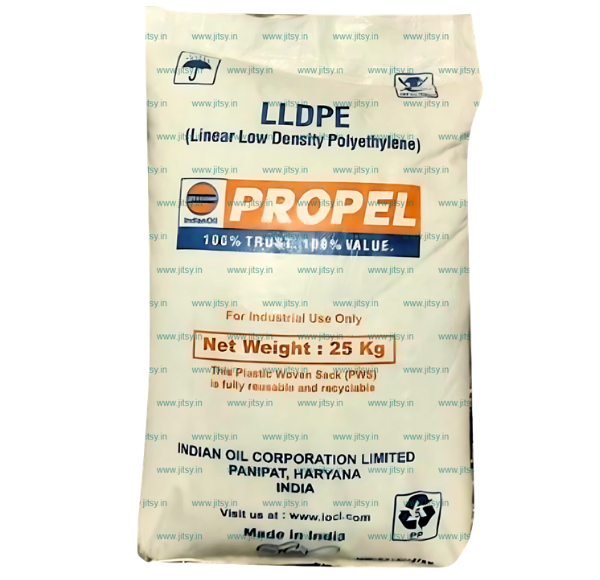
IOCL Propel LLDPE 010F18S is also commonly searched and referenced as: LLDPE 010F18S, IOCL 010F18S film slip granules, White 010F18S IOCL LLDPE film slip granules, IOCL blown film slip 0.9 MFI 010F18S, Propel LLDPE 010F18S, LLDPE 1 MFI slip film grade IOCL, and Natural PROPEL LLDPE 010F18S 25 kg bag.
Frequent misspellings and alternate formats include: 010 F18S, 010f18s LLDPE, IOCL lldpe 010-F18-S, IOCL 0.9 MFI film slip LLDPE granules, and IOCL polyethylene film slip 0.9 MFI.











Reviews
Clear filtersThere are no reviews yet.