IOCL Propel LLDPE 020F18A is a butene comonomer-based linear low-density polyethylene (LLDPE) manufactured by Indian Oil Corporation Ltd (IOCL) under its PROPEL polymer brand. It is produced using Nova Chemicals’ Sclairtech solution polymerization technology — a precision process that ensures consistent molecular weight distribution, predictable melt behaviour and reliable film properties across production runs. With a melt flow index of 2.0 g/10 min, 020F18A offers higher output and easier drawdown than 0.9 MFI film grades, while its non-slip, non-antiblock formulation gives converters full control over film surface properties through their own masterbatch selection.
IOCL describes 020F18A as a natural-coloured polymer with easy processability, low gel content and no slip or antiblock additives. These three attributes together define the grade’s positioning: easy to run on blown and cast film lines at higher speeds, optically clean with minimal gel defects, and surface-neutral so that ink adhesion, laminate bonding and coefficient of friction can be engineered precisely through formulation. It is the 2 MFI counterpart to IOCL’s 0.9 MFI non-slip grade 010F18A — same density, same additive-free base, higher flow for applications that benefit from faster throughput or thinner film gauge.
According to IOCL’s product technical datasheet, LLDPE 020F18A is recommended for lamination films, cast films, stretch cling films and air bubble film. This application set covers some of the most throughput-sensitive film processes in packaging and logistics — where a resin that flows well, stays optically clear, and delivers consistent mechanical performance across thin gauges creates measurable production and quality advantages over lower-flow or additive-loaded alternatives.
Technical Insights
Resin Properties
- MFI: 2.0 g/10 min (ASTM D1238, 190 °C / 2.16 kg) — The 2.0 MFI rating is the defining difference between 020F18A and IOCL’s 0.9 MFI film grades. Higher melt flow means lower melt viscosity, which translates into higher extrusion output rates, easier drawdown for thinner gauges and better processability on cast film lines and stretch cling equipment. For processors running thin lamination or cast films where output efficiency matters, 020F18A’s MFI allows faster line speeds than 010F18A while maintaining adequate film toughness for most packaging applications.
- Density: 0.918 g/cm³ (ASTM D1505, 23 °C) — Identical to IOCL 010F18A, this density places 020F18A in the flexible-to-semi-rigid zone of the LLDPE range. It enables good film sealability at moderate temperatures, balanced flexibility and strength in laminated structures, and the low-temperature toughness relevant for cold-chain and refrigerated packaging applications.
Mechanical Film Properties
- Tensile Strength at Yield – MD/TD: 12.5 MPa / 12.0 MPa (ASTM D882) — Balanced yield strength in both directions ensures lamination and cast films resist permanent deformation under the tension loads of form-fill-seal equipment, roll winding and pallet stretch application.
- Ultimate Tensile Strength – MD/TD: 33 MPa / 28 MPa (ASTM D882) — High break strength across both film orientations confirms that 020F18A provides structural integrity in laminated pouches, stretch wrap and bubble film even at thin gauges where each micron of film must carry more load.
- Elongation at Break – MD/TD: 700% / 800% (ASTM D882) — Very high elongation is essential for stretch cling films, which are stretched significantly during pallet wrapping and food cling applications. Values of 700% (MD) and 800% (TD) indicate that 020F18A films can accommodate high elongation without rupturing — a critical requirement for stretch and cling performance. It is marginally lower than the 850% TD value of 010F18A, consistent with the slightly lower molecular weight of the 2 MFI grade.
Impact, Tear and Optical Properties
- Dart Impact Strength: 2.5 g/µm (ASTM D1709, 38 mm dart, 66 cm height) — Solid puncture resistance per micron of film thickness. At 2.5 g/µm, 020F18A is slightly lower than the 3.5 g/µm of the 0.9 MFI grade 010F18A, which is the expected trade-off for higher melt flow. For lamination films, cast films and air bubble film where other film layers or construction geometries provide additional protection, this impact level is fully adequate.
- Tear Strength – MD/TD: 3 g/µm / 8 g/µm (ASTM D1922) — The transverse direction tear strength of 8 g/µm provides good resistance to edge tearing and side-seam splitting in laminated pouches and stretch-wrapped loads. The lower MD value (3 g/µm) is typical for oriented LLDPE films and is compensated by the grade’s high elongation.
- Haze: 9% (ASTM D1003) — A 9% haze value indicates good film optical clarity, which is important for packaging applications where product visibility matters — laminated food pouches, clear stretch wrap over pallets and transparent bubble film for protective packaging. The low gel formulation of 020F18A contributes directly to achieving this haze level consistently in production.
Recommended Processing Window
IOCL recommends a blown film processing temperature of 170–210 °C for LLDPE 020F18A. The higher MFI of this grade means the melt flows more easily within this window than lower-MFI grades, typically allowing processing towards the lower end of the range (170–190 °C) without sacrificing film properties — which reduces energy consumption and thermal degradation risk. Operating above 210 °C can cause oxidative degradation, increased gels and haze development, negating the low-gel advantage that IOCL highlights for this grade.
Applications of IOCL LLDPE 020F18A
Lamination Films and Multilayer Cast Films
IOCL LLDPE 020F18A is widely used as a lamination film layer and as a component in multilayer cast film structures for food packaging, pharmaceutical wraps, industrial packaging and consumer goods. Its 2.0 MFI enables higher extrusion output compared with 0.9 MFI grades, making it more cost-efficient on high-speed lamination lines where throughput directly affects unit economics. The absence of slip and antiblock additives is critical here — converters who print or laminate the film surface need a clean, high-energy surface for ink adhesion and adhesive bonding, and built-in slip additives would migrate to the surface and reduce both. IOCL explicitly recommends 020F18A for lamination films in its product technical datasheet.
Stretch Cling Films and Pallet Wrap
For stretch cling film and pallet wrap applications, 020F18A’s combination of 2.0 MFI, high elongation (700–800%) and good tear resistance (8 g/µm TD) makes it a strong candidate. Stretch and cling films are drawn down to very thin gauges on cast or blown lines and then stretched around loads — a process that demands both high drawdown flow and sufficient toughness to prevent film tearing during application. The non-slip, additive-free base allows formulators to add tackifier (such as PIB) and control cling performance precisely without interference from pre-dispersed antiblock, enabling better formulation flexibility than additive-containing grades. IOCL lists stretch cling films as a primary recommended application for 020F18A.
Air Bubble Film for Protective Packaging
020F18A is recommended by IOCL for air bubble film — the cushioning material used for protective packaging of fragile goods. Bubble film requires a resin that processes easily (to form uniform bubble geometry), holds air retention well (good film barrier) and resists puncture when the packaged product shifts against the bubbles. The grade’s good dart impact strength (2.5 g/µm), high elongation and low haze (9%) support these requirements. The low gel specification is particularly important for bubble film: gel particles in the film create weak points that cause premature bubble bursting under light contact, so the “low gels” attribute IOCL highlights for 020F18A is a direct quality differentiator for this application.
Cast Films
Cast film processes run at higher speeds and tighter gauge tolerances than blown film, placing greater demands on resin flow consistency and melt uniformity. 020F18A’s higher MFI (2.0 g/10 min) and narrow molecular weight distribution from Sclairtech technology support stable cast film extrusion with good gauge uniformity and consistent optical properties. For cast film applications in food packaging — such as direct-contact wraps, window patches and sealant films in multilayer structures — the grade’s food-contact regulatory approvals (IS 10146, IS 10141, FDA 177.1520) provide the necessary compliance foundation.
Comparable Alternative LLDPE Film Grades
IOCL 020F18A sits in a clearly defined segment of 2 MFI non-slip LLDPE blown film grades produced by Indian domestic manufacturers. These grades are commonly evaluated side by side by converters running lamination, cast and stretch cling film applications.
OPaL LLDPE F2002A and F2002S from ONGC Petro Additions Ltd are the closest structural analogues. Both are 2 MFI LLDPE film grades produced via Ineos gas-phase polymerization technology with densities around 0.920 g/cm³. F2002A is the non-slip lamination grade, positioned similarly to IOCL 020F18A for lamination and cast films; F2002S adds slip and antiblock for general packaging and stretch film applications. The OPaL grades are produced via gas-phase technology rather than Sclairtech solution polymerization, which can result in differences in molecular weight distribution and optical properties that may be visible on-line as minor differences in bubble stability or film haze. OPaL has not confirmed that F2002A is a drop-in replacement for IOCL 020F18A; equivalence is not confirmed by the manufacturer and should be validated through line trials.
GAIL G-Lene F18A020U is a 2 MFI LLDPE film grade from GAIL (India) Ltd marketed as “LLDPE Film Non-Slip Granules” for blown film extrusion with an optimum balance of mechanical and optical properties. It is described as suitable for general-purpose, heavy-duty and liquid packaging films in both laminated and non-laminated blown film applications. However, some commercial descriptions of F18A020U mention that it contains adequate slip and antiblock agents — which would place it closer to a slip grade than IOCL 020F18A’s strictly non-slip formulation. Converters requiring a fully additive-free surface for lamination or printing should confirm the additive package directly with GAIL before substituting F18A020U for 020F18A. GAIL has not confirmed equivalence; equivalence is not confirmed by the manufacturer.
IOCL 010F18A is the 0.9 MFI counterpart from the same IOCL product family — same density (0.918 g/cm³), same non-slip/non-antiblock formulation, but lower MFI. Compared with 020F18A, 010F18A offers higher dart impact (3.5 vs 2.5 g/µm) and slightly higher ultimate tensile strength (39/30 vs 33/28 MPa), making it the better choice for applications where maximum film toughness is the priority. 020F18A is the better choice when higher output, easier drawdown for thin gauges, or faster processing is the priority. IOCL does not market these as substitutes; the right grade depends on the application’s balance of output rate versus film toughness.
Haldia 71602W is a 2 MFI non-slip LLDPE blown film grade from Haldia Petrochemicals, produced via Spherilene gas-phase technology, without slip or antiblock additives. It targets general-purpose packaging films in a similar MFI/density range, making it a comparable grade. Haldia has not confirmed equivalence to IOCL 020F18A; differences in production technology may result in subtle processing and optical property differences that need evaluation.
Regulatory Compliance, Food Contact and Safety for IOCL LLDPE 020F18A
IOCL’s product technical datasheet for LLDPE 020F18A confirms three explicit regulatory approvals that are essential for packaging converters serving food, pharmaceutical and potable water sectors.
The grade meets IS 10146:1982 — the Bureau of Indian Standards specification for polyethylene for safe use in contact with foodstuffs, pharmaceuticals and drinking water. It also conforms to the positive list of constituents as per IS 10141:1982, which governs permitted additives in food-contact polyethylene in India. Additionally, IOCL states that the grade and its incorporated additives comply with FDA CFR Title 21, Section 177.1520 (Olefin Polymers) — the US FDA regulation for olefin-based polymers in food-contact applications.
These three approvals collectively make 020F18A suitable for use in food-contact lamination films, cast wraps, multilayer food pouches and pharmaceutical packaging structures — provided the full laminate or film construction also meets applicable regulations. For converters supplying brand owners who require documented resin-level compliance, IOCL’s regulatory statements in the datasheet serve as the primary reference.
Manufacturer Details – IOCL PROPEL LLDPE 020F18A
IOCL Propel LLDPE 020F18A is manufactured by Indian Oil Corporation Ltd (IOCL), India’s largest public-sector oil and petrochemicals company. IOCL’s polymer range is marketed under the PROPEL brand, with LLDPE grades produced at the Panipat petrochemical complex using Nova Chemicals’ Sclairtech solution polymerization technology. This technology is noted for its ability to produce LLDPE with narrow, well-controlled molecular weight distribution — a key factor in 020F18A’s consistent processability, low gel levels and predictable film properties.
Common Search Variants and Grade Misspellings
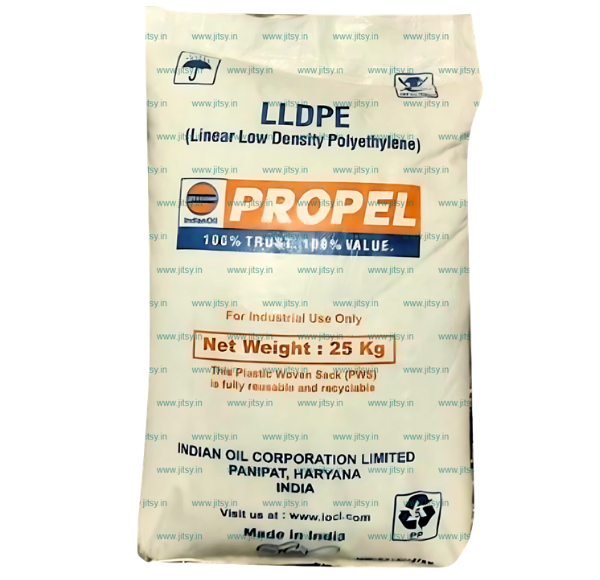
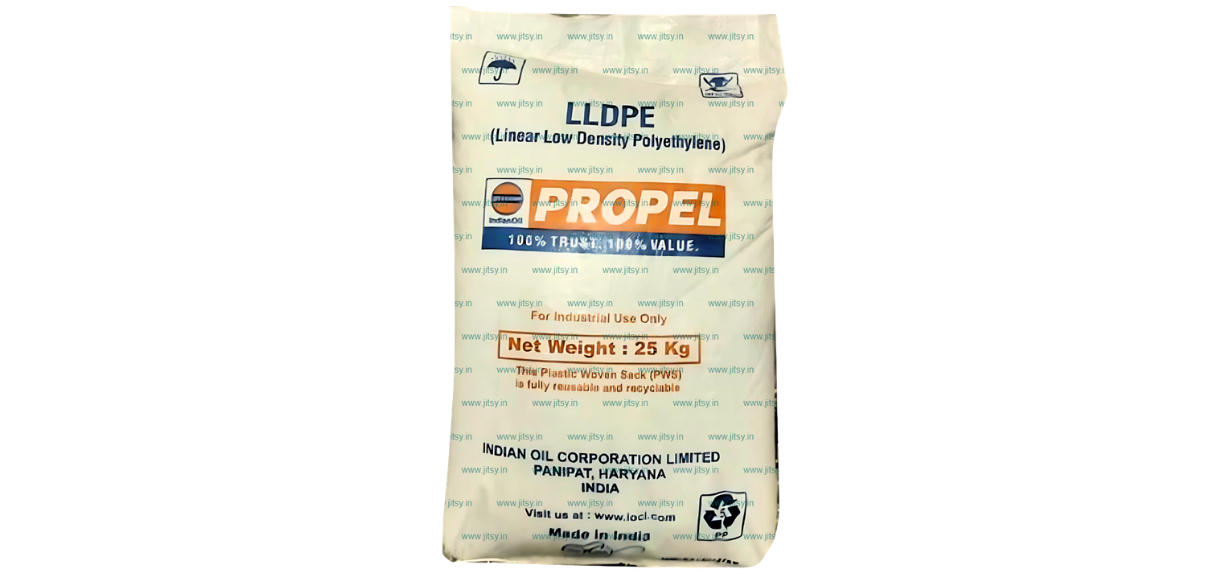
IOCL Propel LLDPE 020F18A is also commonly searched and referenced as: IOCL LLDPE Blown Film Non Slip 2.0 MFI 020F18A, LLDPE Film 2 MFI Non Slip IOCL 020F18A, 020F18A IOCL LLDPE granules, PROPEL LLDPE 020F18A lamination film grade, White 020F18A IOCL LLDPE 25 kg bag, and IOCL LL Film 020F18A 2 MFI blown film.
Frequent misspellings and alternate formats include: 020 F18A LLDPE, 020f18a IOCL granules, IOCL lldpe 020-F18-A non slip, and IOCL LLDPE 2.0 MFI non-slip film grade 020F18A.














Reviews
Clear filtersThere are no reviews yet.