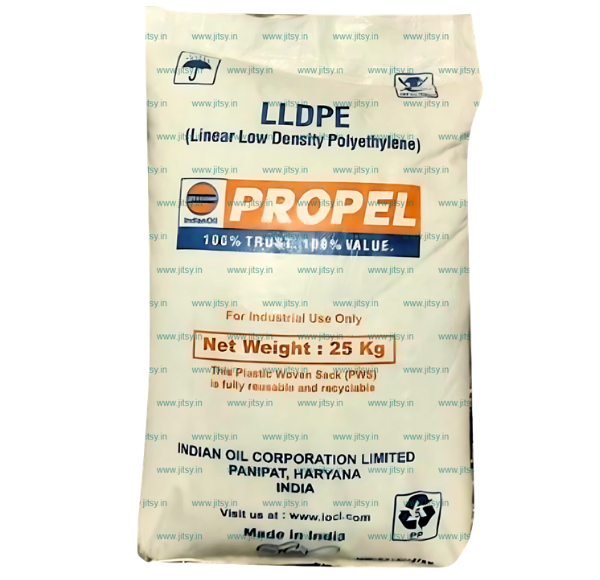
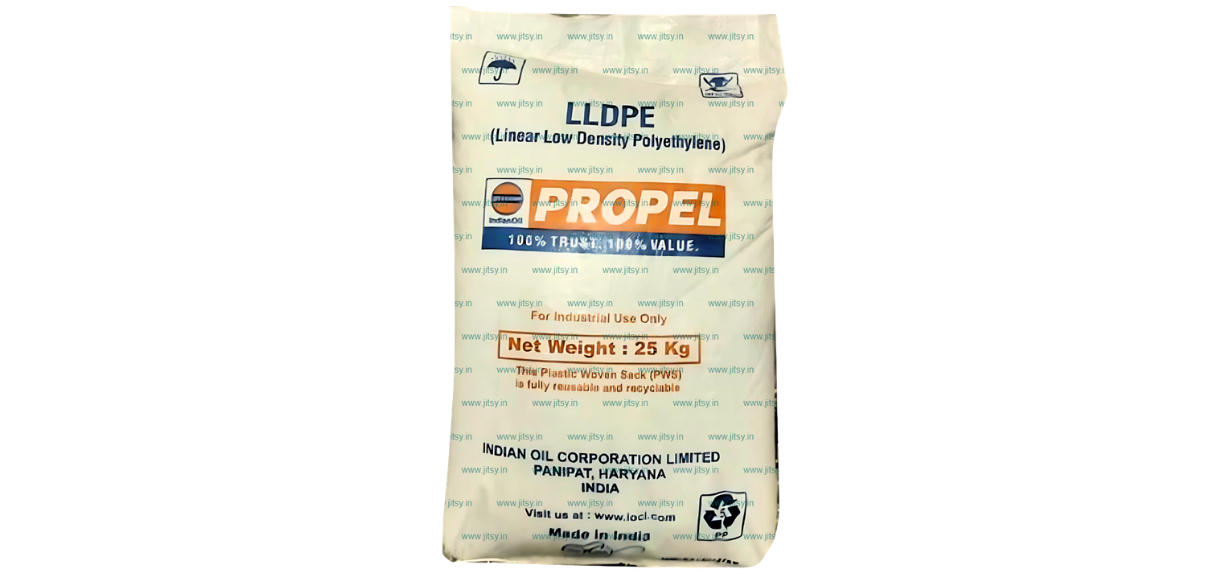
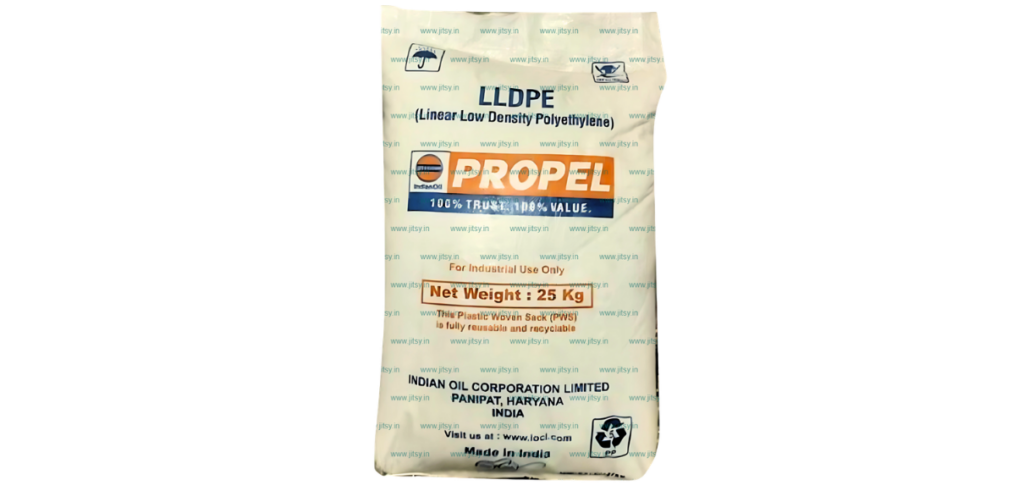
IOCL Propel LLDPE 500M24A is a butene comonomer-based linear low-density polyethylene (LLDPE) manufactured by Indian Oil Corporation Ltd (IOCL) under its PROPEL polymer brand. It is produced using Nova Chemicals’ Sclairtech solution polymerization technology — a precision process that delivers a narrow molecular weight distribution, consistent melt behaviour and excellent flow properties. With a melt flow index of 50 g/10 min, 500M24A is one of the highest-flow LLDPE grades in IOCL’s portfolio, designed specifically for applications where fast mould filling, low warpage and good dispersion of pigments and additives are critical requirements.
IOCL describes 500M24A as a natural-coloured polymer with narrow molecular weight distribution, excellent processability and outstanding flow properties. Its linear polymer structure, derived from the LLDPE family, gives it better tensile strength, toughness and chemical resistance compared with LDPE grades of similar density — making it a preferred base resin for colour and additive masterbatches where the carrier polymer must disperse high loadings uniformly without compromising melt flow or the final product’s mechanical integrity.
According to IOCL’s product technical datasheet, LLDPE 500M24A is designed as a base resin for masterbatches and to make moulding of flat and large warpage-free products and lids. These two primary roles — masterbatch carrier and injection-moulded lid resin — both demand the same core attributes: very high flow for fast filling and dispersion, narrow molecular weight distribution for uniform melt behaviour, and adequate stiffness and toughness for the finished part or compound to hold its shape and performance through end-use.
Technical Insights
Resin Properties
- MFI: 50 g/10 min (ASTM D1238, 190 °C / 2.16 kg) — This exceptionally high melt flow index is the defining characteristic of 500M24A. At 50 MFI, the resin flows rapidly and evenly through hot-runner systems, multi-cavity moulds and mixing equipment, enabling fast injection cycles, complete cavity fill and thorough pigment dispersion in masterbatch compounding. It is the reason this grade is specified specifically for large, flat lids and high-loading masterbatch formulations where slower-flowing resins would result in incomplete fill or uneven dispersion.
- Density: 0.924 g/cm³ (ASTM D1505, 23 °C) — A medium-low density for LLDPE, this value reflects the butene comonomer content and places 500M24A in the flexible-to-semi-rigid range. It supports good toughness and elongation in moulded parts, balanced with the dimensional stability needed for flat, warp-resistant lids and covers.
Mechanical Properties
All values are typical figures from IOCL’s product technical datasheet, measured on injection-moulded specimens. They are not specification limits.
- Tensile Yield Strength: 11–12 MPa (ASTM D638) — Two official TDS copies report slightly different typical values (11 MPa and 12 MPa respectively); both indicate adequate structural strength for lids, covers and moulded flat parts that are not subject to high sustained mechanical loads.
- Elongation at Break: >500% (ASTM D638) — Very high elongation before fracture confirms the grade’s toughness. In masterbatch applications, this ensures the carrier resin does not embrittle compounds, even at high filler loadings. For moulded lids, it means they can flex and absorb impact without cracking.
- Flexural Modulus: 300 MPa (ASTM D790) — Reflects the stiffness of a moulded part. At 300 MPa, 500M24A produces semi-rigid lids and flat parts with enough rigidity to hold their shape in service, without the brittleness of higher-modulus grades. This lower modulus compared to OPaL M2550 (400 MPa) also means slightly more flexibility, which can be advantageous for snap-fit lid applications.
Thermal and Environmental Properties
- Vicat Softening Point: 98 °C (ASTM D1525, 10 N) — The temperature at which the material begins to soften under load. At 98 °C, 500M24A moulded parts retain their shape well below typical sterilization or heat-filling temperatures and are suitable for most ambient and moderately warm storage and distribution environments.
- Environmental Stress Crack Resistance (ESCR), F50: <10 hours (ASTM D1693B) — A low ESCR value indicates limited resistance to cracking under sustained stress in the presence of aggressive chemicals. This is acceptable and expected for 500M24A, which is designed for masterbatch compounding and flat lids rather than pressure-rated pipes or chemical containers that require high ESCR. Specifying 500M24A for stress-crack-sensitive applications should be avoided.
Recommended Processing Window
IOCL recommends a processing temperature of 180–215 °C for injection moulding of LLDPE 500M24A. The high MFI means the resin flows easily within this window, enabling fast shot speeds and short fill times even for large, thin-section lids. Exceeding 215 °C risks oxidative degradation given the high surface area and low molecular weight of this high-flow grade — visible as colour change, odour development and loss of tensile properties. IOCL also advises processing the material within six months of delivery to maintain full performance.
Applications of IOCL LLDPE 500M24A
Base Resin for Colour and Additive Masterbatches
The most widely cited application for IOCL LLDPE 500M24A is as a carrier or base resin in colour masterbatches, filler masterbatches and functional additive compounds. In masterbatch manufacturing, the carrier resin must have very high melt flow to allow thorough mixing of pigments, fillers and additives at high loading rates without causing excessive equipment wear or non-uniform dispersion. At 50 MFI, 500M24A provides the flow needed for twin-screw compounders and mixing extruders to blend high pigment concentrations — such as carbon black, titanium dioxide, organic pigments and inorganic fillers — into a homogeneous masterbatch that disperses cleanly when let down into final resin. Its narrow molecular weight distribution ensures consistent melt behaviour batch to batch, which is critical for masterbatch producers who need predictable processing and colour consistency across production runs.
Injection-Moulded Lids, Covers and Flat Parts
500M24A is specifically designed by IOCL for injection moulding of flat and large warpage-free products and lids — a category that includes pail lids, drum covers, container caps, trays and other shallow mouldings where dimensional accuracy and flat surface finish are essential. Large flat injection mouldings are among the most demanding applications for any resin because differential cooling and uneven molecular orientation cause warpage — a chronic problem with lower-flow, broader-MWD grades. The 50 MFI and narrow molecular weight distribution of 500M24A allow very fast, even cavity fill with minimal frozen-in stresses, which directly reduces warpage and dimensional distortion after demoulding. The combination of adequate stiffness (300 MPa flexural modulus) and high elongation (>500%) ensures lids are rigid enough to seal containers properly while being tough enough not to crack on impact during handling or assembly.
Filler Compounds and Polymer Blends
Beyond pure colour masterbatch, IOCL 500M24A is used in the broader filler compound and polymer blending sector — for example, as the polyethylene matrix or carrier in talc-filled compounds, calcium carbonate masterbatches and functional additive concentrates used in packaging, agriculture and industrial applications. The grade’s high flow reduces the viscosity of heavily filled compounds, improving their processability on single-screw extruders and injection moulding machines that would otherwise struggle with thick, high-viscosity blends. The food-contact approvals it carries (IS 10146, IS 10141 and FDA 177.1520) also make it suitable as a carrier in masterbatches intended for use in food-contact packaging resins, where the carrier resin’s regulatory status matters as much as its physical properties.
Comparable Alternative 50 MFI LLDPE Injection Grades
IOCL 500M24A belongs to a small group of 50 MFI LLDPE injection grades available from Indian producers. These grades are routinely grouped together in distributor catalogues and are often evaluated side by side by masterbatch manufacturers and moulding processors.
OPaL LLDPE M2550 from ONGC Petro Additions Ltd is the closest structural analogue to IOCL 500M24A in the Indian market. M2550 is a butene comonomer-based LLDPE produced via Ineos gas-phase polymerization technology with an MFI of 50.0 g/10 min and density of 0.934 g/cm³. OPaL explicitly recommends M2550 for masterbatch and compounding, housewares, thin-walled containers and lids, and notes it is “suitable for faster moulding cycle” — identical application positioning to IOCL 500M24A. Key differences: OPaL M2550 has a higher density (0.934 vs 0.924 g/cm³) and higher flexural modulus (400 MPa vs 300 MPa), which means M2550 produces stiffer moulded parts. Its Vicat softening point (95 °C) is marginally lower than 500M24A’s (98 °C). Both carry IS 10146, IS 10141 and FDA 177.1520 regulatory approvals. OPaL has not confirmed that M2550 is a drop-in replacement for IOCL 500M24A; equivalence is not confirmed by the manufacturer and should be validated through processing trials.
Reliance Relene M26500 is a 50 MFI LLDPE injection grade from Reliance Industries Ltd with a density of 0.926 g/cm³, listed in Reliance’s LLDPE grade slate for lids, thin-walled injection mouldings and base resin for masterbatches — exactly the same use cases as IOCL 500M24A. Density (0.926 g/cm³) is very close to IOCL 500M24A (0.924 g/cm³). However, a full mechanical property comparison requires Reliance’s M26500 TDS, which is not available in the publicly published grade list alone. Reliance has not declared M26500 as interchangeable with 500M24A; equivalence is not confirmed by the manufacturer.
GAIL G-Lene I26A500U is a 50 MFI LLDPE injection grade from GAIL (India) Ltd, listed by distributors as suitable for injection moulding applications requiring excellent gloss, high flow and a good balance of impact strength and rigidity. It is commonly offered alongside IOCL 500M24A, OPaL M2550 and Reliance M26500 in distributor product lines covering the LLDPE injection grade category. However, detailed density and mechanical property data from GAIL’s primary TDS for I26A500U were not available in the sources used for this page — making a full property comparison unverified. GAIL has not confirmed equivalence to 500M24A; equivalence is not confirmed by the manufacturer.
The key differentiator for IOCL 500M24A in this peer group is its lower density (0.924 g/cm³) compared with M2550 and M26500, which contributes to a lower flexural modulus (300 MPa) and slightly more flexible finished parts. For applications where maximum rigidity is needed, OPaL M2550 may be the better fit. For applications where softer, more flexible lids or higher-toughness compounds are required, 500M24A’s lower density and modulus are advantages.
Regulatory Compliance, Food Contact and Safety for IOCL LLDPE 500M24A
IOCL’s product technical datasheet for LLDPE 500M24A carries explicit regulatory approvals that are relevant for masterbatch producers and moulders supplying food-contact and drinking-water applications.
The grade meets IS 10146:1982 — the Bureau of Indian Standards specification for polyethylene for safe use in contact with foodstuffs, pharmaceuticals and drinking water. It also conforms to the positive list of constituents as per IS 10141:1982, which specifies the additives and processing aids permitted in food-contact polyethylene. Additionally, IOCL confirms that the grade and its incorporated additives comply with FDA CFR Title 21, Section 177.1520 (Olefin Polymers) — the US FDA regulation for olefin-based polymers used in food-contact materials.
These approvals are significant for masterbatch manufacturers who supply colour or additive concentrates to food-packaging producers. When 500M24A is used as the carrier resin, its regulatory clearances support the masterbatch supplier’s own compliance claims for food-contact applications, provided that the overall formulation (including pigments and additives) also meets the relevant standards.
Manufacturer Details – IOCL PROPEL LLDPE 500M24A
IOCL Propel LLDPE 500M24A is manufactured by Indian Oil Corporation Ltd (IOCL), India’s largest public-sector oil and petrochemicals company. IOCL’s polymer portfolio is marketed under the PROPEL brand, covering polyethylene and polypropylene grades from its Panipat petrochemical complex. The LLDPE/HDPE swing plant at Panipat uses Nova Chemicals’ Sclairtech solution polymerization technology, which allows precise control of molecular weight distribution — the basis for 500M24A’s narrow MWD and highly consistent melt flow that distinguishes it from gas-phase LLDPE grades in processing predictability.
Common Search Variants and Grade Misspellings
IOCL Propel LLDPE 500M24A is also commonly searched and referenced as: LLDPE IOCL 500M24A plastic granules, 500M24A IOCL LLDPE injection granules, IOCL Propel 500M24A 50 MFI LLDPE, LLD injection MFI50 IOCL, LL moulding IOCL 500M24A, masterbatch base resin LLDPE 50 MFI, and IOCL LLDPE injection grade 500 M24A.
Frequent misspellings and alternate formats include: 500 M24A LLDPE, 500m24a IOCL granules, IOCL lldpe 500-M24-A injection moulding, and IOCL Propel LLDPE 50MFI injection grade.

















Reviews
Clear filtersThere are no reviews yet.