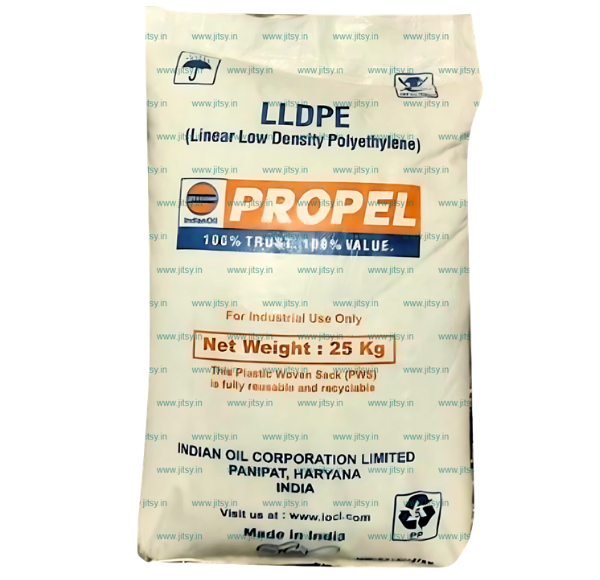
IOCL LLDPE Propel 040R40A is a higher-density linear low-density polyethylene manufactured by Indian Oil Corporation Ltd (IOCL) under its PROPEL polymer brand. It is produced at IOCL’s LLDPE/HDPE swing plant in Panipat using Nova Chemicals’ Sclairtech solution polymerization technology — a process that delivers precise control over molecular weight distribution and comonomer incorporation, resulting in consistent batch-to-batch resin properties and reliable rotomoulding performance.
With a density of 0.940 g/cm³ and a flexural modulus of 900 MPa, 040R40A sits at the stiffer, denser end of IOCL’s LLDPE roto grade family. IOCL describes this grade as offering very good processability alongside enhanced rigidity — a combination that distinguishes it from lighter LLDPE roto grades and makes it the preferred choice for moulded parts where dimensional stability under sustained mechanical load is the primary requirement.
IOCL LLDPE Propel 040R40A is designed for rotational moulding applications that demand greater wall stiffness and load-bearing rigidity than standard-density LLDPE grades can reliably deliver. According to IOCL’s product technical datasheet, recommended applications include medium and large water storage tanks, underground water tanks, rainwater harvesting tanks, septic tanks, manholes and inspection chambers, oil and grease traps, and automobile components — products where the moulded article must resist sustained external loads, hydrostatic pressure, soil pressure or mechanical stress across its service life.
Technical Insights
Resin Properties
- MFI: 3.6 g/10 min (ASTM D1238, 190 °C / 2.16 kg) — A melt flow index in the 3–4 g/10 min range is well-matched to rotomoulding thick-walled parts. The slightly lower flow compared to IOCL’s 042R35A (4.8 g/10 min) reflects the higher molecular weight underlying the greater stiffness of 040R40A, and it remains within the range considered practical for even sintering across large mould cavities.
- Density: 0.940 g/cm³ (ASTM D1505, 23 °C) — This is the key differentiator for 040R40A within IOCL’s LLDPE roto range. At 0.940 g/cm³, the resin sits at the upper boundary of the LLDPE density range and approaches medium-density polyethylene (MDPE) territory. Higher density means tighter polymer chain packing, which directly translates to the grade’s elevated stiffness and improved resistance to long-term deformation under load.
- Hardness: 58 Shore D (ASTM D2240) — Slightly firmer than the 55 Shore D of 042R35A, consistent with the higher density and stiffness. A 58 Shore D surface finish provides good resistance to scratching, indentation and mechanical handling damage for large tanks during transport and installation.
Mechanical Properties
- Tensile Yield Strength: 21 MPa (ASTM D638) — Higher yield strength than standard LLDPE roto grades (typically 15–17 MPa), indicating improved resistance to permanent deformation under load. For underground tanks subject to soil overburden and water column pressure simultaneously, higher yield strength is directly relevant to long-term structural integrity.
- Elongation at Break: >600% (ASTM D638) — Despite the elevated stiffness, 040R40A retains the high elongation characteristic of linear polyethylene grades. This means the material stretches significantly before rupture rather than cracking under impact or point load — a safety attribute important for buried tanks subject to ground movement.
- Notched Izod Impact Strength: 220 J/m (ASTM D256, 23 °C) — A clear trade-off relative to softer LLDPE roto grades: the 040R40A impact strength is lower than that of 042R35A (>500 J/m), which is the predictable mechanical consequence of increased density and stiffness. At 220 J/m, the grade still provides substantial impact toughness adequate for normal tank handling and installation, but applications requiring exceptional drop-impact performance at low temperature should be evaluated carefully with this figure in view.
- Flexural Yield Strength: Not separately reported in IOCL datasheet — The flexural modulus figure provides the primary stiffness reference.
- Flexural Modulus: 900 MPa (ASTM D790) — This is the most significant mechanical differentiator for 040R40A: at 900 MPa, it is exactly double the flexural modulus of IOCL’s 042R35A (450 MPa). For large underground or below-grade tanks, a higher flexural modulus directly reduces wall deflection under soil pressure and hydrostatic load, allowing thinner or more consistent walls to maintain their shape over time compared to what a lower-modulus grade would require.
Thermal Properties
- Vicat Softening Point: 118 °C (ASTM D1525, 10 N) — Virtually identical to 042R35A (117 °C). At 118 °C, 040R40A provides reliable dimensional stability well above ambient and solar-surface temperatures encountered in Indian operating conditions, including midsummer ground temperatures in shallow buried applications.
Processing Temperature Window
IOCL recommends a rotomoulding oven temperature of 170–215 °C for LLDPE 040R40A. This is the same processing window as 042R35A. Operating within this range ensures full and homogeneous sintering. Processing below 170 °C risks incomplete fusion and pinholes in the wall; processing above 215 °C risks thermal degradation, discolouration and mechanical property loss. IOCL notes that all mechanical properties reported in the datasheet were determined on injection-moulded test specimens — actual properties of roto-moulded parts will vary with wall thickness and processing conditions.
Applications of IOCL LLDPE 040R40A
Underground Water Tanks and Rainwater Harvesting Systems
The most technically demanding application for IOCL LLDPE 040R40A is the rotomoulding of underground water storage tanks and rainwater harvesting chambers. Unlike above-ground tanks where gravity load is the primary structural concern, underground tanks must withstand soil overburden pressure from all sides simultaneously while also carrying the hydrostatic load of stored water internally. The 900 MPa flexural modulus of 040R40A — double that of standard LLDPE roto grades — means tank walls resist deformation and ovalization under these combined loads more effectively. Its compliance with IS 10146:1982 and IS 10141:1982 for food and drinking water contact, as stated in the IOCL datasheet, confirms suitability for potable water storage in underground cisterns and harvesting systems.
Septic Tanks and Wastewater Chambers
040R40A’s combination of chemical resistance, structural stiffness and elongation makes it a practical roto moulding resin for below-ground septic tanks, grease interceptors and wastewater chambers. In buried septic tank applications, the high flexural modulus supports the tank against surrounding soil pressure during and after installation, while the elongation at break (>600%) and tensile yield strength (21 MPa) provide tolerance for ground movement, frost heave and uneven bedding. The grade’s inherent LLDPE resistance to dilute aqueous solutions, weak acids and alkalis is consistent with the chemical environment within standard domestic and light-commercial septic systems.
Manholes, Inspection Chambers and Civil Infrastructure Components
IOCL lists manholes and chambers among the recommended applications for 040R40A, reflecting the grade’s elevated stiffness and load-bearing capability. Rotomoulded manholes and inspection chambers must withstand both soil load and, in trafficked locations, live load from above. At 900 MPa flexural modulus, 040R40A provides a more rigid moulded article than standard 0.935 g/cm³ LLDPE grades, reducing deformation under compression. For civil drainage and utility access components, this stiffness advantage directly influences the structural performance classification and long-term dimensional stability of the installed product.
Automobile Components and Oil-Grease Traps
The higher tensile yield strength and stiffness of 040R40A make it suitable for rotomoulded automotive components — fuel tanks, reservoirs, under-body housings and similar hollow structural parts — where the material must retain shape under mechanical load, thermal cycling and fluid pressure. IOCL’s datasheet also lists oil and grease traps among recommended applications, where the combination of chemical resistance to hydrocarbons, good stiffness and reliable processability allows consistent production of these functional industrial components.
Comparable Alternative Grades for High-Stiffness Roto Moulding
IOCL 040R40A occupies a specific segment within the domestic roto LLDPE range — higher density and stiffness than standard 0.935 g/cm³ grades, positioned for underground and structurally demanding applications. Understanding how it sits relative to available alternatives helps procurement and technical teams make informed sourcing decisions.
IOCL 042R35A is IOCL’s standard roto moulding LLDPE grade from the same Sclairtech plant. Its density (0.935 g/cm³), MFI (4.8 g/10 min) and flexural modulus (450 MPa) position it firmly in the overhead water tank segment, where toughness and processability matter more than rigid structural performance. The notched Izod impact of >500 J/m versus 040R40A’s 220 J/m illustrates the classic stiffness-toughness trade-off: 042R35A absorbs impacts better; 040R40A resists deformation better. The two grades are not interchangeable — application selection should be driven by whether the design priority is impact resistance (042R35A) or structural rigidity (040R40A).
OPaL T4003U or equivalent high-density roto grades from ONGC Petro Additions Ltd are produced via gas-phase polymerization and targeted at demanding roto moulding applications. OPaL’s product range includes UV-stabilised roto grades across different density bands; a grade with density approaching 0.940 g/cm³ and MFI in the 3–4 g/10 min range would be functionally comparable to 040R40A in terms of processing and structural performance. OPaL has not published documentation confirming that any specific grade is a direct equivalent of IOCL 040R40A; equivalence must be confirmed through processing trials and full datasheet comparison.
GAIL G-Lene higher-density roto grades — GAIL produces a range of roto LLDPE grades under the G-Lene brand at density points above 0.935 g/cm³. A G-Lene grade with matching MFI and density would sit in a comparable application window to 040R40A for underground tanks and chambers. GAIL has not published documentation confirming interchangeability with IOCL 040R40A; qualification trials are required before substitution in a production run.
Reliance Relene higher-density roto grades — Reliance Industries produces polyethylene under the Relene brand, including roto moulding grades. Reliance’s portfolio includes grades targeting the medium and large tank segment where stiffness is valued over maximum toughness. No Reliance documentation has been found confirming any Relene grade as a direct equivalent of IOCL 040R40A.
Regulatory Compliance, Food Contact and Drinking Water Approvals
The grade meets IS 10146:1982 (Specification for Polyethylene for Safe Use in Contact with Foodstuff, Pharmaceuticals and Drinking Water) and conforms to the positive list of constituents as per IS 10141:1982 — the core BIS standards governing food and drinking water contact for plastic materials in India. The datasheet also states that the grade and its incorporated additives comply with FDA CFR Title 21, Section 177.1520 (Olefin Polymers), the US FDA regulation for olefin-based polymers used in food-contact articles.
These approvals confirm that LLDPE 040R40A granules and parts moulded from them are qualified for use in contact with potable water — a mandatory requirement for underground drinking water storage tanks and rainwater harvesting systems supplied to residential, commercial and institutional end users in India.
Alternative Names, Common Search Variants and Grade Misspellings
IOCL LLDPE Propel 040R40A is also commonly searched and referenced as: LLDPE 040R40A, IOCL 040R40A granules, IOCL roto moulding LLDPE 3.6 MFI, IOCL 040R40A underground tank grade, IOCL LLDPE high rigidity roto grade, polyethylene granules 040R40A LLDPE RM, IOCL LLDPE Propel 040-R40-A, and IOCL LLDPE medium density roto 040R40A.
Frequent misspellings and alternate spellings include: 040 R40A, 040r40a lldpe, roto molding LLDPE 040R40A, rotomoulding LLDPE 040R40A, IOCL MDPE roto grade 040R40A, and IOCL LLDPE Propel 040r40.


















Reviews
Clear filtersThere are no reviews yet.