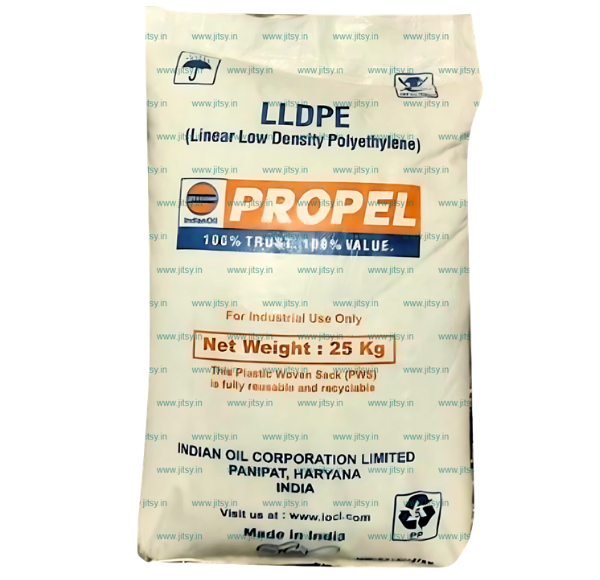
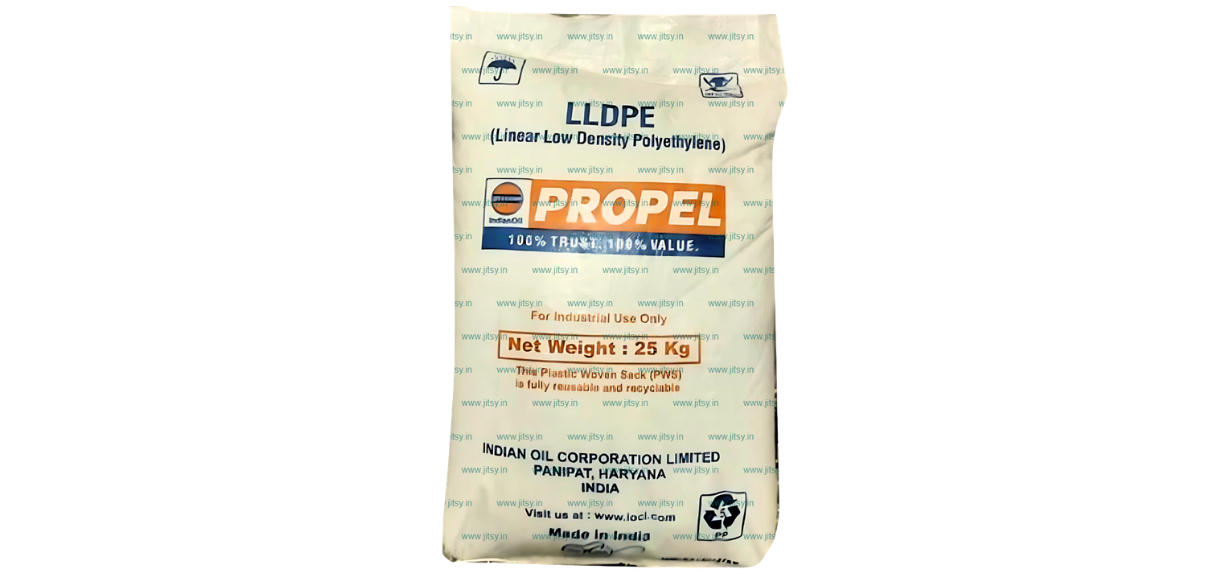
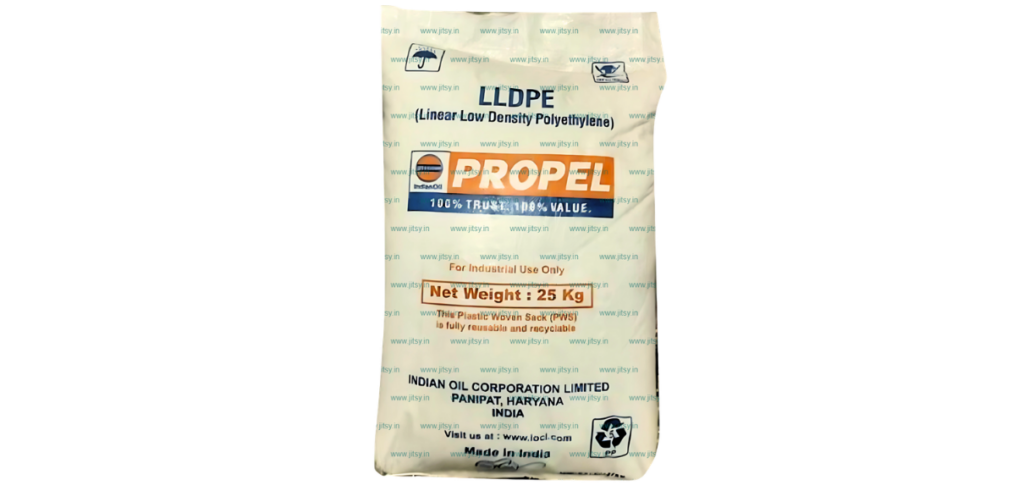
LLDPE Propel 042R35A is a medium-density linear low-density polyethylene rotational moulding grade manufactured by Indian Oil Corporation Ltd. (IOCL) under its Propel polymer brand. Produced using Nova Chemicals’ Sclairtech Solution Polymerization Technology at IOCL’s Panipat Naphtha Cracker Complex in Haryana, the grade is designed for rotational moulding — a processing method used to produce large hollow parts including overhead and loft water tanks, underground septic tanks, chemical storage tanks, playground toys, and outdoor furniture. IOCL’s official grade documentation describes 042R35A as “a medium density polyethylene manufactured using Nova Chemicals’ Sclairtech Solution Polymerization Technology,” and positions it in the LLDPE rotational moulding sector. The grade is supplied as natural-coloured granules in 25 kg BIS-compliant raffia bags.
Rotational moulding is fundamentally different from the extrusion, blow moulding, and injection moulding methods that have been the processing context for all other Propel grades in this series. In rotomoulding, a pre-weighed charge of polymer granules or powder is loaded into a hollow closed mould, which is then heated in a large oven while rotating simultaneously on two perpendicular axes. The polymer melts and coats the inside surface of the mould by centrifugal force and gravity, forming a uniform hollow wall. The mould is then cooled while still rotating, after which the solidified part is demoulded. There is no applied pressure in this process — unlike extrusion or injection moulding, the melt flows and consolidates entirely through gravitational and thermal forces. This has a direct and critical consequence for material selection: the MFI of a rotomoulding resin must be high enough for the melt to flow uniformly across the mould surface and fuse into a dense, void-free wall without the assistance of a screw, die, or injection piston. For 042R35A, the MFI of 4.8 g/10 min at 2.16 kg load is by far the highest of any grade in the LLDPE Propel series reviewed here — the direct expression of this fundamental rotomoulding requirement.
Technical Insights
Understanding the Key Properties of LLDPE 042R35A
An important testing convention note for this grade: the mechanical properties of 042R35A are reported on injection-moulded specimens rather than compression-moulded specimens, as the datasheet explicitly states. This is the test basis for the tensile, flexural, impact, and hardness values listed below. Properties of actual rotomoulded parts will differ from these injection-moulded specimen values because the rotomoulding process involves slower cooling rates, potential for minor residual porosity, and a different crystalline microstructure than injection moulding produces. The datasheet values serve as grade characterisation and selection references; final part qualification should be based on tests of rotomoulded specimens using the specific mould, cycle, and oven conditions of the converter’s process.
- Melt Flow Index — 4.8 g/10 min (ASTM D1238, 190 °C / 2.16 kg): At 4.8 g/10 min, this is the highest MFI value among the LLDPE Propel grades reviewed in this series — more than four times the MFI of the drip lateral grade 010L22S (1.1 g/10 min) and substantially higher than any other Propel grade that uses the 2.16 kg load convention. The reason is specific to rotomoulding: because there is no applied pressure in the process, the polymer melt must flow and consolidate under gravity and centrifugal force alone. A higher MFI means lower melt viscosity and faster, more complete flow across the mould surface during the heating phase, reducing the risk of incomplete fusion, surface pinholes, and internal voids that would structurally compromise a water tank or septic tank wall. For large-part rotomoulding — tanks of 500 litres to several thousand litres — the 4.8 g/10 min MFI is within the standard range for rotomoulding-grade polyethylene and is appropriate for the mould surface areas and heating cycles used in commercial tank production.
- Density — 0.935 g/cm³ at 23 °C (ASTM D1505): The 0.935 g/cm³ density sits in the MDPE range, above typical LLDPE film grades (0.918–0.924 g/cm³) and below HDPE (above 0.940 g/cm³). For a rotomoulded water or chemical storage tank, density is the primary dial for balancing stiffness against toughness: too high a density produces a stiffer but more brittle wall that can crack when the tank is dropped during delivery or struck in service; too low a density produces a tough wall that sags or deforms under the hydrostatic load of a full tank. At 0.935 g/cm³, 042R35A delivers the flexural modulus needed for structural tank wall rigidity, combined with the impact resistance associated with the lower-crystallinity end of the MDPE range.
- Tensile Strength at Yield — 15 MPa (ASTM D638, injection-moulded specimen): The 15 MPa tensile yield strength is consistent with LLDPE at 0.935 g/cm³. For rotomoulded tanks, the tensile yield of the wall material governs the onset of permanent deformation under hydrostatic pressure — the sustained stress from a full water column above the tank wall. At 15 MPa, the tank wall has adequate yield resistance for the operating pressures of gravity-fed overhead water tanks and underground tanks at standard fill levels.
- Ultimate Tensile Strength — 20 MPa (ASTM D638, injection-moulded specimen): The 20 MPa UTS marks the stress at which the material fractures after yielding. For a rotomoulded tank exposed to sudden overfill, hydraulic surge, or mechanical impact, the large post-yield deformation region between 15 MPa yield and 20 MPa fracture means the tank wall absorbs substantial energy before failure — behaving in a ductile rather than brittle manner, which gives warning before final failure rather than sudden catastrophic cracking.
- Elongation at Break — >600% (ASTM D638, injection-moulded specimen): Elongation at break exceeding 600% confirms the highly ductile character of 042R35A. For a water or chemical storage tank, high elongation in the wall material is important because tanks undergo differential thermal expansion and contraction with daily temperature cycles and seasonal temperature changes. A material with high elongation accommodates these dimensional changes without initiating cracks at stress concentrators — weld lines, mould corners, fittings, and insert interfaces in the moulded part.
- Flexural Yield Strength — 13 MPa (ASTM D790, injection-moulded specimen): Flexural yield strength is the stress at which the test specimen yields under a three-point bending load. It is a direct measure of the resistance of the tank wall to bending deformation under sustained load — the load condition experienced by a large water tank wall under the hydrostatic pressure of the water column it contains, or by a buried septic tank under backfill soil load. The 13 MPa flexural yield strength for 042R35A is the property that governs the minimum wall thickness needed to prevent visible bowing or deformation in service.
- Flexural Modulus — 450 MPa (ASTM D790, injection-moulded specimen): The 450 MPa flexural modulus is the lowest in the Propel series reviewed here, reflecting the lower crystallinity and greater chain flexibility of the LLDPE/MDPE molecular architecture at 0.935 g/cm³. For context, the high-density HDPE blow moulding grade 012DB60 has a flexural modulus of 1300 MPa — nearly three times higher. The lower modulus of 042R35A means a rotomoulded tank wall of equivalent thickness will deflect more under load than an HDPE wall, which is why rotomoulded LLDPE water tanks are designed with greater wall thicknesses than HDPE pipes or blow-moulded containers at equivalent volume. The 450 MPa modulus is appropriate and widely used for rotomoulded water tank applications; the design compensates for the lower modulus through wall thickness and geometry rather than requiring a stiffer material.
- Notched Izod Impact Strength — >500 J/m at 23 °C (ASTM D256, injection-moulded specimen): At greater than 500 J/m — equal to the highest Notched Izod in the series, matching the drip lateral grade 010L22S — 042R35A is an extremely tough material in the isotropic injection-moulded state. High impact resistance is one of the primary reasons LLDPE is the preferred resin for rotomoulded water tanks over HDPE: a water tank must survive being dropped from a truck during delivery, being struck by tools or vehicles on a construction site, and the thermal shock of cold water filling a hot tank under direct summer sun in Indian conditions. The >500 J/m Notched Izod confirms the material’s energy absorption capacity before crack initiation.
- Hardness — 55 Shore D (ASTM D2240): The 55 Shore D hardness reflects the surface resistance to indentation at the 0.935 g/cm³ density level. For rotomoulded water tanks and furniture, surface hardness affects scratch resistance during transport and installation. At 55 Shore D, 042R35A is softer than HDPE blow moulding grades in the series (65 Shore D for 012DB60) but provides adequate surface durability for the applications intended.
- Vicat Softening Point — 117 °C at 10 N (ASTM D1525): The 117 °C Vicat point is the lowest in the Propel series reviewed here, directly reflecting the lower crystallinity of the MDPE/LLDPE structure at 0.935 g/cm³. For overhead water tanks installed on rooftops in India — where the tank surface temperature under direct summer sun can reach 50–70 °C — the 117 °C Vicat provides a comfortable safety margin well above the maximum ambient service temperature. The Vicat also confirms that the moulded tank retains its dimensional geometry through the thermal cycling of normal outdoor storage service without softening or creeping under the weight of the water it contains.
- Processing Temperature — 170–215 °C: The 170–215 °C processing window for 042R35A is the oven temperature range recommended for rotational moulding. This is a narrower and lower window than the 180–250 °C range used for HDPE raffia grades or the 180–230 °C range for the drip lateral grade, consistent with the lower melting point and lower crystallinity of MDPE/LLDPE at 0.935 g/cm³. Rotomoulding converters must balance oven temperature against cycle time: sufficient temperature to fully melt and fuse the granules into a uniform void-free wall, without overheating the material and causing thermal degradation of the melt or the moulded part surface. The 170–215 °C range is the starting envelope for process optimisation; specific oven temperature profiles depend on mould size, wall thickness target, rotation speed, and oven type.
All values are typical figures from IOCL’s technical documentation for LLDPE 042R35A (including the Provisional Technical Datasheet dated 2026-01-22 and the Polymerupdate IOCL grade specification) and are not specification limits. Values may change without prior notice; buyers should verify against IOCL’s current grade sheet before final qualification.
Applications
Overhead and Loft Water Storage Tanks
The primary application for LLDPE Propel 042R35A — and the largest-volume rotomoulding application in India — is the manufacture of overhead polyethylene water storage tanks used in residential buildings, commercial properties, and agricultural installations. India’s overhead water tank market, served by manufacturers across Rajasthan, Gujarat, Haryana, Maharashtra, and Uttar Pradesh, predominantly uses LLDPE/MDPE rotomoulding resin in the 300-litre to 10,000-litre range. The tank must hold its cylindrical or cylindro-conical shape under the full hydrostatic load of water, resist distortion from roof mounting hardware and strapping under thermal expansion, survive the impact of a fall during installation, and deliver multi-decade service life in outdoor rooftop environments exposed to UV radiation, monsoon rain cycles, and summer heat. IOCL explicitly positions 042R35A for overhead water tanks, and the grade’s combination of >500 J/m impact resistance, flexural modulus appropriate for typical rotomoulded wall thicknesses, and Vicat softening point of 117 °C supports this application profile. IOCL’s food-contact regulatory references (IS 10146:1982, IS 10141:1982, and FDA 21 CFR 177.1520) confirm the base polymer and additive system’s compliance with polyethylene standards for use in contact with drinking water, which is commercially relevant for tanks serving potable water storage.
Septic Tanks and Underground Liquid Containment Systems
IOCL lists septic tanks as a primary application for 042R35A. Rotomoulded polyethylene septic tanks have grown as a product category in India’s sanitation infrastructure — used for on-site sewage treatment in individual homes, housing societies, commercial establishments, and rural communities where centralized sewerage is unavailable. The requirements for a septic tank are more mechanically demanding than for an overhead water tank: the tank is buried, subject to soil pressure and groundwater loading from outside and liquid contents from inside, must accept inlet and outlet fittings without leakage at the fitting-wall interface, and must maintain structural integrity across seasons of soil freeze-thaw or drought-expansion cycles depending on geography. The 042R35A’s elongation at break exceeding 600% and >500 J/m Notched Izod contribute to the tank wall’s ability to accommodate soil loading and installation stresses without brittle cracking, while the medium density supports the minimum flexural stiffness needed to prevent wall collapse under external pressure. For a septic tank resin, the absence of claimed UV stabilisation for 042R35A is not a disqualifier — buried tanks have no UV exposure in service — making this grade appropriate for standard buried septic tank applications where UV stabilisation is not required.
Chemical Storage Tanks and Industrial Liquid Containment
IOCL identifies chemical storage tanks as a further application for 042R35A, placing it in the industrial liquid containment segment where polyethylene tanks store acids, alkalis, fertiliser solutions, and other industrial chemicals at ambient temperature. LLDPE’s inherent chemical resistance to most non-oxidising acids, alkalis, salts, and aqueous solutions is the primary selection driver for chemical storage tanks, alongside the impact and toughness properties that protect the tank from mechanical damage in industrial handling environments. At 0.935 g/cm³, the grade’s molecular structure provides ESCR-relevant toughness (consistent with the high Notched Izod value) that helps the tank wall resist slow crack initiation at fitting penetrations and moulded-in inserts — common stress concentration sites in chemical storage vessels. Buyers specifying 042R35A for chemical storage should evaluate the chemical resistance of polyethylene to the specific stored chemical at the expected concentration and temperature, and should assess whether the grade’s standard additive package is appropriate for the chemical environment.
Toys, Playground Equipment and Outdoor Furniture
IOCL’s application list for 042R35A includes toys and furniture — rotomoulded consumer and commercial products where the combination of impact resistance, design freedom in large hollow shapes, surface quality, and colourability from masterbatch makes LLDPE rotomoulding the preferred manufacturing route. Rotomoulded playground equipment — climbing frames, sandpit enclosures, seesaws, and slide channels — requires a resin with very high impact resistance to survive the dynamic loading of children’s activity and the outdoor UV and temperature exposure of permanent playground installation. Rotomoulded garden furniture — chairs, tables, planters, and storage boxes — requires dimensional stability, scratch resistance, and the ability to hold moulded-in texture and colour uniformity across large flat and curved surfaces. For both categories, 042R35A’s >500 J/m Notched Izod and >600% elongation at break provide the toughness base that rotomoulded consumer products require; moulders specifying this grade for outdoor toy or furniture applications where UV exposure is a multi-year service condition should evaluate whether the natural grade without UV stabilisation is appropriate for their specific product life expectation, or whether the UV-stabilised variant 042R35U is required.
Comparable Alternatives
LLDPE Propel 042R35U is the most directly related grade within IOCL’s rotomoulding portfolio. Based on available documentation, 042R35U is a UV-stabilised variant in the same rotomoulding grade family as 042R35A, positioned specifically for outdoor applications and products with long-term exposure to sunlight. The core polymer architecture and MFI range appear to be closely related between the two grades; the key differentiation is the UV stabilisation package incorporated in 042R35U, which protects the moulded part from photo-oxidative degradation during the multi-year outdoor service life of overhead tanks, playground equipment, and furniture installed in direct sunlight. For applications where the moulded product is primarily indoors or buried (septic tanks, underground chemical storage), 042R35A without UV stabilisation is appropriate. For applications with extended outdoor sun exposure — rooftop tanks in direct sunlight, open-air playground equipment, outdoor furniture, and exterior water storage vessels in uncovered installations — 042R35U should be evaluated as the preferred option. IOCL does not confirm the two grades as interchangeable; buyers should assess the UV exposure conditions of their specific application before selecting between them.
LLDPE Propel 040R40A is another IOCL LLDPE rotomoulding grade listed in the same grade slate, with MFI approximately 4.0 g/10 min and density 0.940 g/cm³. Compared with 042R35A, the slightly lower MFI of 040R40A (4.0 vs 4.8 g/10 min) would produce a somewhat higher melt viscosity in the oven — potentially advantageous for mould geometries where slower flow gives better wall thickness uniformity, but potentially requiring a higher oven temperature or longer cycle time to achieve equivalent fusion quality. The higher density of 040R40A (0.940 vs 0.935 g/cm³) places it at the boundary between MDPE and HDPE and would produce a stiffer, higher-modulus moulded wall at equivalent thickness — relevant for large tanks where structural rigidity is the governing design parameter. IOCL does not confirm 040R40A as equivalent to 042R35A; converters should conduct comparative moulding trials to determine which grade’s MFI and density profile produces better cycle efficiency and finished-part properties on their specific rotomoulding equipment.
Other Indian LLDPE rotomoulding grades from producers including Reliance Industries, GAIL India, and imported sources serve the same overhead water tank and chemical storage tank market as 042R35A. No manufacturer has published confirmed grade equivalence to IOCL 042R35A. Rotomoulding converters considering a resin change should conduct full processing trials — measuring oven temperature profiles, peak internal air temperature, part wall thickness uniformity, impact resistance, and hydrostatic pressure performance — before qualifying an alternative grade for production. Resin-level datasheet comparison is the starting point, not the qualification endpoint.
Common Search Variants
Buyers and engineers commonly search for this grade using terms such as IOCL LLDPE rotomoulding grade, Propel 042R35A granules, 042R35A water tank resin, IOCL 042R35A roto grade, LLDPE for polyethylene water tanks India, and 042R35A technical datasheet. Frequent misspellings and alternate notations include 042R35, 042R 35A, 042R35A IOCL LLDPE, IOCL HDPE Propel 042R35, and 042R35A roto moulding grade — all refer to the same product.

















Reviews
Clear filtersThere are no reviews yet.