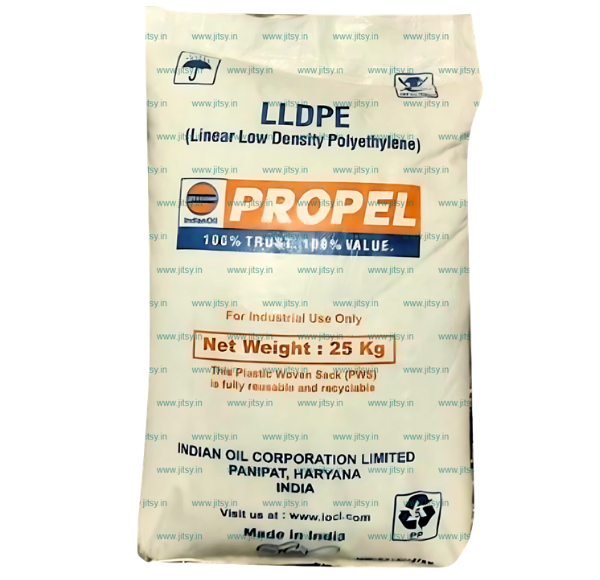
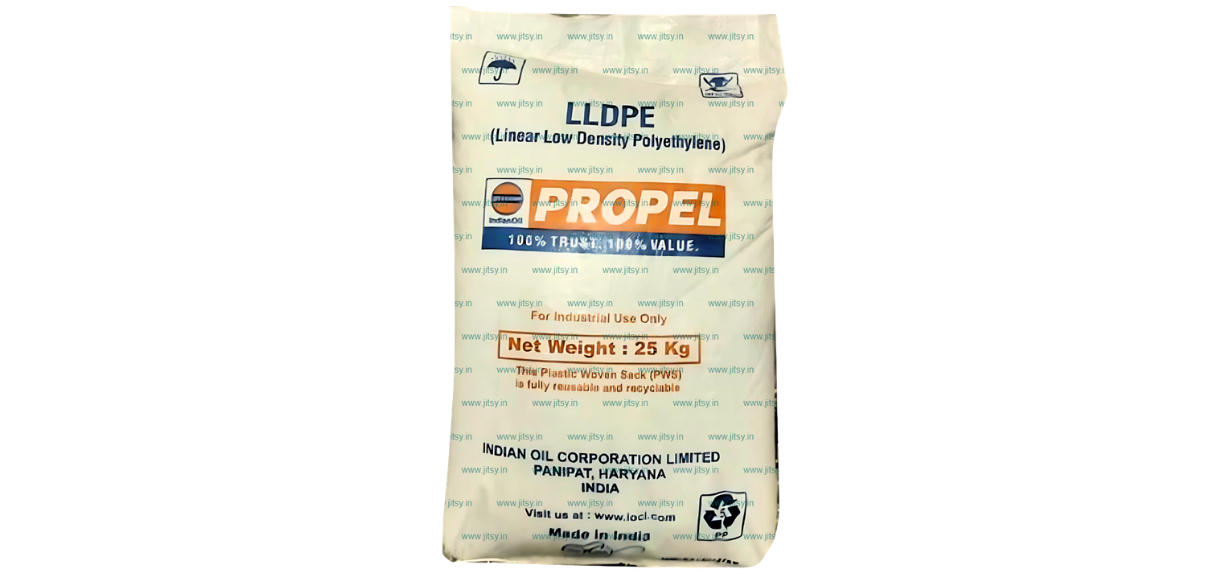
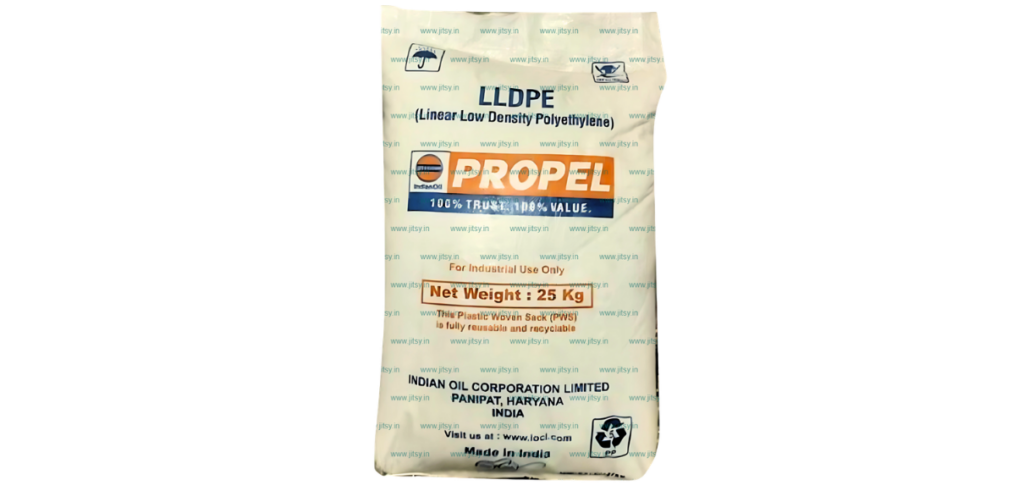
IOCL LLDPE Propel 010L22S is a butene-comonomer linear low-density polyethylene (LLDPE) grade manufactured by Indian Oil Corporation Ltd. (IOCL) under its Propel polymer brand. Produced using Nova Chemicals’ Sclairtech Solution Polymerization Technology at IOCL’s Panipat Naphtha Cracker Complex in Haryana, the grade is designed specifically for the extrusion of drip lateral pipes for agricultural drip irrigation systems, with particular emphasis on high-speed pipe extrusion lines. It is supplied as natural-coloured granules in 25 kg BIS-compliant raffia bags.
IOCL positions 010L22S with four manufacturing and performance attributes: excellent processability, good strength, controlled morphology, and low gel content. Each of these addresses a specific requirement for drip lateral pipe production. Excellent processability refers to the melt behaviour on high-speed single-screw extrusion lines — the grade must maintain stable melt pressure, consistent output rate, and uniform parison formation at the pipe die across extended production runs. Good strength means the pipe wall has sufficient tensile yield and elongation to survive installation stresses, hydraulic pressure cycling in service, and mechanical contact with soil, stones, and installation tools. Controlled morphology refers to the uniformity of the crystalline-amorphous microstructure across the pipe wall cross-section — a critical quality factor for thin-wall pipe where local variations in morphology create stress concentration sites that can initiate slow crack growth. Low gel content means the absence of unmelted or cross-linked polymer particles that would form surface protrusions or subsurface voids in the extruded pipe wall — the primary source of premature burst and pinhole failures in thin-wall irrigation tubing in service.
Technical Insights
Understanding the Key Properties of LLDPE 010L22S
The properties of LLDPE Propel 010L22S are reported on compression-moulded Type IV specimens tested per ASTM D638 — the same isotropic test geometry used for HDPE raffia and injection grades in the Propel series, not a pipe-specific pressure test. Compression-moulded values characterise the bulk polymer in an unoriented state and serve as grade selection and inter-grade comparison references; they do not directly predict the burst pressure, hoop stress, or installed service life of extruded pipe, which depend on the pipe’s wall thickness, outside diameter, extrusion conditions, and the pressure-rating standard it is manufactured to meet. IOCL’s technical datasheet states explicitly that all values are typical and should not be construed as specification limits.
- Melt Flow Index — 1.1 g/10 min (ASTM D1238, 190 °C / 2.16 kg): The MFI is measured at the 2.16 kg load convention, consistent with Sclairtech-process grades across IOCL’s LLDPE and lower-viscosity HDPE grade families. At 1.1 g/10 min, 010L22S has a melt flow level appropriate for high-speed single-screw pipe extrusion — the processing method used to produce drip lateral pipe at commercial production rates. The MFI is in the range where the melt has adequate flow to fill the die annulus uniformly without excessive back-pressure at high screw speeds, while retaining the melt strength needed to prevent parison sag and dimensional variation as the pipe exits the die and enters the sizing and cooling section. For a drip lateral pipe with outside diameters typically in the 12–20 mm range and wall thicknesses of 0.8–1.5 mm, the 1.1 g/10 min MFI is consistent with a stable extrusion process on a modern high-speed line.
- Density — 0.922 g/cm³ at 23 °C (ASTM D792): The density is measured by ASTM D792 (liquid displacement) rather than ASTM D1505 (density-gradient column) as used for HDPE grades in this series — a minor but technically accurate difference between the two methods at these density levels. At 0.922 g/cm³, 010L22S is in the standard LLDPE density range, well below the HDPE range of 0.940–0.970 g/cm³. This lower density reflects the butene comonomer’s disruption of crystalline packing and is the structural basis for the grade’s toughness, elongation, and ESCR performance. For drip lateral pipe, the lower density also means the pipe wall has more inherent flexibility than an HDPE pipe of equivalent wall thickness, which is beneficial for field installation — drip laterals are typically coiled on reels and unspooled during installation, requiring the pipe to flex repeatedly without kinking or cracking.
- Tensile Strength at Yield — 13 MPa (ASTM D638, Type IV, compression-moulded): The 13 MPa tensile yield strength is the lowest in the Propel series reviewed here, directly reflecting the lower crystallinity and greater molecular mobility of LLDPE at 0.922 g/cm³ compared with HDPE grades at 0.950–0.960 g/cm³. For drip lateral pipe applications, tensile yield of the base resin is not the governing design property — the pipe’s pressure rating and structural performance are determined by the pipe’s geometric dimensions (outer diameter, wall thickness, and the SDR ratio) and the material’s long-term hydrostatic strength, not the short-term tensile yield of the compression-moulded specimen. The 13 MPa value provides the grade-comparison reference but should not be used to calculate the service pressure rating of finished pipe.
- Tensile Strength at Break — 20 MPa (ASTM D638, Type IV, compression-moulded): The 20 MPa tensile strength at break is measured after the material has yielded and undergone substantial plastic deformation. For LLDPE, the ratio of yield strength to break strength is low because the material elongates extensively before fracture — a characteristic of the comonomer-modified chain architecture. In practice, for thin-wall drip pipe in service, this ductile failure behaviour means the pipe deforms visibly and progressively before it fractures, as opposed to the sudden brittle splitting that can occur in materials with low elongation capacity.
- Elongation at Break — >600% (ASTM D638, Type IV, compression-moulded): The >600% elongation at break confirms 010L22S as a highly ductile material in the unoriented state. For drip lateral pipe applications, this high elongation capacity means the pipe wall can absorb the deformation imposed by soil settlement, root intrusion pressure, installation bending, and hydraulic surge without initiating a crack. In thin-wall irrigation pipe that is typically buried at shallow depths and subject to cyclic thermal expansion and contraction over seasons of field service, the ability to accommodate dimensional change without brittle fracture is a key long-term reliability attribute.
- Notched Izod Impact Strength — 500 J/m at 23 °C (ASTM D256, compression-moulded): At 500 J/m, this is the highest Notched Izod impact value in the Propel series reviewed here — higher than the bimodal HDPE pipe grade 010DP45U (300 J/m) and higher than all blow moulding and injection moulding grades in the series. The very high impact value reflects the fundamental toughness of LLDPE at 0.922 g/cm³: the short butene branches on the polymer chains create an amorphous phase that absorbs impact energy very effectively, making the material highly resistant to crack initiation under sudden loading. For drip lateral pipe, high impact resistance is practically relevant during installation, when the pipe may be stepped on, driven over by machinery in field conditions, or struck by installation tools.
- Environmental Stress Crack Resistance (ESCR) — >1000 h (ASTM D1693, Condition B, F50, 10% Igepal): The ESCR of greater than 1000 hours is the highest in the Propel series reviewed here — exceeding the pipe grade 010DP45U (>600 h) and the high-ESCR blow moulding grade 010DB50 (>500 h). ESCR is the single most critical long-term performance property for drip lateral pipe because it governs the pipe’s resistance to slow crack growth under the combination of surface-active stress concentrations (soil chemicals, agrochemical residues, surfactants in fertiliser solutions) and the sustained hoop stress from operating pressure.
- Processing Temperature — 180–230 °C: IOCL’s recommended processing window of 180–230 °C is narrower at the upper end than the 180–250 °C window specified for the HDPE raffia grades in the same Sclairtech process family. Converters should optimise barrel zone temperatures, die temperature, and cooling water flow within this window for their specific machine configuration, pipe diameter, and target production rate.
Applications
Drip Lateral Pipes for Agricultural Drip Irrigation Systems
LLDPE Propel 010L22S is positioned by IOCL exclusively and specifically for drip lateral pipe extrusion — the thin-wall, small-bore polyethylene tubes that form the distribution network in a drip irrigation system, carrying water from the sub-main supply line to individual drip emitters or inline emitter tapes placed at the plant root zone. IOCL’s technical datasheet states the grade is “recommended mainly for agricultural drip irrigation applications: drip lateral pipes for high-speed extruders.” Drip laterals are among the highest-volume agricultural plastic products manufactured in India, where drip irrigation is a central technology for improving water-use efficiency in horticulture, vegetable cultivation, and sugarcane, cotton, and other row crops across water-scarce regions in Rajasthan, Maharashtra, Andhra Pradesh, Karnataka, Gujarat, and Haryana. The pipe must meet IS 12786:1989 — “Irrigation equipment — Polyethylene Pipes for irrigation laterals — specification” — the Indian Standards specification IOCL explicitly lists in the 010L22S compliance references. For pipe manufacturers supplying to government-subsidy-linked drip irrigation programmes and to private irrigation system installers, IS 12786:1989 compliance of the resin and finished pipe is a procurement prerequisite, and IOCL’s positioning of 010L22S against this standard directly addresses that requirement.
The technical properties of 010L22S are selected to meet the specific extrusion and service demands of drip lateral pipe production. Low gel content is the most critical extrusion quality requirement because drip lateral pipe is produced at wall thicknesses of 0.8–1.5 mm, where even a small unmelted gel particle creates a thin spot or protrusion in the pipe wall that becomes a premature burst or pinhole failure site in the field. Controlled morphology ensures the crystalline microstructure of the pipe wall is uniform across the cross-section, avoiding the local stress concentrations that initiate slow crack growth under long-term hoop stress and soil-chemical exposure. The ESCR of greater than 1000 hours provides the evidence base for the multi-year service life that drip irrigation infrastructure requires from its pipe network. High-speed extrusion processability at 1.1 g/10 min MFI supports commercial production rates on modern extruder lines, reducing the pipe manufacturer’s per-unit cost while maintaining dimensional consistency at the tight tolerance bands required by IS 12786:1989.
High-Speed Pipe Extrusion for Drip Irrigation Infrastructure Programmes
India’s ongoing expansion of drip irrigation under the Pradhan Mantri Krishi Sinchayee Yojana (PMKSY) and the Per Drop More Crop programme has driven substantial growth in drip lateral pipe manufacturing capacity across major agricultural states. Pipe manufacturers serving these programmes require LLDPE drip lateral resins that can run on high-speed extruder lines — often operating at production speeds of 80–150 metres per minute or higher for small-diameter laterals — without process interruptions from gel-induced pipe defects, MFI variability, or melt instability at the die. IOCL explicitly describes 010L22S as designed for “high-speed extruders,” distinguishing it from general-purpose LLDPE film grades that are not formulated for the combination of gel control, morphology consistency, and processability that high-output pipe extrusion requires. For pipe manufacturers competing for cost and quality in a market where resin consistency directly determines yield rates and scrap losses, sourcing a dedicated drip lateral grade like 010L22S from a verified domestic producer provides supply-chain reliability alongside the technical performance the application demands.
Comparable Alternatives
LLDPE Propel 010F18S is the closest adjacent LLDPE grade in IOCL’s Sclairtech-process product family, but it is a film grade rather than a drip lateral pipe grade and the two serve different applications. 010F18S has MFI 0.90 g/10 min and density 0.918 g/cm³, and is positioned for liquid packaging film, heavy-duty film, and lamination applications where blown film processing is used. The lower MFI of 010F18S (0.90 vs 1.1 g/10 min) and marginally lower density (0.918 vs 0.922 g/cm³) reflect a different molecular weight and comonomer distribution optimised for blown film bubble stability and film mechanical properties rather than for the single-screw pipe extrusion stability and pipe-wall morphology control that 010L22S is formulated to deliver. IOCL does not confirm 010F18S as an equivalent to 010L22S for drip lateral pipe extrusion, and using a film-grade LLDPE in a pipe application — or vice versa — carries the risk of gel content, morphology, or processability mismatch that could affect pipe quality and compliance with IS 12786:1989.
Other LLDPE drip lateral grades from Indian producers including Reliance Industries, HMEL (under the PROPYLENE brand), and imported resin sources occupy the same drip pipe application segment. No manufacturer has published confirmed grade equivalence to IOCL 010L22S in the documentation reviewed. For pipe manufacturers considering a resin switch, the relevant qualification parameters are gel content testing on extruded pipe samples, IS 12786:1989 compliance verification on the finished pipe using the alternative resin, and ESCR testing of pipe specimens — a more application-relevant test than the resin-level ESCR reported in the TDS. The resin-level ESCR of greater than 1000 hours for 010L22S provides a strong starting-point indicator but does not substitute for pipe-level qualification on the converter’s line.
Common Search Variants
Buyers and engineers commonly search for this grade using terms such as IOCL LLDPE drip lateral grade, LLDPE Propel 010L22S, 010L22S drip pipe resin, IOCL 010L22S granules, LLDPE for drip irrigation pipe India, and 010L22S technical datasheet. Frequent misspellings and alternate notations include 010L220S, 010L2ZS, 010 L22S, LLDPE 010L22S IOCL, and Propel 010L22S drip grade — all refer to the same product.















Reviews
Clear filtersThere are no reviews yet.