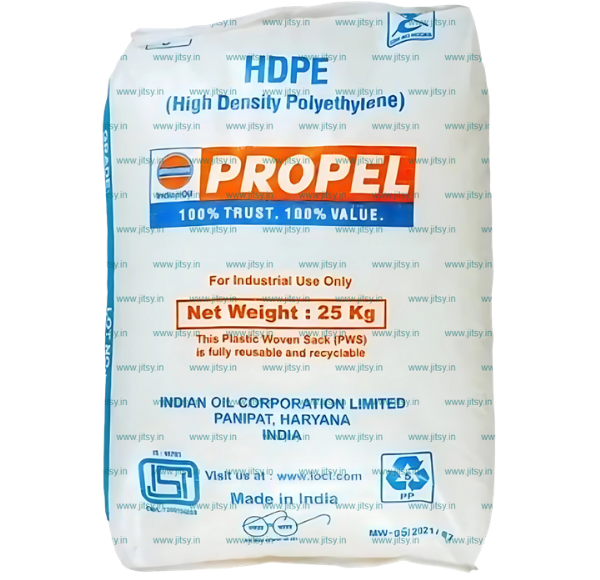
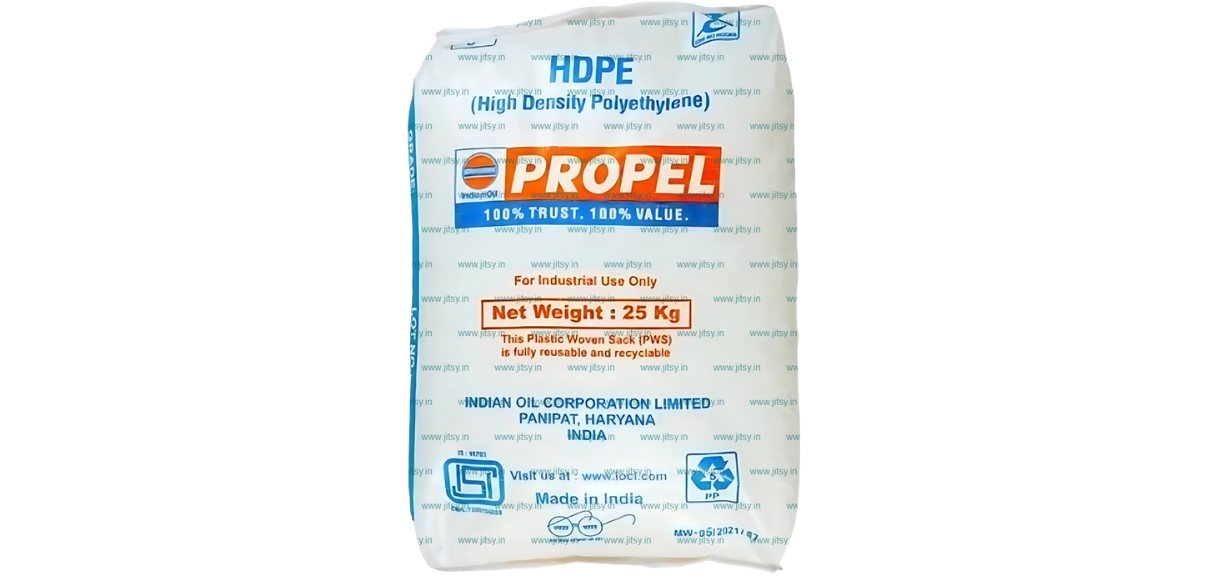
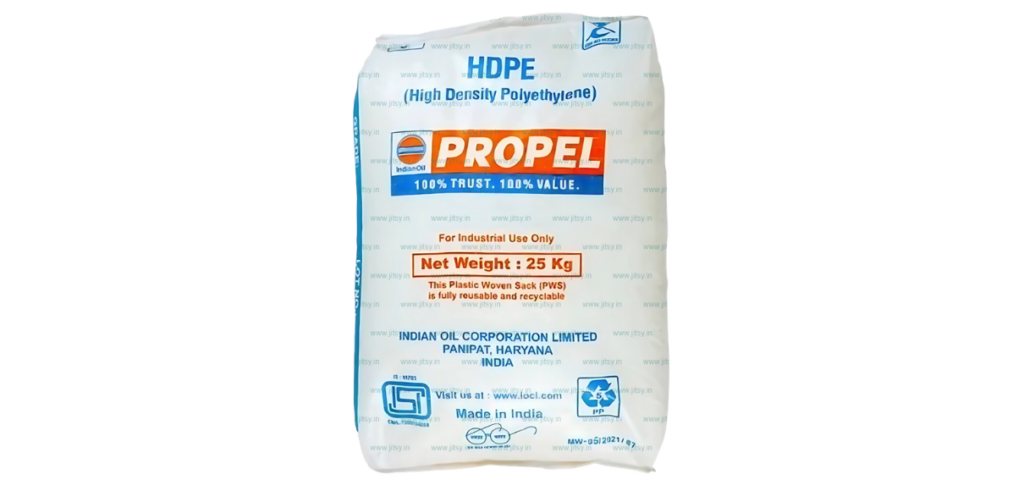
Propel 012E50 is a raffia and monofilament grade of high-density polyethylene manufactured by Indian Oil Corporation Ltd. (IOCL) under its Propel polymer brand. Produced using Nova Chemicals’ Sclairtech Solution Polymerization Technology at IOCL’s Panipat Naphtha Cracker Complex in Haryana, the grade is designed for oriented tape and monofilament extrusion applications with an emphasis on process stability, drawability to fine denier, and mechanical integrity in the finished fibre or tape. Primary applications include woven sacks, tarpaulins, monofilament yarn for mosquito nets, fishing nets, and filter cloth. The grade is supplied as natural-coloured granules in 25 kg BIS-compliant raffia bags.
The grade designation is consistent with IOCL’s Propel naming system. The “01” prefix identifies it as a Sclairtech solution-polymerised grade — the same production platform as the Propel injection moulding, film, and other raffia grades — as distinct from the Hostalen slurry process used for bimodal blow moulding and pipe grades. The “2” following “01” is a variant identifier within the Sclairtech raffia sub-family. The “E” designates the oriented tape and monofilament processing family, identical to the “E” designation used for the related grade 010E52. The “50” corresponds to the density classification of approximately 0.950 g/cm³.
IOCL characterises 012E50 with four defining attributes: excellent orientation characteristics, low water carry-over, superior mechanical properties, and good processability. These attributes have the same meaning in the context of 012E50 as they do for IOCL’s broader raffia grade family. Excellent orientation characteristics refers to the polymer’s ability to be drawn to high draw ratios without breakage, producing high-tenacity tape or filament. Low water carry-over means the granule surface and the extruded profile shed moisture cleanly, avoiding surface inconsistencies in the drawing zone on lines using water-bath quench systems. Good processability and superior mechanical properties refer collectively to the balance between melt stability during extrusion and tensile performance in the drawn product. IOCL’s 2025 grade sheet also associates 012E50 with UV stabilisation, extending the grade’s relevance to outdoor applications including tarpaulin fabric and agricultural shade netting where multi-season UV exposure is a service condition.
Manufacturer
Propel 012E50 is produced by Indian Oil Corporation Ltd. (IOCL), India’s largest integrated refining and petrochemicals company, at the Panipat Naphtha Cracker Complex, Haryana. Grade development and technical documentation are managed by IOCL’s Product Application and Development Centre (PADC), Panipat. The grade is distributed across India under the Propel brand through IOCL’s authorised distributor network.
Technical Insights
The properties of Propel 012E50 are reported on compression-moulded Type IV specimens tested per ASTM D638 — the standard isotropic test geometry rather than the film geometry (ASTM D882 at defined BUR and die gap) used for IOCL’s blown film grades. This distinction matters for how the values should be interpreted. Compression-moulded tensile and impact properties reflect the behaviour of the polymer in an unoriented, isotropic state before any drawing or orientation is applied. They characterise the raw material and allow consistent grade comparison, but they do not directly represent the tensile strength or elongation of the finished drawn tape or monofilament, which will be substantially higher in the draw direction after orientation. Buyers should not use the compression-moulded tensile yield of 20 MPa as a predictor of the drawn tape’s tenacity; the actual drawn tape properties depend on the draw ratio, draw temperature, and line configuration of the converter’s process.
- Melt Flow Index — 1.2 g/10 min (ASTM D1238, 190 °C / 2.16 kg): The MFI is measured at the 2.16 kg load convention used for injection moulding, film, and raffia grades — not the 5 kg load used for blow moulding and pipe grades. At 1.2 g/10 min, 012E50 flows more readily than the companion raffia grade 010E52 (0.90 g/10 min at the same load). In practice, this means 012E50 generates lower back-pressure at the die head at equivalent extrusion temperatures and screw speeds, making it better suited to the smaller die-hole geometries used in monofilament spinneret systems. For woven tape production, the higher MFI also provides a wider processing window at the lower end of the temperature range, which is useful for converters running high-speed tape lines where maintaining low melt temperature reduces the thermal degradation risk for a UV-stabilised grade.
- Density — 0.950 g/cm³ at 23 °C (ASTM D1505): The 0.950 g/cm³ density positions 012E50 at the lower end of the HDPE raffia grade density range. Lower density corresponds to lower crystallinity, which in the undrawn state produces a more ductile, flexible polymer with higher elongation at break and impact absorption before the orientation step. For monofilament yarn applications — fishing nets, mosquito net yarn, filter cloth — the lower crystallinity of 0.950 g/cm³ means the filament retains flexibility and knot strength after drawing, properties that are critical for net mesh structures that see repeated dynamic loading. For woven tape applications, the 0.950 g/cm³ density delivers slightly lower initial stiffness in the undrawn tape compared to denser grades, but orientation at the draw stage adds the tenacity needed for functional woven sack or tarpaulin fabric.
- Tensile Strength at Yield — 20 MPa (ASTM D638, 50 mm/min, compression-moulded Type IV): The 20 MPa yield strength on a compression-moulded specimen is the baseline isotropic tensile yield of the material before drawing. It is lower than the yield values reported for blow moulding grades in this series at comparable or higher densities, which is expected: the Sclairtech solution process and the moderate density of 0.950 g/cm³ produce a molecular structure optimised for orientation efficiency rather than maximum isotropic stiffness. The yield value of the drawn tape or filament after orientation will be significantly higher, determined by the draw ratio and thermal conditions of the converter’s line.
- Ultimate Tensile Strength — 37 MPa (ASTM D638, 50 mm/min, compression-moulded Type IV): The 37 MPa UTS on the compression-moulded specimen indicates the total load the isotropic material can sustain before fracture. For a raffia-family grade, this value is meaningful primarily as a grade comparison reference. After orientation in production, the UTS in the draw direction will exceed this value substantially, while the transverse direction will reflect the lower undrawn properties. The ratio of drawn-to-undrawn UTS is governed by the draw ratio and is an outcome the converter optimises for their target tape denier and fabric construction.
- Elongation at Break — >1000% (ASTM D638, compression-moulded Type IV): The >1000% elongation at break in the compression-moulded state is the single most directly useful property for predicting how far the material can be mechanically drawn before failure during tape or monofilament production. A grade with >1000% elongation in the unoriented state can in principle be drawn to very high ratios before the tape or filament breaks in the drawing zone, provided the drawing temperature and rate are within the grade’s orientation window. The >1000% value for 012E50 provides substantial headroom for converters to apply the draw ratios needed for their target tenacity while maintaining acceptable line breakage rates.
- Notched Izod Impact Strength — 400 J/m at 23 °C (ASTM D256, compression-moulded specimen): The 400 J/m Notched Izod value is the highest of any Sclairtech or Hostalen grade in the Propel series reviewed here, and it reflects the combination of 0.950 g/cm³ density (lower crystallinity, more flexible amorphous phase) and the Sclairtech solution process architecture at this MFI level. In a raffia-grade context, the Notched Izod on a compression-moulded specimen is not a container drop-test predictor — it is a characterisation of the unoriented polymer’s energy absorption capacity. For monofilament yarn applications, high toughness in the undrawn polymer is beneficial because it reduces the incidence of brittle fracture initiation at surface defects in the extrusion and drawing process. For woven fabric applications, the drawn tape’s impact behaviour in service is governed by the woven construction, not the isotropic Notched Izod value.
- Hardness — 65 Shore D (ASTM D2240): The 65 Shore D hardness reflects the surface hardness of the compressed, isotropic polymer at the 0.950 g/cm³ density level. In raffia and monofilament applications, Shore D is not a primary selection criterion, but it gives converters a reference for the surface quality of the extruded profile before drawing and for resistance to surface abrasion in the drawing and winding process.
- Processing Temperature — 180–250 °C: IOCL’s recommended processing window of 180–250 °C for 012E50 is wide by design, reflecting the variety of extrusion systems used in raffia and monofilament production. Tape extrusion with flat film dies typically operates toward the higher end of the range; monofilament spinneret systems may operate closer to 190–210 °C at the die for fine-denier filaments where precise temperature control is needed to prevent draw resonance. The wide manufacturer-stated window is the starting envelope; converters optimise within it for their specific machine, die geometry, and draw configuration. IOCL advises processing the material within six months of delivery and storing it below 50 °C in a dry, dust-free environment away from direct sunlight.
All values are typical figures from IOCL’s technical documentation for HDPE 012E50 (including IOCL’s Provisional Technical Datasheet dated 2026-01-22 and the IOCL Final Grade Sheet Leaflet) and are not specification limits. Values may change without prior notice; buyers should verify against IOCL’s current grade sheet before final qualification.
Applications
Woven Sacks and Wrapping Fabrics for Bulk Packaging
Propel 012E50’s most widely recognised application is the production of raffia tapes for woven HDPE sacks used across India’s bulk packaging supply chain — fertilisers, food grains, sugar, cement, salt, and chemical commodities. IOCL explicitly positions 012E50 for woven sacks as part of its raffia product family. The grade’s higher MFI of 1.2 g/10 min, relative to the companion grade 010E52, makes it suitable for tape lines that benefit from greater melt flow at the die — including high-speed flat-film extrusion systems and lines producing a wide range of tape widths from a single die configuration. After tape slitting and orientation at the draw rolls, the >1000% elongation at break in the undrawn state translates into the line headroom to apply draw ratios that produce tapes with the tenacity and denier specifications required for woven sacks carrying 25–50 kg payloads through the handling, transport, and storage cycles typical of agricultural and industrial bulk packaging.
Tarpaulins for Agriculture, Construction and Outdoor Protection
IOCL lists tarpaulin as a primary application for 012E50, and IOCL’s newer grade sheet further associates the grade with UV stabilisation — a direct reference to outdoor-use service conditions. HDPE tarpaulins are manufactured as laminated woven structures where raffia tape forms the structural base layer, typically coated or laminated with LDPE or HDPE film to provide the waterproofing function. In tarpaulin applications, the raffia tape base layer must resist tensile loading from wind, mechanical fasteners, and the weight of materials it covers, while the UV stabilisation package in the grade protects the tape from photo-oxidative embrittlement during seasons of outdoor sun exposure. The combination of 012E50’s orientation capability, elongation at break exceeding 1000%, and UV stability in the newer grade specification makes it an appropriate resin for tarpaulin woven-base fabric, where both mechanical performance and long-term outdoor durability are required from the same grade.
Monofilament Yarn for Mosquito Nets and Insect-Netting Products
One of the most technically demanding applications for 012E50 is monofilament yarn extrusion for mosquito nets — the residential and institutional insect-netting products used widely across India and export markets for malaria and vector-borne disease prevention. Mosquito net monofilaments are produced at very fine deniers, typically 20–50 denier, through multi-hole spinneret systems at high draw ratios. The requirements for the resin in this application are precise: the melt must flow consistently through very small die holes without melt fracture or pressure variation, the undrawn filament must have sufficient elongation to survive the drawing zone at the draw ratios needed for target denier, and the drawn filament must achieve adequate knot strength for the warp-knitting process used to produce the net mesh. IOCL explicitly includes mosquito net monofilaments in 012E50’s application set. The 1.2 g/10 min MFI at 2.16 kg load provides the melt flow level for fine spinneret-hole extrusion; the 0.950 g/cm³ density and >1000% elongation at break ensure drawing headroom and filament toughness in the final net product.
Fishing Nets and Aquaculture Netting
IOCL identifies fishing nets as a recommended application for 012E50. HDPE monofilament for fishing nets and aquaculture cage netting is produced at a range of deniers — from fine monofilament for gill nets and cast nets to heavier-gauge yarn for trawl nets and aquaculture containment cages. The requirements for fishing-net monofilament include resistance to prolonged water immersion without mechanical property loss, UV resistance for surface-set nets and aquaculture installations with above-water exposure, knot strength for the knotted-mesh constructions used in many fishing net types, and fatigue resistance for nets that cycle through regular use, hauling, and drying. The 400 J/m Notched Izod impact value and >1000% elongation at break for 012E50 in the undrawn state indicate a tough, ductile base polymer that, after orientation, can deliver the knot strength and dynamic toughness that fishing net applications require. IOCL’s association of the grade with UV stabilisation in the 2025 grade sheet is particularly relevant here, as fishing nets deployed in surface-set conditions can receive continuous UV exposure through a season.
Filter Cloth and Industrial Technical Fabrics
IOCL lists filter cloth among 012E50’s confirmed applications. HDPE monofilament filter cloth is used in industrial filtration systems for liquid-solid separation across the mining, chemical, food processing, and wastewater treatment industries — woven or knitted from HDPE monofilament into flat or tubular filter media with defined mesh apertures, air permeabilities, and mechanical strength ratings. Filter cloth applications require a monofilament with consistent diameter uniformity (for reproducible mesh aperture), adequate stiffness for handling and installation, and chemical resistance to the process fluid being filtered. The moderate MFI and 0.950 g/cm³ density of 012E50 produce a monofilament with the balance of drawability and mechanical performance that filter cloth converters require, and HDPE’s inherent chemical resistance to most non-oxidising acids, alkalis, and aqueous media provides the service-fluid compatibility that makes HDPE the standard choice for many industrial filter cloth applications.
Comparable Alternatives
Propel 010E52 is the closest comparable grade within IOCL’s own raffia portfolio and the most relevant starting point for any buyer considering a switch. Both grades are Sclairtech solution-polymerised HDPE raffia grades from IOCL Panipat, sharing the same processing technology platform, the same recommended application set for woven sacks, tarpaulin, and monofilament, and the same 180–250 °C processing window. The primary documented difference is MFI: 012E50 at 1.2 g/10 min versus 010E52 at 0.90 g/10 min, both measured at 2.16 kg load. The higher MFI of 012E50 means lower melt viscosity and reduced die pressure at equivalent extrusion conditions, making it preferable for fine-denier monofilament lines where die pressure control is critical and for tape lines running at high output rates where lower back-pressure reduces melt temperature build-up. 010E52, with its slightly higher density (0.952 g/cm³) and lower MFI, is preferred where maximum tensile yield and stiffness in the drawn tape are the priority — for example, heavy-denier woven sack tapes where higher draw-direction tenacity is needed from the denser grade. IOCL does not confirm the grades as equivalents; they are differentiated by MFI and the associated processing and performance trade-offs, and converters should validate both on their specific line configurations before committing to one grade.
Other Indian HDPE raffia grades from producers including Reliance Industries (Relene EE20, E52009), OPaL (R5410), and GAIL India (Y50A010U) occupy the same application space as 012E50. Among these, Reliance Relene EE20 (MFI 1.45 g/10 min, density 0.945 g/cm³) is positioned similarly to 012E50 for low-to-medium denier raffia and monofilament at higher MFI and lower density, making it a candidate for comparison in fine-filament applications. OPaL R5410 (MFI 0.90 g/10 min, density 0.954 g/cm³) is closer in profile to 010E52 — the denser, lower-flow variant. No manufacturer has confirmed any of these grades as equivalent to IOCL 012E50. Property differences across production technologies (Sclairtech solution process versus Ineos gas-phase versus other routes) will influence molecular weight distribution, gel content, and orientation behaviour, and converters switching supply source should conduct line trials rather than assuming process-neutral substitution.
Common Search Variants
Buyers and engineers commonly search for this grade using terms such as IOCL HDPE 012E50 raffia grade, Propel 012E50 granules, 012E50 monofilament HDPE, IOCL 012E50 woven sack resin, HDPE for mosquito net yarn India, and 012E50 technical datasheet. Frequent misspellings and alternate notations include 012E5O (letter O instead of zero), 012-E50, HDPE 012E50 IOCL, IOCL HDPE Propel 012 E50, and 012E50 raffia granules IOCL — all refer to the same product.
















Reviews
Clear filtersThere are no reviews yet.