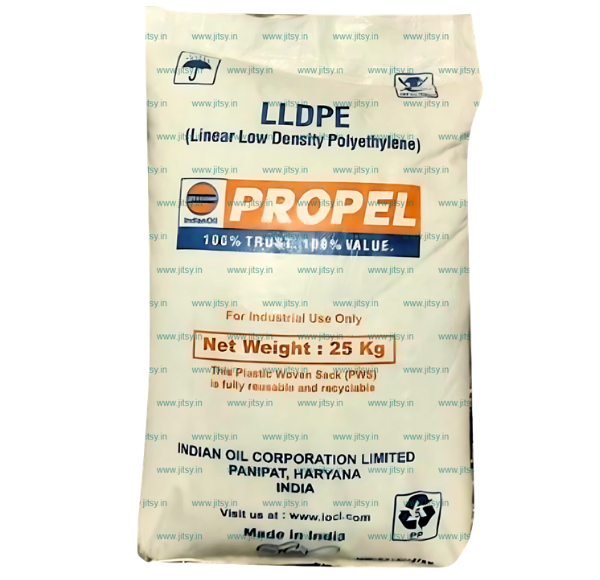
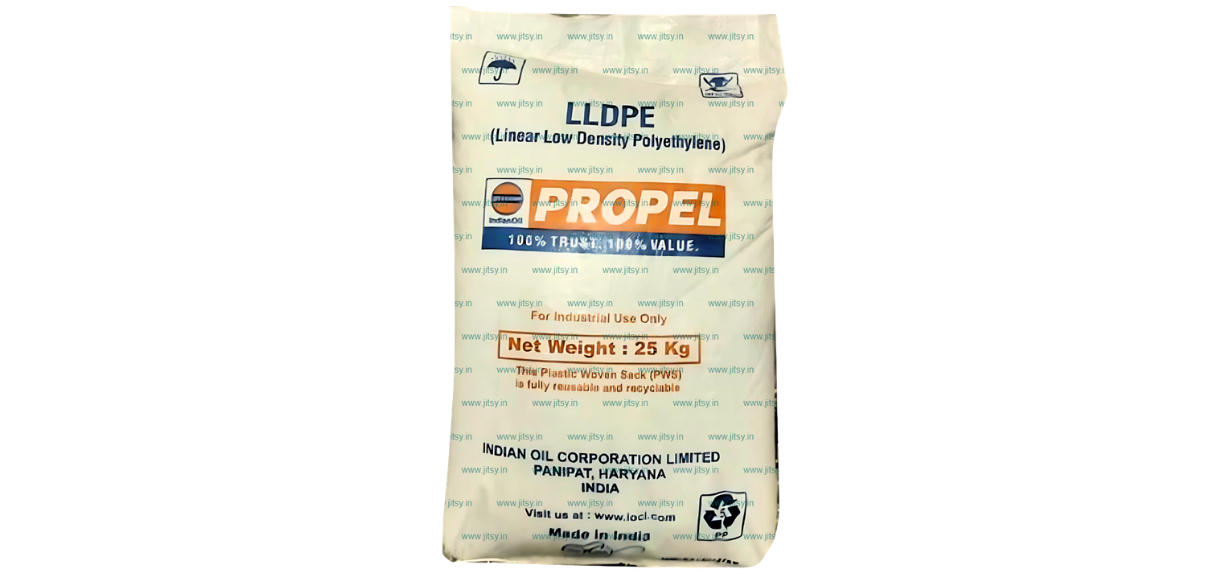
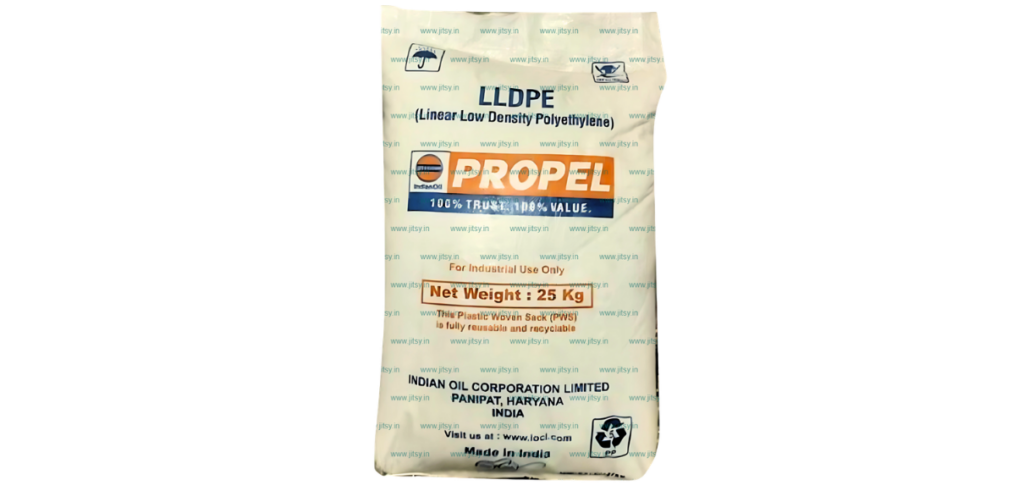
IOCL Propel LLDPE 010L22S
IOCL Propel LLDPE 010L22S is a linear low-density polyethylene (LLDPE) grade made for drip lateral pipe. It is produced using Sclairtech solution polymerisation technology with butene as the comonomer. The grade has a melt flow index of 1.1 g/10 min and density of 0.922 g/cm³.
The grade meets the requirements of IS 12786:1989 when compounded with carbon black for PE-25 drip lateral pipe. Its ESCR exceeds 1000 hours — the highest stress crack resistance value in the IOCL Propel LLDPE range. This makes it suitable for agricultural pipe systems that are exposed to soil chemicals, fertilisers, and UV over extended service cycles.
The natural (unpigmented) granule must be dry-blended or melt-compounded with 2.5 ± 0.5% carbon black by mass, verified per IS 2530, before pipe extrusion. The compounded material delivers the UV resistance and PE-25 classification required for drip lateral pipe.
Technical Insights
- MFI 1.1 g/10 min (190°C/2.16 kg), ASTM D1238 — Low melt flow gives controlled extrusion. The pipe wall holds consistent thickness at standard line speeds.
- Density 0.922 g/cm³, ASTM D1505 — Low-density LLDPE range. Short-chain butene branches reduce crystallinity and create a flexible, tough pipe.
- ESCR >1000 h, ASTM D1693 (F50, 10% Igepal) — The highest ESCR value in the Propel LLDPE series. Resists stress cracking caused by fertiliser chemicals, herbicides, and soil contaminants in drip irrigation systems.
- Tensile Strength at Yield ~11–12 MPa, ASTM D638 — Adequate load resistance for buried lateral pipe without brittleness.
- Elongation at Break >600%, ASTM D638 — High elongation absorbs ground movement and installation stress without cracking.
- Flexural Modulus ~350–400 MPa, ASTM D790 — Lower stiffness than HDPE grades. The pipe is flexible enough to coil for transport and uncoil without kinking.
- Vicat Softening Point ~104–108°C, ASTM D1525 — Suitable for standard agricultural conditions. Not designed for hot-water pipe.
- Carbon black compounding required — 2.5 ± 0.5% by mass, IS 2530 — This step is mandatory for IS 12786:1989 PE-25 classification. The natural grade without carbon black does not qualify as PE-25.
- Sclairtech solution polymerisation — Narrow molecular weight distribution, clean and consistent melt behaviour, low gel content. Suited for thin-wall, small-diameter lateral pipe.
Applications
Drip Irrigation Lateral Pipe (IS 12786:1989, PE-25)
LLDPE 010L22S is primarily used for drip lateral pipe — the thin-wall small-diameter tube that runs through agricultural fields and delivers water to crop root zones. These pipes are buried in soil, exposed to fertilisers and herbicides, and often remain under pressure for months without interruption. The grade’s ESCR of more than 1000 hours means the pipe wall resists chemical-induced cracking over long field life. The low density (0.922 g/cm³) and high elongation (>600%) allow the pipe to flex with soil movement and survive coiling, uncoiling, and rough installation. Once compounded with 2.5 ± 0.5% carbon black per IS 2530, it qualifies as a PE-25 pipe material under IS 12786:1989 — the Indian standard governing drip lateral pipe.
Agricultural Micro-Irrigation Components
Beyond the lateral pipe itself, LLDPE 010L22S is used for associated micro-irrigation fittings — connectors, T-joints, end caps, and emitter bodies — where the same flexibility and ESCR performance are needed. Agricultural pipe systems operate across temperature cycles and soil chemistry variations. The material’s toughness and crack resistance make it a reliable base material for injection-moulded fittings that connect to PE-25 lateral pipe runs.
Film and Flexible Packaging (Natural Grade)
In its natural (uncompounded) form, LLDPE 010L22S can be used for flexible film — stretch wrap, agricultural mulch film, and general-purpose packaging film — where high elongation, puncture resistance, and good clarity in thin gauge are needed. The low MFI supports blown film processing with standard LLDPE equipment. Applications that need pigmentation or UV stabilisation can incorporate masterbatch at the extrusion stage.
Flexible Pipe and Tubing (Non-IS 12786 Applications)
Where IS 12786:1989 certification is not required, the grade serves as a flexible polyethylene pipe base for garden hose, micro-sprinkler connectors, and light-duty fluid transfer tubing. The combination of flexibility, ESCR, and consistent melt processing makes it a versatile base resin for small-diameter flexible pipe in irrigation and industrial fluid lines.
Comparable Alternatives
LLDPE 010L22S vs Comparable Drip Pipe Grades
LLDPE grades for PE-25 drip lateral pipe share similar targets: MFI near 1.0–1.2 g/10 min, density around 0.922 g/cm³, and ESCR above 500 hours. The grades below are the closest alternatives available in India.
Reliance JD22010 is the most direct match. MFI 1.1 g/10 min, density 0.922 g/cm³, ESCR >1000 h. The specifications are nearly identical to IOCL 010L22S across all key parameters. Both target PE-25 drip lateral pipe and require carbon black compounding for IS 12786:1989 compliance. The choice between them typically comes down to supply availability, supplier credit terms, and regional logistics.
Reliance LL20DS010 is a slightly higher MFI drip pipe grade (1.2 g/10 min) at similar density. The marginally higher flow rate may suit faster extrusion lines but can require die setting adjustments for dimensional control on thin-wall pipe.
GAIL D22S010 / D22S010A are GAIL’s PE-25 drip lateral grades. MFI approximately 1.0 g/10 min, density 0.922 g/cm³. Very close to 010L22S in processing behaviour. GAIL supply is typically strongest in central and western India.
HMEL D0120L is HMEL’s equivalent drip lateral grade with comparable MFI and density. Processing characteristics are similar. HMEL supply is concentrated in North India through Bathinda refinery output.
Haldia 71601D is an older Haldia Petrochemicals drip grade. It meets PE-25 requirements but is available primarily in eastern and southern India. Processing characteristics are broadly similar.
Borouge LE2270 is a UAE-origin LLDPE import grade used in India for drip pipe applications. It may offer different comonomer chemistry and slightly different flexibility characteristics. Import pricing and availability vary with exchange rates and freight cycles.
For Indian buyers, IOCL 010L22S, Reliance JD22010, and GAIL D22S010A are the highest-supply domestic options. All require carbon black compounding before IS 12786:1989-compliant pipe extrusion.
Common Search Variants
Buyers search for this grade as Propel LLDPE 010L22S, IOCL 010L22S, LLDPE drip pipe grade India, PE-25 LLDPE IS 12786, and IOCL LLDPE for drip irrigation. Some procurement teams also search by polymer family — butene LLDPE 0.922 density or LLDPE MFI 1.1 drip grade.
Need Technical guidance?
Why buy IOCL Propel LLDPE 010L22S from JITSY?
- Direct import & verified sourcing
- Authorised channel–led supply
- Pan-India B2B delivery
- Transparent pricing & documentation
- Mobile app–enabled procurement
- Full compliance (RoHS, BIS/ISI, EPR, GST)
- Batch traceability
FAQs
Frequently Asked Questions
What is IOCL Propel LLDPE 010L22S used for?
What does PE-25 mean and how does this grade qualify?
Why must carbon black be added before pipe extrusion?
Why is LLDPE better than HDPE for drip lateral pipe?
What does ESCR >1000 h mean for field performance?
How does LLDPE 010L22S compare to Reliance JD22010?
Can LLDPE 010L22S be used for blown film without carbon black?
What Customers Say
You must be logged in to post a review.
Other Relevant Products Available in India
Related Articles
Complete Guide to EVA Materials: Grades, Applications & Selection Tips
Expandable microspheres are small hollow beads that have a thin shell made of plastic and contain a liquid core. The liquid vaporises, the bead expands and the shell expands
How EVA Improves Adhesion in Packaging and Assembly?
Expandable microspheres are small hollow beads that have a thin shell made of plastic and contain a liquid core. The liquid vaporises, the bead expands and the shell expands
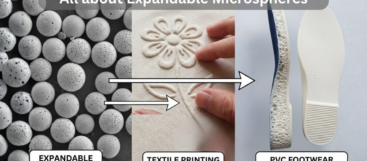
What Are Expandable Microspheres and How Are They Used in Textile Printing and PVC Footwear?
Expandable microspheres are small hollow beads that have a thin shell made of plastic and contain a liquid core. The liquid vaporises, the bead expands and the shell expands
How Small & Mid-Sized Manufacturers Can Compete Using Digital Procurement
Small and mid-sized manufacturers have never given up on competing. In the modern market, it is no longer sufficient to compete with the quality of the work and hard labour.
Why India Is Becoming a China+1 Option for Raw Material Sourcing
Businesses can no longer rely on a single nation. They currently diversify risk and seek partners who are stable. Meanwhile, the increased cost of labour in China.
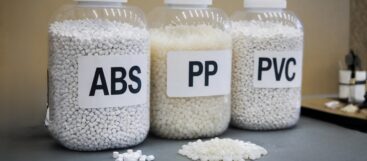
Choosing the Correct Polymer for Your Manufacturing Needs: ABS vs PP vs PVC
Confusion is common when manufacturers are considering ABS vs PP vs PVC. Different polymers are suitable for different applications, with specific pros and cons.
Top Procurement Mistakes Indian Manufacturers Make While Scaling
I have seen promising Indian manufacturers grow and then struggle during scaling. Often, success itself exposes operational cracks that were previously hidden.
Raw Materials Used in Toy Manufacturing: Safety, Compliance & Cost Factors
The materials used in toy manufacturing can impact the safety of children and the reputation of the company. There are multiple documented cases where improper material selection has led to recalls, litigation, and severe financial damage to toy manufacturers.

Choosing the Right Polymer Grades for Injection Molding
Purchasing the wrong polymer grade for injection molding can directly result in product failure, high rejection rates, or field performance issues. Different applications require vastly different material characteristics.

How Digital Procurement Platforms Reduce Raw Material Fraud
Raw material fraud is a frequent issue in conventional procurement. It usually happens due to the lack of supplier verification, the absence of records, and low levels of transparency. In manual systems, it is hard and time-consuming to keep track of materials.
How Crude Oil Prices Impact Plastic Raw Material Costs in India
Crude oil plays a powerful role in the worldwide plastic industry & India is no exception. Most of the plastic raw materials, like PE, PP, and PVC, are extracted from petrochemicals sourced from crude oil.

The Great Procurement Divide: Why Your Best Engineers Make Your Worst Buyers
Walk into any manufacturing facility across India—from PVC pipe makers in Gujarat to automotive component manufacturers in Chennai—and you’ll hear this logic echoed in boardrooms and production floors alike.
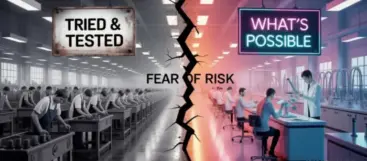
Copy-Paste vs. Innovation
Is playing it safe actually the riskiest strategy? The uncomfortable truth about innovation avoidance in Indian manufacturing
The Credit Cycle Shift: Why 30-Day Payments Are Winning Hearts (and Wallets)
If you’ve ever done business in India, you know this vibe. Long credit terms weren’t just about money—they were about trust, connection, and that warm cup of chai shared over a handshake deal. You’d walk into your supplier’s office, chat about life, and walk out with goods worth lakhs, no questions asked.

The Great Inventory Debate
When COVID hit, I think all of us felt something shift in how we think about supply chains. It wasn’t just disruption. It was exposure. What we thought was working… suddenly wasn’t. Containers stuck. Prices all over the place. Buyers unsure. And for many manufacturers—raw material just wasn’t there when it was needed.

The 0.1% That Destroys the 99.9%: Why Documentation in B2B Trade Isn’t Optional Anymore
this is how businesses have functioned. Fast, informal, and based on mutual trust. And in 99.9% of the cases, it works. Goods are delivered, payments are made, and relationships grow stronger.


Reviews
Clear filtersThere are no reviews yet.