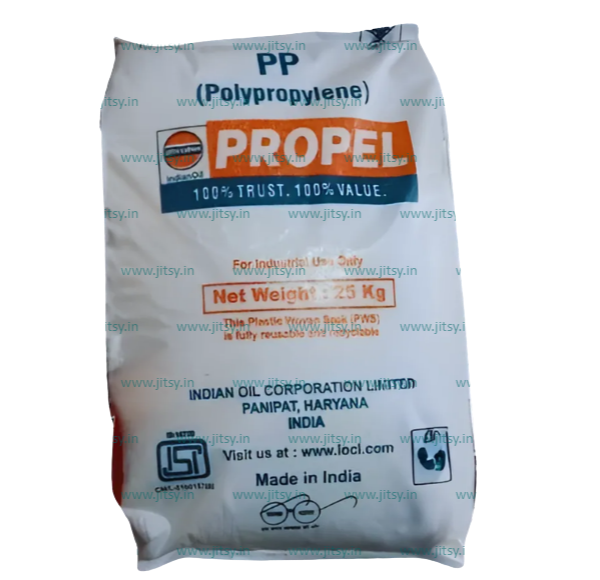
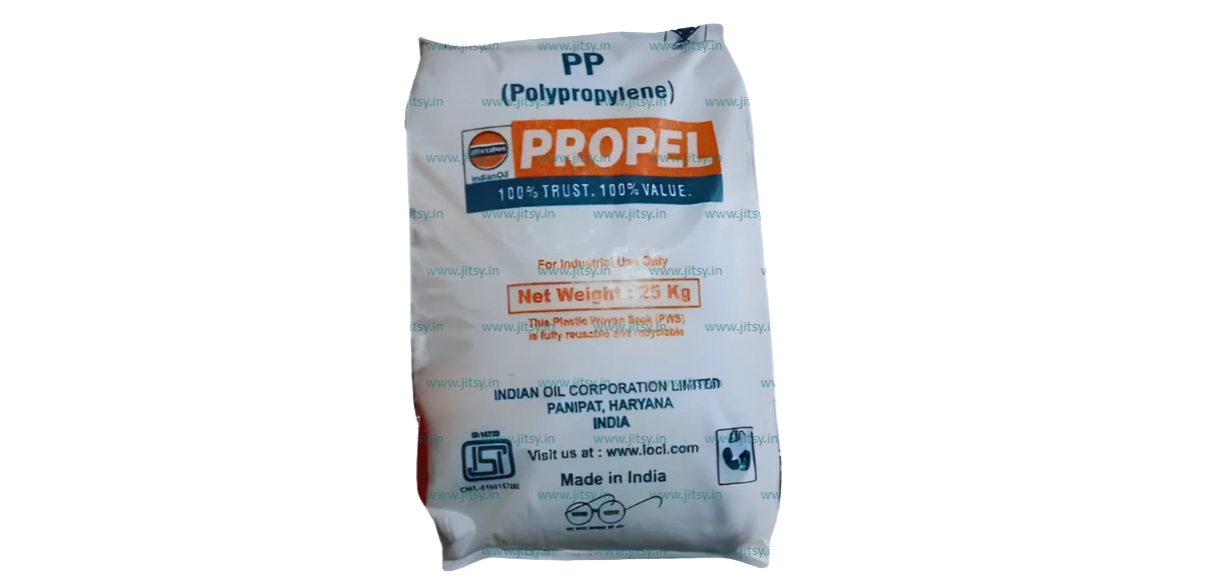
IOCL Propel PPCP 3550MN is a polypropylene impact copolymer (PPCP) manufactured by Indian Oil Corporation Ltd (IOCL) under its PROPEL polymer brand, produced at the Panipat Petrochemical Complex using Spheripol II Technology. IOCL classifies 3550MN as a heterophasic, natural-coloured, very high-flow, medium-impact-resistance grade that is also nucleated — a combination of characteristics that makes it one of the highest-performing injection moulding PP resins in IOCL’s impact copolymer portfolio.
At an MFI of 55 g/10 min (230 °C / 2.16 kg), 3550MN is among the highest-flow PP impact copolymer grades available from IOCL. This level of flow is not typical for standard impact copolymers, which usually operate in the 8–20 MFI range. The very high MFI of 3550MN is the defining processing attribute: it allows complete filling of thin-wall mould cavities at very fast injection speeds, and uniform filling of large, complex cavities with multiple long flow paths — both challenging scenarios for lower-flow PP grades. Nucleation adds a further processing advantage by promoting faster and more uniform crystallisation during the cooling phase, reducing cycle time and improving consistency of mechanical properties across a production run.
Nucleation refers to the addition of nucleating agents during polymerisation or compounding that create a larger number of smaller, more uniform crystal nuclei as the molten polymer solidifies. In a non-nucleated PP, crystallisation is slower and less uniform, leading to longer cycle times and potentially variable surface finish. A nucleated PP like 3550MN solidifies faster, with finer crystalline structure — which reduces cycle time, improves dimensional stability of the moulded part, and can contribute to surface quality and stiffness consistency. For injection moulders targeting high-volume thin-wall parts where every second of cycle time translates to productivity and unit cost, the nucleation of 3550MN is a direct commercial advantage.
IOCL positions 3550MN specifically with “excellent processability and a good balance of stiffness and impact properties” — positioning language that directly reflects the nucleated, heterophasic structure and the MFI 55 flow performance.
Technical Insights
Resin Properties
- MFI: 55 g/10 min (ASTM D1238, 230 °C / 2.16 kg) — The most important processing parameter for 3550MN and its clearest differentiator from other IOCL PP impact copolymer grades. At 55 g/10 min, this grade flows at more than double the rate of IOCL’s 3250MG (MFI 25) and significantly faster than typical general-purpose PP impact copolymers (usually MFI 8–20). This enables thin-wall injection moulding of parts with 0.5–1.5 mm wall sections at high production speeds, and reliable filling of large-area or long-flow-path moulds where lower-flow grades would show short shots, weld lines or significant pressure loss.
- Density: 0.90 g/cm³ (ASTM D1505, 23 °C) — Standard density for a polypropylene impact copolymer, reflecting the PP matrix with dispersed elastomeric phase. At 0.90 g/cm³, 3550MN is lighter than polyethylene and most engineering polymers, which contributes to weight-efficient thin-wall parts in appliances and automotive components.
Mechanical Properties
- Tensile Yield Strength: 24 MPa (ASTM D638, 50 mm/min) — Moderate tensile yield, slightly lower than 3250MG (26 MPa), reflecting the balance between the PP matrix and the impact-modifying rubber phase. At 24 MPa, moulded parts have adequate structural integrity for the appliance, houseware and automotive component applications IOCL targets with this grade — sufficient to resist normal service loads without permanent deformation.
- Elongation at Yield: 5% (ASTM D638, 50 mm/min) — Low elongation at yield, consistent with a stiff, high-modulus impact copolymer. This indicates that the material resists deformation at low strain levels — appropriate for rigid moulded parts where dimensional stability under mechanical load is required.
- Flexural Modulus: 1200 MPa (ASTM D790, 1.3 mm/min) — The same flexural modulus as 3250MG, confirming that 3550MN’s very high MFI comes without a penalty to part stiffness. At 1200 MPa, moulded thin-wall parts maintain structural rigidity — lids and panels resist flex, housings hold dimensional tolerances, and automotive compound substrates provide the load-bearing performance required for their application.
- Notched Izod Impact Strength: 65 J/m (ASTM D256, 23 °C) — Good impact resistance for an injection moulding PP copolymer, slightly below 3250MG’s 75 J/m. The modest reduction reflects the optimisation trade-off between very high flow and impact retention: at MFI 55, some reduction in the effective impact contribution from the dispersed rubber phase relative to lower-flow grades is expected. At 65 J/m, 3550MN still provides substantially better impact performance than PP homopolymers (typically 20–30 J/m) and adequate toughness for appliance housings, thin-wall containers and automotive interior components.
Thermal Properties
- Heat Deflection Temperature: 105 °C (ASTM D648, 0.46 N/mm²) — Slightly higher than 3250MG (100 °C HDT), reflecting the benefit of nucleation on the effective thermal rigidity of the crystallised part. At 105 °C, 3550MN moulded parts maintain shape and load-bearing capacity well above domestic use temperatures and up to the operating conditions of most appliance housings. This makes 3550MN suitable for components in proximity to heating elements, motors and compressors where sustained temperature exposure is part of the design requirement.
- Vicat Softening Point: 145 °C (ASTM D1525, 10 N) — Identical to 3250MG, confirming the same base PP matrix thermal stability. At 145 °C Vicat, the resin’s surface remains firm under needle load well above any practical service temperature for injection-moulded appliance parts, automotive interior trim and domestic products.
Processing Temperature Window and Nucleation Benefit
IOCL recommends a processing temperature of 170–230 °C for PPCP 3550MN on injection moulding equipment. For thin-wall parts at high injection speeds, melt temperatures towards 210–225 °C combined with high injection velocity are typical to ensure complete cavity fill before gate freeze. The nucleation of 3550MN accelerates solidification during the cooling phase, so mould cooling time can often be reduced relative to equivalent non-nucleated PP grades — a direct contribution to shorter cycle times and higher output rates. For automotive compound applications, the processing window is consistent with standard PP compound compounding lines.
Applications of IOCL PPCP 3550MN
Thin-Wall Injection Moulded Containers and Lids
The most processing-demanding application for 3550MN is thin-wall injection moulding (TWIM) of containers, lids, trays and packaging components with wall thicknesses below 1.5 mm. At MFI 55, the resin flows at very high speed through thin gates and narrow wall sections without requiring extreme injection pressure or temperature, reducing the risk of mould damage, degradation and cycle-to-cycle inconsistency. The nucleation of 3550MN supports fast cooling and part ejection, which is critical in high-cavitation thin-wall moulds running at outputs of hundreds of thousands of parts per day. Despite the very high flow, the 1200 MPa flexural modulus ensures that thin-wall parts retain sufficient wall rigidity for stacking, filling and transport without buckling or collapse.
Appliance Parts and Housings
IOCL explicitly recommends 3550MN for appliance parts — a category that includes injection-moulded housings, covers, panels, brackets and internal structural components for domestic and commercial appliances. Appliance parts in this segment have specific requirements: they must be produced at high volumes with short cycle times and consistent dimensional tolerances, they must withstand the thermal environment near motors, heating elements or compressors (where the 105 °C HDT of 3550MN provides a practical safety margin), and they must present a consistent surface quality across a production run. The nucleation of 3550MN directly addresses cycle time and surface consistency requirements; the 65 J/m impact resistance handles the mechanical stresses of assembly and service; the 145 °C Vicat ensures no surface softening under the thermal conditions present in most appliance designs.
Large Injection Moulded Products
Beyond thin-wall parts, 3550MN’s very high flow suits the opposite end of the injection moulding scale — large, heavy-section moulded articles such as trays, bins, panels, pallets and structural housing components where the mould volume is large and the melt must travel long distances from the gate to the extremities of the cavity. Lower-flow PP grades often show pressure drop issues in large-part moulds, requiring higher barrel temperatures or injection pressures that increase energy cost and degradation risk. At MFI 55, 3550MN fills large cavities more readily at standard conditions, supporting consistent packing, reduced sink marks and uniform mechanical properties across the full moulded cross-section.
Automotive Compounds and Interior Components
IOCL lists automotive compounds among the recommended applications for 3550MN. In this role, the grade serves as a base resin in PP compound formulations for automotive interior trim, door panels, instrument clusters, pillar covers and other injection-moulded structural or semi-structural automotive components. The very high MFI of 55 g/10 min facilitates dispersion of fillers, glass fibre, talc and other reinforcing or functional additives during compounding, and ensures that the finished compound retains adequate flow for complex automotive part moulds at standard cycle times. The base PP matrix’s thermal performance (105 °C HDT, 145 °C Vicat) supports the elevated temperature requirements of automotive interior components, which can reach 80–100 °C surface temperatures in parked vehicles under direct sun in Indian summer conditions.
Comparable Alternative Grades for High-Flow PP Impact Copolymer Injection Moulding
3550MN is a specific grade within a narrower sub-segment of the PP impact copolymer market: very high-flow, nucleated grades designed for thin-wall and high-speed injection moulding. Understanding how it relates to adjacent grades helps processors make the right selection for their specific mould geometry, part design and output requirements.
IOCL Propel PPCP 3250MN is a lower-flow PP impact copolymer grade from IOCL’s same PROPEL PPCP range. Grade code logic and available references indicate 3250MN operates at a lower MFI than 3550MN, positioning it for standard injection moulding of medium-complexity parts where very high flow is not required. For thin-wall or high-cavitation moulds where 3550MN’s MFI 55 is the key selection driver, 3250MN would require higher injection pressure or temperature to achieve equivalent cavity fill, which changes cycle time and process window. The two grades are not direct equivalents. Processors considering 3250MN as an alternative to 3550MN (or vice versa) should evaluate the fill behaviour of their specific mould at both grade’s flow characteristics before committing to a change.
IOCL Propel PPCP 3650MN appears in IOCL’s PP grade documentation alongside 3550MN. The grade code structure suggests 3650MN may be a companion grade at a different (likely higher) flow level within the same nucleated impact copolymer family. Without a directly accessible TDS for 3650MN providing full property data, a numerical comparison cannot be made with confidence. Processors who find 3550MN’s MFI 55 slightly below their thin-wall filling requirement should investigate 3650MN as a potentially higher-flow alternative within the same product family, subject to IOCL’s own grade documentation and processing trials. Equivalence is not confirmed.
IOCL Propel PPCP 5080MG is an IOCL super-impact copolymer grade — a different class of heterophasic PP with a much larger and more compliant rubber phase than 3550MN, delivering very high impact toughness at a significant cost to stiffness and thermal performance. 5080MG is not a substitute for 3550MN in thin-wall or high-flow applications; it is designed for applications where impact dominates the design requirement over stiffness and flow — thick-walled automotive bumpers, crates and industrial containers. The two grades target fundamentally different design requirements and are not interchangeable.
IOCL Propel PPCP 3250MG is the extrusion coating-oriented PPCP grade reviewed separately in this series (MFI 25, HDT 100 °C, notched Izod 75 J/m). It is tuned for surface bonding and coating line performance rather than high-speed thin-wall injection. Despite sharing similar density and modulus values with 3550MN, the very different MFI (25 vs 55) and application positioning make the two grades non-interchangeable for their respective primary uses.
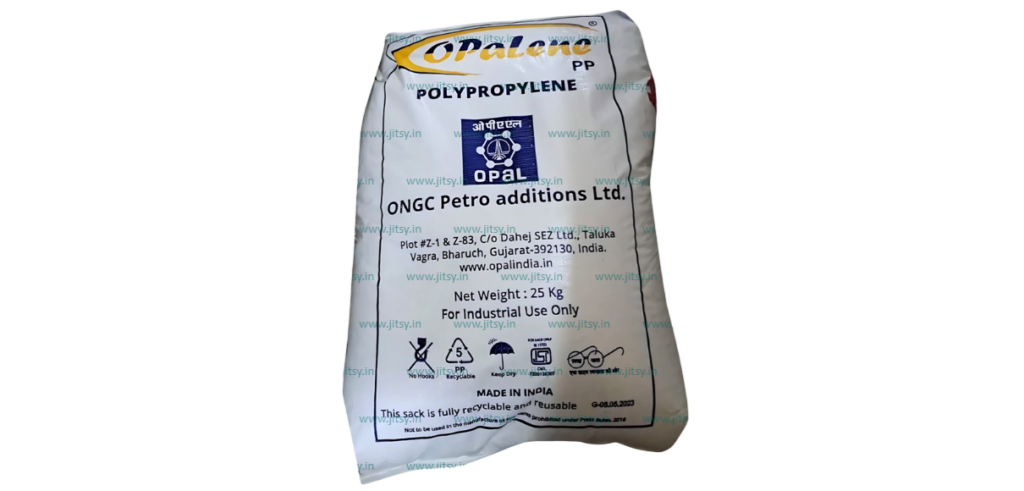
PP impact copolymer grades from other Indian producers — OPaL, Reliance Industries and GAIL produce high-flow PP copolymer grades for thin-wall injection and automotive applications. A grade from any of these producers with MFI in the 50–60 g/10 min range and nucleated designation would occupy a similar processing and application space to 3550MN. No other producer has confirmed a specific grade as equivalent to IOCL 3550MN; individual TDS comparison and processing trials are required before substitution.
Regulatory Compliance and Food Contact Information
IOCL’s product technical datasheet for PPCP 3550MN confirms compliance with the relevant Indian and international standards for polypropylene copolymer materials.
For food and pharmaceutical contact applications in India, polypropylene copolymers are governed by IS 10910 (Specification for Polypropylene Copolymers for Use in Manufacture of Utensils and Articles Intended to Come into Contact with Foodstuff, Pharmaceuticals and Drinking Water). 3550MN’s regulatory section confirms compliance with this standard. IS 10909, which covers PP homopolymers for the same food-contact purpose, is the equivalent standard for homopolymer grades.
The grade and its incorporated additives comply with FDA CFR Title 21, Section 177.1520 (Olefin Polymers), the US FDA regulation for olefin-based polymers in food-contact articles. For injection-moulded food containers, lids or houseware articles produced from 3550MN, processors should confirm that their processing conditions, any colorants or additional additives, and the intended end-use conditions all comply with the applicable IS 10910 and FDA 177.1520 requirements.
Alternative Names, Common Search Variants and Grade Misspellings
IOCL Propel PPCP 3550MN is also commonly searched and referenced as: PROPEL PP 3550MN, IOCL 3550MN PP granules, PP impact copolymer 3550MN, PP CP 3550MN, PPCP 3550MN IOCL, PP-CP 3550MN Propel, IOCL nucleated PP impact copolymer 3550MN, and high-flow PP 3550MN injection moulding grade.
Frequent misspellings and alternate spellings include: 3550 MN, 3550-MN, 3550mg iocl, 3550mN propel, PPCP 3550 MN, and PP copolymer IOCL 3550MN.



















Reviews
Clear filtersThere are no reviews yet.