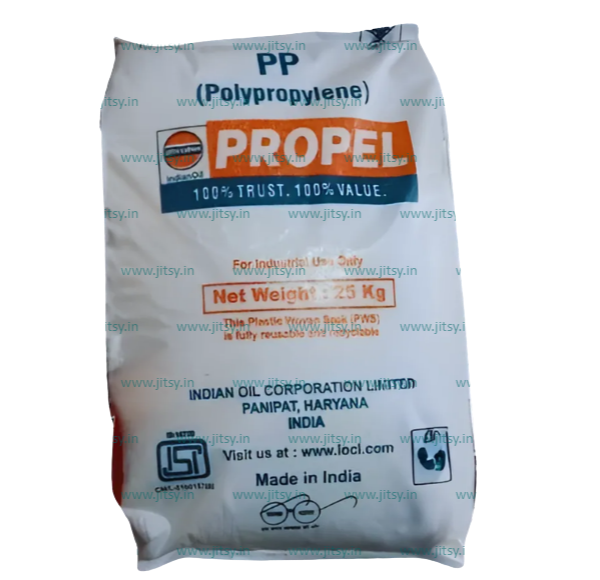
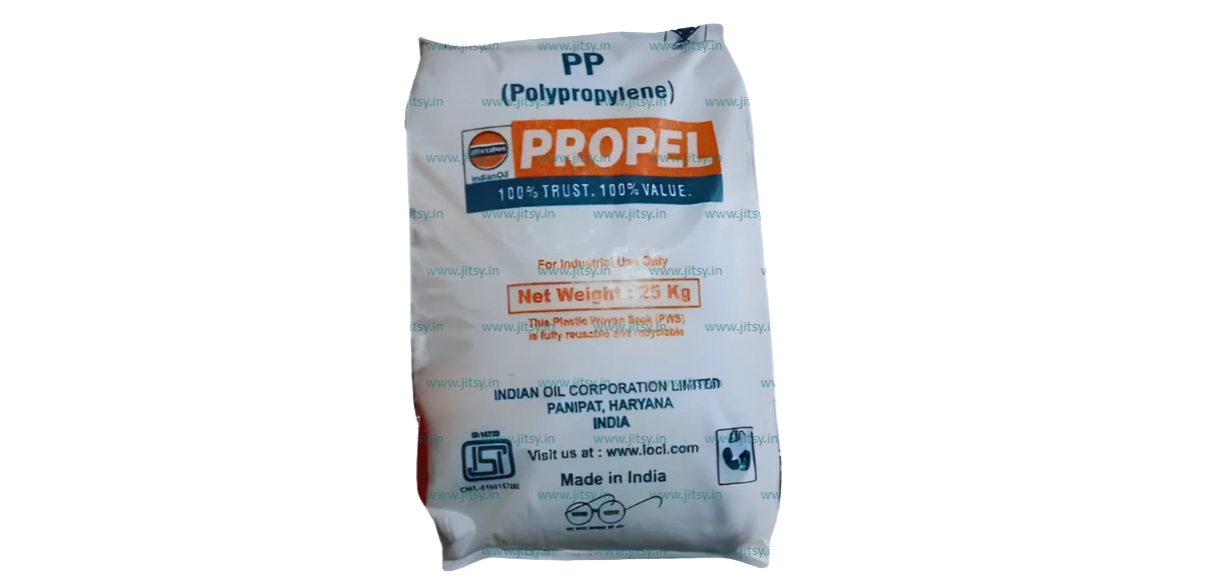
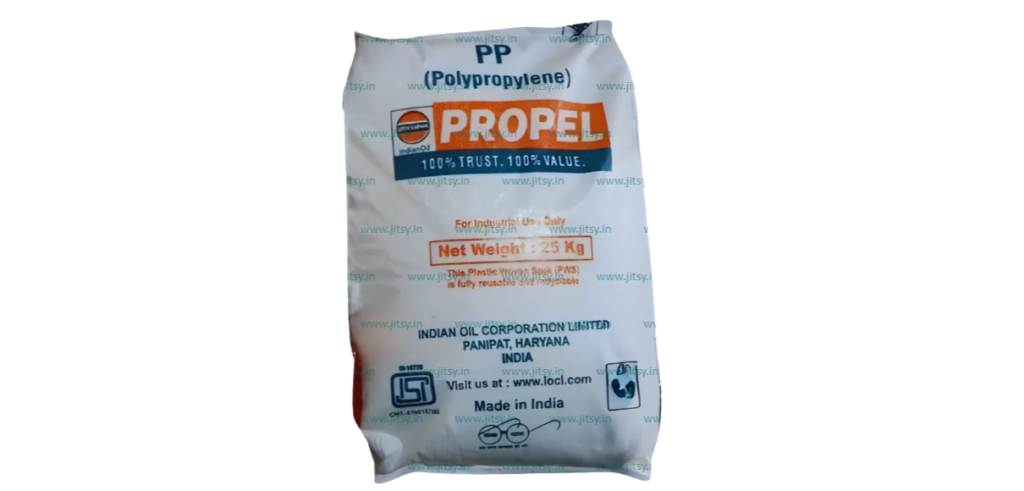
IOCL PPCP Propel 4015EG is a polypropylene impact copolymer (PPCP) manufactured by Indian Oil Corporation Ltd (IOCL) under its PROPEL polymer brand, produced using Spheripol II Technology. IOCL positions 4015EG as a high-impact-resistance, nucleated, heterophasic grade with medium flow for easy processing — a property combination that places it in a fundamentally different segment from IOCL’s high-flow injection moulding PP grades. Where grades like 3550MN (MFI 55) and 3250MG (MFI 25) are designed for fast injection moulding at high shear, 4015EG is designed for the lower-shear, higher-viscosity processing conditions of blow moulding and sheet extrusion.
At an MFI of 1.6 g/10 min (230 °C / 2.16 kg), 4015EG is a low-flow grade by PP standards. This is intentional and necessary. In blow moulding, the molten polymer must form a stable, uniform parison (or preform in injection stretch blow moulding) that holds its shape under gravity between extrusion and inflation — a task that requires adequate melt strength and viscosity rather than fast flow. In sheet extrusion, the melt must exit the flat die and solidify into a dimensionally stable sheet without excessive sag, sagging being the primary quality failure of low-viscosity resins on sheet lines. The 1.6 MFI of 4015EG provides the melt strength needed for both of these processes.
The notched Izod impact strength of 200 J/m at 23 °C is the defining mechanical attribute of this grade. This is exceptionally high for a PP copolymer — approximately three times the impact toughness of IOCL’s injection moulding PPCP grades (3250MG and 3550MN at 75 J/m and 65 J/m respectively) and far above any PP homopolymer or random copolymer. The large dispersed rubber phase responsible for this toughness is built into the polymer architecture during Spheripol II reactor polymerisation, not blended in post-reactor — delivering uniform distribution of the impact modifier throughout the resin.
Why 4015EG Is Specified for Blow Moulding and Sheet Extrusion
The combination of low MFI and very high impact toughness in 4015EG directly reflects the design requirements of blow moulding and sheet extrusion applications. Blow-moulded PP bottles, automotive ducts and hollow components must survive drop impacts and mechanical loads in service. Extruded PP sheets destined for thermoforming must withstand the forming forces applied during vacuum or pressure thermoforming without cracking at tool contact points. Thermoformed automotive parts, industrial trays and large containers must resist impact across their service life. The 200 J/m notched Izod of 4015EG ensures that moulded and formed articles from this resin are tough enough for these demanding end uses.
Technical Insights
Resin Properties
- MFI: 1.6 g/10 min (ASTM D1238, 230 °C / 2.16 kg) — Low by PP standards, and deliberately so. Blow moulding and sheet extrusion require a higher-viscosity melt than injection moulding. In extrusion blow moulding, the parison extruded from the die head must remain dimensionally stable for long enough to be enclosed by the mould and inflated — a low-viscosity (high-MFI) melt would sag, thin out and produce uneven wall distribution. In sheet extrusion, a low-viscosity melt would sag between the die and the calendar rolls, creating thickness variation. At 1.6 MFI, 4015EG provides the melt strength needed for parison stability and sheet gauge consistency.
- Density: 0.90 g/cm³ (ASTM D1505, 23 °C) — Standard for a PP impact copolymer. At 0.90 g/cm³, 4015EG produces light-weight moulded and sheet articles consistent with PP’s advantage over heavier engineering polymers and polyolefins.
Mechanical Properties
- Tensile Yield Strength: 27 MPa (ASTM D638, 50 mm/min) — Adequate tensile resistance for blow-moulded containers and thermoformed parts that must hold shape under the loads of filling, stacking and handling. At 27 MPa, 4015EG sits between rigid PP homopolymers and more compliant rubber-toughened grades, providing practical structural performance for its target applications.
- Elongation at Yield: 13% (ASTM D638, 50 mm/min) — Higher yield elongation than IOCL’s injection moulding PPCP grades (5–6%), reflecting the more compliant character of 4015EG’s large-rubber-phase heterophasic structure. Higher elongation at yield contributes to the material’s ability to deform substantially before yielding permanently — relevant to thermoforming, where the sheet must stretch and draw without early cracking at forming tool contact points.
- Flexural Modulus: 1150 MPa (ASTM D790, 1.3 mm/min) — Slightly lower than IOCL’s injection moulding PPCP grades (1200 MPa for 3250MG and 3550MN), reflecting the trade-off between impact toughness and stiffness inherent in high-impact heterophasic PP grades. At 1150 MPa, 4015EG maintains adequate wall rigidity for blow-moulded bottles, automotive components and thermoformed trays, while the large rubber phase delivers the toughness that defines this grade.
- Notched Izod Impact Strength: 200 J/m (ASTM D256, 23 °C) — Exceptional toughness. A notched Izod of 200 J/m is more than double that of most PP impact copolymers used for injection moulding (typically 65–100 J/m). This level of impact resistance positions 4015EG clearly as a high-impact grade rather than a medium-impact grade — suitable for applications where the moulded or thermoformed part must survive repeated mechanical impacts, drop loads, or assembly stresses without fracturing. For automotive ducts and panels that must pass drop-test specifications, and for PP blow-moulded containers that must withstand cold-chain and distribution handling, this toughness is the primary selection driver.
Thermal Properties
- Heat Deflection Temperature: 85 °C (ASTM D648, 0.46 N/mm²) — Lower than IOCL’s higher-crystallinity injection moulding PPCP grades (100–105 °C HDT), which is the expected consequence of the large rubber phase reducing effective matrix crystallinity. At 85 °C HDT, 4015EG moulded and thermoformed articles maintain shape under load up to temperatures consistent with outdoor storage, hot-fill packaging and automotive interior ambient conditions. Applications requiring sustained structural performance above 85 °C under load should be evaluated with this figure in view.
- Vicat Softening Point: 150 °C (ASTM D1525, 10 N) — The highest Vicat among IOCL’s PPCP grades documented in this series, confirming that the PP matrix component of 4015EG is well-crystallised with a high softening resistance despite the large rubber phase. At 150 °C Vicat, the resin surface remains firm under needle load well above any practical service temperature for blow-moulded bottles, automotive components and thermoformed industrial parts.
Processing Guidance
4015EG is designed for extrusion blow moulding and sheet extrusion — both continuous-extrusion processes rather than cyclic injection processes. IOCL’s full processing temperature recommendations for 4015EG were not fully accessible in public sources reviewed for this page; processors should refer directly to IOCL’s product technical datasheet for the specific barrel, die and melt temperature settings recommended for this grade on blow moulding and sheet extrusion lines. For general reference, PP impact copolymers at this MFI level are typically processed in the 190–240 °C melt temperature range on blow moulding equipment, but this is industry context rather than a confirmed IOCL recommendation for 4015EG specifically.
Applications of IOCL PPCP Propel 4015EG
Extrusion Blow Moulding – PP Bottles, Containers and Hollow Parts
Extrusion blow moulding of polypropylene requires a resin with sufficient melt viscosity to form a dimensionally stable parison and enough impact toughness in the finished part to survive filling, capping, labelling, distribution and consumer use. IOCL PPCP Propel 4015EG is specifically recommended for blow moulding applications, and its property profile — MFI 1.6 g/10 min for parison stability and 200 J/m notched Izod for part toughness — directly addresses both requirements. Blow-moulded PP bottles produced from 4015EG are used for packaging food products, household chemicals, personal care items and industrial fluids where PP’s chemical resistance, light weight and rigid structure are commercially preferred. For cold-chain or distribution-intensive applications where bottles must survive drop and impact loads, the high toughness of 4015EG provides a meaningful safety margin over lower-impact PP grades.
Sheet Extrusion and Thermoforming
PP sheet extrusion followed by thermoforming is used to produce trays, tubs, lids, industrial containers, automotive interior parts and large structural components. In this two-stage process, 4015EG granules are first extruded through a flat sheet die and solidified into uniform sheets, which are then reheated and formed into three-dimensional shapes using vacuum, pressure or matched-die thermoforming tools. The low MFI of 1.6 g/10 min ensures the extruded sheet has adequate melt strength to maintain gauge uniformity across the full sheet width, while the 13% elongation at yield and 200 J/m impact toughness allow the sheet to stretch and draw into deep thermoformed geometries without premature cracking at tool radii or corners. Thermoformed 4015EG parts in automotive and industrial applications benefit from the same toughness that makes the grade valuable for blow-moulded containers — resistance to crack propagation under mechanical load in service.
Automotive Components – Ducts, Panels and Structural Parts
IOCL lists automotive components among the recommended applications for 4015EG. In automotive manufacturing, PP impact copolymers are widely used for injection-moulded and blow-moulded interior trim, underbody ducts, air ducting systems, door skins and boot liners where toughness, light weight and chemical resistance are required. The 200 J/m notched Izod of 4015EG is directly relevant to automotive specifications that require moulded parts to survive defined drop or pendulum impact tests at ambient and sub-ambient temperatures. For blow-moulded automotive ducts and hollow structural components where extrusion blow moulding is the preferred process, 4015EG’s combination of low MFI and high impact makes it a technically appropriate base resin. For thermoformed automotive interior panels and protective covers, the sheet extrusion and forming capability of the grade enables large-format parts production that would not be practical by injection moulding.
Comparable Alternative Grades for High-Impact PP Blow Moulding and Sheet Extrusion in India
4015EG occupies a specific and relatively specialised position in IOCL’s PP portfolio: a low-MFI, high-impact PPCP grade designed for blow moulding and sheet extrusion. Most of IOCL’s PPCP grades documented in publicly accessible sources are injection moulding grades with MFI in the 10–55 g/10 min range — making direct numerical comparisons within the IOCL range informative for understanding what makes 4015EG distinctive.
IOCL PPCP Propel 3550MN and 3250MG are the injection moulding and extrusion coating-oriented PPCP grades reviewed earlier in this series. Their MFI values (55 and 25 g/10 min respectively) are fundamentally incompatible with blow moulding or sheet extrusion at commercial standards: the melt is too fluid to form a stable parison in blow moulding and would sag excessively in sheet extrusion. These grades are not alternatives to 4015EG for its intended applications and should not be evaluated as such.
IOCL PPCP Propel 4100MH is another IOCL impact copolymer grade with an MFI reported in the 11 g/10 min range. At 11 MFI, 4100MH would be better suited to injection moulding of larger or thicker-wall parts rather than to blow moulding or sheet extrusion, where 1.6 MFI is appropriate. Without a directly accessible TDS for 4100MH showing notched Izod impact values comparable to 4015EG, a full property comparison is not possible here. IOCL has not confirmed 4100MH as an equivalent to 4015EG; their different MFI profiles suggest different process and application targets.
IOCL PPCP Propel 3030MG is another IOCL impact copolymer listed in commercial sources for injection moulding applications. Its application positioning is for injection moulded parts rather than blow moulding or sheet, and its flow characteristics would be different from the 1.6 MFI required for 4015EG’s applications. It is not a substitute for 4015EG.
PP impact copolymer blow moulding grades from other Indian producers — OPaL, Reliance Industries and other domestic PP producers offer impact copolymer grades across a range of MFI values, including grades tuned for blow moulding and sheet extrusion. A PP impact copolymer from any producer with MFI in the 1–3 g/10 min range and high notched Izod impact (150 J/m or above) would occupy a similar processing space to 4015EG for blow moulding and thermoforming applications. No other producer has confirmed a specific grade as equivalent to IOCL 4015EG; TDS comparison and processing trials are required before substitution.
Regulatory Compliance and Food Contact Information
IOCL’s PPCP grades are produced with additive systems that meet relevant Indian and international standards for polypropylene contact with food and pharmaceuticals, and 4015EG is listed in the IOCL PROPEL range with similar compliance positioning to other grades in the portfolio.
For food-contact articles produced by blow moulding or thermoforming from polypropylene copolymers in India, IS 10910 (Specification for Polypropylene Copolymers for Use in Manufacture of Utensils and Articles Intended to Come into Contact with Foodstuff, Pharmaceuticals and Drinking Water) is the relevant standard. For blow-moulded PP bottles intended for food or beverage packaging, and for thermoformed food trays, compliance with IS 10910 is a material qualification requirement.
The grade is also positioned for compliance with FDA CFR Title 21, Section 177.1520 (Olefin Polymers), applicable to PP-based food-contact articles under US FDA regulations. Processors manufacturing food-contact articles from 4015EG should confirm compliance of their specific article — including any pigments, additives and processing aids — with IS 10910 and other applicable regulations. IOCL’s full regulatory statements for 4015EG should be verified against the official product technical datasheet.
Alternative Names, Common Search Variants and Grade Misspellings
IOCL PPCP Propel 4015EG is also commonly searched and referenced as: PROPEL PP 4015EG, IOCL 4015EG PP granules, PP impact copolymer 4015EG, PP CP 4015EG, PPCP 4015EG IOCL, IOCL high-impact PP blow moulding grade 4015EG, PP copolymer 4015EG for bottles and sheets, and Propel 4015EG thermoforming resin.
Frequent misspellings and alternate spellings include: 4015 EG, 4015-EG, 4015eg iocl, 4015mg propel, PPCP 4015 EG, PP copolymer IOCL 4015EG, and 4015eg pp blow molding.

















Reviews
Clear filtersThere are no reviews yet.