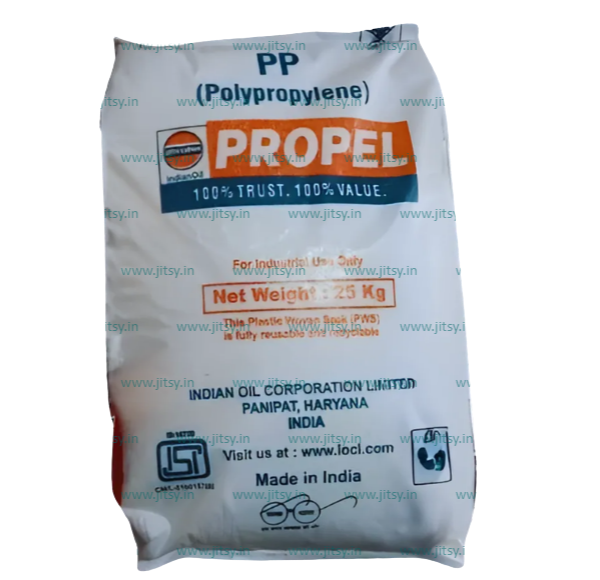
IOCL Propel PPCP 3250MG is a polypropylene impact copolymer (PPCP) manufactured by Indian Oil Corporation Ltd (IOCL) under its PROPEL polymer brand. It is produced at IOCL’s Panipat Petrochemical Complex using Spheripol II Technology — an advanced loop-reactor polymerization process that builds a heterophasic polymer structure in-reactor rather than through post-reactor blending. IOCL classifies 3250MG as a high-flow, medium-impact-resistance grade, positioning it with good processability, good gloss and surface finish, and good substrate bonding — the combination of attributes that defines an effective extrusion coating and lamination resin.
The term “heterophasic” describes the internal architecture of this polymer. Unlike a PP random copolymer where ethylene is distributed randomly along individual polymer chains, a heterophasic PP copolymer contains a dispersed elastomeric phase (ethylene-propylene rubber) embedded within a semi-crystalline polypropylene matrix — built as a single reactor product. This rubber phase is what delivers the improved impact resistance relative to PP homopolymer, while the PP matrix preserves stiffness, gloss and thermal stability. With an MFI of 25 g/10 min at 230 °C/2.16 kg, 3250MG flows readily at extrusion coating line speeds and in injection moulding cycles, making it a practical high-throughput resin for consumer-facing and industrial surface-critical applications.
IOCL Propel PPCP 3250MG is designed for extrusion coating, lamination, appliance parts, housewares, and compounding. The grade’s combination of high flow, good adhesion on substrates, and gloss performance suits applications where the PP coating or moulded surface must meet both mechanical and aesthetic requirements. For extrusion coating on raffia fabric, paper or other substrates, 3250MG’s substrate bonding characteristic is the key functional attribute. For injection-moulded appliance parts and housewares, the balance between its 1200 MPa flexural modulus, 75 J/m impact resistance and 145 °C Vicat softening point positions it as a structurally capable resin that holds shape well under domestic and light-industrial service conditions.
Technical Insights
Resin Properties
- MFI: 25 g/10 min (ASTM D1238, 230 °C / 2.16 kg) — A high MFI for a polypropylene impact copolymer. At 25 g/10 min, 3250MG flows efficiently through extrusion coating dies and injection mould cavities at normal processing temperatures, allowing high line speeds in coating applications and short cycle times in injection moulding. This elevated flow is a deliberate design attribute — it ensures the molten polymer wets the substrate surface thoroughly during extrusion coating, which is directly linked to the adhesion and substrate bonding performance IOCL highlights for this grade.
- Density: 0.90 g/cm³ (ASTM D1505, 23 °C) — Standard density for a polypropylene copolymer, reflecting the combination of the semi-crystalline PP matrix and the lower-density elastomeric dispersed phase. At 0.90 g/cm³, 3250MG is lighter than polyethylene-based coating resins, which is a practical advantage in packaging and lamination where part weight and material cost per unit area are factors.
Mechanical Properties
- Tensile Yield Strength: 26 MPa (ASTM D638, 50 mm/min) — A moderate tensile yield, lower than PP random copolymer grades (typically 30–35 MPa) and PP homopolymer (35–40 MPa), which is expected for an impact copolymer where the dispersed rubber phase moderates matrix stiffness and yield behaviour. For extrusion-coated substrates and injection-moulded housewares, a 26 MPa tensile yield provides adequate structural performance under normal handling, filling and service loads.
- Elongation at Yield: 6% (ASTM D638, 50 mm/min) — Controlled deformation before permanent yield, consistent with a moderately stiff PP copolymer. The elongation at yield is relevant to coated substrate applications, where the coating layer must deform with the substrate under flexing or tension without de-bonding prematurely.
- Flexural Modulus: 1200 MPa (ASTM D790, 1.0% secant, 1.3 mm/min) — The primary measure of part and coating stiffness. At 1200 MPa, 3250MG is stiffer than IOCL’s PP random copolymer 2300MC (1100 MPa), reflecting the higher crystallinity retained in the PP matrix of the heterophasic structure. For appliance housings, houseware containers and laminated structures, this modulus provides good dimensional stability and a solid, premium feel in the finished part.
- Notched Izod Impact Strength: 75 J/m (ASTM D256, 23 °C) — Meaningfully higher impact toughness than PP random copolymers (typically 40–60 J/m) and substantially higher than PP homopolymer (typically 20–30 J/m). The 75 J/m notched Izod confirms that the heterophasic rubber phase is working effectively — absorbing impact energy and reducing crack propagation under sharp-notch conditions. For appliance parts that must survive assembly stresses and product lifetime impacts, and for housewares subject to everyday drops and knocks, this impact performance provides a practical safety margin.
Thermal Properties
- Heat Deflection Temperature: 100 °C (ASTM D648, 0.46 N/mm²) — Notably higher than IOCL’s random copolymer 2300MC (80 °C HDT), reflecting the higher crystallinity of the PP matrix in 3250MG’s heterophasic structure. A 100 °C HDT means moulded parts and coated substrates maintain dimensional stability and shape well above normal domestic use temperatures — including hot-liquid contact, dishwasher exposure and light industrial applications up to 90–95 °C.
- Vicat Softening Point: 145 °C (ASTM D1525, 10 N) — A high Vicat for a PP copolymer grade, again reflecting the well-crystallised PP matrix. At 145 °C, 3250MG’s surface remains firm under needle load well above any practical service temperature for houseware, appliance or laminated packaging applications, confirming good thermal robustness of the resin.
Processing Temperature Window
IOCL recommends a processing temperature of 170–230 °C for PPCP 3250MG, applicable to both extrusion coating lines and injection moulding. At the lower end (170–190 °C), the resin is appropriate for slower-speed injection moulding of thicker sections. For extrusion coating at commercial line speeds, melt temperatures towards 200–225 °C typically provide the best balance of flow, adhesion and surface quality. Exceeding 230 °C risks thermal degradation, colour change and potential gel formation; operating below 170 °C risks incomplete homogenisation and poor substrate wetting.
Applications of IOCL PPCP 3250MG
Extrusion Coating on HDPE Raffia Fabric and Paper
IOCL Propel PPCP 3250MG is designed for extrusion coating on substrates such as HDPE raffia fabric and paper. In this application, a thin layer of molten 3250MG is deposited onto the moving substrate via a flat die extrusion line, bonding to the surface on contact and cooling to form an integrated coated structure. The high MFI of 25 g/10 min allows the resin to spread uniformly at extrusion coating line speeds, while the good substrate bonding characteristic noted by IOCL ensures reliable adhesion between the PP coating layer and the substrate without the delamination risk that would occur with a grade not formulated for this application. For HDPE raffia, the coated structure is used in woven sacks, tarpaulins and FIBC liners where the PP coating adds printability, barrier properties and sealing capability. For paper, the PP extrusion coating layer creates heat-sealable, moisture-resistant food-service packaging and industrial wrapping materials.
Lamination and Composite Structures
3250MG is listed by IOCL among the recommended applications for lamination — processes where PP film or coatings are bonded to paper, film, foil or fabric substrates under heat and pressure to create multi-layer composite structures. The grade’s good gloss and surface finish properties ensure that PP laminate layers present a smooth, aesthetically consistent surface, which matters for printed retail packaging and consumer-facing laminated products. The combination of 1200 MPa stiffness and good bonding ensures the laminated structure maintains cohesion under the mechanical stresses of die-cutting, folding, filling and distribution.
Appliance Parts and Industrial Components
The elevated thermal performance of 3250MG — HDT 100 °C and Vicat 145 °C — makes it well-suited for injection-moulded housings, covers and structural components in domestic and light-commercial appliances. Appliance parts that sit near heat sources, are exposed to hot air, or contact warm liquids require materials that maintain dimensional stability beyond 60–80 °C. At 100 °C HDT, 3250MG is a practical choice for components such as appliance back panels, air vent housings, motor covers and utility parts where standard PP random copolymer grades (typically 75–85 °C HDT) may not provide sufficient thermal margin. The 75 J/m impact resistance additionally provides protection against mechanical stresses during assembly and product service.
Housewares and Consumer Containers
IOCL explicitly recommends 3250MG for housewares, and its property balance — good surface finish, 1200 MPa stiffness, 75 J/m impact, and elevated thermal resistance — suits a range of moulded household products including storage containers, utility boxes, trays, organisers and kitchen items where PP’s chemical resistance, cleanability and light weight are advantages. The good gloss and surface finish properties specified by IOCL mean 3250MG-based houseware products have an attractive surface appearance directly from the mould, reducing the need for secondary finishing operations. For applications requiring contact with food or beverages, regulatory compliance (see below) should be confirmed for the specific article and use conditions.
Compounding Base Resin
IOCL also lists compounding among the recommended uses for 3250MG. In this role, the grade serves as a PP impact copolymer base resin into which fillers, pigments, flame retardants, glass fibre or other functional additives are incorporated to produce PP compounds with tailored property profiles. The high MFI of the base resin facilitates mixing and dispersive compounding at commercial throughputs, and the heterophasic structure provides a starting impact toughness that can be further enhanced or balanced against filler loading through the compounding formulation.
Comparable Alternative Grades for PP Extrusion Coating and Impact Copolymer Applications
3250MG occupies a specific position in IOCL’s PP grade portfolio: a high-flow PPCP tuned for extrusion coating and surface-critical applications, with medium impact resistance and elevated thermal stability. Understanding how it relates to nearby grades helps processors select the most appropriate resin for their process and end-product requirements.
IOCL Propel PPCP 3250MN is another IOCL PP impact copolymer grade with a similar grade designation. Available sources indicate 3250MN is positioned primarily for injection moulding rather than extrusion coating. The “MN” suffix versus “MG” suffix in IOCL’s grade nomenclature may reflect different additive packages, flow characteristics or processing optimisation between the two grades. Without a directly accessible TDS for 3250MN in the same format, a full numerical comparison of MFI, tensile, impact and thermal values is not possible here. Processors evaluating 3250MN as an alternative to 3250MG for extrusion coating should verify MFI, neck-in behaviour and substrate bonding performance through processing trials. Equivalence is not confirmed by IOCL documentation.
IOCL Propel PPCP 3120MA is another impact copolymer grade in IOCL’s PROPEL PP range, listed in commercial sources for injection moulding applications. Its grade code suggests a different MFI and application tuning compared to 3250MG. For extrusion coating where high flow and specific substrate bonding are required, 3120MA’s processing suitability would need to be verified against its own TDS data. It is not confirmed by IOCL as a direct substitute for 3250MG.
IOCL Propel PPRCP 2300MC is IOCL’s PP random copolymer grade (reviewed separately), with MFI 30 g/10 min, flexural modulus 1100 MPa, and Vicat 125 °C. Compared to 3250MG: 2300MC has a slightly higher MFI but lower thermal performance (HDT 80 °C vs 100 °C, Vicat 125 °C vs 145 °C) and lower impact resistance (50 J/m vs 75 J/m). Random copolymer 2300MC is the better grade for applications requiring transparency and organoleptic performance (e.g., food containers and ISBM bottles). 3250MG is the better grade for applications requiring higher thermal performance, better impact toughness, and good substrate bonding in extrusion coating — where the slight opacity of the heterophasic structure is not a commercial limitation.
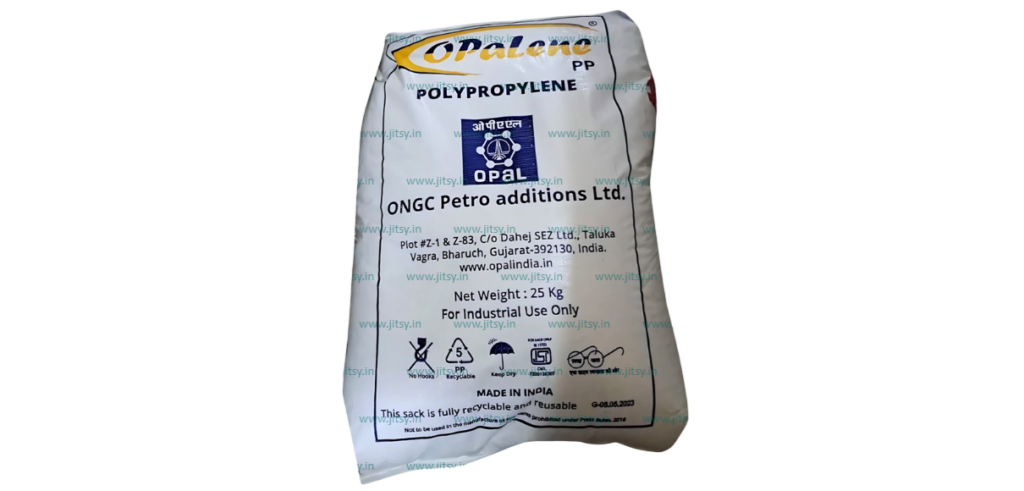
PP impact copolymer extrusion coating grades from other Indian producers — OPaL, Reliance Industries and GAIL produce PP copolymer grades for extrusion coating and lamination applications. A PP impact copolymer grade from any of these producers with MFI in the 20–30 g/10 min range would occupy a similar processing and application space to 3250MG. No producer has published documentation confirming a specific alternative grade as equivalent to IOCL 3250MG; each candidate grade’s TDS should be compared at the property level, and processing trials should be conducted before substitution in a qualified production line.
Regulatory Compliance and Food Contact Information
IOCL’s product technical datasheet for PPCP 3250MG confirms the grade’s compliance with relevant Indian and international standards for PP-based materials intended for food and pharmaceutical contact applications.
For contact with foodstuffs, pharmaceuticals and drinking water in India, polypropylene copolymer materials are governed by IS 10910 (Specification for Polypropylene Copolymers for Use in Manufacture of Utensils and Articles Intended to Come into Contact with Foodstuff, Pharmaceuticals and Drinking Water). 3250MG’s datasheet confirms compliance with this standard, establishing its suitability as a material for producing food-contact articles when processed and used within the conditions specified by the standard.
The grade and its incorporated additives also comply with FDA CFR Title 21, Section 177.1520 (Olefin Polymers), the US FDA regulation governing olefin-based polymers in food-contact articles, including polypropylene homopolymers and copolymers.
For final regulatory qualification of specific food-contact articles produced from 3250MG, processors and brand owners are responsible for confirming compliance of the finished article — including processing conditions, pigments, additives, and intended use conditions — with the requirements of IS 10910 and any other applicable regulations.
Alternative Names, Common Search Variants and Grade Misspellings
IOCL Propel PPCP 3250MG is also commonly searched and referenced as: PROPEL PP 3250MG, IOCL 3250MG extrusion coating granules, PP CP 3250MG, PP impact copolymer 3250MG, IOCL PPCP 3250MG, PP copolymer 3250MG IOCL, PP-CP extrusion coating IOCL 3250MG, and Propel 3250MG polypropylene granules.
Frequent misspellings and alternate spellings include: 3250 MG, 3250-MG, 3250mg iocl, PPCP 3250mg propel, PP copolymer IOCL 3250 MG, and 3250Mg IOCL extrusion.


















Reviews
Clear filtersThere are no reviews yet.