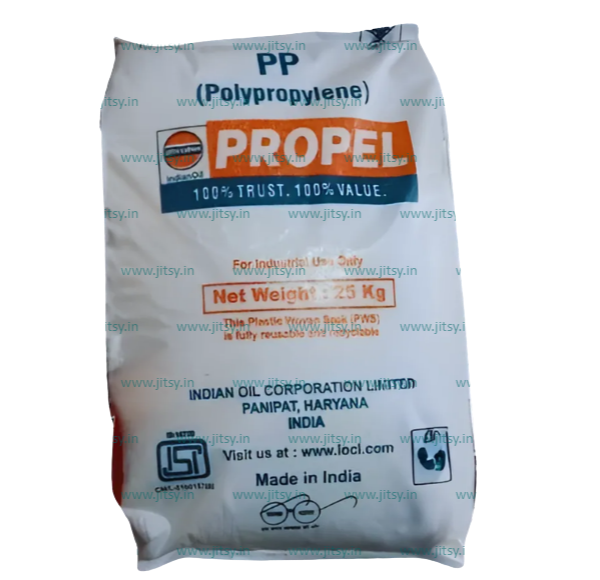
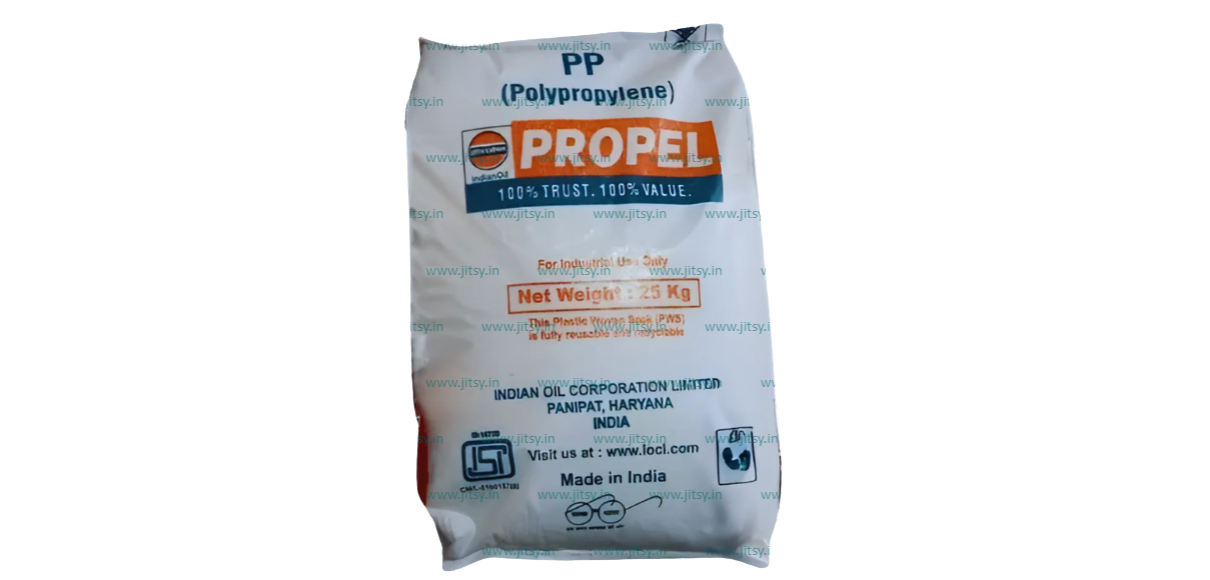
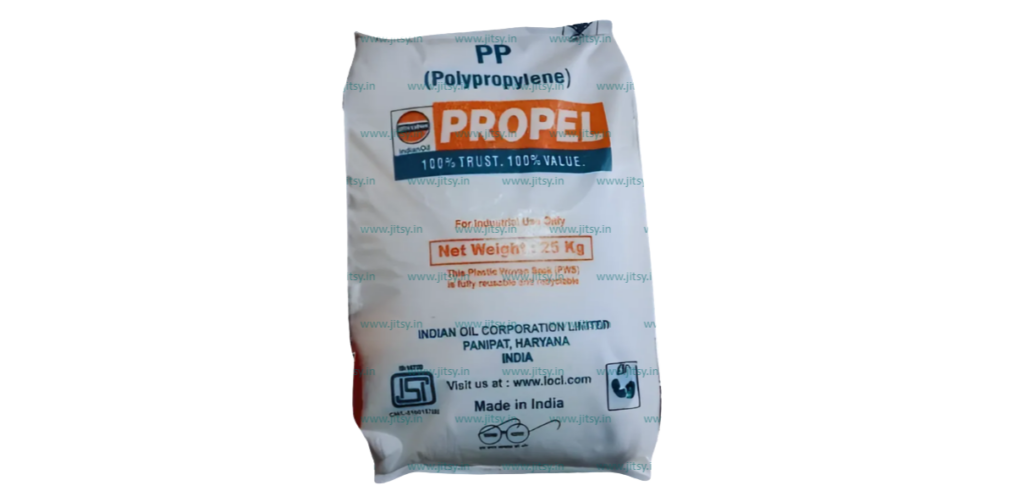
IOCL Propel PPRCP 2300MC is a polypropylene random copolymer (PPRCP) manufactured by Indian Oil Corporation Ltd (IOCL) under its PROPEL polymer brand. It is produced using Spheripol II Technology — a leading reactor polymerization process that incorporates the comonomer (typically ethylene) directly into the polypropylene chain in a random distribution during polymerization, rather than as a post-reaction blend. This reactor-grade approach gives 2300MC its defining characteristics: exceptionally good transparency, gloss, a well-balanced combination of stiffness and impact properties, and excellent organoleptic performance — meaning the resin imparts minimal taste, odour or extractable contamination to food or beverage contents in finished containers.
With a melt flow index of 30 g/10 min at 230 °C/2.16 kg, 2300MC is a high-flow PP random copolymer grade, designed for fast, efficient injection moulding of thin-wall parts and for injection stretch blow moulding (ISBM) of transparent bottles and containers. IOCL describes the grade in its PROPEL product line as a natural-coloured resin in prime/virgin quality, positioned specifically for houseware and consumer packaging applications where visual clarity and clean organoleptic performance are commercial requirements.
A polypropylene random copolymer is different from a PP homopolymer in a way that directly affects the properties relevant to transparent containers. In a homopolymer, propylene units pack into a highly ordered (isotactic) crystalline structure, which makes it stiff and strong but also opaque or hazy. In a random copolymer like 2300MC, a small amount of ethylene comonomer is distributed randomly along the PP chain. This disrupts regular crystallisation, producing smaller and more numerous crystallites — which scatter less light and give the resin its transparency and improved gloss. The random copolymer structure also softens the material slightly compared to homopolymer (lower melting point, better impact at lower temperatures), making it a more rounded material for everyday consumer product applications.
Technical Insights – Properties and What They Mean for Performance
Resin Properties
- MFI: 30 g/10 min (ASTM D1238, 230 °C / 2.16 kg) — A high melt flow index for a polypropylene grade. At 30 g/10 min, 2300MC flows rapidly through injection moulds, filling thin-wall sections completely and cleanly at high production speeds. This is the critical processing attribute for thin-wall injection moulded (TWIM) containers, where wall thicknesses of 0.5–1.5 mm must be filled reliably at short cycle times. High MFI also supports ISBM, where the preform must deform uniformly during blow moulding to produce consistent bottle wall thickness and optical clarity.
Mechanical Properties
- Tensile Yield Strength: 32 MPa (ASTM D638, 50 mm/min) — Good tensile performance at yield for a PP random copolymer. The lower tensile yield compared to PP homopolymer (typically 35–40 MPa) reflects the random copolymer’s slightly lower crystallinity, but 32 MPa is sufficient for rigid containers and housewares that must hold shape and resist deformation during filling, stacking and use.
- Elongation at Yield: 12% (ASTM D638, 50 mm/min) — Elongation at yield for a random copolymer is typically lower than for more flexible polyolefins. A 12% yield elongation indicates the material will deform in a controlled manner before yielding permanently — appropriate for rigid containers where some flex before permanent deformation is expected.
- Flexural Modulus: 1100 MPa (ASTM D790, 1.3 mm/min) — The primary measure of part stiffness. At 1100 MPa, 2300MC produces containers and housewares with good wall rigidity — the lids click shut positively, the container walls don’t flex under a firm grip, and the finished product has the premium feel associated with well-designed houseware products. This is lower than a PP homopolymer (typically 1400–1700 MPa), reflecting the softer random copolymer structure, but adequate for most rigid consumer container designs.
- Notched Izod Impact Strength: 50 J/m (ASTM D256, 23 °C) — Impact performance for a PP random copolymer at room temperature. At 50 J/m, 2300MC provides acceptable impact resistance for household containers, tubs and lids that may be dropped from handling height. This is significantly better than typical PP homopolymer at room temperature (often 20–30 J/m) — one of the practical advantages of the random copolymer structure. Applications requiring even higher impact performance, particularly at low temperatures, would be better served by a PP impact copolymer grade.
Thermal Properties
- Heat Deflection Temperature: 80 °C (ASTM D648, 0.46 N/mm²) — The temperature at which the material begins to deflect under load. An HDT of 80 °C means containers produced from 2300MC can withstand hot liquids and dishwasher lower rack temperatures without distorting. This is relevant for microwave-safe containers, hot-fill food packaging and kitchenware. However, for sustained high-temperature service above 80 °C, additional engineering assessment is needed.
- Vicat Softening Point: 125 °C (ASTM D1525, 10 N) — The point at which the surface begins to soften under needle pressure. At 125 °C, 2300MC provides thermal stability well above typical household use temperatures, confirming that the material is not at risk of surface softening or deformation under normal kitchen or houseware conditions.
Processing Temperature Window
IOCL recommends a processing temperature of 180–230 °C for PPRCP 2300MC on injection moulding and ISBM equipment. For thin-wall injection moulding, temperatures towards the upper end of this range (210–230 °C) combined with high injection speeds and pressures help achieve complete mould filling at minimum cycle time. For ISBM, preform temperature control is critical to achieving uniform wall distribution and consistent optical clarity in the finished bottle. Processing below 180 °C risks incomplete melt homogenisation, flow marks and poor weld line strength. Processing above 230 °C risks thermal degradation, discolouration and loss of organoleptic integrity — particularly important for food-contact grades.
Applications of IOCL PPRCP 2300MC
Thin-Wall Injection Moulded Containers and Lids
The primary application for IOCL Propel PPRCP 2300MC is thin-wall injection moulding of transparent or translucent containers, lids and closures. The 30 g/10 min MFI allows the melt to flow rapidly through thin gates and wall sections at high injection speeds without incomplete fill, flow marks or weld line weakness — the common failure modes of low-flow resins in thin-wall moulds. The combination of 1100 MPa flexural modulus and 50 J/m notched Izod impact means the finished container has enough wall rigidity to feel solid and premium, while resisting the occasional drop or knock that consumer products routinely experience. Transparency and gloss — the defining optical properties of 2300MC — allow the consumer to see the contents clearly, which is a key purchase driver and quality signal for food containers, snack pots, salad bowls and similar products in retail settings.
Rigid Housewares — Buckets, Tubs, Boxes and Storage Containers
IOCL lists rigid containers and housewares among the recommended applications for 2300MC, and the grade’s property balance suits a wide range of household injection moulded products beyond thin-wall packaging. For medium-wall buckets, storage tubs, utility boxes and food-grade containers, the random copolymer structure provides better clarity and lower haze than a standard PP homopolymer — allowing a semi-transparent or translucent appearance that lets users see contents without opening the lid. The flexural modulus of 1100 MPa provides adequate wall rigidity for stacking and filling, while the impact resistance of 50 J/m reduces cracking risk during normal household use. Excellent organoleptic properties — low odour and minimal flavour transfer — make 2300MC suitable for direct food contact housewares where taste integrity matters.
Injection Stretch Blow Moulding (ISBM) — Bottles and Jars
Injection stretch blow moulding is a two-stage process where a polypropylene preform is injection moulded and then stretch blow moulded into a bottle or jar at elevated temperature. PP random copolymer grades like 2300MC are preferred for ISBM over homopolymers because the random comonomer distribution improves clarity in the blown article and softens the material enough to allow consistent stretch orientation across the bottle wall. The high MFI of 30 g/10 min supports efficient preform injection moulding at fast cycle times. The resulting bottle has the transparency associated with ISBM PP — approaching PET-like clarity for packaging of pharmaceuticals, food products, personal care items and household liquids where a clear rigid bottle is commercially preferred. For food and beverage ISBM applications, the food contact compliance of 2300MC is a direct qualification requirement.
Comparable Alternative Grades for Transparent PP Injection Moulding
2300MC is positioned as a high-flow, transparent PP random copolymer for thin-wall and ISBM applications. Placing it in context with related grades helps buyers make informed decisions about which grade best matches their specific process and product requirements.
IOCL Propel PPRCP 2120MC is another IOCL PP random copolymer grade from the same PROPEL range. Available technical references indicate 2120MC is positioned for similar injection moulding and houseware applications within the IOCL portfolio. The grade code suffix suggests a different MFI or property point compared to 2300MC — a lower flow suitable for slightly thicker-wall parts or where different mechanical performance trade-offs are needed. Without a directly accessible IOCL TDS for 2120MC in the same format, a numerical property comparison cannot be made with confidence. Buyers choosing between 2120MC and 2300MC should compare their respective TDS values and process the decision through mould trials, particularly if switching mid-production run. Equivalence between the two grades is not confirmed by IOCL documentation.
IOCL Propel PPCP 3030MG is a polypropylene impact copolymer (PPCP) from IOCL — not a random copolymer. Impact copolymers are structurally different: they contain a rubber (elastomeric) dispersed phase that delivers significantly higher impact toughness, particularly at low temperatures, at the cost of optical clarity. 3030MG or similar impact copolymer grades from IOCL would be appropriate for applications where drop-impact performance is the priority and transparency is not required — crates, industrial containers, automotive parts. For transparent houseware containers and ISBM bottles where clarity is a commercial requirement, 3030MG and other impact copolymers are not suitable substitutes for 2300MC.
PP random copolymer grades from Reliance Industries and other producers — Reliance produces PP copolymer grades under its own brand for injection moulding and ISBM applications. Other Indian producers of polypropylene, including HPL Additives’ downstream offerings, also market PP RCP grades for transparent container applications. Grades from any producer with MFI in the 25–35 g/10 min range and density near 0.900 g/cm³ (typical for PP RCP) would occupy a similar application space to 2300MC for thin-wall injection moulding and ISBM. However, no other producer has published documentation confirming their specific grade as a direct equivalent to IOCL 2300MC; MFI, mechanical properties, additive systems and organoleptic performance should be compared at the TDS level and validated through processing trials before substitution.
Regulatory Compliance and Food Contact Approvals
IOCL’s product technical datasheet for PPRCP 2300MC confirms compliance with the relevant Indian and international food contact standards for polypropylene copolymers.
For food contact use in India, polypropylene materials for articles intended to contact foodstuffs must meet IS 10910 (Specification for Polypropylene Materials for Use in Manufacture of Utensils and Articles Intended to Come into Contact with Foodstuff, Pharmaceuticals and Drinking Water — Copolymers). This standard sets requirements for PP copolymers specifically, distinguishing them from the homopolymer standard IS 10909. 2300MC’s compliance with this standard, as indicated in IOCL’s regulatory declarations, confirms its suitability as a food-contact material for the manufacture of food containers, storage boxes and kitchen utensils when processed and used within the conditions specified.
The grade and its incorporated additives also comply with FDA CFR Title 21, Section 177.1520 (Olefin Polymers), the US FDA regulation governing olefin-based polymers in food-contact applications — a standard that applies to polypropylene resins and copolymers used in food packaging and storage articles.
Excellent organoleptic properties — a specific positioning claim made by IOCL for 2300MC — means the resin is formulated to minimise taste, odour and extractable residue transfer to food or beverage contents. This is a direct commercial requirement for food-grade containers and bottles, where even mild taint or odour from the container material would be unacceptable to brand owners and consumers.
Alternative Names, Common Search Variants and Grade Misspellings
IOCL Propel PPRCP 2300MC is also commonly searched and referenced as: PROPEL PP 2300MC, IOCL 2300MC PP granules, PP random copolymer 2300MC, PP RCP 2300MC, PPR 2300MC, PPRCP 2300MC IOCL, IOCL PP 2300MC injection moulding grade, and Propel 2300MC transparent PP granules.
Frequent misspellings and alternate spellings include: 2300 MC, 2300-MC, 2300mc iocl, IOCL propel pp 2300 mc, pprcp 2300, PP copolymer IOCL 2300MC, and 2300ZMC propel.


















Reviews
Clear filtersThere are no reviews yet.