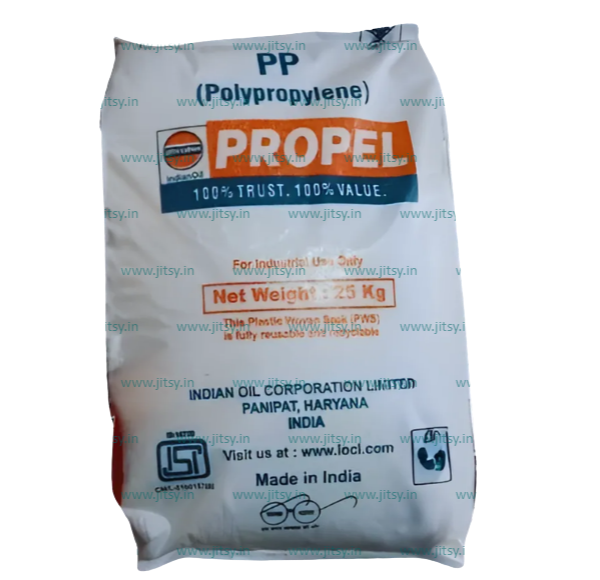
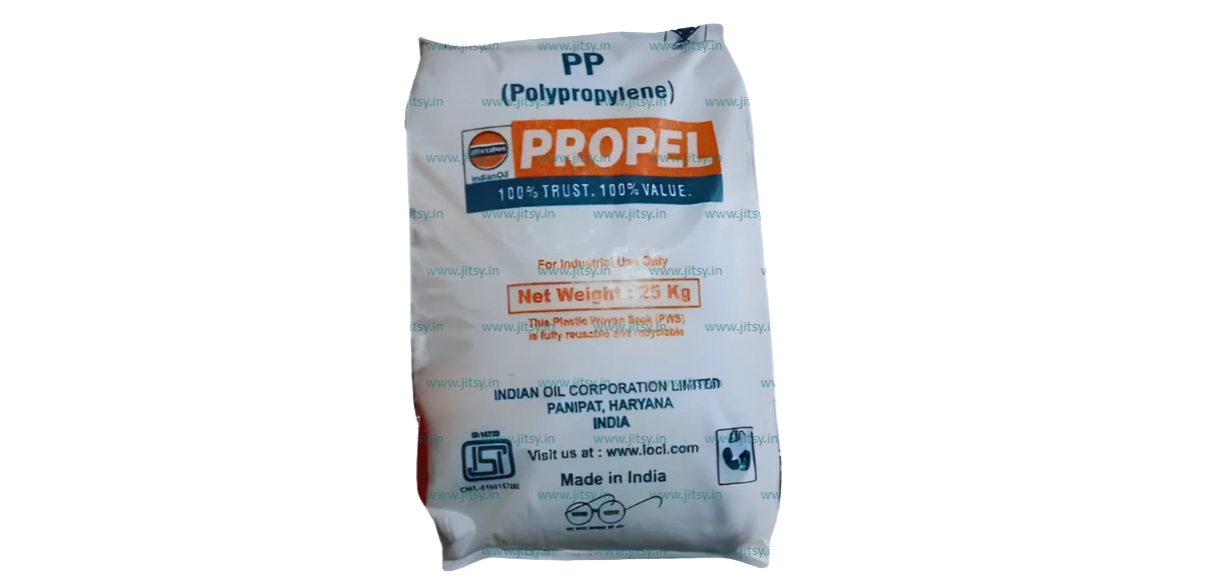
IOCL PP Propel 1060MG is a natural-coloured polypropylene homopolymer manufactured by Indian Oil Corporation Ltd (IOCL) using Spheripol II Technology at its Panipat plant. It is part of IOCL’s PROPEL range — a widely used line of PP grades across Indian manufacturing — and is designed specifically for general-purpose injection moulding and extrusion applications.
The grade is positioned by IOCL primarily on the basis of high stiffness. It is a versatile, medium-flow material suited to manufacturers who need a stiff, dimensionally stable finished part across a range of moulded and extruded product formats. Common applications include household articles, rigid packaging containers, and thermoformed sheets.
1060MG is supplied as prime, virgin granules in natural colour. It is not a compounded or recycled material.
Technical Insights
Chemistry and Polymer Family
1060MG belongs to the polypropylene homopolymer family — the purest PP structure, built entirely from propylene monomers with no ethylene or other co-monomer modification. Homopolymers consistently deliver higher stiffness and better heat resistance than copolymer grades of equivalent flow, making them the standard choice for rigid, structurally demanding applications.
The Spheripol II manufacturing process gives 1060MG a consistent molecular weight distribution and controlled particle morphology. This translates into predictable processing behaviour across moulding and extrusion equipment, with minimal variation batch to batch.
Property Breakdown
Melt Flow Index (MFI): 6.0 g/10 min (ASTM D1238, 230°C / 2.16 kg) An MFI of 6.0 positions 1060MG in the medium-to-high flow range for PP homopolymers. It fills cavities more readily than lower-flow grades like 1030MG, making it particularly useful for multi-cavity moulds, parts with moderate wall thickness, and extrusion lines requiring consistent output. The higher flow also allows for lower processing temperatures and reduced cycle times, contributing to processing efficiency.
Density: 0.90 g/cm³ (ASTM D1505, 23°C) Standard for PP homopolymers. This low density gives finished parts a lightweight profile — relevant for packaging, household goods, and any application where material-to-weight efficiency matters.
Tensile Strength at Yield: 35 MPa (ASTM D638, 50 mm/min) Consistent with IOCL’s other homopolymer moulding grades, the 35 MPa tensile yield supports parts that must hold their shape under moderate static loads. It is well suited for rigid containers, trays, household articles, and structural packaging components.
Elongation at Yield: 12% (ASTM D638, 50 mm/min) A 12% elongation value confirms this is a stiff, rigid material rather than a flexible one. The part will resist deformation under load before yielding — desirable in rigid packaging and moulded household goods.
Flexural Modulus: 1500 MPa (ASTM D790, 1.3 mm/min) This is the primary stiffness indicator and a key differentiator for 1060MG. At 1500 MPa, it offers higher rigidity than lower-MFI homopolymer grades like 1030MG (1350 MPa). Parts produced from 1060MG resist bending and flexing under load, making it the more appropriate choice for applications where shape retention and structural performance are critical.
Notched Izod Impact Strength: 40 J/m (ASTM D256, 23°C) Slightly above what is typical for a standard PP homopolymer at this flow rate. The 40 J/m value indicates the material can handle routine handling impacts in normal use — product drops, minor knocks — without cracking. It is not suited for high-impact applications, but for household and packaging end uses, this level is adequate.
Heat Deflection Temperature (HDT): 94°C (ASTM D648, 0.46 N/mm²) Parts made from 1060MG can withstand temperatures up to approximately 94°C under load before deforming. This is appropriate for household articles and packaging that encounter warm environments, including moderate heat exposure during transport and storage.
Vicat Softening Point: 154°C (ASTM D1525, 10 N) Indicates the temperature at which the material softens under a specified needle load — relevant for applications involving sterilisation, hot-fill, or elevated service temperatures.
Processing Temperature Range: 170–230°C A wide and manageable processing window compatible with standard injection moulding and extrusion equipment set up for PP. No special tooling or unusual process conditions are required.
Packaging: 25 kg raffia bags only.
Shelf Life and Storage: Store below 50°C, away from direct sunlight and heat, in a dry, dust-free environment. Process within 6 months of delivery. Exposure to heat or UV before processing causes colour change, odour development, and performance degradation in the resin.
Applications and Use Cases
Household Articles and Consumer Goods
1060MG’s high stiffness and good flow make it well suited for household article manufacturing. Products such as storage bins, organiser boxes, containers, utility trays, and everyday rigid goods benefit from the combination of a flexural modulus of 1500 MPa and processable MFI of 6.0. Manufacturers using multi-cavity moulds for consumer goods find the grade’s cavity-fill behaviour consistent and its cycle times efficient. The natural colour base also makes downstream pigmentation straightforward.
Rigid Packaging
For rigid PP packaging applications — containers, caps, closures, industrial bins, and transport packaging — the grade delivers the structural rigidity that rigid-walled formats require. At 1500 MPa flexural modulus and 35 MPa tensile strength, finished packaging parts hold shape under load during stacking, transit, and warehousing. The low density of 0.90 g/cm³ keeps unit material weight down, which matters at scale in packaging production.
Thermoforming
1060MG is explicitly listed by IOCL for thermoforming applications. PP homopolymer sheet extruded from this grade produces a stiff, consistently dimensioned feedstock for thermoforming lines. Thermoformed trays, food service packaging, industrial inserts, and protective packaging components are typical downstream applications. The high flexural modulus ensures that thermoformed parts resist sagging and deformation in service.
General Extrusion
Beyond thermoforming sheet, 1060MG is suitable for other extrusion formats where a stiff, dimensionally stable PP homopolymer is required. The 170–230°C processing window covers standard extrusion conditions, and the MFI of 6.0 supports consistent melt throughput on standard PP extrusion lines.
Comparable Grades in India
IOCL 1030MG (Not Equivalent — Lower Flow, Lower Stiffness)
1030MG is a PP homopolymer from the same PROPEL range with an MFI of 3.0 and a flexural modulus of 1350 MPa. It is the lower-flow, slightly less stiff sibling of 1060MG. For applications where cavity fill is not a constraint and maximum part rigidity is not critical, 1030MG may be suitable. However, for processors requiring faster fill, shorter cycle times, and higher part stiffness, 1060MG is the more appropriate choice. The two grades are not interchangeable without process revalidation.
IOCL 1110MG (Not Equivalent — Higher Flow)
1110MG sits above 1060MG in MFI, making it better suited to thin-wall moulding, complex cavity geometries, or applications where the highest flow is prioritised. The trade-off at higher MFI is typically some reduction in mechanical properties. Manufacturers selecting between 1060MG and 1110MG should evaluate whether the application needs the balanced stiffness-flow of 1060MG or the enhanced flow of 1110MG. These are not direct equivalents.
IOCL 1030FG (Not Equivalent — Film Grade)
1030FG is a PP homopolymer optimised for BOPP film and metallisable film. Its property profile is tuned for thin film orientation, not for moulded or thermoformed rigid parts. 1030FG and 1060MG serve completely different end-use formats and are not substitutable.
IOCL 3030MG (Not Equivalent — Impact Copolymer)
3030MG is a PP impact copolymer, not a homopolymer. It offers significantly better impact toughness than 1060MG but at the cost of lower stiffness and heat resistance. Switching between homopolymer 1060MG and copolymer 3030MG requires full revalidation of part design, processing parameters, and finished-part performance specifications. Choose 1060MG when high rigidity and heat resistance are the priority; consider 3030MG when impact toughness is required.
Other PP Homopolymer Moulding Grades from Indian Suppliers
Several other domestic polymer producers offer PP homopolymer moulding grades with MFI values and mechanical property ranges comparable to 1060MG. These are functionally similar for rigid packaging and household article applications, but manufacturer-confirmed technical equivalence with 1060MG has not been established. Direct property comparison using datasheets and, where necessary, trial runs should precede any substitution.
Common Search Variants
This product is also searched as: PP H 1060MG, PP moulding 1060MG, P1060MG, 1060MG PP granules, PP 1060MG IOCL, PROPEL 1060MG, Indian Oil PP 1060, and common misspellings including 1060mg, 1060-mg, p1060mg, 1060 MG, and p 1060 mg.















Reviews
Clear filtersThere are no reviews yet.