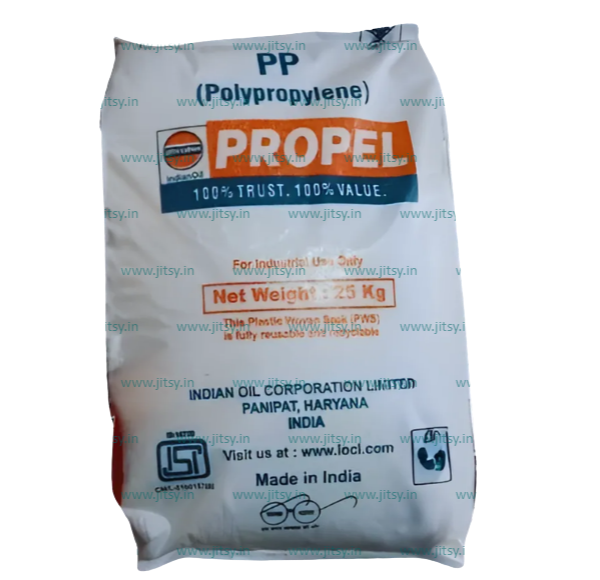
IOCL PP Propel 1110MAS is a natural-coloured polypropylene homopolymer manufactured by Indian Oil Corporation Ltd (IOCL) using Spheripol II Technology at its Panipat plant. It belongs to the PROPEL range and is one of the more technically distinct grades in IOCL’s moulding portfolio — combining high melt flow, very high stiffness, excellent gloss, and a built-in antistatic agent.
The “MAS” designation signals a specific functional additive profile. The antistatic agent in 1110MAS reduces static charge build-up in finished parts — a meaningful advantage in consumer-facing products, automotive interior components, and household articles where dust attraction and electrostatic discharge are quality or safety concerns.
1110MAS is designed for injection moulding of parts where rapid cavity fill, dimensional rigidity, surface appearance, and antistatic performance all matter simultaneously. IOCL lists furniture, household articles, and auto components as the primary application areas. The grade is supplied as prime, virgin granules in natural colour — not compounded or recycled.
Technical Insights
Chemistry and Polymer Family
1110MAS is a polypropylene homopolymer — built entirely from propylene monomers without ethylene co-monomer modification. Homopolymers deliver higher stiffness, better heat resistance, and superior surface gloss compared to copolymer grades at similar flow rates. The grade also incorporates a proprietary antistatic additive, which distinguishes it from standard IOCL homopolymer moulding grades.
The Spheripol II manufacturing process gives 1110MAS a consistent molecular weight distribution and controlled morphology, resulting in predictable processing behaviour and part-to-part consistency across injection moulding runs.
Property Breakdown
Melt Flow Index (MFI): 11 g/10 min (ASTM D1238, 230°C / 2.16 kg) At MFI 11, this is a high-flow PP homopolymer. It fills cavities quickly and completely, even in complex geometries or multi-cavity moulds. The high flow directly supports shorter cycle times, lower injection pressure requirements, and reduced mould wear — all relevant to high-volume production of furniture and household article components. Sources indicate potential cycle time reductions, though the exact percentage is source-dependent and should be validated under specific moulding conditions.
Density: 0.90 g/cm³ (ASTM D1505, 23°C) Standard for PP homopolymers. The low density keeps finished parts lightweight relative to their volume — important for large moulded parts like furniture components where weight matters for handling and freight.
Tensile Strength at Yield: 42 MPa (ASTM D638, 50 mm/min) 42 MPa is notably higher than the 35 MPa tensile strength seen in lower-flow PROPEL homopolymer grades like 1030MG and 1060MG. This higher tensile value makes 1110MAS suitable for structurally demanding moulded parts — chair shells, auto interior panels, and household goods that must resist applied load without deforming.
Elongation at Yield: 8% (ASTM D638, 50 mm/min) At 8% elongation, 1110MAS is stiffer and less ductile than lower-stiffness homopolymers. Parts will resist deformation under load but have less tolerance for bending before yield. This is expected and appropriate for rigid, dimensionally critical applications like furniture and auto components.
Flexural Modulus: 1800 MPa (ASTM D790, 1.3 mm/min) The highest flexural modulus in the commonly compared IOCL homopolymer moulding range. At 1800 MPa, finished parts are exceptionally stiff — they resist bending and flex under service loads. This is a key reason 1110MAS is specified for furniture and auto interior applications where dimensional stability and part rigidity are non-negotiable.
Notched Izod Impact Strength: 30 J/m (ASTM D256, 23°C) Lower than some grades in the moulding range, which is typical as stiffness increases and impact toughness decreases in PP homopolymers. The 30 J/m value is adequate for indoor furniture, household goods, and auto interior parts under normal service conditions, but this grade is not suited for applications requiring high-impact resistance.
Heat Deflection Temperature (HDT): 114–115°C (ASTM D648, 0.46 N/mm²) Significantly higher than lower-stiffness homopolymer grades in the PROPEL range (which typically show 94°C). The 114–115°C HDT makes 1110MAS more suitable for applications exposed to elevated temperatures — auto interior parts near heat sources, appliance components, or products that experience elevated ambient temperatures during storage and transport.
Vicat Softening Point: 154°C (ASTM D1525, 10 N) Indicates the temperature at which the material softens under a defined needle load, relevant for understanding resistance to localised heat in service or assembly.
Antistatic Performance: The built-in antistatic agent reduces static charge build-up in finished parts. This has direct functional value in household goods and consumer products where static causes dust accumulation and surface contamination, and in auto components where electrostatic discharge can be a concern near electronic systems.
Gloss: IOCL positions 1110MAS on excellent gloss — a surface quality advantage relevant to consumer-facing products where appearance affects perceived quality. The high flow (MFI 11) contributes to smooth, well-filled surfaces.
Processing Temperature Range: 170–230°C Standard for PROPEL PP homopolymer grades and compatible with conventional injection moulding equipment set up for PP.
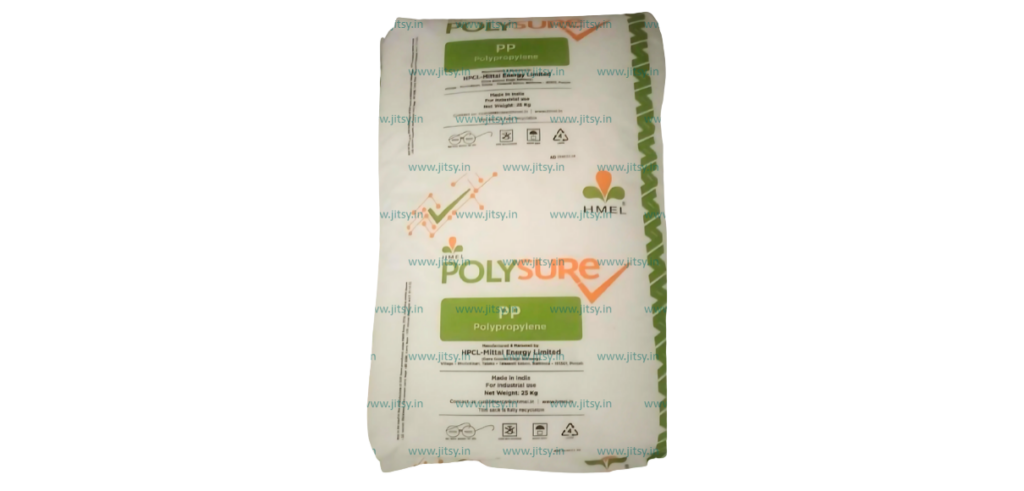
Packaging: 25 kg raffia bags only.
Shelf Life and Storage: Store below 50°C, away from direct sunlight and heat, in a dry, dust-free environment. Process within 6 months of delivery. Heat and UV exposure before processing can degrade the resin and affect performance, colour, and odour.
Applications and Use Cases
Furniture Components
1110MAS is purpose-designed for plastic furniture manufacturing. Chair shells, seat frames, stool bodies, and storage furniture components benefit from the grade’s combination of MFI 11 flow (fast cycle times, clean cavity fill) and flexural modulus 1800 MPa (rigid, dimensionally stable finished parts). The excellent gloss supports the surface appearance expected in consumer furniture, and the antistatic agent reduces the dust build-up that affects the perceived quality of furniture in retail and residential environments.
Household Articles and Consumer Goods
For household injection-moulded goods — storage boxes, bins, organisers, hangers, and utility items — 1110MAS delivers both the fast production throughput of high-flow PP and the structural rigidity of a very high stiffness grade. The antistatic additive is particularly relevant here, as static on household plastic surfaces causes persistent dust adhesion that affects product appearance and consumer perception. The grade’s gloss finish also supports a premium look in consumer-facing products without additional surface treatment.
Automotive Interior Components
1110MAS is listed by IOCL for auto components. In automotive interior applications — instrument panel inserts, door trim components, pillar covers, and interior brackets — the grade’s high HDT of 114–115°C is a critical advantage. Auto interior parts are regularly exposed to elevated temperatures from sun exposure and proximity to heat sources. The high tensile strength (42 MPa) and very high flexural modulus (1800 MPa) ensure dimensional stability and part integrity under these conditions, while the antistatic property reduces dust attraction on visible interior surfaces.
Comparable Grades in India
IOCL 1110MG (Closest Family — Not Equivalent)
1110MG is the standard homopolymer moulding grade from IOCL at a similar MFI level, without the antistatic additive or the specific MAS positioning on gloss and cycle time. If antistatic performance is not required and surface appearance standards are lower, 1110MG may be appropriate. However, for applications where the antistatic and gloss attributes of 1110MAS are functional requirements — not cosmetic preferences — the two grades are not interchangeable. Manufacturer confirmation of exact MFI and property differences should be sought before substitution.
IOCL 1060MG (Not Equivalent — Lower Flow, Lower Stiffness)
1060MG has an MFI of 6.0 and a flexural modulus of 1500 MPa — significantly lower flow and stiffness than 1110MAS (MFI 11, 1800 MPa). It does not contain an antistatic additive. 1060MG is appropriate for general rigid packaging and household articles where speed and maximum stiffness are not critical. For furniture, auto components, or any application where the faster cycle, higher rigidity, gloss, and antistatic performance of 1110MAS are specified, 1060MG is not a suitable substitute.
IOCL 1030MG (Not Equivalent — Much Lower Flow)
1030MG has an MFI of 3.0 and is a balanced stiffness-flow grade for general injection moulding. It offers none of the specialised attributes of 1110MAS — no antistatic additive, no high-gloss positioning, lower stiffness (1350 MPa), and a processing profile suited to different part geometries and cycle requirements. These grades serve distinct market positions.
IOCL 1200MG (Not Equivalent — Different Flow Profile)
1200MG is a higher-flow homopolymer with good stiffness and gloss positioning, but its MFI and property balance differ from 1110MAS. Without confirmed manufacturer equivalence data, 1200MG should not be substituted for 1110MAS without full revalidation.
Other PP Homopolymer Injection Grades from Indian Suppliers
Other domestic PP producers supply homopolymer moulding grades in the MFI 10–12 range with high stiffness positioning. These may be functionally comparable for furniture and household article injection moulding but do not replicate the specific antistatic additive system of 1110MAS. Buyers requiring the antistatic functionality should confirm additive content and antistatic performance with the alternative supplier before substitution.
Common Search Variants
This product is also searched as: PP H 1110MAS, antistatic PP granules IOCL, P1110MAS, 1110MAS PP granules, PROPEL 1110MAS, Indian Oil PP 1110MAS, high stiffness PP homopolymer antistatic, and common misspellings including 1110mas, 1110-mas, p1110mas, 1110 MAS, pp 1110 mas, and p1110 m a s.
















Reviews
Clear filtersThere are no reviews yet.