What is IOCL PP Propel P1100FS?
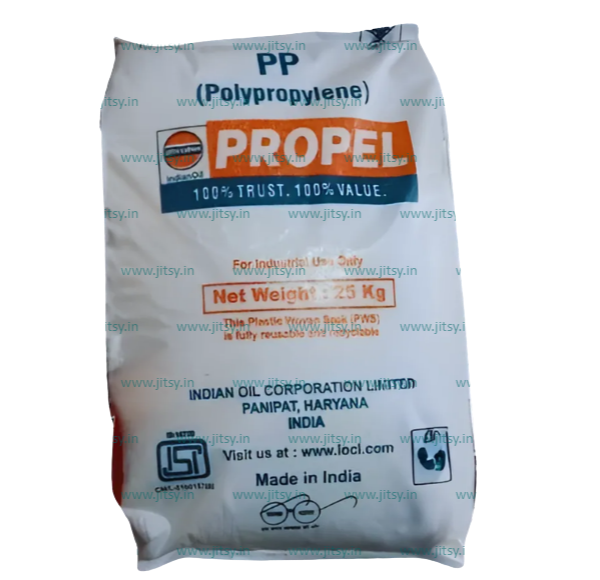
IOCL PP Propel P1100FS is a natural-coloured polypropylene homopolymer film grade manufactured by Indian Oil Corporation Ltd (IOCL) using Spheripol II Technology at its Paradip plant. It belongs to IOCL’s PROPEL range and is designed specifically for Tubular Water Quench Polypropylene — commonly known as TQPP — film extrusion, one of the primary processes used to produce flexible PP packaging films.
P1100FS is not a general-purpose moulding grade. It is purpose-built for film extrusion and differentiated from standard homopolymer grades by three key additive and optical attributes: built-in slip and antiblock additives, and a positioning on excellent gloss and clarity. These characteristics address the specific handling, converting, and appearance requirements of packaging film applications — areas where standard moulding-grade PP would be inadequate.
The grade is used by film producers supplying packaging for food, garments, textiles, and bakery products. Its combination of high flow, good optical quality, and functional additives makes it a practical choice for film lines targeting the flexible packaging market.
P1100FS is supplied as prime, virgin granules in natural colour — not compounded or recycled.
Technical Insights
Chemistry, Polymer Family, and Additive System
P1100FS is a polypropylene homopolymer — built entirely from propylene monomers without ethylene co-monomer addition. The homopolymer base delivers the stiffness, clarity, and processing consistency that packaging film extrusion requires.
What separates P1100FS from standard PROPEL homopolymer grades is its functional additive package. The grade contains slip and antiblock additives incorporated at the resin manufacturing stage — not added downstream. Slip additives reduce the coefficient of friction on the film surface, which is critical for high-speed converting lines where film must travel smoothly across rollers and through packaging equipment without sticking or jamming. Antiblock additives prevent adjacent layers of film from adhering together during winding, storage, and unwinding, ensuring clean separation in commercial use. Together, these additives significantly improve film runnability and downstream handling without requiring the film converter to source and compound them separately.
The grade is also positioned by IOCL on excellent gloss and clarity — the optical attributes buyers in food packaging, garment, and retail overwrap markets require for product visibility.
Property Breakdown
Melt Flow Index (MFI): 11 g/10 min (ASTM D1238, 230°C / 2.16 kg) An MFI of 11 provides good melt flow for tubular film extrusion. It supports consistent bubble formation and stable throughput on TQPP film lines, with sufficient melt strength to maintain bubble integrity during the water quench process. Lower MFI grades may struggle with consistent bubble stability in TQPP lines, while excessively high flow can reduce melt strength and cause bubble instability.
Tensile Strength at Yield: 35 MPa (ASTM D638, 50 mm/min) This tensile value reflects the resin’s mechanical character as a film-forming material. In the final film, tensile performance is influenced by extrusion conditions and the degree of molecular orientation achieved during the process. The resin’s 35 MPa yield value provides a baseline of structural integrity appropriate for packaging film applications.
Elongation at Yield: 10% (ASTM D638, 50 mm/min) At 10% elongation, P1100FS is moderately stiff in the resin form. The film’s final elongation characteristics will be influenced by processing conditions, but the resin’s homopolymer structure delivers a degree of rigidity that supports crisp, stable film rather than a limp or elastic product.
Flexural Modulus: 1500 MPa (ASTM D790, 1.3 mm/min) Consistent with a high-stiffness PP homopolymer film grade. A flexural modulus of 1500 MPa supports the dimensional stability and crinkle resistance expected in packaging films used for bakery, garment, and textile overwrap applications.
Notched Izod Impact Strength: 21 J/m (ASTM D256, 23°C) Lower than impact copolymers, as expected for a PP homopolymer. In film applications, the primary requirements are optical quality, processing behaviour, and surface properties rather than impact resistance. The 21 J/m value is consistent with a grade optimised for film performance rather than structural impact toughness.
Heat Deflection Temperature (HDT): 100°C (ASTM D648, 0.46 N/mm²) An HDT of 100°C is higher than most standard PROPEL moulding grades at 94°C, which is relevant for films that may encounter moderate heat in food processing environments, hot-fill packaging, or storage in warm conditions.
Vicat Softening Point: 151°C (ASTM D1525, 10 N) Indicates the temperature threshold at which the resin softens under a defined load — relevant for understanding heat seal compatibility and high-temperature processing limits in converting operations.
Processing Temperature Range: 170–220°CThe upper limit of 220°C is narrower than the 230°C ceiling on PROPEL moulding grades. This is typical for film-grade PP, where controlled melt temperature supports consistent bubble quality and prevents thermal degradation of the slip and antiblock additives during extrusion.
Density: Not confirmed in available sources. Buyers requiring the density value should request the official IOCL technical datasheet.
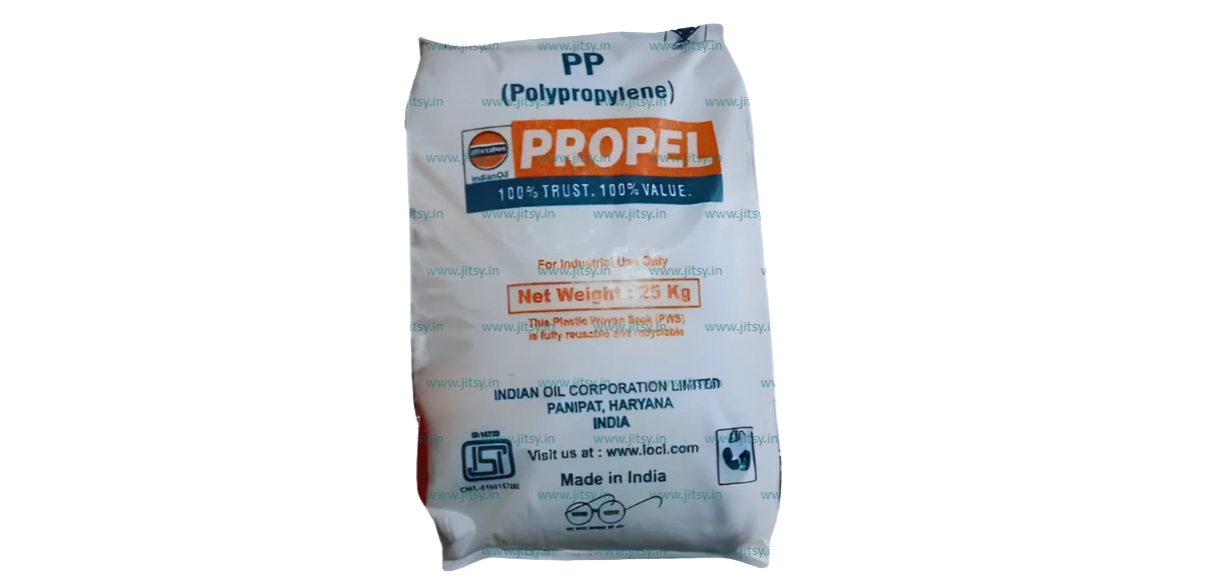
Packaging: 25 kg raffia bags only.
Shelf Life and Storage: Store below 50°C, away from direct sunlight and heat, in a dry, dust-free environment. Process within 6 months of delivery. Heat and UV exposure before processing can degrade the resin, affect additive performance, and reduce film optical quality.
All values above are manufacturer-stated typical values, not specification limits.
Applications and Use Cases
Food Packaging Films
P1100FS is specifically positioned for food packaging film production. Its excellent gloss and clarity allow the packaged product to remain fully visible through the film — a commercial requirement in snack, bakery, and fresh food categories where retail shelf appeal drives purchase decisions. The built-in slip and antiblock additives enable the film to run cleanly through high-speed form-fill-seal and flow-wrap packaging lines. For snack manufacturers, bakeries, and food processors sourcing TQPP film, a grade like P1100FS that combines optical quality with functional additives in a single resin simplifies film converter procurement.
Garment Bags and Retail Packaging
Garment bag film requires clarity for product display, adequate stiffness to maintain shape, and smooth surface properties for clean sealing and easy opening. P1100FS’s homopolymer clarity, flexural modulus of 1500 MPa, and slip-enhanced surface make it appropriate for garment bag film extrusion. Clothing manufacturers, laundries, and textile distributors using PP film for garment protection and retail presentation are the primary buyers of film converted from grades like P1100FS.
Textile Overwrap
In textile overwrap applications — packaging rolls of fabric, bundles of yarn, or finished goods in retail-ready PP film — the requirements are similar to garment bags: clarity, stiffness, and smooth handling in automated packaging lines. The antiblock additive in P1100FS prevents film layers from sticking during winding and storage, which is essential when film is produced and stored in roll form before conversion and use.
Snack and Bakery Packaging Films
The snack and bakery segment is one of the highest-volume end markets for TQPP film. These applications demand consistent film gauge, good heat sealability at the film converter level, and attractive packaging appearance. P1100FS’s high-flow resin character supports consistent film extrusion at commercial throughput rates, while its optical properties maintain the clarity expected in snack and bakery retail packaging formats.
Comparable Grades in India
IOCL 1030FG (Not Equivalent — BOPP Film Grade)
1030FG is a PP homopolymer film grade from IOCL, but it is positioned for BOPP (Biaxially Oriented Polypropylene) film rather than TQPP film. BOPP and TQPP are fundamentally different extrusion processes — BOPP requires biaxial stretching of the film after extrusion, which demands different resin morphology, molecular weight distribution, and additive requirements. A BOPP-targeted grade like 1030FG is not a direct substitute for a TQPP-targeted grade like P1100FS. Using a BOPP grade on a TQPP line, or vice versa, requires full revalidation of the film extrusion process.
IOCL Moulding Grades (1030MG, 1060MG, 1110MG — Not Equivalent)
PROPEL moulding grades such as 1030MG, 1060MG, and 1110MG do not contain slip and antiblock additives and are not designed for film extrusion. Using a moulding-grade PP on a film extrusion line produces film with poor surface handling characteristics — high blocking tendency, high friction, and inadequate optical quality for packaging applications. P1100FS is the appropriate grade when film extrusion is the process.
Other PP Homopolymer TQPP Film Grades from Indian Suppliers
Other domestic PP producers supply homopolymer film grades designed for TQPP film extrusion with slip and antiblock additives. These may be functionally comparable for food, garment, and textile film applications. However, confirmed technical equivalence with P1100FS has not been established, and additive content, MFI, and optical property differences should be assessed through direct TDS comparison and film trials before substitution.
Common Search Variants
This product is also searched as: PP H 1100FS, TQPP film PP grade, P1100FS IOCL, 1100FS PP granules, PROPEL 1100FS, Indian Oil PP film grade, PP homopolymer for food packaging film, slip antiblock PP resin, and common misspellings including 1100fs, 1100-fs, p1100fs, 1100 FS, pp 1100 f s, and iocl 1100 fs.















Reviews
Clear filtersThere are no reviews yet.