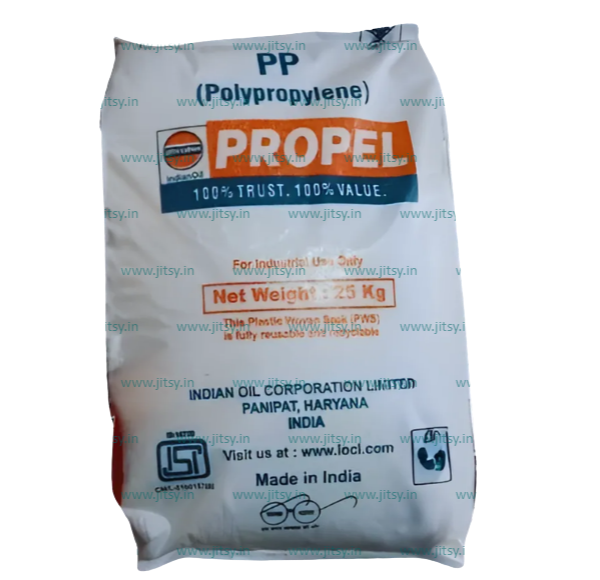
IOCL PP Propel P1350EG is a natural-coloured polypropylene homopolymer manufactured by Indian Oil Corporation Ltd (IOCL) using Spheripol II Technology at its Panipat plant. It belongs to IOCL’s PROPEL range and is purpose-built for extrusion coating and lamination — a different processing category from both injection moulding grades and film extrusion grades in the same portfolio.
P1350EG is defined by three process-critical attributes that IOCL states directly: excellent flow, low neck-in, and excellent adhesion to substrate. With an MFI of 35 — among the highest in the PROPEL homopolymer range — it is designed to coat substrates at high line speeds without the processing difficulties that arise when lower-flow PP resins are used in coating applications. Its low neck-in characteristic reduces draw resonance and maintains consistent coating width across the substrate, which is a significant operational benefit on wide-web lamination lines. The strong substrate adhesion makes it effective for bonding to PP raffia fabric structures used in woven bags and industrial packaging.
P1350EG is supplied as prime, virgin granules in natural colour. IOCL is one of India’s largest domestic polymer producers, and PROPEL PP grades are supported by full documentation including test certificates, GST invoices, and e-way bills. P1350EG is listed in IOCL’s active grade portfolio.
Technical Insights
Chemistry, Polymer Family, and Process Position
P1350EG is a polypropylene homopolymer — built entirely from propylene monomers without co-monomer additions. As a dedicated extrusion coating and lamination grade, it is chemically part of the same homopolymer family as PROPEL moulding and film grades but is formulated and tested for a fundamentally different process. The coating and lamination application demands very different resin behaviour from moulding or blown/cast film extrusion: the resin must flow at high speed, spread uniformly across a moving substrate, resist edge draw-in, and bond effectively to the base material.
Property Breakdown
Melt Flow Index (MFI): 35 g/10 min (ASTM D1238, 230°C / 2.16 kg) The highest MFI in the commonly compared PROPEL homopolymer moulding and film range. At MFI 35, P1350EG is a very high-flow resin, which is a direct requirement for extrusion coating. In coating applications, the molten curtain of resin must cover the substrate uniformly at high line speeds. Lower-flow resins cannot spread effectively at the speeds commercial lamination lines operate, leading to coating defects, uneven coverage, and edge instability. MFI 35 ensures the melt flows freely, coats evenly, and supports high-speed production.
Low Neck-in: Neck-in is the reduction in coating width that occurs as the melt curtain narrows between the die lips and the nip point on the substrate. Excessive neck-in wastes material, creates uncoated edges, and forces line operators to run wider die gaps to compensate — reducing coating uniformity and efficiency. IOCL positions P1350EG specifically on low neck-in, which means the melt curtain maintains its width more effectively during draw-down, improving material efficiency and coating consistency on wide-web lines.
Excellent Adhesion to Substrate: The primary functional requirement in raffia fabric coating and lamination is that the PP coating bonds reliably to the woven or non-woven substrate. Poor adhesion produces delamination in service — a critical failure mode for industrial bags and packaging used to carry bulk materials. IOCL states excellent adhesion to substrate as a key attribute of P1350EG, distinguishing it from general-purpose PP grades that are not formulated for coating adhesion.
Tensile Strength at Yield: 35 MPa (ASTM D638, 50 mm/min) Consistent with the homopolymer family. In coating applications, the final laminate’s tensile performance is a function of both the substrate and the coating layer together; the resin’s base tensile value contributes to overall laminate integrity.
Elongation at Yield: 9% (ASTM D638, 50 mm/min) Slightly lower than standard moulding grades, reflecting the high MFI and the trade-off between flow and ductility at this flow level. For coating applications, elongation at yield is less critical than flow, adhesion, and neck-in behaviour.
Flexural Modulus: 1500 MPa (ASTM D790, 1.3 mm/min) Consistent with other PROPEL homopolymer grades at similar stiffness positions. A flexural modulus of 1500 MPa ensures the coating layer contributes rigidity to the laminate structure — relevant for bags and packaging that must resist flexing and maintain shape under load.
Notched Izod Impact Strength: 22 J/m (ASTM D256, 23°C) Appropriate for a high-flow homopolymer in a coating application. Impact resistance in the laminate is primarily governed by the substrate; the coating layer’s role is adhesion and surface quality rather than impact absorption.
Heat Deflection Temperature (HDT): 95°C (ASTM D648, 0.46 N/mm²) Adequate for industrial bags and packaging used in ambient and warm storage environments. PP raffia-based bags often encounter elevated temperatures during storage and transport, and an HDT of 95°C ensures the coating layer does not soften and lose adhesion under typical service conditions.
Vicat Softening Point: 150°C (ASTM D1525, 10 N) Indicates the resin’s resistance to localised softening under a defined load — relevant for understanding processing window margins and service temperature limits.
Processing Temperature Range: 180–250°C The upper limit of 250°C is higher than PROPEL film grades (220°C) and standard moulding grades (230°C). The wider and higher processing window reflects the demands of extrusion coating lines, where higher melt temperatures are needed to achieve flow uniformity, effective draw-down, and substrate adhesion at commercial line speeds.
Density: Not confirmed in available sources. Buyers requiring density data should request the official IOCL technical datasheet.
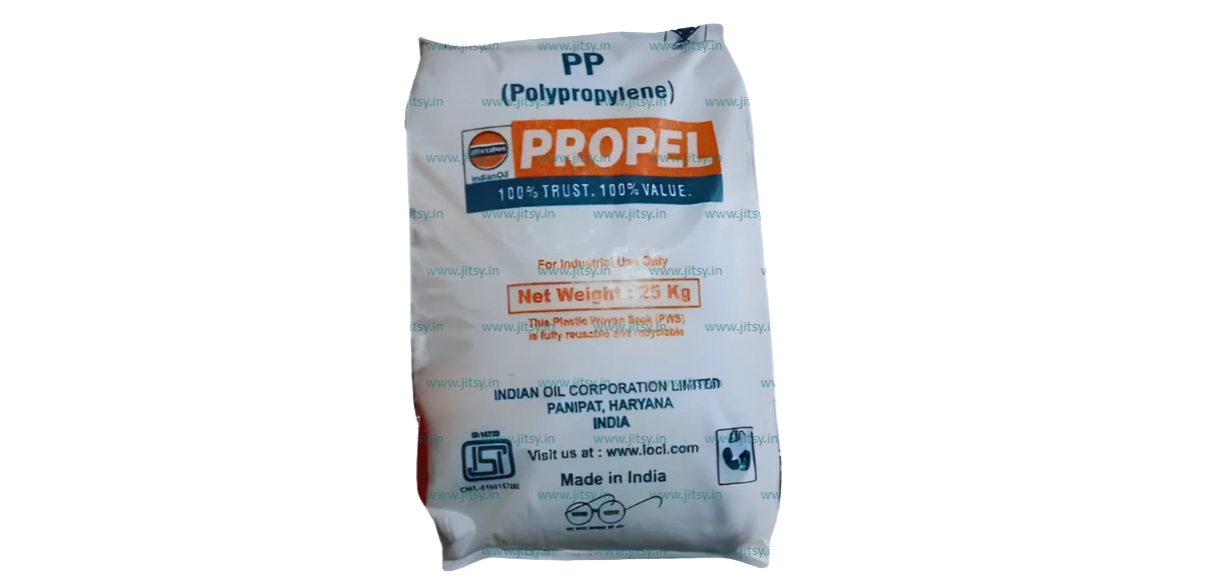
Packaging: 25 kg raffia bags only.
Shelf Life and Storage: Store below 50°C, away from direct sunlight and heat, in a dry, dust-free environment. Process within 6 months of delivery. Heat and UV exposure before processing can degrade the resin and negatively affect melt behaviour, coating adhesion, and surface quality.
Applications and Use Cases
Extrusion Coating on PP Raffia Fabric
The primary application for P1350EG is extrusion coating onto woven PP raffia fabric — the substrate used in industrial woven bags for cement, fertiliser, food grains, chemicals, and construction materials. In this application, molten P1350EG is extruded as a thin melt curtain and pressed onto the fabric surface under a nip roller, bonding the coating to the woven structure. The coating improves the bag’s moisture resistance, surface printability, and structural integrity. For this process to work reliably at commercial production speeds, the resin needs very high flow, low neck-in to maintain consistent coating width, and strong adhesion to the PP raffia substrate. P1350EG is designed to meet all three requirements simultaneously.
Lamination Processes for Industrial Packaging
Beyond direct raffia coating, P1350EG is also used in lamination — bonding two or more layers of substrate material together using the PP resin as an adhesive layer applied through an extrusion die. In woven bag manufacturing and flexible industrial packaging, laminated structures improve barrier performance, stiffness, and print quality compared to uncoated substrates. The high MFI of 35 supports fast, even laminate bonding at commercial line speeds, while the substrate adhesion attribute ensures the laminate holds together under the mechanical stress of filling, handling, and transport.
High-Speed Coating Lines for Wide-Web Applications
Manufacturers running wide-web extrusion coating lines for industrial flexible packaging benefit directly from P1350EG’s low neck-in characteristic. On wide-web lines, even modest neck-in creates significant material waste and requires wider die gaps that reduce coating uniformity. A resin with controlled neck-in behaviour runs more efficiently, reduces trim waste, and allows operators to run at higher line speeds without compromising coating consistency across the full web width.
Comparable Grades in India
IOCL 1100FS (Not Equivalent — Film Grade with Additives)
P1100FS is a PROPEL homopolymer film grade designed for TQPP film extrusion with built-in slip and antiblock additives. Its MFI of 11 and additive profile are optimised for bubble extrusion and film converting — not for the high-flow, high-adhesion requirements of coating and lamination. Using a TQPP film grade in a coating application would result in insufficient flow for high-speed coating lines and the wrong surface additive chemistry for substrate bonding. P1100FS and P1350EG are not interchangeable.
IOCL 1350YG (Not Equivalent — Different Application)
1350YG is a high-flow PROPEL homopolymer at a similar MFI level, but positioned for nonwoven and yarn-related applications rather than extrusion coating and lamination. While both grades share a high-flow positioning, their application-specific property optimisation, additive systems, and processing guidance differ. They are not confirmed equivalents, and substitution should not be made without full revalidation on the coating or lamination line.
IOCL 1030FG (Not Equivalent — BOPP Film Grade)
1030FG is a PP homopolymer film grade designed for BOPP film production. Its MFI, molecular weight profile, and property balance are tuned for biaxial film orientation — a completely different process from extrusion coating. Flow, neck-in, and adhesion performance in a coating context would not be equivalent to P1350EG.
IOCL Moulding Grades (1030MG, 1060MG, 1110MG — Not Equivalent)
Standard PROPEL moulding grades have MFI values between 3 and 11 — significantly lower than the MFI 35 of P1350EG. At these lower flow levels, the resin cannot spread uniformly across substrates at coating line speeds and will not deliver the adhesion performance required for raffia lamination. Moulding grades are not suitable for extrusion coating applications.
Other PP Extrusion Coating and Lamination Grades from Indian Suppliers
Other domestic PP producers supply high-flow homopolymer grades designed for extrusion coating and lamination applications with comparable MFI ranges. These may be functionally similar for raffia fabric coating and industrial packaging lamination, but confirmed technical equivalence with P1350EG — particularly in neck-in control and substrate adhesion — has not been established. Coating trial runs and direct TDS comparison are the appropriate basis for substitution decisions.
Common Search Variants
This product is also searched as: PP H 1350EG, high flow PP coating resin, P1350EG IOCL, 1350EG PP granules, PROPEL 1350EG, Indian Oil PP coating grade, PP homopolymer for raffia lamination, low neck-in PP resin, extrusion coating PP granules, and common misspellings including 1350eg, 1350-eg, p1350eg, 1350 EG, pp 1350 eg, and iocl 1350 eg.














Reviews
Clear filtersThere are no reviews yet.