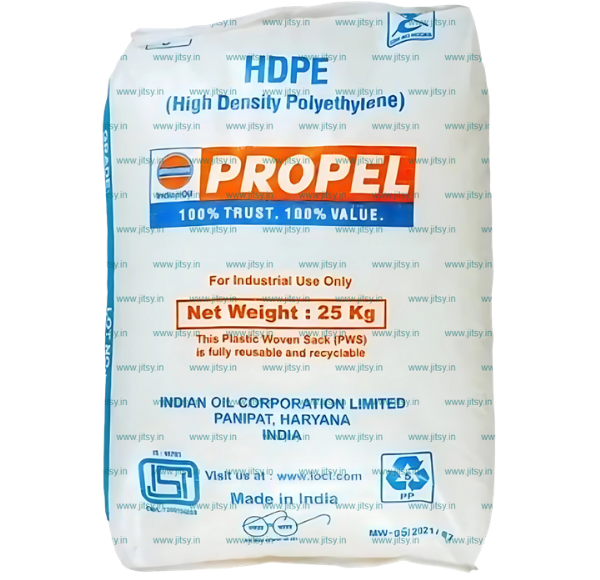
Propel 003F46 is a high-density polyethylene blown film grade manufactured by Indian Oil Corporation Ltd. (IOCL) under the Propel brand, produced at IOCL’s Product Application and Development Centre (PADC) at Panipat Refinery, Haryana. Like IOCL’s injection-moulding Propel grades, it is manufactured using Nova Chemical’s Sclairtech solution polymerisation technology — a process that delivers controlled molecular weight distribution, excellent homogeneity, and the low gel content that film converters require for defect-free production runs. The grade is supplied as natural-coloured granules, consistent with IOCL’s standard packaging for Propel grades.
HDPE 003F46 occupies a different processing domain from IOCL’s injection-moulding and blow-moulding HDPE grades. It is not designed for moulded parts or rigid containers; it is formulated exclusively for the blown film extrusion process, where the resin is melted, extruded as a tubular parison upward through a circular die, and then inflated with air to produce a continuous film bubble that is collapsed, wound, and slit into film or bag stock. IOCL’s own product technical datasheet states explicitly: “HDPE 003F46 is designed for co-extrusion film and liners.” This positioning is reinforced by distributor documentation and commercial listings across the Indian polymer trade, which consistently identify co-extrusion films, liners, and general-purpose blown film as the recommended end uses.
The two defining characteristics that IOCL and distributors consistently highlight for HDPE 003F46 are good processability and low gel content. In the blown film context, these attributes matter because gel particles — localised high-molecular-weight inclusions in the melt — produce visible defects in the finished film, create points of mechanical weakness, and in severe cases can rupture the film bubble during production. Low gel content, achieved through the homogeneous molecular architecture of the Sclairtech solution process, makes 003F46 suitable for film structures where surface quality, optical performance, and consistency across widths and gauges are production requirements. Good processability in the blown film context means the resin builds and holds a stable bubble at the recommended blow-up ratios and die conditions, supporting consistent output without frequent bubble collapses or gauge variations.
At a density of 0.946 g/cm³, HDPE 003F46 provides the crystallinity and stiffness characteristic of HDPE films — higher stiffness, better moisture barrier, and stronger tensile properties than LLDPE or LDPE at equivalent gauge — while the MFI of approximately 0.30–0.35 g/10 min at 190 °C / 2.16 kg kg provides the melt viscosity and melt strength needed to maintain bubble integrity at blow-up ratios of 2.0–3.0. The mechanical properties of the grade are characterised on oriented film rather than compression-moulded specimens — a critical distinction from the injection and blow-moulding grades in the Propel family. The film properties therefore reflect both the resin’s molecular characteristics and the orientation effect of the blown film process, which explains the high elongation at break values (780–800% in the machine direction, 950% in the transverse direction) that would not be seen on moulded specimens of the same polymer.
IOCL’s documentation confirms regulatory compliance with IS 10146:1982, IS 10141:1982, and FDA CFR Title 21 Section 177.1520 for olefin polymers. These certifications support the grade’s use in packaging films that come into contact with food, pharmaceuticals, or drinking water, subject to the finished article also meeting applicable end-use testing requirements.
Technical Insights
Understanding the Key Properties of HDPE 003F46
The properties of Propel 003F46 must be read in the context of blown film production — all mechanical values are measured on 40 μm film produced at a specific die gap (0.75 mm) and blow-up ratio (2.75), as stated in IOCL’s TDS. This means the numbers reflect both the resin’s base molecular properties and the orientation introduced by the film-making process, and they are not directly comparable with property values from injection-moulded or compression-moulded specimens.
- Melt Flow Index — 0.30–0.35 g/10 min (ASTM D1238, 190 °C / 2.16 kg): A small but notable discrepancy exists between sources: IOCL’s own TDS reports MFI 0.30 g/10 min, while distributor documentation consistently cites 0.35 g/10 min. Both figures are typical values — not specification limits — and the difference is within the batch-to-batch variability expected for HDPE resins. The practical implication for blown film converters is the same in either case: an MFI in the 0.30–0.35 g/10 min range places 003F46 in the moderate-viscosity segment for HDPE film grades, providing enough melt strength to hold a stable bubble at standard blow-up ratios without excessive extruder back-pressure. Unlike the very low-MFI blow-moulding grades (such as HDPE 002DB52 at 0.2 g/10 min at 5 kg load), the film-grade MFI is measured at 2.16 kg and reflects extrusion film die conditions rather than parison behaviour.
- Density — 0.946 g/cm³ (ASTM D1505, 23 °C): At 0.946 g/cm³, HDPE 003F46 is firmly within the high-density polyethylene classification and at the characteristic density level for HDPE film grades. This density level drives the stiffness, moisture barrier, and tensile strength that make HDPE films preferred over LLDPE or LDPE in applications where film rigidity, rustling hand-feel, and strength-to-gauge ratio matter. It is slightly lower than IOCL’s injection-moulding and blow-moulding grades (0.952–0.960 g/cm³), which is typical for film-grade HDPEs where the molecular weight distribution is tuned for film processability rather than maximum crystallinity.
- Low Gel Content — Manufacturer-stated Feature: Gel content is not captured by a single numeric test value but is explicitly identified by IOCL as a defining feature of 003F46. Gel particles in blown film resin originate from localised high-molecular-weight or cross-linked polymer fractions that do not melt uniformly. In finished film, they appear as translucent or opaque spots, create thin points that reduce puncture resistance, and can cause film breaks during high-speed extrusion. IOCL’s Sclairtech solution polymerisation process produces a molecularly homogeneous polymer that minimises gel formation — a direct functional benefit for co-extrusion film lines and high-quality liner applications where defect-free production runs and consistent film structure across all layers are required.
- Tensile Strength at Yield — 29 MPa (MD) / 26 MPa (TD) (ASTM D882): Film tensile properties are reported in two directions: machine direction (MD, along the direction of film travel) and transverse direction (TD, perpendicular to film travel). The slightly higher MD yield strength reflects the molecular orientation introduced during film drawing in the machine direction. At 29 / 26 MPa, the grade delivers tensile yield values comparable with typical HDPE film grades and appropriate for packaging films and liners that must resist the stresses of filling, sealing, and handling without deforming at the yield point.
- Ultimate Tensile Strength — 45 MPa (MD) / 40 MPa (TD) (ASTM D882): The ultimate tensile strength — the stress at which the film fractures — of 45 MPa (MD) and 40 MPa (TD) indicates that films produced from 003F46 have significant residual strength after yielding. The difference between yield and ultimate tensile values is itself a measure of the strain-hardening capability of the film, which contributes to puncture resistance and toughness in dynamic loading situations such as drop impacts on filled bags and liner penetration by sharp edges.
- Elongation at Break — 780% (MD) / 950% (TD) (ASTM D882, IOCL TDS) / 800% (MD) / 950% (TD) (Instamine): The very high elongation at break values in both machine and transverse directions are characteristic of HDPE film produced by the blown film process. The higher TD elongation reflects the molecular orientation balance achieved at the blow-up ratio used for testing. These values confirm that the film will stretch substantially before fracturing — a property that contributes to puncture resistance, dynamic impact performance, and the film’s ability to conform to irregular contents without tearing.
- Dart Impact Strength — 2 g/μm (ASTM D1709, F50, 38 mm dart, 66 cm height): Dart impact strength is the standard measure of film’s resistance to a falling weight puncture — the most relevant test for bags and liners that must withstand contents falling against the film surface. At 2 g/μm, the film needs to be 2 grams thick per micron of gauge to resist puncture at the F50 failure level. For practical purposes, a 25 μm film would need the full surface mass of the film to absorb the impact; this value provides a basis for gauge specification against known drop weight requirements in the end-use application.
- Tear Strength — 0.4 g/μm (MD) / 0.45 g/μm (TD) (ASTM D1922): Tear strength measured by the Elmendorf method reflects resistance to tear propagation once a notch has initiated. The slightly higher TD tear value is typical for HDPE blown film and reflects the transverse molecular orientation. For liner applications where the film must resist tearing from sharp edges, contact stress, or rough surfaces, these values confirm that the film has the tear propagation resistance expected of a well-formed HDPE blown film grade.
- Processing Temperature — Barrel 180–200 °C / Melt 190–210 °C; BUR 2.0–3.0; Die Gap 0.75–2.5 mm (IOCL TDS): These manufacturer-stated parameters define the operating envelope for blown film processing of 003F46. The relatively narrow barrel temperature range of 180–200 °C reflects the need to maintain consistent melt homogeneity and viscosity for stable bubble formation. The BUR range of 2.0–3.0 covers most standard single and co-extrusion blown film configurations, and the die gap range of 0.75–2.5 mm accommodates a range of target film gauges.
All values above are typical figures from IOCL’s product technical datasheet and mirror sources. They are not specification limits and may change without prior notice. Buyers should verify against the current IOCL TDS before any design-critical use or formal material qualification.
Applications
Co-extrusion Films for Multilayer Packaging
IOCL’s own TDS explicitly identifies co-extrusion films as the primary designed application for HDPE 003F46, and this is the segment where its low gel content and processability attributes have the greatest impact. In multilayer co-extrusion blown film — where HDPE, LLDPE, LDPE, or other polymers are simultaneously extruded through a multi-layer die to form a composite film structure — each layer’s melt must be homogeneous and free of defects that would propagate through the layer boundary and into adjacent layers. A gel particle in an HDPE layer of a co-extrusion structure creates a localised thin spot that compromises the barrier, strength, and sealability of the entire film at that point. HDPE 003F46’s low gel content, delivered by the Sclairtech solution process, directly addresses this requirement. The grade provides the stiffness and barrier performance expected of an HDPE layer — higher modulus than LLDPE, better moisture barrier than LDPE — within a co-extrusion structure designed for industrial bags, heavy-duty sacks, multilayer food packaging, or technical protective films.
Liners for Industrial Bags, Containers, and Bulk Packaging
For blown film liners — used inside woven polypropylene sacks, big bags (FIBC), cardboard boxes, and bulk containers — the critical film properties are puncture resistance, tear resistance, and dimensional consistency across the liner circumference. HDPE 003F46’s 2 g/μm dart impact strength, 780–950% elongation at break, and 0.4–0.45 g/μm tear strength confirm a film that resists the puncture and tearing stresses from the granular, powder, or lumpy contents typical of industrial liner applications. The density of 0.946 g/cm³ also provides the moisture barrier performance that many liner applications require to protect hygroscopic contents such as cement, fertiliser, chemical powders, and food ingredients from ambient humidity.
General-Purpose Blown Film for Bags and Protective Packaging
Beyond the co-extrusion and liner applications that IOCL positions as primary, HDPE 003F46 is suitable for general-purpose blown film applications — carry bags, shopping bags, garbage bags, and protective wrapping films — where HDPE’s characteristic stiffness, print-friendliness, and strength-to-gauge ratio are the selection drivers. For converters serving the grocery, retail, and general packaging sectors, 003F46’s MFI in the 0.30–0.35 g/10 min range supports bubble stability on standard single-layer blown film lines, while the high elongation at break enables controlled downgauging — producing thinner films that still meet the tensile and impact requirements of the application — which directly reduces raw material cost per unit of film produced.
Extrusion Blow-Moulded Products — General Purpose
Distributor documentation also lists general-purpose extrusion blow moulding as a suitable processing route for 003F46, extending its applicability to small blow-moulded containers and bottles where the film-grade MFI and density provide adequate parison behaviour for compact, thin-wall applications. Buyers considering 003F46 for blow-moulded containers should note that IOCL’s dedicated blow-moulding grades — including 002DB52 and 003DB52 — are specifically engineered for medium to large containers with defined ESCR performance and container-specific mechanical profiles. The extrusion blow-moulding positioning for 003F46 is therefore most applicable to smaller, general-purpose blown items where the film-grade resin’s property profile is sufficient, not to large industrial drums or tanks where blow-moulding-specific grade selection is required.
Comparable Alternatives
Within the IOCL HDPE Propel film grade family, the most directly relevant comparisons are with other HDPE film grades in the Propel portfolio — including HDPE 002DF50 and HDPE 003DF49, both listed under IOCL’s HDPE film category. These grades exist for specific film segments (potentially narrower gauge, food packaging, or different MFI/density combinations) but their full property profiles are not publicly confirmed in accessible IOCL documentation. They should be treated as related alternatives — same manufacturer and film-grade family — but not confirmed substitutes for 003F46. Any converter considering a switch between these grades must verify the MFI, density, and film property set from IOCL’s current TDS and run production trials to confirm processability and end-product performance.
IOCL HDPE Propel 002DB52 is the blow-moulding grade in the same Propel portfolio. Despite being made by the same manufacturer, it is a fundamentally different product: bimodal molecular weight distribution from the Hostalen slurry process, very low MFI of 0.2 g/10 min measured at 5 kg load, and a property set designed for container wall thickness and parison strength rather than film orientation and gauge uniformity. It is not an alternative for blown film applications, and 003F46 is not an alternative for large container blow moulding. The two grades serve entirely different processing technologies and end-use requirements.
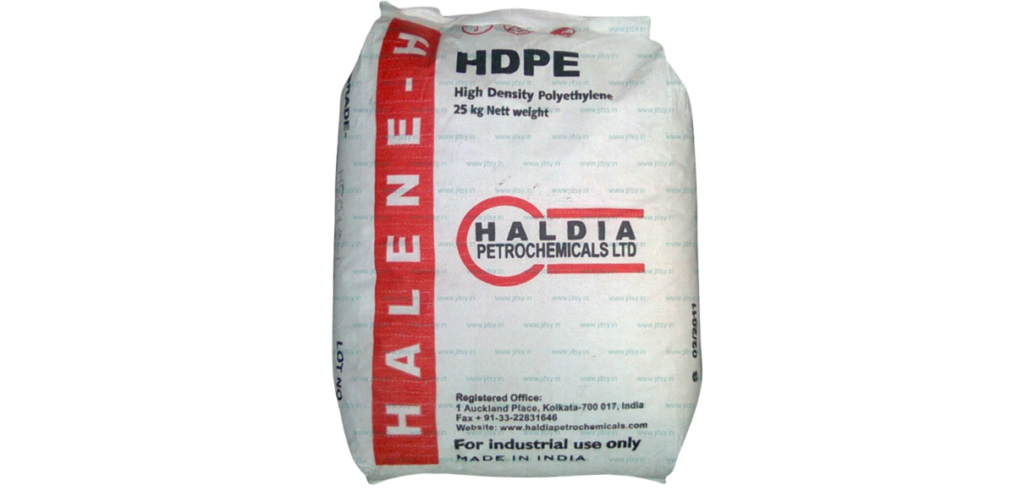
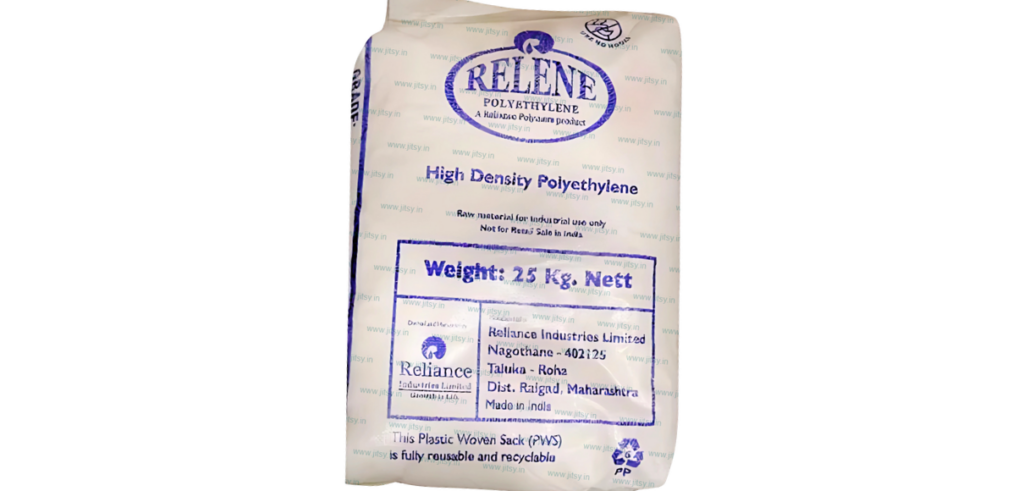
Reliance Relene F46003 and F46003E are the most directly comparable grades from another major Indian HDPE producer in the co-extrusion and liner film segment. Reliance’s grade summary lists F46003 for co-extrusion, liners, and blow-moulding under 5 L, with a reported MFI of 0.35 and density of 0.948 — close to the 003F46 profile. The more detailed F46003E TDS shows tensile values of 29/26 MPa (yield) and 45/40 MPa (ultimate), elongation at break of 780/950%, dart impact of 2 g/μm, and tear strength of 0.40/0.45 g/μm — a mechanical property set that mirrors IOCL 003F46 closely. However, F46003E has a notably higher MFI of 1.0 g/10 min (compared to 003F46’s 0.30–0.35 g/10 min), which represents a meaningful difference in melt viscosity and processing characteristics on the film line. Direct property equivalence between F46003/F46003E and 003F46 is not confirmed by either manufacturer; any commercial substitution requires independent film trials and customer qualification.
OPaL HDPE F52H04 is a film extrusion grade from ONGC Petro Additions Limited, produced using Mitsui CX slurry technology and positioned for garment bags, grocery bags, merchandise bags, and similar blown film applications. The grade carries the same IS 10146:1982, IS 10141:1982, and FDA CFR 21 177.1520 regulatory compliance as 003F46. However, the Mitsui CX slurry technology differs from IOCL’s Sclairtech solution process in molecular weight distribution architecture, which can affect gel behaviour, processability, and film property profiles differently. OPaL F52H04 is a comparable film-grade option for bag applications, but not a confirmed equivalent to 003F46 for co-extrusion film structures where low gel content is the specific selection driver.
Common Search Variants
Buyers and engineers commonly search for this grade using terms such as HDPE blown film granules India, IOCL film grade HDPE 003F46, co-extrusion HDPE resin granules, Propel liner grade, and IOCL HDPE 0.35 MFI film grade. Frequent spacing variants and alternate notations include IOCL HDPE 003 F46, 003F46 HDPE granules, HD raffia IOCL 003F46, and IOCL HDPE blown film 003F46 0.35 MFI — all refer to the same product.















Reviews
Clear filtersThere are no reviews yet.