IOCL HDPE Propel 002DB52 is a high-density bimodal polyethylene blow-moulding grade manufactured by Indian Oil Corporation Ltd. (IOCL) under the Propel brand. Unlike IOCL’s injection-moulding HDPE grades — which are produced using Nova Chemical’s Sclairtech solution polymerisation technology — HDPE 002DB52 is produced at IOCL’s dedicated HDPE plant using LyondellBasell’s Hostalen slurry process. This is a critical distinction: the Hostalen slurry process is specifically designed to produce bimodal molecular weight distribution HDPE, a polymer architecture that delivers an exceptional balance of stiffness and impact toughness that unimodal grades typically cannot achieve simultaneously at the same density.
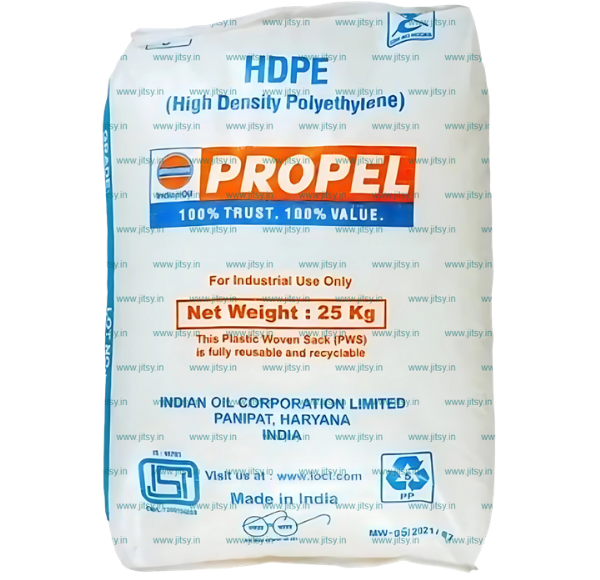
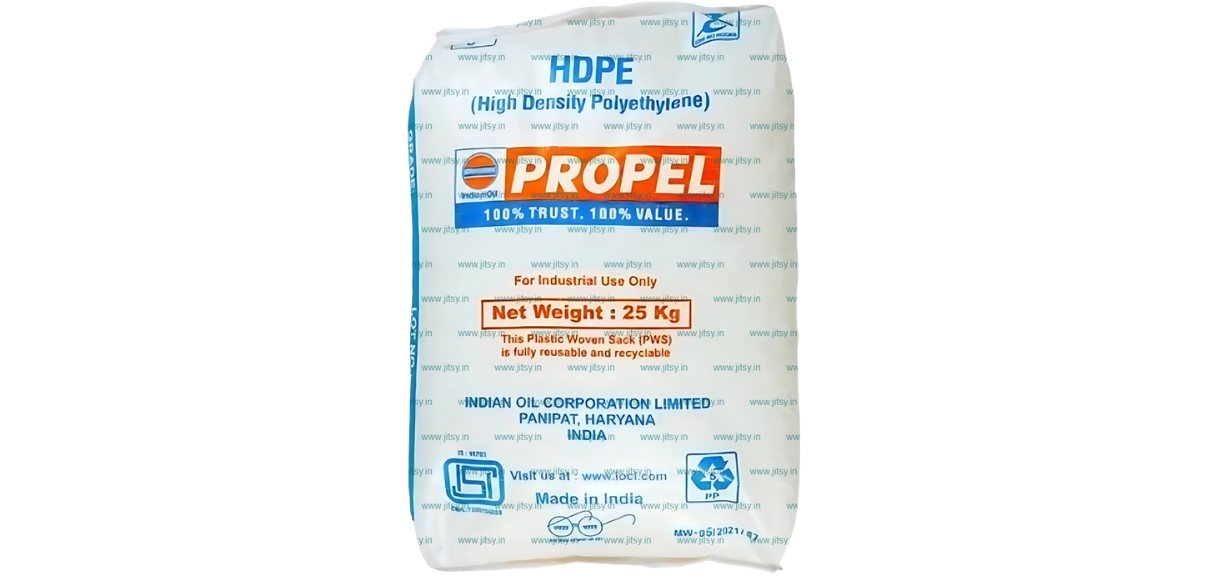
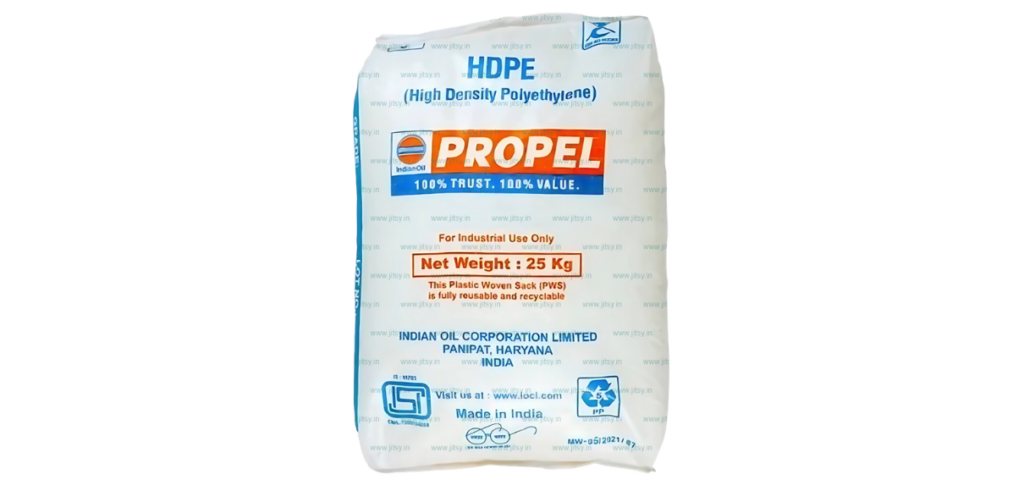
The grade is supplied as natural-coloured granules in 25 kg BIS-compliant raffia bags and is positioned by IOCL for extrusion blow moulding applications — specifically for blow-moulded containers for lubricating oil packaging up to 5 L capacity, as stated in IOCL’s grade sheet, and for large blow-moulded containers up to 100 L for the transport and storage of chemicals. The grade is also associated with the water tank industry in distributor-channel documentation, though IOCL’s primary grade for large blow-moulded water tanks up to 1,000 L is the sister grade 003DB52; 002DB52 is better positioned for chemical containers and smaller-volume lube oil packaging.
The term “bimodal” in the grade designation refers to the molecular weight distribution of the resin. Bimodal HDPE contains two distinct polymer populations — a high-molecular-weight fraction that contributes toughness, ESCR (environmental stress crack resistance), and long-term strength, and a lower-molecular-weight fraction that provides the melt processability needed for blow-moulding equipment to run efficiently. The Hostalen slurry process, developed by LyondellBasell, achieves this distribution through a dedicated reactor cascade, producing a polymer that outperforms single-reactor unimodal HDPE on the stiffness-impact balance at equivalent density. This is why IOCL’s own positioning for 002DB52 describes it as a grade with “excellent processability and mechanical properties” and “a good balance of stiffness and impact properties.”
Technical Insights
The property profile of IOCL HDPE Propel 002DB52 is built around the requirements of industrial blow-moulding applications — particularly chemical containers and lube oil packaging — where wall-thickness consistency, top-load strength, drop resistance, and chemical resistance all play a role in determining product performance and service life.
- Melt Flow Index — 0.2 g/10 min (ASTM D1238, 190 °C / 5 kg) and 5.5 g/10 min (ASTM D1238, 190 °C / 21.6 kg): Blow-moulding HDPE grades are characterised using two MFI values measured at different loads — unlike injection-moulding HDPE grades, which are measured at 2.16 kg. The low-load MFI (0.2 g/10 min at 5 kg) reflects the melt viscosity under conditions closest to parison formation, where the molten tube of resin must hold its shape and resist gravitational sag between the die exit and mould closure. An MFI as low as 0.2 g/10 min indicates a highly viscous melt with strong parison integrity — the property that enables wall-thickness uniformity in tall or large-diameter blow-moulded containers. The high-load MFI (5.5 g/10 min at 21.6 kg) characterises the shear-thinning behaviour of the melt under the higher stress conditions of the die, indicating that the resin flows adequately through the blow-moulding head and produces acceptable throughput rates despite its high molecular weight.
- Density — 0.953 g/cm³ (ASTM D1505, 23 °C): At 0.953 g/cm³, HDPE 002DB52 sits at the higher-density end of standard blow-moulding HDPE. High density in HDPE correlates with crystallinity, which directly governs stiffness, moisture barrier performance, and chemical resistance. For chemical containers and lube oil packaging, the density level ensures that the container wall provides adequate barrier against moisture ingress, resists permeation by hydrocarbon-based contents, and maintains dimensional integrity when exposed to the chemicals it is designed to hold.
- Tensile Strength at Yield — 28 MPa (ASTM D638): A tensile yield strength of 28 MPa is slightly higher than the 25 MPa typical of IOCL’s injection-moulding HDPE grades, reflecting the density advantage of this bimodal resin. For blow-moulded containers, this governs how much internal pressure or external mechanical load the container wall can absorb before beginning to deform permanently — relevant for filled chemical drums and oil containers that experience hydrostatic pressure, handling stress, and stacking loads.
- Elongation at Yield — 10% / Elongation at Break — >600% (ASTM D638): The combination of a defined yield point at 10% strain and very high elongation at break exceeding 600% describes a tough, ductile material that resists sudden brittle fracture under impact. This high ductility is critical for blow-moulded containers subject to drop testing during certification, rough handling in chemical plants, and the cyclic stresses of repeated filling and emptying cycles over a long service life.
- Flexural Modulus — 1,100 MPa (ASTM D790): At 1,100 MPa, HDPE 002DB52 delivers significantly higher stiffness than IOCL’s injection-moulding grades, which typically range from 800 to 900 MPa. This elevated modulus is a direct outcome of the grade’s higher density and bimodal molecular weight distribution, both of which increase crystallinity and contribute to stiffer polymer chains. For blow-moulded containers, high flexural modulus translates into better top-load performance — the ability to stack filled containers without the bottom containers deforming — and better dimensional stability of container walls under hydrostatic pressure from the contents.
- Notched Izod Impact Strength — 500 J/m (ASTM D256, 23 °C): This is the standout figure in the 002DB52 property set and the most direct expression of the bimodal architecture’s performance advantage. At 500 J/m, the grade delivers notched impact strength more than five times higher than IOCL’s standard injection-moulding HDPE grades (80–90 J/m range). The high-molecular-weight fraction of the bimodal distribution creates polymer chain entanglements that bridge crack fronts and resist crack propagation — the mechanism that produces this exceptional toughness. For chemical drums and large containers, 500 J/m impact strength means container walls and base sections resist cracking at notch-like weld lines, parting lines, and handle attachment points even under severe drop and impact conditions.
- Hardness — 63 Shore D (ASTM D2240): At 63 Shore D, the moulded container surface is firmer than most injection-moulding HDPE grades in the Propel family and resistant to surface indentation and scuffing in industrial handling environments. This hardness level reflects the high density and crystallinity of the resin.
- Vicat Softening Point — 126 °C (ASTM D1525) / HDT — 75 °C at 0.455 MPa (ASTM D648): The Vicat softening point of 126 °C indicates that the polymer begins to soften under a defined load at this temperature. The heat deflection temperature of 75 °C at 0.455 MPa is the more operationally relevant figure for container design: it indicates the temperature at which the moulded container will begin to deflect under a defined bending load. For blow-moulded chemical containers stored in industrial environments or exposed to hot-fill contents, the 75 °C HDT confirms that containers maintain their functional shape under moderate thermal loads but should not be used for contents significantly exceeding this temperature on a continuous basis.
- Processing Temperature — 180–220 °C (Extrusion Blow Moulding): The 180–220 °C processing window for 002DB52 is standard for industrial blow-moulding HDPE and is compatible with conventional continuous and accumulator-head blow-moulding machines used for containers ranging from 1 L to 100 L capacity.
All values are typical figures reported in IOCL’s grade documentation and mirror sources. They are not to be construed as specification limits; values may change without prior notice. Buyers should verify all data against the current IOCL technical datasheet before design qualification.
Applications
Lubricating Oil and Automotive Fluid Packaging
IOCL’s grade sheet explicitly positions Propel 002DB52 for blow-moulded containers for lubricating oil packaging up to 5 L capacity. This is the most directly manufacturer-confirmed application for the grade. Lube oil containers — used for engine oils, transmission fluids, hydraulic oils, and industrial lubricants — require a blow-moulding HDPE that combines good parison control for consistent wall thickness, adequate stiffness for stable stacking on filling lines and in retail display, and chemical resistance to the hydrocarbon-based contents. The 0.953 g/cm³ density and 1,100 MPa flexural modulus of 002DB52 provide the stiffness and barrier properties for this application, while the 500 J/m notched Izod impact strength ensures containers survive the drop impacts and rough handling of automotive aftermarket distribution channels.
Large Chemical Containers and Industrial Drums
For large blow-moulded chemical containers up to 100 L for the transport and storage of chemicals, HDPE 002DB52 is positioned as a technically capable blow-moulding resin. Large chemical containers face the most demanding combination of requirements in industrial packaging: high hydrostatic pressure from the fill weight, chemical contact with a wide range of aggressive substances, regulatory requirements for materials that are not adulterated by the contents, and the mechanical demands of industrial logistics environments that include forklift handling, pallet stacking, and long-distance transport. The bimodal molecular weight distribution of 002DB52 directly addresses the ESCR challenge — the tendency of HDPE to develop stress cracks when under mechanical stress in contact with surfactants, solvents, or aggressive chemicals. Bimodal HDPE grades produced via the Hostalen slurry process are well established in the chemical packaging industry for precisely this combination of high ESCR, high stiffness, and good blow-moulding processability.
Water Storage and Utility Containers
IOCL’s grade family documentation and distributor-channel data associate 002DB52 with the water tank industry and large blow-moulded containers. For smaller blow-moulded water tanks, water storage containers, and utility vessels in this size range, 002DB52’s mechanical property profile is relevant. It is important to note, however, that IOCL’s dedicated blow-moulding grade for large water tanks up to 1,000 L is the sister grade 003DB52, which is explicitly positioned by IOCL for that application. Buyers specifying blow-moulded water storage products at the larger end of the range should evaluate 003DB52 as the primary IOCL option, while 002DB52 remains suitable for smaller water containers and utility storage applications where the chemical container and lube oil packaging property profile is appropriate.
Industrial Packaging for Detergents, Agrochemicals, and Process Chemicals
Beyond lubricant and bulk chemical applications, HDPE blow-moulded containers produced from 002DB52 are applicable across the industrial packaging landscape for detergents, cleaning chemicals, agrochemical formulations, and process industry fluids. The IS 10146:1982 and IS 10141:1982 compliance certifications provide the regulatory basis for containers used in segments where material compliance to Indian standards is a procurement requirement. The grade’s HDPE chemistry provides inherent resistance to the surfactants, alkalis, and aqueous formulations common across these sectors, and the high notched Izod impact strength ensures containers remain structurally sound through the handling conditions of industrial supply chains.
Comparable Alternatives
IOCL HDPE Propel 003DB52 is the most directly related sister grade and the most important comparison for buyers evaluating blow-moulding HDPE options within the IOCL HDPE Propel family. Both grades are bimodal HDPE produced via LyondellBasell’s Hostalen slurry process at the same IOCL plant. The key published differences from 003DB52’s TDS are a slightly higher MFI (0.32 g/10 min at 5 kg versus 0.2 g/10 min for 002DB52), a marginally lower density of 0.952 g/cm³, a higher flexural modulus of 1,300 MPa, and a higher tensile yield of 32 MPa, but lower notched Izod impact strength of 300 J/m compared with 500 J/m for 002DB52. The 003DB52 grade is explicitly positioned by IOCL for blow-moulded water tanks up to 1,000 L, solar panel floaters, and containers for detergents and chemicals up to 100 L, with a specific ESCR rating (F50 500 h) published in its TDS. For buyers requiring confirmed ESCR performance data for chemical containers or selecting a grade for large water tanks, 003DB52’s documented ESCR value and water-tank positioning make it the preferred specification. HDPE 002DB52, with its higher published impact strength at 500 J/m, is better positioned for applications where notch-toughness is the dominant selection criterion. The two grades are not confirmed equivalents and must be evaluated separately through blow-moulding trials.
IOCL HDPE Propel 012DB54 is another bimodal blow-moulding grade within the Propel family, positioned for general-purpose containers and bottles up to 5 L for lube oil, edible oil, and FMCG products. With a higher MFI than 002DB52, 012DB54 is better suited to smaller, thin-wall containers and general-purpose packaging where processability and output rate are prioritised over the parison strength and heavy-duty mechanical performance that 002DB52 is designed to deliver. For buyers whose application requires containers up to 5 L in a general-purpose FMCG or edible oil context, 012DB54 is the more appropriate IOCL option; for lubricating oil packaging and chemical containers where structural performance matters, 002DB52 is the correct specification.
IOCL’s injection-moulding HDPE grades — including Propel 080M60, 080M55, 020M52, and 180M50 — are produced by a completely different polymerisation technology (Sclairtech solution process), have a different molecular architecture, and are formulated for injection moulding, not blow moulding. These grades are not alternatives for blow-moulded containers and should not be evaluated as substitutes. The processing equipment, mould design, and wall-thickness expectations are entirely different between injection and blow moulding applications.
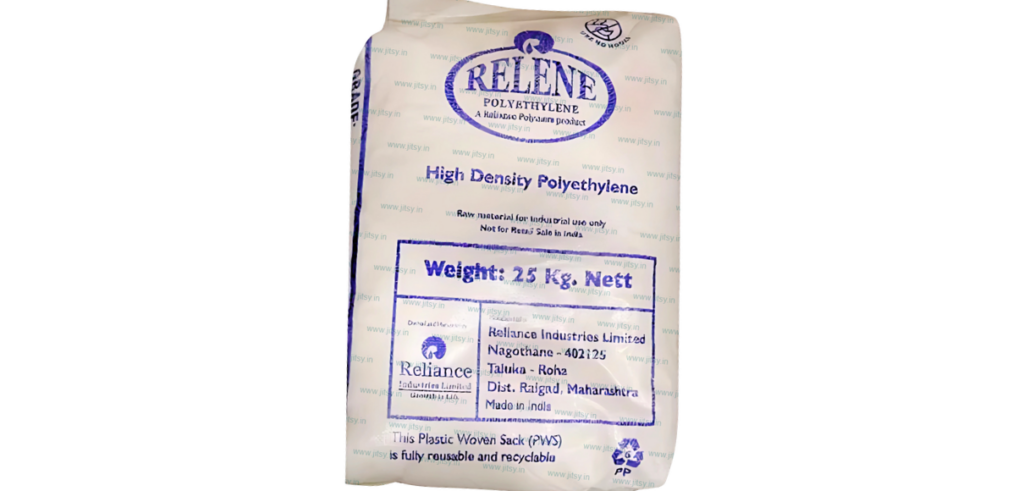
Reliance Relene 52GB002 is a broadly comparable Indian blow-moulding HDPE grade with published MFI of 0.25 g/10 min and density 0.952 g/cm³, described for blow-moulded containers up to approximately 100 L with good ESCR. On headline MFI and density, this grade occupies a similar space to 002DB52. However, direct property-by-property equivalence between Relene 52GB002 and Propel 002DB52 is not confirmed by either manufacturer, and the differences in polymerisation technology, additive systems, and property measurement protocols can produce meaningful variation in ESCR performance, impact behaviour, and processing characteristics. Any substitution must be validated through independent blow-moulding trials and relevant container testing before qualification.
Haldia Petrochemicals B5500 is another Indian bimodal HDPE blow-moulding grade with a slightly higher density (0.956 g/cm³) and a focus on high-ESCR bulk containers and water tanks. It is a higher-density variant that sits in the same general application segment but differs on density and performance profile. Equivalence to 002DB52 is not confirmed; it should be evaluated independently for any specific container application.
Common Search Variants
Buyers and engineers commonly search for this grade using terms such as bimodal HDPE for chemical drums, IOCL blow moulding HDPE granules, Propel large container grade, 002DB52 IOCL granules, and HDPE blow moulding grade for lube oil containers India. Frequent spacing variants and alternate notations include IOCL HDPE 002 DB 52, 002DB52 HDPE granules, IOCL 002DB52 blow moulding, and Propel bimodal HDPE 002DB52 — all refer to the same product.











Reviews
Clear filtersThere are no reviews yet.