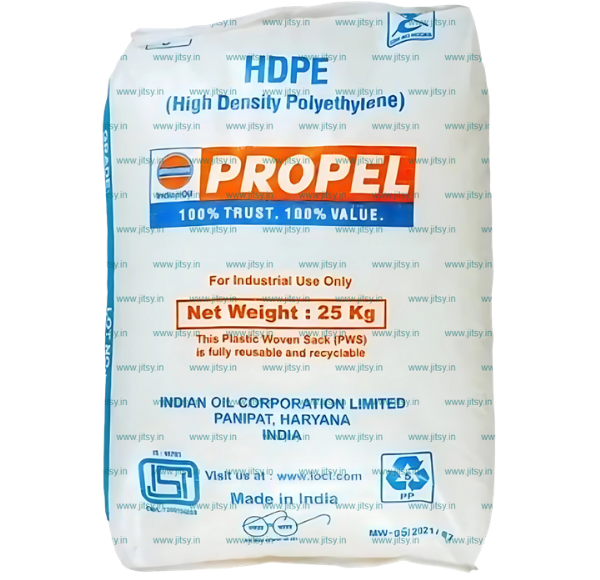
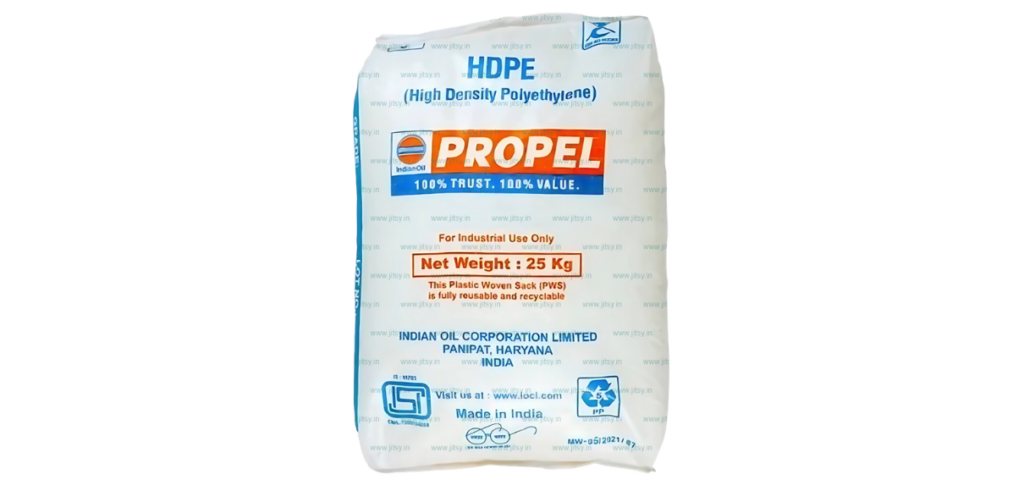
HDPE Propel 080M60U is a UV-stabilized high-density polyethylene injection-moulding grade manufactured by Indian Oil Corporation Ltd. (IOCL) under the Propel brand. Produced using Nova Chemical’s Sclairtech solution technology, it is supplied as natural-coloured granules in 25 kg BIS-compliant raffia bags and is positioned by IOCL for injection-moulded crates and paint pails intended for outdoor applications.
The “U” in the grade designation is the defining identifier: it indicates a UV stabilisation package built into the polymer formulation. Without UV stabilisation, prolonged exposure to sunlight causes photo-oxidative degradation in HDPE — a process that progressively embrittles the polymer, causes surface chalking, and leads to premature cracking and structural failure in moulded parts. The UV stabilisers in HDPE 080M60U interrupt this degradation mechanism, extending the functional service life of outdoor crates, storage pails, and open-environment material-handling equipment significantly beyond what a non-stabilised grade of equivalent properties would deliver.
Alongside UV stabilisation, IOCL characterises 080M60U as having good ESCR — environmental stress crack resistance — in addition to good processability and very good mechanical properties. ESCR is the resistance of a polymer to cracking when simultaneously under mechanical stress and in contact with chemical agents that accelerate surface degradation. For paint pails and outdoor storage containers that may hold paints, detergents, agricultural chemicals, or cleaning products, good ESCR is not a secondary consideration; it is the property that determines whether the container wall and base remain structurally sound through fill, storage, and distribution without developing stress cracks at mould weld lines, corners, or load-bearing sections.
The mechanical and flow profile of HDPE 080M60U is built on the same foundation as the base 080M60 grade. At MFI 8.0 g/10 min, the grade fills large crate and pail cavities efficiently. The 850 MPa flexural modulus and 90 J/m notched Izod impact strength provide the rigidity and toughness combination that outdoor material-handling products require to survive repeated loading, stacking, forklift handling, and environmental exposure. The 127 °C Vicat softening point ensures parts retain their dimensional integrity through India’s summer ambient temperatures and direct-sun exposure, where surface temperatures on outdoor plastic can exceed 60 °C significantly. IOCL’s compliance certifications for IS 10146:1982, IS 10141:1982, and FDA CFR Title 21 Section 177.1520 apply to this grade family, providing the regulatory basis for food-adjacent and regulated packaging applications.
Technical Insights
Understanding the Key Properties of HDPE 080M60U
The properties of HDPE Propel 080M60U are best evaluated as an integrated profile for outdoor injection moulding, where UV durability and ESCR are layered on top of a solid mechanical and processing foundation.
- UV Stabilisation — Built-in Additive Package: This is the grade’s defining attribute and the reason for specifying 080M60U over any non-UV grade of similar MFI and density. The UV stabilisers work by absorbing or scavenging the UV radiation and free radicals that initiate photo-oxidative chain reactions in polyethylene. Without them, prolonged outdoor exposure leads to surface chalking, colour fade, loss of elongation, and ultimately brittle fracture under loads that the original moulded part would have handled without issue. The stabiliser package in 080M60U is formulated to extend service life in open-environment conditions where crates and pails face daily UV cycling and weather exposure.
- ESCR — Good Environmental Stress Crack Resistance: ESCR is the resistance of a moulded HDPE part to cracking when it is under mechanical stress and in contact with an ESCR-active medium such as a surfactant, detergent, paint solvent, or cleaning agent. For paint pails specifically, the combination of the filled container weight, residual moulding stresses, and the chemical nature of the pail contents makes ESCR a critical selection criterion. IOCL’s explicit ESCR characterisation for 080M60U distinguishes it from standard crate grades and positions it for the pail and outdoor container segment where this property matters.
- Melt Flow Index — 8.0 g/10 min (ASTM D1238, 190 °C / 2.16 kg): The MFI of 8.0 g/10 min supports efficient filling of the deep, ribbed cavities common in industrial crate and pail moulds. It delivers a balance between fill speed and molecular weight retention — high enough for good productivity, low enough to preserve the mechanical and ESCR performance that outdoor applications require.
- Density — 0.960 g/cm³ (ASTM D1505, 23 °C): The 0.960 g/cm³ density reflects a high degree of crystallinity, which underpins the stiffness, chemical barrier, and moisture resistance of the moulded crate or pail. High crystallinity also contributes positively to ESCR by reducing the free volume in the polymer matrix through which stress-cracking agents can diffuse.
- Tensile Strength at Yield — 25 MPa / Elongation at Break — >800% (ASTM D638): The 25 MPa tensile yield strength provides structural integrity under the loads that filled crates and pails experience in transit and stacking. The high elongation at break of over 800% confirms ductile failure behaviour, meaning that parts deform plastically before fracturing — a property that contributes to impact and ESCR performance in service.
- Flexural Modulus — 850 MPa / Flexural Yield Strength — 20 MPa (ASTM D790): At 850 MPa, moulded crate walls and pail bases resist bending under stacked loads. This stiffness level ensures that crates maintain their shape in racking and palletised storage systems, and that pails do not deform or oval when handled by their handles under full fill weight.
- Notched Izod Impact Strength — 90 J/m (ASTM D256, 23 °C): Outdoor crates and pails are exposed to drop impacts, rough handling, and impact from loading equipment. At 90 J/m, HDPE 080M60U provides meaningful toughness at notch-sensitive weld lines, corner features, and rim sections where cracking would otherwise initiate under sudden mechanical load.
- Hardness — 55 Shore D (ASTM D2240): A Shore D of 55 gives crate and pail surfaces a firm, scuff-resistant finish that withstands the abrasion and surface contact of warehouse and yard environments without marking easily.
- Vicat Softening Point — 127 °C (ASTM D1525): The 127 °C Vicat point is directly relevant to outdoor products in India where surface temperatures on dark-coloured or black crates left in direct sun can rise substantially above ambient air temperature. At 127 °C, moulded parts retain dimensional stability well above the thermal conditions encountered in outdoor storage yards, uncovered logistics environments, and agricultural field use.
- Processing Temperature — 180–215 °C: The standard HDPE injection processing window applies to 080M60U, providing compatibility with existing machine and mould configurations used for non-UV crate and pail grades.
All values are typical figures from IOCL’s provisional technical datasheet and are not specification limits. Values may change without prior notice; buyers should verify against the current IOCL grade sheet before final grade qualification.
Applications
Outdoor Material-Handling Crates and Storage Equipment
The primary application for HDPE Propel 080M60U is injection-moulded crates used in outdoor material-handling, agricultural logistics, and open-yard storage environments. Standard HDPE crate grades without UV stabilisation will perform adequately indoors or in covered warehouses, but will degrade progressively when left in direct sunlight across seasons — losing surface gloss first, then elongation, then impact resistance, before reaching a brittle failure state. HDPE 080M60U addresses this directly: the UV stabilisation package extends the operational life of crates used in outdoor yards, agricultural fields, fish landing centres, and uncovered logistics hubs where daily sun exposure is unavoidable. For crate specifiers and buyers who need product life guarantees across multiple outdoor seasons, 080M60U is the correct grade; the non-UV 080M60 is not a suitable substitute in those environments.
Paint Pails and Coating Containers
IOCL explicitly positions HDPE 080M60U for paint pails, and the grade’s property profile explains why. Paint pails face a combination of challenges that most other injection-moulded containers do not: the container walls and base carry a substantial fill weight, the paint or coating chemistry can include solvents, surfactants, and reactive components that act as ESCR-active agents, and the containers are often stored outdoors at retail or construction sites under direct sunlight. The good ESCR of 080M60U addresses the chemical stress component; the UV stabilisation addresses the light-exposure component; and the 850 MPa flexural modulus and 90 J/m impact strength address the structural and handling demands of a heavy, filled container in a rough-use environment. Together, these attributes make 080M60U a purpose-matched grade for this application.
Agricultural Crates and Produce Handling Equipment
In Indian agriculture, reusable plastic crates for fruits, vegetables, fish, and poultry are frequently used in outdoor environments — from farm to mandis to distribution hubs — often without covered storage between uses. UV degradation in unstabilised crate grades leads to shortened product life, increased crate breakage, and higher replacement costs for farmers and aggregators. HDPE 080M60U’s UV stabilisation package extends crate service life in these conditions, supporting the economics of reusable crate programmes. The grade’s 90 J/m impact strength and >800% elongation at break also ensure that crates survive the drop impacts, rough stacking, and vehicle transport vibration inherent in agricultural supply chains.
Outdoor Industrial Containers and Utility Products
Beyond paint pails, HDPE 080M60U is applicable to a range of injection-moulded industrial containers and utility products used in outdoor environments — storage buckets, outdoor waste bins, site containers, meter boxes, and utility enclosures. For any rigid injection-moulded HDPE product that will spend meaningful time in direct sunlight, specifying a UV-stabilised grade is the engineering-correct decision. The mechanical property profile of 080M60U — derived from the same Sclairtech polymer base as 080M60 — ensures that this UV protection comes without compromise to the structural and handling performance the end product requires.
Outdoor Crates for Cold Chain and Fishery Logistics
Fish crates and cold-chain containers used in Indian coastal and inland fisheries are among the highest-wear reusable plastic items in the logistics sector. They are used on fishing boats, at landing centres, in open ice storage, and during transport — all conditions involving direct sunlight, saltwater, and frequent rough handling. The combination of UV stabilisation, good ESCR, 90 J/m impact strength, and the chemical resistance inherent in 0.960 g/cm³ HDPE makes 080M60U a well-matched grade for fishery-sector injection-moulded crates that are expected to deliver multi-year service life in these demanding conditions.
Comparable Alternatives
HDPE Propel 080M60 — the non-UV variant — is the most direct comparison and the most important one for buyers to understand. The two grades share the same MFI of 8.0 g/10 min, the same density of 0.960 g/cm³, and the same mechanical property set: 25 MPa tensile yield, 850 MPa flexural modulus, 90 J/m notched Izod, and 127 °C Vicat. The single differentiating factor is the UV stabilisation in 080M60U and the associated ESCR characterisation. For applications entirely indoors or in covered environments with no meaningful sunlight exposure, 080M60 is appropriate and the UV additive in 080M60U adds no functional value. For any application involving direct or prolonged indirect sunlight — outdoor crates, open-yard pails, agricultural handling equipment — 080M60U is the required specification. Substituting 080M60 for 080M60U in an outdoor application is an engineering error that will result in premature product failure.
HDPE Propel 080M55 shares the same MFI of 8.0 g/10 min and a similar overall property range, but is positioned for caps, closures, and industrial products at a slightly lower density of 0.955 g/cm³. It does not carry the UV stabilisation or ESCR characterisation of 080M60U. For outdoor crate and pail applications, 080M55 is not the appropriate choice regardless of its similar MFI; the UV stabilisation gap makes it unsuitable for extended outdoor service.
Other Propel injection grades — including 020M52 (MFI 2.7 g/10 min, caps and closures focus) and 180M50 (MFI 18 g/10 min, housewares and thin-wall focus) — serve distinct application segments and different processing requirements. Neither carries UV stabilisation and neither is designed for the outdoor crate and pail market. They are not comparable alternatives for the use cases that define 080M60U’s market positioning.
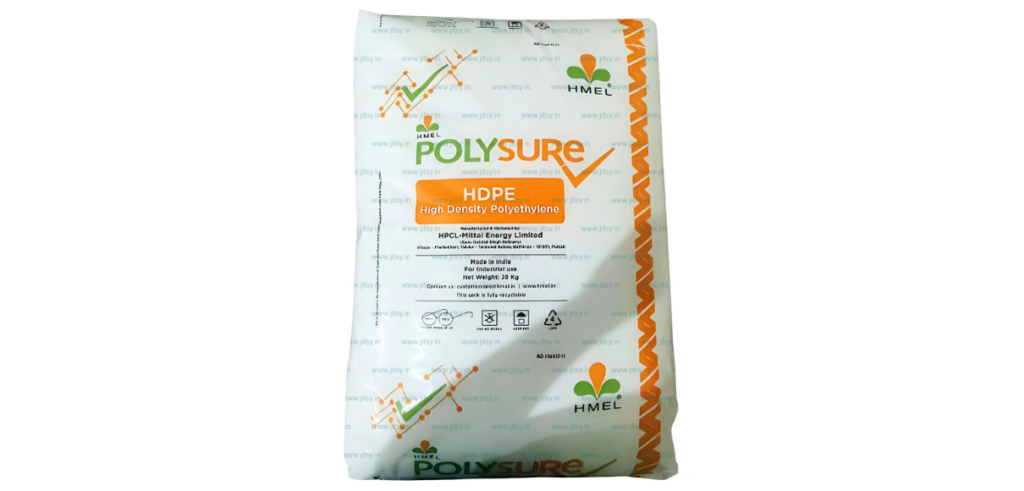
Other Indian UV-stabilized HDPE injection grades may exist from producers including HMEL, GAIL, OPAL, and Haldia Petrochemicals. Direct equivalence to HDPE Propel 080M60U is not confirmed unless grades are matched property-by-property from manufacturer TDS — including confirmation of UV stabiliser type, loading level, and ESCR performance — and validated through outdoor weathering trials or accelerated UV testing on the specific moulded part geometry. The UV stabilisation package and its performance over time is not fully described by standard mechanical property values alone.
Common Search Variants
Buyers and engineers commonly search for this grade using terms such as UV-stabilized HDPE crate grade, outdoor HDPE injection granules India, UV HDPE for paint pails, Propel granules 080M60U, and IOCL HDPE UV stabilized injection grade. Frequent misspellings and alternate notations include HDPE 80M60U, 080M6OU (with the letter O instead of zero), Propel 080M60U HDPE, IOCL 080M60U granules, and HDPE Propel 080M60 UV — all refer to the same product.











Reviews
Clear filtersThere are no reviews yet.