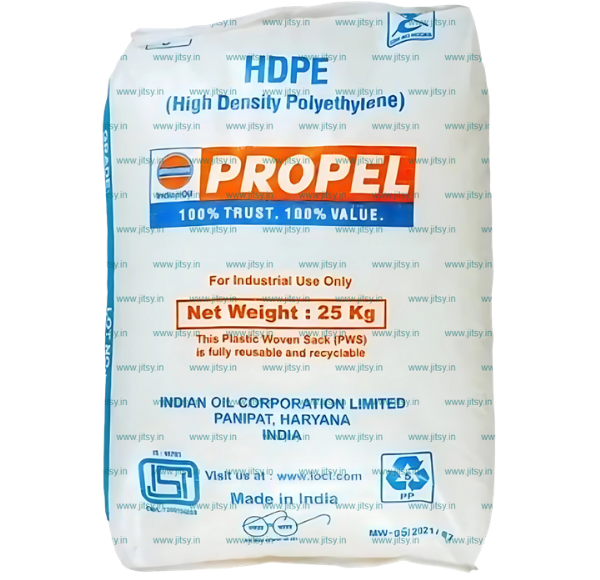
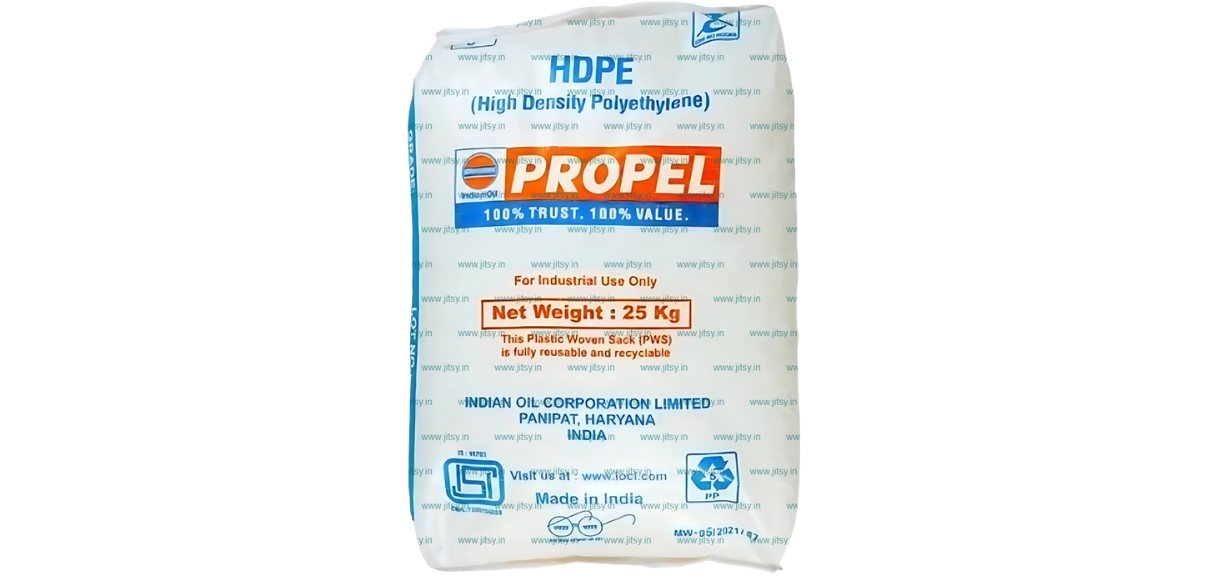
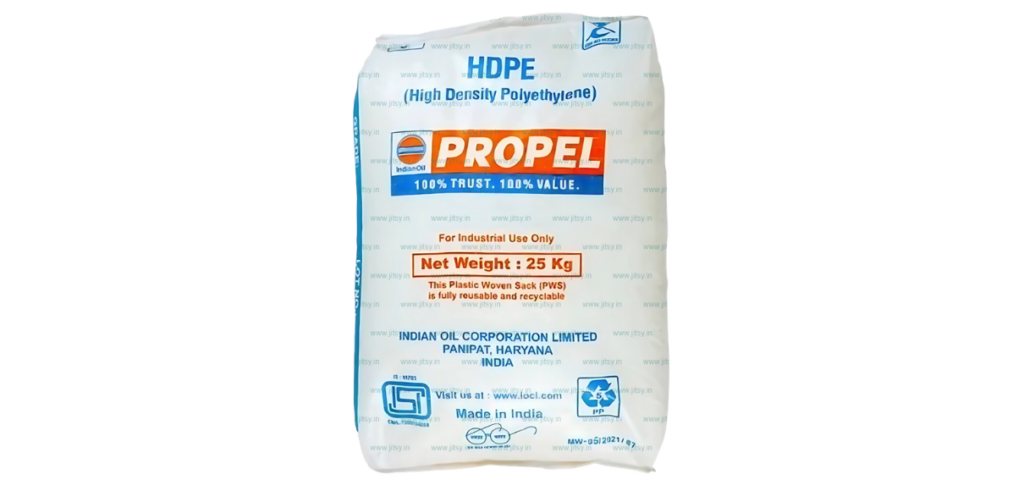
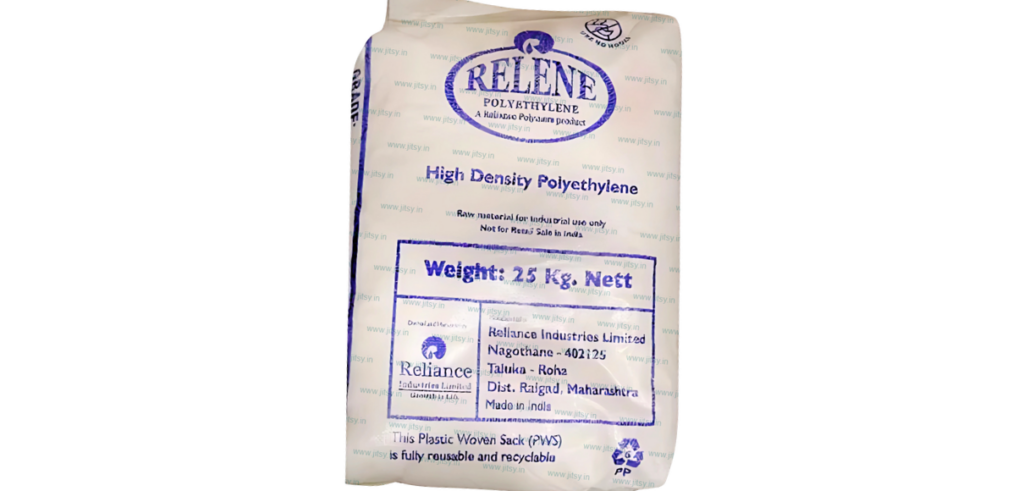
HDPE Propel 080M55 is a high-density polyethylene resin manufactured by Indian Oil Corporation Ltd. (IOCL) under its Propel brand. Produced using Nova Chemicals’ Sclairtech solution polymerisation technology, the grade is engineered specifically for injection moulding and is officially positioned by IOCL for caps and closures alongside a broader range of industrial moulded products. The grade is supplied as natural-coloured granules and is available commercially in India, packed in 25 kg BIS-compliant raffia bags.
IOCL characterises HDPE 080M55 as a polymer with good processability, very good mechanical properties, and good dimensional stability. This three-attribute description is deliberate: it captures the functional logic of the grade’s design. At MFI 8.0 g/10 min, the resin provides enough flow to fill closure cavities efficiently and support good surface detail in industrial moulded parts, without sacrificing the structural integrity that repeat-use caps and industrial fitments require. At density 0.955 g/cm³ and flexural modulus 850 MPa, it delivers the stiffness needed for closures to engage threads reliably and maintain part geometry through the handling, filling, and distribution cycle.
What makes the grade particularly relevant for closure applications is the combination of a high elongation at break — exceeding 800% — and an 80 J/m notched Izod impact strength. Together, these properties mean that closures moulded from HDPE 080M55 fail in a ductile manner rather than brittle fracture when stressed. For tamper-evident bands, snap-fit lids, hinge closures, and threaded caps that must open and close repeatedly without cracking at stress concentration points, ductile failure behaviour is the preferable failure mode by design. The 127 °C Vicat softening point further ensures that finished closures and industrial components retain their dimensions and function under the elevated temperatures encountered in hot-fill packaging lines, warm-climate distribution, and industrial environments.
IOCL certifies the HDPE Propel injection grade family — including 080M55 — as compliant with IS 10146:1982, IS 10141:1982, and FDA CFR Title 21 Section 177.1520 for olefin polymers. These certifications establish the grade’s applicability to food-contact closures and regulated packaging formats.
Technical Insights
The property set of HDPE Propel 080M55 reflects a balance engineered for caps, closures, and injection-moulded industrial parts — applications where flow, toughness, and dimensional stability must all be adequate, without any single attribute being pushed to an extreme at the expense of the others.
- Melt Flow Index — 8.0 g/10 min (ASTM D1238, 190 °C / 2.16 kg): An MFI of 8.0 g/10 min positions 080M55 in the productive mid-range of injection-moulding HDPEs. For closure moulds, this MFI supports clean cavity fill, good surface replication in fine thread geometries, and reasonable cycle times across standard single- and multi-cavity tooling. It is fast enough to fill efficiently without requiring the ultra-high pressures that lower-MFI grades demand, while retaining enough molecular weight for good toughness performance in the moulded part.
- Density — 0.955 g/cm³ (ASTM D1505, 23 °C): The density governs the level of crystallinity, which directly influences stiffness, chemical resistance, and barrier behaviour. At 0.955 g/cm³, HDPE 080M55 delivers reliable chemical resistance to moisture, oils, detergents, and a wide range of aqueous solutions — relevant for closures across food, chemical, and industrial packaging. The density is consistent with the HDPE classification and appropriate for parts expected to resist dimensional change through fill-line temperatures and distribution environments.
- Tensile Strength at Yield — 25 MPa (ASTM D638): The tensile yield strength determines how much tensile load the part can absorb before permanent deformation begins. For closures, this governs how much capping torque or consumer removal force the part can handle without deforming at the thread engagement zone. A 25 MPa yield strength is well-matched to the structural demands of rigid injection-moulded caps and fitments.
- Elongation at Yield — 11% / Elongation at Break — >800% (ASTM D638): The combination of an 11% elongation at yield and a very high elongation at break exceeding 800% is significant for closure design. It means the part has a well-defined elastic limit before yielding, but once past that limit it can deform substantially before fracturing. This ductile behaviour is particularly relevant for tamper-evident closures — where the band is designed to stretch and separate rather than snap — and for snap-fit lids where the design relies on controlled elastic deformation during opening.
- Flexural Yield Strength — 20 MPa / Flexural Modulus — 850 MPa (ASTM D790): Flexural modulus is the primary measure of part stiffness in bending. At 850 MPa, closure panels, container lids, and industrial fitments will hold their shape under stacking loads and resist the warping that can prevent proper sealing or lead to line jams on automated filling equipment. The 20 MPa flexural yield strength supports the same conclusion: parts will spring back from moderate deformation without taking a permanent set.
- Notched Izod Impact Strength — 80 J/m (ASTM D256, 23 °C): An impact strength of 80 J/m is appropriate for caps, closures, and injection-moulded industrial products that encounter mechanical shock during filling-line handling, transport vibration, and consumer use. It is not the highest impact value in the Propel injection family — lower-MFI grades like 020M52 deliver higher notched Izod values at the cost of flow — but it is sufficient for the geometry and wall thicknesses typical of rigid closure designs where the part is not under sustained impact loading.
- Hardness — 55 Shore D (ASTM D2240): Shore D hardness reflects surface firmness and scratch resistance. At 55 Shore D, closures have a firm, rigid surface that retains its appearance through retail handling and repeat consumer use. This hardness level is consistent with IOCL’s “very good mechanical properties” characterisation of the grade.
- Vicat Softening Point — 127 °C (ASTM D1525): The Vicat point confirms that the moulded part retains dimensional stability well above ambient and warm-climate service temperatures. For closures on hot-fill beverages and food products, and for industrial fitments exposed to process heat, a 127 °C Vicat point provides meaningful thermal headroom above actual service conditions.
- Processing Temperature — 180–215 °C: This standard HDPE injection window provides flexibility across machine configurations, closure geometries, and cycle rates. Staying within this range preserves the balance of flow, surface quality, and mechanical properties that the grade is formulated to deliver.
All values above are typical figures from IOCL’s technical datasheet and are not specification limits. Values may change without prior notice; buyers should verify against the current IOCL grade sheet before final grade qualification.
Applications
Caps and Closures for Food and Beverage Packaging
The primary positioning of HDPE Propel 080M55 is for injection-moulded caps and closures, and food and beverage packaging is the segment where this is most directly applicable. Closures on water bottles, juices, edible oils, dairy products, and condiment containers require a resin that fills thread geometries cleanly, maintains dimensional accuracy on high-speed capping lines, and survives consumer open-close cycles without cracking at thread roots or tamper-band perforations. HDPE 080M55’s MFI 8.0 g/10 min enables efficient fill in compact closure cavities, while the elongation at break exceeding 800% ensures ductile behaviour at the stress-concentration points built into tamper-evident and snap-closure designs. Food-contact compliance under IS 10141:1982 and FDA CFR 21 177.1520 supports direct use in food packaging without additional material qualification steps.
Caps and Closures for Chemical, Agrochemical, and Household Product Packaging
Closures for cleaning products, agrochemicals, lubricants, and household chemicals must seal effectively while resisting the contents they are applied to. The density and crystallinity of HDPE 080M55 provide the chemical resistance profile expected in this segment, including resistance to surfactants, dilute acids and alkalis, agricultural formulations, and hydrocarbon-based products. The 127 °C Vicat softening point also supports hot-fill applications in household chemical packaging where the product is filled at elevated temperature before the closure is applied. IS 10146:1982 compliance provides the regulatory basis for closures applied to containers carrying products within that standard’s scope.
Industrial Moulded Products and Fitments
IOCL’s positioning of HDPE 080M55 extends explicitly to industrial moulded products, which covers a wide range of injection-moulded components beyond consumer-facing closures: dispensing plugs, vent caps, container fitments, valve components, pipe end caps, and similar rigid parts used across manufacturing, logistics, and process industries. For these applications, the combination of good processability — MFI 8.0 g/10 min with a standard 180–215 °C processing window — and very good mechanical properties supports efficient production of consistent, dimensionally stable parts across standard injection-moulding equipment.
Material-Handling and Packaging Components
IOCL’s broader Propel injection-moulding grade family associates this MFI and property range with crates, pallets, and handling products alongside caps and closures. For smaller-format injection-moulded material-handling components — tote handles, container fitments, bin clips, and pallet accessories — HDPE 080M55 offers a processable, structurally adequate option. The elongation at break exceeding 800% and the 80 J/m impact strength are relevant for parts that experience repeated mechanical stress in warehouse and logistics environments, where brittleness would cause rapid in-service failure.
Industrial and Consumer Container Components
For moulded components attached to or integrated with industrial containers — including pail handles, lid fitments, drum closures, and bulk container caps — HDPE 080M55’s combination of dimensional stability, chemical resistance, and moderate impact performance is a practical choice. The grade’s regulatory compliance statements support its use in containers for food-grade industrial products, while its processing profile suits the varied part geometries and wall thicknesses encountered across container fitment applications.
Comparable Alternatives
HDPE Propel 020M52 — IOCL’s other primary caps-and-closures injection grade — runs at MFI 2.7 g/10 min and delivers 180 J/m notched Izod impact strength. Compared with 080M55, it is significantly tougher at notch-sensitive stress concentrations, which is the appropriate choice when closure geometry — thin tamper bands, sharp undercuts, fine thread roots — creates high local stress concentrations that demand maximum ductile resistance to cracking. The trade-off is that 020M52’s lower MFI requires more injection pressure and typically longer fill times, which affects throughput on high-cavitation tools. HDPE 080M55, at MFI 8.0 g/10 min with adequate 80 J/m impact, is the better fit when closure productivity and fill efficiency are the primary production requirements alongside acceptable toughness performance.
HDPE Propel 080M60 shares the same MFI of 8.0 g/10 min with HDPE 080M55, making it the most directly comparable grade in terms of processing behaviour. The key differences are density — 080M60 at 0.960 g/cm³ versus 080M55 at 0.955 g/cm³ — and the application positioning IOCL assigns: 080M60 is targeted at industrial crates and pallets where heavier-wall structural moulding is the dominant use, while 080M55 is targeted at caps, closures, and industrial products. The marginally higher density of 080M60 gives it slightly greater stiffness, which is meaningful for large structural crate and pallet geometries but is less relevant for the thinner, more compact geometry of most closures. Converters running the same injection equipment and needing to process both closure and crate grades should confirm process parameters separately for each, despite the shared MFI.
HDPE Propel 180M50, at MFI 18 g/10 min, is the high-flow end of the Propel injection family. For very thin-wall closure designs, high-cavitation tools, or applications where gloss and fast fill dominate the requirements, 180M50 is the more appropriate choice. The substantially higher MFI of 180M50 compared with 080M55 represents a different processing regime and a different molecular weight profile; the two are not interchangeable and each suits different closure converter needs.
Other Indian HDPE injection grades in the caps-and-closures segment from producers including HMEL, GAIL, OPAL, and Haldia Petrochemicals may appear in the same MFI and density range. Direct equivalence to HDPE Propel 080M55 is not confirmed unless grades are matched property-by-property from manufacturer TDS and validated through trials on the specific closure mould and machine configuration in use.
Common Search Variants
Buyers and engineers commonly search for this grade using terms such as HDPE dana for caps and closures, 8 MFI HDPE injection granules, closure-grade HDPE resin India, Propel granules 080M55, and IOCL HDPE cap grade. Frequent misspellings and alternate notations include HDPE 80M55, 080M5O (with the letter O instead of zero), Propel 080M55 HDPE, IOCL 080M55 granules, and HDPE Propel 080M55 datasheet — all refer to the same product.



















Reviews
Clear filtersThere are no reviews yet.