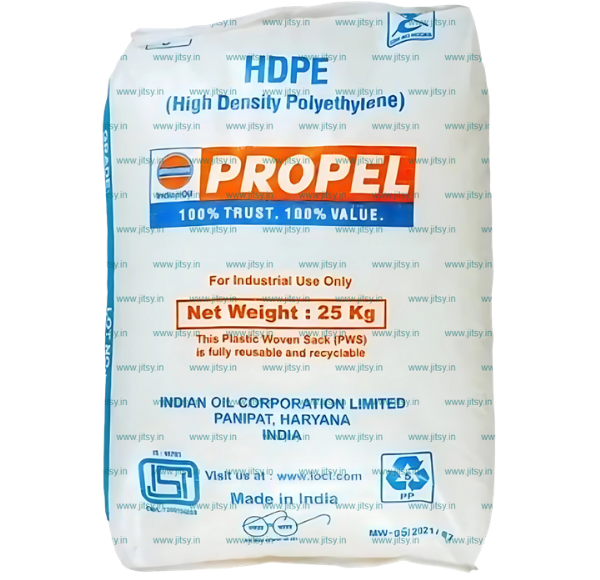
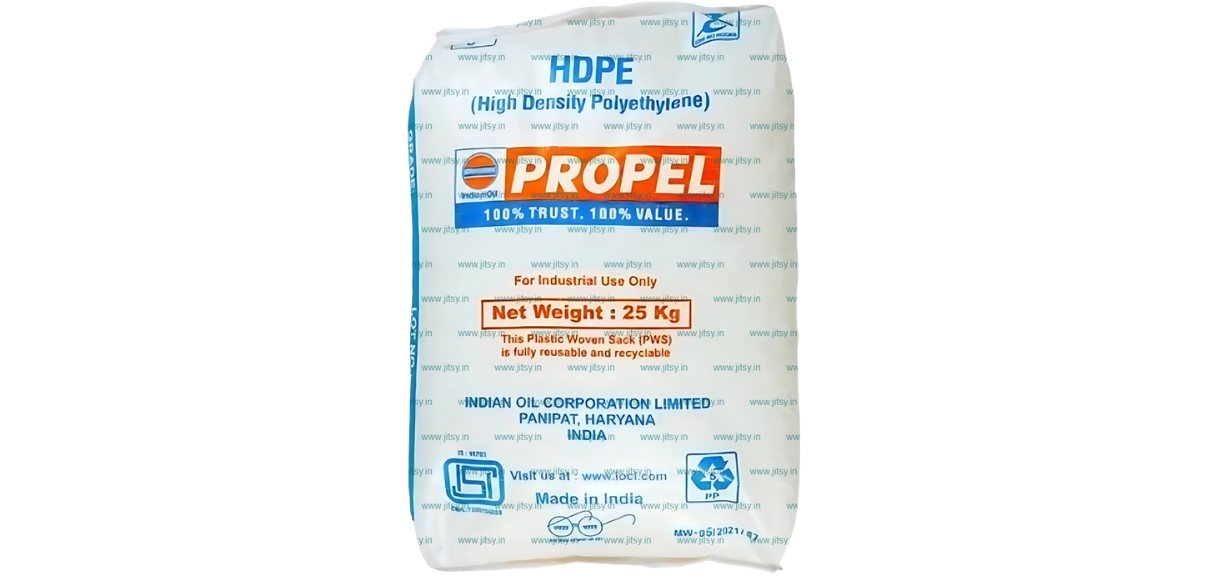
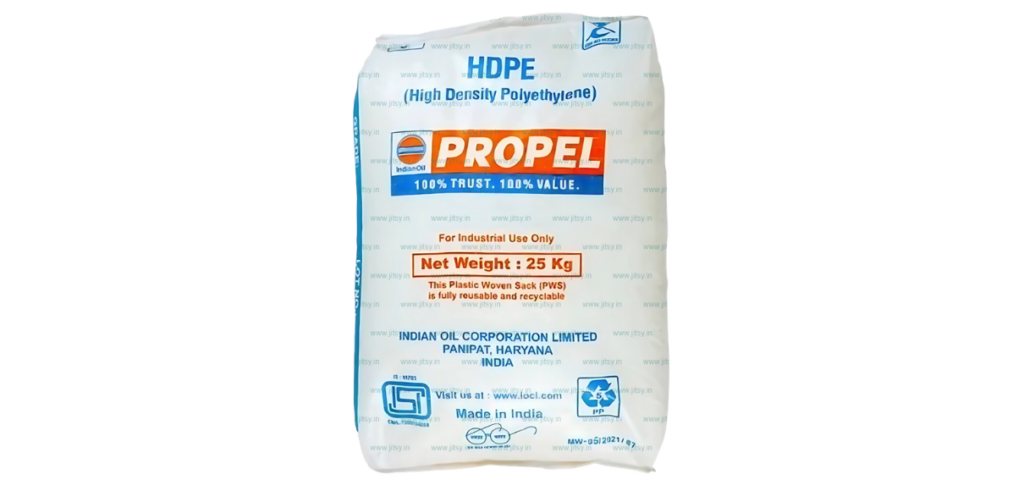
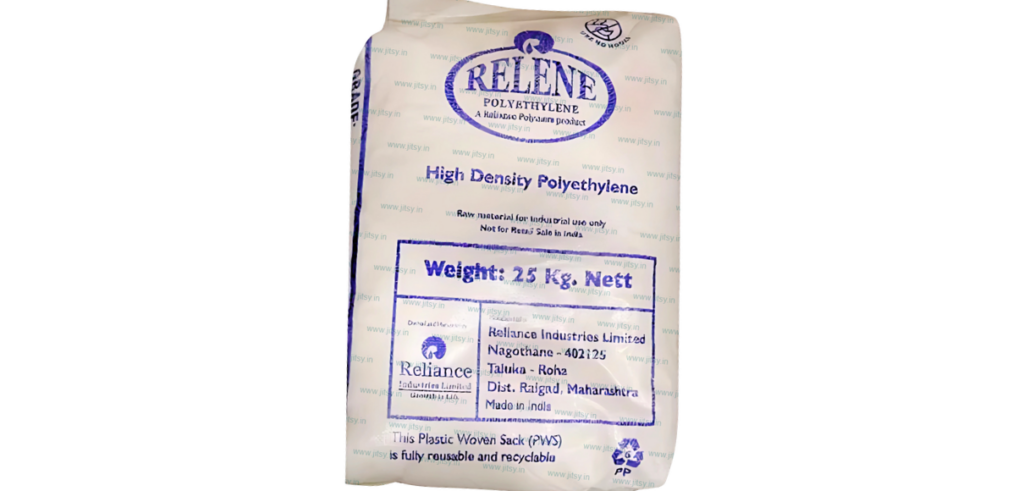
HDPE Propel 020M52 is a high-density polyethylene resin manufactured by Indian Oil Corporation Ltd. (IOCL) under its Propel brand. It is produced using Nova Chemical’s Sclairtech solution polymerisation technology and is formulated specifically for injection moulding applications, with IOCL’s own positioning identifying caps and closures as the primary end-use. The grade is supplied as natural-coloured granules and is an active commercial product available in India.
What distinguishes HDPE 020M52 from higher-flow grades in the Propel injection family is its property balance. With an MFI of 2.7 g/10 min and a notched Izod impact strength of 180 J/m, the grade is built for applications where toughness and long-term mechanical integrity in the moulded part matter more than raw throughput speed. IOCL characterises 020M52 as having superior processability and superior mechanical properties — a pairing that reflects the grade’s ability to process cleanly within a defined window while producing closures with the impact resistance, dimensional stability, and surface quality required for repeated open-close service across multiple packaging formats.
The processing window for HDPE 020M52 is 160–190 °C — notably lower than many injection-moulding HDPE grades, which typically run at 180–215 °C. This lower processing temperature reduces thermal stress on the polymer during moulding, supports consistent part colour when pigmented compounds are processed, and makes the grade compatible with energy-efficient machine settings on modern injection moulding equipment. For high-cavitation closure moulds running continuously, this thermal efficiency is a meaningful operational benefit.
At a density of 0.952 g/cm³, HDPE 020M52 delivers the chemical resistance, moisture barrier, and stiffness characteristics expected of high-density polyethylene, while the 800 MPa flexural modulus and 125 °C Vicat softening point confirm that finished closures retain shape and function across the temperatures and chemical environments typical of food, beverage, agrochemical, and household product packaging. IOCL certifies the grade as compliant with IS 10146:1982, IS 10141:1982, and FDA CFR Title 21 Section 177.1520 for olefin polymers, establishing its suitability for food-contact and regulated end uses.
Technical Insights
Understanding the Key Properties of HDPE 020M52
The property profile of HDPE Propel 020M52 makes most sense when read as a set of interconnected choices optimised for caps and closures rather than as isolated datasheet values. Each figure answers a specific question a closure designer or procurement team would ask before qualifying the grade.
- Melt Flow Index — 2.7 g/10 min (ASTM D1238, 190 °C / 2.16 kg): An MFI of 2.7 g/10 min is relatively low by injection-moulding HDPE standards. This indicates a higher molecular weight polymer, which is the direct source of the grade’s superior impact strength and elongation at break. For caps and closures, a moderate-to-low MFI is not a limitation — closure moulds are typically compact with short flow paths, and the higher molecular weight that comes with lower MFI produces tougher, more durable parts that survive repeated mechanical stress without cracking or deforming.
- Density — 0.952 g/cm³ (ASTM D1505, 23 °C): This density places the grade firmly in the HDPE range, delivering the chemical resistance and barrier properties that closure applications demand. Closures for food, beverage, agrochemical, lubricant, and cleaning product containers all benefit from HDPE’s resistance to moisture ingress and chemical attack, which the 0.952 g/cm³ density supports.
- Tensile Strength at Yield — 25 MPa (ASTM D638): The tensile yield strength determines how much pulling or stretching force the moulded closure can absorb before it begins to deform permanently. At 25 MPa, closures produced from HDPE 020M52 have adequate structural strength for container handling, capping-line torque, and consumer use without requiring over-engineered wall thicknesses.
- Elongation at Break — >600% (ASTM D638): An elongation at break exceeding 600% is a strong indicator of toughness and ductility. It means that if a closure is stressed beyond its yield point, it will stretch and deform substantially before fracturing rather than snapping suddenly. For closures that experience hinge flexing, tamper-evident band separation, or drop impacts, this high ductility is a critical safety and performance characteristic.
- Notched Izod Impact Strength — 180 J/m (ASTM D256, 23 °C): This is the standout figure in the HDPE 020M52 property set. At 180 J/m, the grade delivers more than double the notched impact resistance of many standard injection-moulding HDPEs in the crate and pallet segment. For closures, this translates directly to resistance against cracking at notch-like stress concentrations — thread roots, snap-fit undercuts, tamper-evident perforations, and sharp internal corners — which are the geometries most likely to initiate failure in service.
- Flexural Modulus — 800 MPa (ASTM D790): At 800 MPa, closures have the stiffness needed to maintain dimensional accuracy on capping lines, resist cross-threading during application, and hold their shape through the temperature excursions of filled-container distribution. The modulus is sufficient for rigid closure applications without being so high that the part becomes brittle at notch-sensitive features.
- Vicat Softening Point — 125 °C (ASTM D1525, 10 N): The Vicat point defines the service temperature ceiling under load. At 125 °C, closures on hot-fill containers, pasteurised products, or items distributed through warm climates will maintain dimensional integrity without distortion or loss of seal. This also supports the grade’s use in applications where filled containers are briefly exposed to elevated temperatures during sterilisation adjacent processes.
- Processing Temperature — 160–190 °C: The lower end of this window — starting at 160 °C — is a practical advantage for processors. It reduces cycle energy consumption, lowers the risk of thermal degradation when the machine pauses or purges, and allows easier processing of pigmented compounds where colour stability at high temperatures can be a concern.
All values above are typical figures from IOCL’s provisional technical datasheet and grade-sheet documentation and are not specification limits. Values may change without prior notice; buyers should verify against the current IOCL grade sheet before final qualification.
Applications
Caps and Closures for Food and Beverage Packaging
HDPE Propel 020M52 is IOCL’s designated grade for caps and closures, and the food and beverage packaging segment is its most direct application. Closures on water bottles, edible oil containers, juice cartons, dairy tubs, and condiment jars are subject to capping-line torque, consumer removal force, and repeated open-close cycles across the product’s shelf life. The 180 J/m notched Izod impact strength ensures that thread roots and tamper-evident band perforations — the two most common fracture initiation points on injection-moulded closures — do not crack under normal mechanical stress. Food-contact compliance under IS 10141:1982 and FDA CFR 21 177.1520 makes HDPE 020M52 directly applicable to closures where material traceability to an approved regulatory standard is a packaging specification requirement.
Caps and Closures for Household Chemical and Cleaning Product Packaging
Closures on cleaning agents, detergents, disinfectants, and personal care products must resist the very chemicals they seal. HDPE’s chemical resistance — a function of its density and crystallinity — makes 020M52 a reliable choice for this segment. The 0.952 g/cm³ density and the structural property balance of the grade ensure that closures do not swell, soften, or lose thread engagement after sustained exposure to surfactants, acids, and alkaline formulations. The 125 °C Vicat softening point also supports hot-fill applications in this category, where cleaning products are occasionally filled at elevated temperatures before capping.
Caps and Closures for Agrochemical and Industrial Container Packaging
In the Indian agrochemical sector, HDPE closures on pesticide, herbicide, and fertiliser containers are subject to both chemical compatibility and regulatory requirements. HDPE 020M52’s inherent chemical resistance to hydrocarbons, solvents, and aqueous solutions positions it well for this application. The grade’s IS 10146:1982 compliance supports its use in containers and closures for agrochemical products that fall under India’s packaging regulations for crop protection materials. The high elongation at break and notched Izod impact strength also provide assurance that closures on heavy-fill containers will not crack during transport and stacking in distribution environments.
Closures for Pharmaceutical-Adjacent and Personal Care Packaging
While HDPE 020M52 is not a pharmaceutical-grade resin in the strict regulatory sense, its FDA CFR 21 177.1520 compliance and consistent mechanical profile make it a credible choice for closures on nutraceuticals, health supplement bottles, and personal care containers where the packaging specification calls for a food-contact compliant closure material. The defined processing window and IOCL’s documentation trail — including batch traceability from the Sclairtech process — support the audit requirements that procurement teams in these sectors typically impose on their packaging material suppliers.
Injection-Moulded Industrial Containers and Fitments
Beyond standalone closures, HDPE 020M52’s property balance is applicable to injection-moulded fitments, dispensing plugs, valve seats, and container accessories where a combination of chemical resistance, impact toughness, and dimensional stability in small-to-medium part geometries is required. The lower processing temperature of 160–190 °C also makes the grade compatible with thin-feature mould tools that may be sensitive to thermal expansion at the higher end of standard HDPE processing ranges.
Comparable Alternatives
Within the IOCL Propel injection-moulding family, the most relevant comparisons are with higher-flow grades used in the same caps-and-closures segment and with the broader crate-and-pallet grades that occupy a different MFI range. HDPE Propel 180M50 runs at MFI 18 g/10 min — more than six times the MFI of 020M52 — and is positioned for thin-wall housewares and fast-cycle, high-gloss consumer applications. For closure applications that prioritise throughput and surface finish over maximum impact toughness, 180M50 would be considered. HDPE Propel 080M60, at MFI 8.0 g/10 min, sits between the two and is used primarily for large structural mouldings such as industrial crates and pallets where impact resistance and modulus at higher wall thicknesses matter. HDPE 020M52 is the appropriate grade when the design requires maximum toughness at the notch-sensitive geometries common in closures, and when the lower processing temperature is operationally advantageous.
The grade’s 180 J/m notched Izod impact strength is the most important differentiator when comparing 020M52 against other HDPE injection grades for closure applications. Many standard injection-moulding HDPEs in the 5–12 g/10 min MFI range deliver 60–120 J/m notched Izod values. At 180 J/m, HDPE 020M52 is positioned at the tough end of the injection-moulding HDPE spectrum, which is relevant for closures with fine threads, snap-fit features, or tamper-evident bands where stress concentration at thin sections is unavoidable in the design.
Other Indian HDPE injection grades for caps and closures exist from producers including HMEL, GAIL, OPAL, and Haldia Petrochemicals. Grades in a comparable MFI range may appear similar on a headline datasheet, but differences in polymerisation technology, molecular weight distribution, and additive package can produce meaningful variation in impact performance, gloss, and long-term environmental stress crack resistance (ESCR) — all of which are functionally important in closure applications. Direct equivalence to HDPE Propel 020M52 is not confirmed unless the relevant grades are matched property-by-property from manufacturer TDS and validated through closure-specific mould trials.
Imported closure-grade HDPEs from producers such as Borouge, LyondellBasell, and Hanwha are available in the Indian market and are specified by some converters for premium closure lines. These grades may offer additional ESCR optimisation or tighter molecular weight control relevant to specific closure geometries. However, for the majority of Indian closure converters where domestic supply reliability, GST-compliant procurement documentation, and cost are primary procurement drivers, HDPE Propel 020M52 provides a well-documented, domestically available option backed by IOCL’s production and supply infrastructure.
Common Search Variants
Buyers and engineers commonly search for this grade using terms such as HDPE dana for caps, closure-grade HDPE granules India, cap resin injection moulding, Propel granules 020M52, and IOCL HDPE closure grade. Frequent misspellings and alternate notations include HDPE 20M52, 020M5O (with the letter O instead of zero), Propel 020M52 HDPE, IOCL 020M52 granules, and 0.95 MFI HDPE closures — all refer to the same product.















Reviews
Clear filtersThere are no reviews yet.