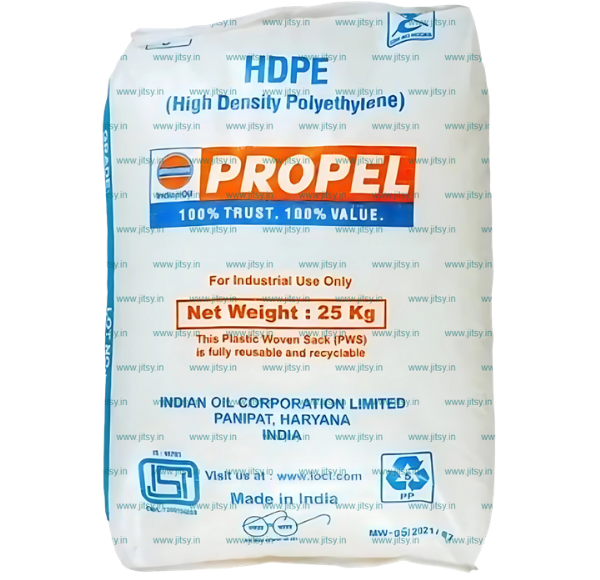
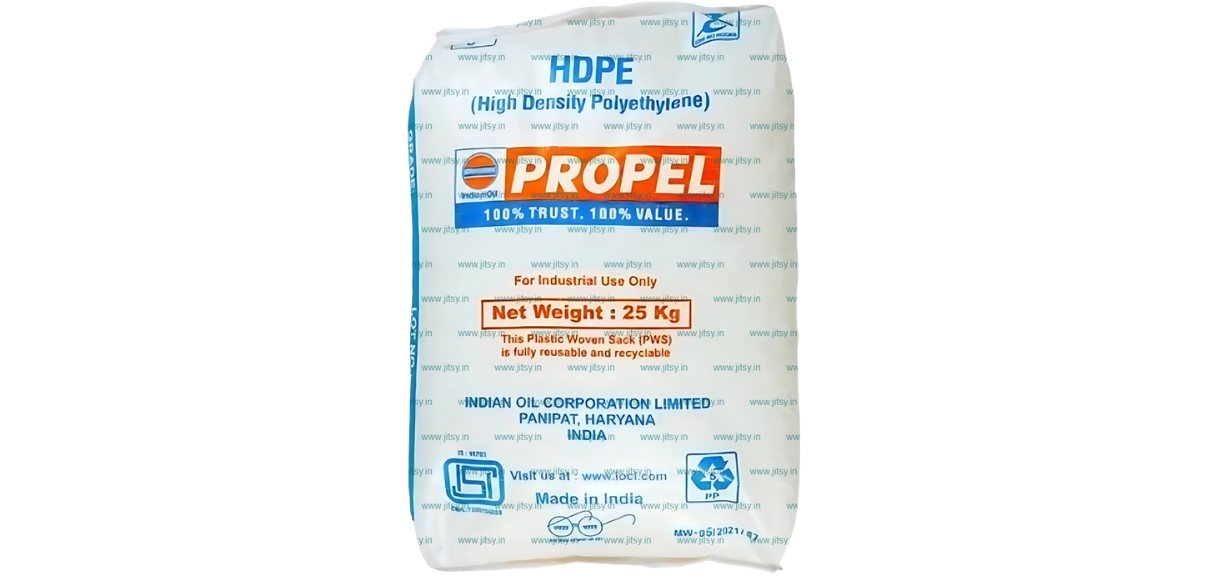
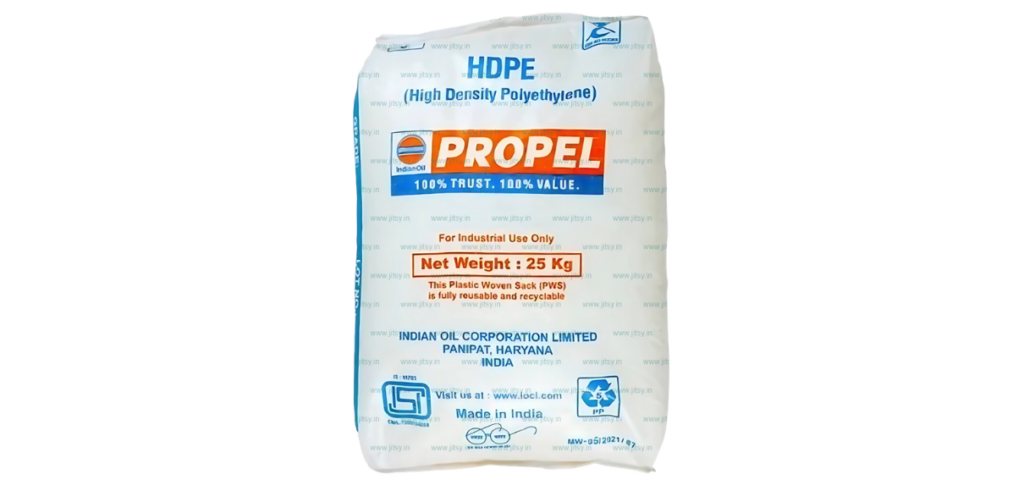
HDPE Propel 180M50 is a high-density polyethylene resin manufactured by Indian Oil Corporation Ltd. (IOCL) under its established Propel brand. Like the broader Propel injection family, it is produced using Nova Chemical’s Sclairtech solution polymerisation technology — a process that delivers tight molecular weight distribution, predictable melt behaviour, and batch-to-batch consistency. The grade is supplied as natural-coloured granules and is engineered exclusively for injection moulding.
What distinguishes HDPE 180M50 within the Propel range is its very high melt flow index of 18 g/10 min. This positions it at the fast-flow end of the HDPE injection spectrum, making it the grade of choice when converters are running thin-wall housewares, multi-cavity closure moulds, small containers, or any application where rapid cavity fill, short cycle times, and a high-gloss surface finish are the primary production requirements. IOCL explicitly characterises 180M50 as having excellent flow properties, very good processability, and excellent gloss — attributes that are directly traceable to its high MFI and the Sclairtech polymerisation process.
At a density of 0.950 g/cc, the grade retains the fundamental characteristics of high-density polyethylene — chemical resistance, rigidity, and a defined thermal profile — while the slightly lower density relative to higher-density crate and pallet grades reflects a molecular architecture that prioritises flow and surface quality alongside structural integrity. The 900 MPa flexural modulus and 70 Shore D hardness confirm that finished parts will be firm, dimensionally stable, and resistant to surface marking, which matters both for consumer-facing housewares and for industrial containers that must maintain shape under stacking loads.
IOCL certifies HDPE Propel 180M50 as compliant with IS 10146:1982, IS 10141:1982, and FDA CFR Title 21 Section 177.1520 for olefin polymers. These regulatory designations make the grade suitable for housewares and containers where food-contact compliance is a procurement or end-use requirement, including food storage containers, kitchen utensils, bottle caps, and reusable household items.
Technical Insights
Each property in the HDPE Propel 180M50 datasheet answers a specific question that a moulding engineer or procurement manager would ask before qualifying or approving a new grade. Understanding what the numbers mean in practice is more useful than referencing them in isolation.
- Melt Flow Index — 18 g/10 min (ASTM D1238, 190 °C / 2.16 kg): This is the defining characteristic of the grade. An MFI of 18 g/10 min indicates a very fluid melt that fills thin, complex cavities quickly under moderate injection pressure. For thin-wall housewares and high-cavitation closure moulds, this translates directly to shorter fill times, reduced clamp tonnage requirements, and faster production cycles — all of which improve converter economics without compromising part quality.
- Density — 0.950 g/cc (ASTM D1505, 23 °C): At 0.950 g/cc, this grade sits within the standard HDPE range (0.941–0.965 g/cc). The density governs crystallinity, which in turn drives stiffness, chemical resistance, and barrier performance. The slightly lower density compared with crate-grade HDPEs is consistent with the molecular weight distribution needed to achieve MFI 18 without sacrificing part integrity in thin-wall applications.
- Tensile Strength at Yield — 24 MPa (ASTM D638): This indicates the stress level at which the part begins to deform permanently under tensile load. For thin-wall housewares — storage boxes, containers, and lids — 24 MPa provides adequate structural strength in normal use while remaining compatible with the wall thicknesses and part geometries that the high MFI enables.
- Elongation at Yield — 12% (ASTM D638): The elongation at yield describes how much the material stretches before permanent deformation begins. At 12%, HDPE 180M50 has enough ductility to absorb minor flexing loads — such as those experienced by container lids, snap-fit closures, and thin-wall walls during handling — without immediate failure at the yield point.
- Flexural Modulus — 900 MPa (ASTM D790): Flexural modulus is the primary indicator of part stiffness. At 900 MPa, moulded houseware components and container walls will hold their shape under normal loads and resist warping during demoulding. This value is higher than many standard injection HDPE grades in the 750–850 MPa range, meaning 180M50 delivers stiffness alongside its high flow — a combination that narrows the typical trade-off between processability and rigidity.
- Hardness — 70 Shore D (ASTM D2240): A Shore D value of 70 is notably firm for an injection HDPE and indicates a hard, scratch-resistant surface. This is relevant for consumer housewares where visible surface marking, scuffing during retail handling, or loss of gloss over product life would be a quality concern. It also supports the grade’s positioning as a gloss-oriented resin.
- Vicat Softening Point — 124 °C (ASTM D1525): The Vicat softening point defines the temperature at which the moulded part begins to lose dimensional integrity under a defined load. At 124 °C, HDPE 180M50 is suitable for housewares exposed to hot water, dishwasher environments, and warm storage conditions, though it is not designed for autoclave sterilisation or continuous high-temperature service.
- Recommended Processing Temperature — 180–215 °C: This window gives processors flexibility across different machine configurations, cavity layouts, and wall thicknesses. Operating within this range maintains melt quality, gloss, and the mechanical properties stated in the technical datasheet. Processing above 215 °C risks thermal degradation and loss of the characteristic surface finish.
All values above are typical figures from IOCL’s technical sheet and provisional datasheet and are not specification limits. Values may change without prior notice; buyers should verify against the current IOCL grade sheet before final qualification.
Applications
Injection-Moulded Housewares and Storage Products
The primary market for HDPE Propel 180M50 is injection-moulded houseware products — storage containers, food boxes, waste bins, baskets, organisers, and similar domestic items. For houseware converters, the critical combination is fast mould fill, dimensional stability, and a surface gloss that meets consumer expectations. HDPE 180M50 delivers all three: the MFI of 18 g/10 min reduces cycle time and pressure requirements even in multi-cavity tools, the 900 MPa flexural modulus keeps container walls and lids flat after demoulding, and the grade’s excellent gloss characteristic produces surfaces that hold colour and sheen in finished consumer goods.
Thin-Wall Injection Moulded Parts
Thin-wall moulding — typically defined as wall sections below 1.5 mm — demands resins that can travel long flow paths quickly before the melt freezes. At MFI 18 g/10 min, HDPE 180M50 is well-matched to thin-wall geometries where lower-flow grades would either require excessively high injection pressures or produce short shots and knit-line failures. Converters producing thin-wall boxes, trays, lids, and industrial trays will find that the grade’s flow-to-stiffness balance — 18 g/10 min MFI alongside 900 MPa flexural modulus — reduces the usual compromise between productivity and part performance in this segment of injection moulding.
Caps, Closures, and Fitments
High-cavitation closure moulds for bottles, containers, and industrial packaging require a resin that fills quickly, replicates thread geometry precisely, and produces parts with consistent dimensions across every cavity. HDPE 180M50’s high MFI and high hardness (70 Shore D) support the close-tolerance moulding that closures demand. The 124 °C Vicat softening point ensures closures remain dimensionally stable in warm distribution environments, while the food-contact compliance certifications (IS 10141:1982, FDA CFR 21 177.1520) make the grade directly applicable to closures on food, beverage, and pharmaceutical-adjacent packaging.
Small Containers and Industrial Packaging Components
Beyond retail housewares, HDPE Propel 180M50 is well-suited to injection-moulded small containers, pails, and industrial packaging components where the end-user requires a balance of chemical resistance, stiffness, and a presentable surface. The grade’s HDPE chemistry provides inherent resistance to a wide range of industrial chemicals, detergents, and moisture — relevant for containers used in cleaning product, agrochemical, and lubricant packaging. The flexural modulus of 900 MPa supports stacking loads in warehouse and transit environments without requiring heavy wall sections.
Crates, Pallets, and Material-Handling Products
While IOCL’s primary positioning for 180M50 is thin-wall housewares, the broader Propel injection-moulding grade family — of which this is a member — is also used for crates, pallets, caps, and closures. For converters targeting lighter-duty crate or small pallet applications where faster cycles and higher gloss are valued alongside structural performance, 180M50 offers a viable option. For heavy-duty, large-format crate and pallet applications requiring maximum impact resistance and structural rigidity at thicker wall sections, lower-MFI injection grades in the Propel family are typically better suited.
Comparable Alternatives
Within the IOCL Propel injection-moulding family, the most relevant comparison is between HDPE 180M50 and lower-MFI grades such as HDPE Propel 080M60. The core distinction is flow versus structural performance. HDPE 080M60 runs at MFI 8.0 g/10 min against 180M50’s 18 g/10 min — a more than twofold difference in flow. This means 080M60 is better suited to thick-section, heavy-duty applications like large crates and pallets that require maximum impact and flexural performance, while 180M50 is the appropriate choice when the priority is fast fill in thin-wall or multi-cavity tools, surface gloss, and production throughput. The two grades should not be treated as interchangeable: the difference in MFI affects not only injection pressure and cycle time but also the molecular weight profile and resulting part toughness. Converters running the same mould with both grades would need to re-optimise process parameters and re-qualify parts.
UV-stabilised variants within the Propel injection family exist for applications involving extended outdoor exposure. If the intended application — such as outdoor storage containers, garden equipment, or open-yard material-handling products — requires resistance to UV-induced degradation, the corresponding UV-stabilised grade should be specified instead of 180M50. The base polymer properties may be similar, but the additive system is meaningfully different and the two grades are not equivalent for outdoor service.
Other Indian injection-moulding HDPE grades in the thin-wall and houseware segment exist from producers including HMEL, GAIL, OPAL, and Haldia Petrochemicals. In the same MFI and density range, these grades may appear nominally comparable on a datasheet, but direct equivalence cannot be confirmed without manufacturer-to-manufacturer TDS comparison and process trials. Differences in polymerisation technology, catalyst system, and additive formulation can produce meaningful variation in gloss, cycle behaviour, and dimensional stability even at similar MFI values. Any substitution should be validated through trials on the specific mould and machine configuration in use.
Imported grades from Borouge, LyondellBasell, Lotte, and similar international producers serve the high-flow injection segment in the Indian market. These may offer very consistent molecular weight distributions optimised specifically for high-gloss, thin-wall applications, and some converters qualify them for premium houseware lines. However, landed cost, import lead times, and lot traceability requirements under GST-compliant procurement typically favour domestically sourced IOCL supply for the majority of Indian converters, particularly in the SME manufacturing segment.
Common Search Variants
Buyers and engineers commonly search for this grade using terms such as HDPE dana for housewares, high-flow injection HDPE granules, thin-wall HDPE resin India, Propel granules 180M50, and IOCL HDPE high-gloss injection grade. Frequent misspellings and alternate notations include HDPE 18M50, 180M5O (with the letter O instead of zero), Propel 180M50 HDPE, IOCL 180M50 granules, and HDPE Propel 180M50 — all refer to the same product.
















Reviews
Clear filtersThere are no reviews yet.