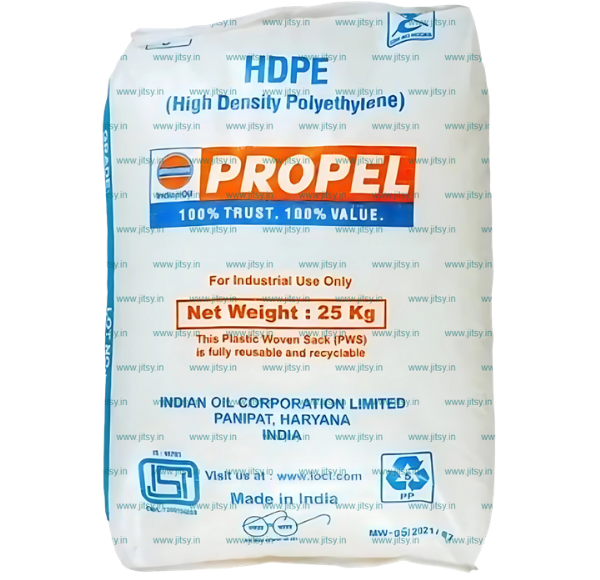
Propel 010DB50 is a high-density polyethylene blow-moulding grade manufactured by Indian Oil Corporation Ltd. (IOCL) at its Panipat Naphtha Cracker Complex under the Propel brand. Like IOCL’s 002DB52 and 003DB52 blow-moulding grades, it is produced using LyondellBasell’s Hostalen slurry process — a two-reactor technology that creates a bimodal molecular weight distribution. IOCL classifies 010DB50 officially as a “High ESCR GPBM Grade,” where GPBM stands for General Purpose Blow Moulding. This classification is the grade’s defining market identity: it is the Propel grade specifically formulated for blow-moulded containers where environmental stress crack resistance is the primary design requirement.
IOCL’s own provisional technical datasheet states the recommended applications as containers and bottles up to 5 L capacity, high ESCR blow-moulded containers, and containers for packing chemicals and pesticides. This is a narrower and more application-specific positioning than IOCL’s larger-container blow-moulding grades. The 5 L upper-bound capacity is directly linked to the grade’s MFI of 1.2 g/10 min at 190 °C / 5 kg — a higher MFI than the large-container grades (002DB52 at 0.2 g/10 min), reflecting the smaller container geometry where parison sag is less critical and faster cycle speeds are operationally valuable. The Hostalen bimodal architecture still delivers the molecular structure needed for exceptional ESCR and toughness at this higher MFI, because in bimodal HDPE it is the high-molecular-weight fraction — not the bulk viscosity — that governs stress-crack performance.
The defining property that differentiates HDPE 010DB50 from general-purpose HDPE blow-moulding grades is its ESCR of greater than 500 hours under ASTM D1693 Condition B at 10% Igepal — an industry-standard surfactant that accelerates stress cracking in HDPE. ESCR is the property that determines how long a container wall can resist cracking when it is simultaneously under residual moulding stress and in contact with a surfactant-active, chemically aggressive, or otherwise ESCR-active medium. For pesticide bottles, agrochemical containers, cleaning product bottles, and industrial chemical containers — all of which hold formulations that act as ESCR-active agents — this property directly governs container shelf life and the risk of leakage or structural failure in the field. IOCL’s choice to explicitly ESCR-rate 010DB50 at >500 h and to classify it as a “High ESCR” grade signals that this performance level is built into the grade specification as a design intent, not an incidental outcome.
The grade’s full property profile supports the applications it is designed for. Flexural modulus of 900 MPa provides the container wall stiffness needed for good top-load performance and dimensional stability on filling lines. Notched Izod impact strength of 150 J/m at 23 °C ensures containers survive drop impacts during transport and retail handling. Vicat softening point of 125 °C and HDT of 70 °C at 0.455 MPa confirm that containers maintain their shape and closure integrity across the temperature conditions of Indian distribution environments. IOCL certifies the grade family as compliant with IS 10146:1982, IS 10141:1982, and FDA CFR Title 21 Section 177.1520 for olefin polymers.
Technical Insights
Understanding the Key Properties of HDPE 010DB50
Every property in the HDPE 010DB50 datasheet can be read as an answer to a specific design question that a packaging engineer or procurement team would ask when specifying a resin for chemical or pesticide containers.
- ESCR — >500 h (ASTM D1693, Condition B, 10% Igepal): This is the grade’s anchor property and the reason for its existence as a distinct IOCL grade. ESCR measures the time to failure when a notched specimen is immersed in a surfactant solution while bent under stress — a controlled simulation of the stress and chemical environment that a blow-moulded container experiences in service. A value exceeding 500 hours at 10% Igepal is a high benchmark for a general-purpose blow-moulding grade, confirming that containers produced from 010DB50 are designed to hold aggressive chemical formulations for the duration of shelf life and use cycles without developing the fine stress cracks that cause leakage and container failure. This performance is delivered by the bimodal molecular weight distribution of the Hostalen process, where the high-molecular-weight polymer chains bridge crack fronts and resist propagation under sustained stress in a chemical environment.
- Melt Flow Index — 1.2 g/10 min (ASTM D1238, 190 °C / 5 kg): The MFI of blow-moulding HDPE grades is measured at 5 kg load — a higher test weight than the 2.16 kg used for injection-moulding grades — because blow-moulding dies operate at higher shear conditions. At 1.2 g/10 min, HDPE 010DB50 flows significantly more freely than the large-container blow-moulding grades (002DB52 at 0.2 g/10 min), which is appropriate for the smaller cavity geometries and thinner wall sections of containers up to 5 L. The higher MFI supports faster cycle times, good mould filling in compact tools, and efficient production on standard continuous extrusion blow-moulding equipment for small bottles and containers.
- Density — 0.950 g/cm³ (ASTM D1505, 23 °C): The density governs crystallinity, which underpins the stiffness, chemical barrier, and moisture resistance of the container wall. At 0.950 g/cm³, the grade delivers reliable chemical resistance across the range of formulations typical in agrochemical, household chemical, and industrial chemical packaging. The bimodal architecture of the Hostalen process means that this density level coexists with the high ESCR performance — a combination that is harder to achieve in unimodal HDPE at equivalent density.
- Tensile Strength at Yield — 25 MPa (ASTM D638, Type IV): This defines the load at which the container wall begins to deform permanently under tensile stress. For chemical containers that must resist internal pressure from fill weight, handle stresses, and external clamping or stacking forces, 25 MPa provides the structural basis for container integrity across the product’s service life.
- Elongation at Break — >600% (ASTM D638, Type IV): High elongation at break in a blow-moulding HDPE indicates ductile failure behaviour — the material will stretch substantially before it fractures. For chemical and pesticide bottles, this is the property that prevents sudden, brittle cracking at weld lines, base sections, and handle attachment points when the container is dropped or stressed. It complements the ESCR value by providing a secondary toughness mechanism against rapid mechanical failure.
- Notched Izod Impact Strength — 150 J/m (ASTM D256, 23 °C): At 150 J/m, the grade delivers solid impact resistance for containers in the 1–5 L range. This value is lower than IOCL’s 002DB52 large-container grade (500 J/m), which is appropriate given the size and wall-thickness difference between the two applications. For small chemical bottles operating within their designed drop and handling conditions, 150 J/m provides adequate resistance to crack initiation at notch-like stress concentrations.
- Flexural Modulus — 900 MPa (ASTM D790): The flexural modulus determines container wall stiffness — how much the wall resists bending under applied load. At 900 MPa, blow-moulded containers from 010DB50 maintain their shape under top-load stacking, resist handling deformation during capping and labelling, and give end users the firm-wall feel associated with quality chemical packaging.
- Vicat Softening Point — 125 °C (ASTM D1525, 10 N) / HDT — 70 °C at 0.455 MPa (ASTM D648): The HDT of 70 °C is the practical upper service temperature for the container under load. For chemical containers in Indian distribution environments — where palletised goods may reach elevated temperatures in transit and storage — this value confirms that containers will not distort or lose closure integrity under the thermal conditions they encounter before reaching the end user.
- Processing Temperature — 160–190 °C: The 160–190 °C processing window for 010DB50 is notably lower than IOCL’s large-container blow-moulding grades, which operate at 180–220 °C. This lower window reduces energy consumption on the extrusion blow-moulding line, minimises the risk of thermal degradation during machine start-up and pauses, and supports faster colour consistency when pigmented compounds are co-processed with the natural resin.
All values are typical figures from IOCL’s provisional technical datasheet (00-10/19) and confirmed mirror sources. They are not specification limits and may change without prior notice; buyers should verify against the current IOCL TDS before formal grade qualification.
Applications
Chemical and Pesticide Bottles for the Agrochemical Sector
The explicitly manufacturer-stated primary application for Propel 010DB50 is containers and bottles for packing chemicals and pesticides. In the Indian agrochemical market, HDPE bottles for crop protection products — insecticides, herbicides, fungicides, and plant growth regulators — are the dominant primary packaging format across the 100 mL to 5 L range. The formulations in these containers present one of the most demanding ESCR environments in consumer and agricultural packaging: surfactants are commonly used as emulsifiers and dispersants in agrochemical formulations, and these act directly as ESCR-active agents in contact with the container wall. HDPE 010DB50’s ESCR rating of greater than 500 hours at 10% Igepal under ASTM D1693 Condition B provides the quantified performance basis for specifying this grade in agrochemical bottles where container integrity through the full product shelf life and field distribution cycle is a regulatory and commercial requirement.
Household and Industrial Chemical Containers Up to 5 L
For household cleaning products — bleach, disinfectants, toilet cleaners, multi-surface sprays — and industrial chemical containers in the 500 mL to 5 L range, the performance requirements closely mirror the agrochemical sector. The active ingredients and surfactants in these formulations are ESCR-active, and containers are expected to maintain closure integrity and wall integrity from filling through retail shelf life and consumer use cycles. HDPE 010DB50’s combination of ESCR >500 h, 900 MPa flexural modulus, and Vicat 125 °C delivers the stiffness, thermal stability, and stress-crack resistance that household and industrial chemical container specifications typically require. The grade’s 150 J/m notched Izod impact strength supports retail-channel drop performance, where containers on shop floors encounter drop heights and hard-surface impacts that standard general-purpose blow-moulding HDPE may not consistently withstand without stress cracking.
High ESCR General-Purpose Blow-Moulded Packaging
Beyond the agrochemical and household cleaning segments, IOCL positions 010DB50 as a high ESCR general-purpose blow-moulding grade — meaning it is applicable wherever a small to medium blow-moulded container is required to resist stress cracking in contact with an aggressive medium. This covers a broad range of industrial packaging: engine treatment bottles, lubricant additives in small packs, specialty chemical samples, laboratory reagent containers, and personal care products with high surfactant content. In all these cases, the explicit >500 h ESCR rating of 010DB50 differentiates it from standard GPBM grades where ESCR is not specifically rated or guaranteed to this level, providing packaging designers with a quantified basis for material selection that passes internal specification requirements and customer qualification audits.
Small-Volume Industrial and Laboratory Chemical Bottles
For industrial distributors, laboratory suppliers, and specialty chemical companies that package products in 1–5 L HDPE bottles, 010DB50 offers a production-ready blow-moulding solution that combines technical performance with domestic supply reliability from IOCL’s Panipat facility. The grade’s moderate MFI of 1.2 g/10 min at 5 kg load suits the compact cavity geometries of small bottle tools, enabling fast cycle times on continuous extrusion blow-moulding lines and consistent wall-thickness distribution in bottle geometries with handle features, neck finishes, and shoulder contours.
Comparable Alternatives
IOCL HDPE Propel 012DB60 is the most directly comparable grade within the IOCL blow-moulding family and the most important distinction for buyers to understand. IOCL’s Grade Sheet 2025 classifies 012DB60 as a “High Density GPBM Grade” — emphasising rigidity — while 010DB50 is classified as a “High ESCR GPBM Grade” — emphasising stress-crack resistance. Instamine data shows 012DB60 with MFI 1.3 g/10 min at 5 kg (similar to 010DB50’s 1.2 g/10 min) but a notably higher density of 0.960 g/cm³ versus 010DB50’s 0.950 g/cm³. The higher density of 012DB60 translates to higher crystallinity and greater stiffness, making it the appropriate choice for applications like lubricant containers and edible oil containers where rigidity and top-load strength are the dominant requirements. The lower density and explicit high ESCR rating of 010DB50 make it the correct specification for pesticide bottles, agrochemical packaging, and chemical containers where the fill product is ESCR-active and long-term stress-crack performance is the primary selection criterion. These two grades serve related but distinct application spaces and should not be treated as equivalents.
IOCL HDPE Propel 002DB52 is the large-container blow-moulding grade in the same Propel family. At MFI 0.2 g/10 min at 5 kg versus 010DB50’s 1.2 g/10 min, 002DB52 has approximately six times higher melt viscosity — the characteristic needed for parison strength and wall-thickness uniformity in containers up to 100 L. For chemical containers and lube oil packaging at the smaller scale (up to 5 L) where 010DB50 is positioned, the higher MFI of 010DB50 is operationally appropriate and supports faster cycling on small bottle equipment. The two grades operate in different size segments with different processing conditions and are not substitutes for each other.
IOCL HDPE Propel 003DB52, the medium blow-moulding grade, has a lower MFI of approximately 0.32 g/10 min at 5 kg and is positioned for containers up to 100 L, water tanks, and solar panel floaters. Its published ESCR (F50 500 h) is in the same range as 010DB50, but its application positioning is for larger containers and tanks rather than the 1–5 L chemical bottle segment. It is a related IOCL alternative but not a confirmed equivalent or substitute for 010DB50 in small-container pesticide and chemical packaging.
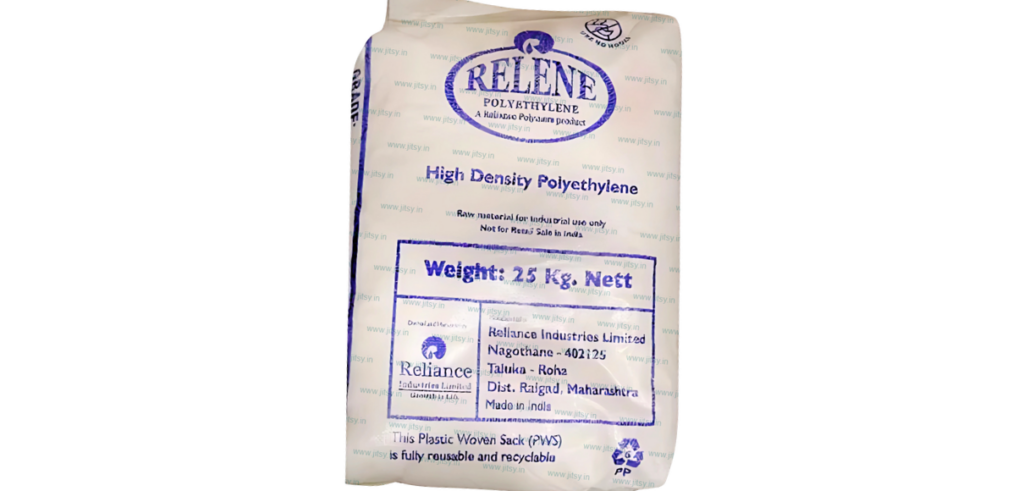
Reliance Relene 54GB012 is a broadly comparable high ESCR blow-moulding HDPE from Reliance Polymers with published MFI of 1.20 at I5 and density 0.954 g/cm³, described for blow-moulding up to 20 L with good ESCR. The MFI is almost identical to 010DB50, and the application overlap — high ESCR blow-moulded chemical containers — is clear. However, 54GB012 is positioned for a larger container range (up to 20 L versus 010DB50’s up to 5 L), and direct property-by-property equivalence is not confirmed by either manufacturer. Any commercial substitution between 010DB50 and 54GB012 must be validated through independent blow-moulding trials and regulatory re-qualification.
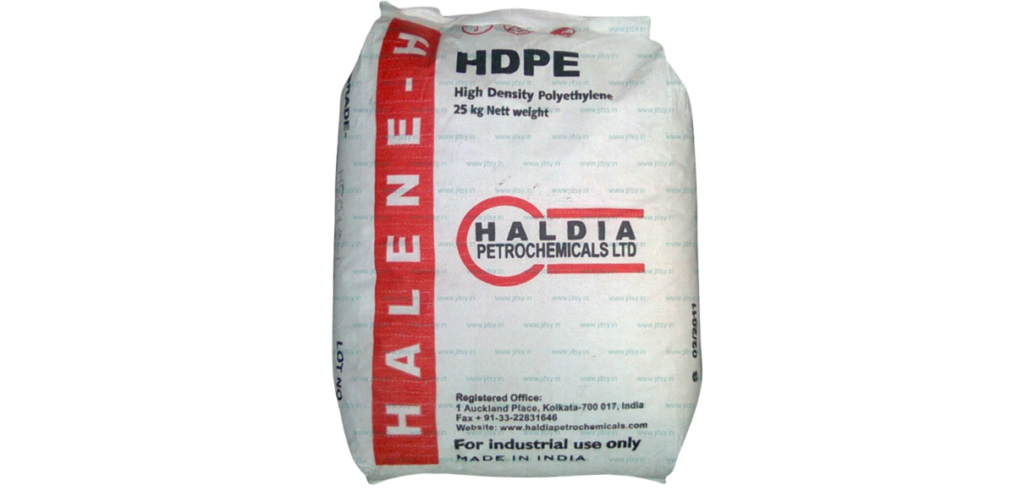
Haldia Petrochemicals B5500 has a notably lower MFI (0.35 at I5) and higher density (0.956 g/cm³) than 010DB50, targeting high-ESCR bulk chemical containers and water tanks. While it occupies the same high-ESCR segment, it is designed for a different container size range and processing window, and is not a confirmed equivalent to 010DB50 for small-bottle applications.
Common Search Variants
Buyers and engineers commonly search for this grade using terms such as high ESCR HDPE for pesticide bottles, IOCL blow moulding HDPE chemical container grade, 010DB50 IOCL granules, Propel pesticide packaging grade, and HDPE high ESCR GPBM grade India. Frequent spacing variants and alternate notations include IOCL HDPE 010 DB 50, 010DB50 1 MFI HDPE, HD Blow IOCL 010DB50, and IOCL HDPE 010DB50 blow moulding granules — all refer to the same product.










Reviews
Clear filtersThere are no reviews yet.