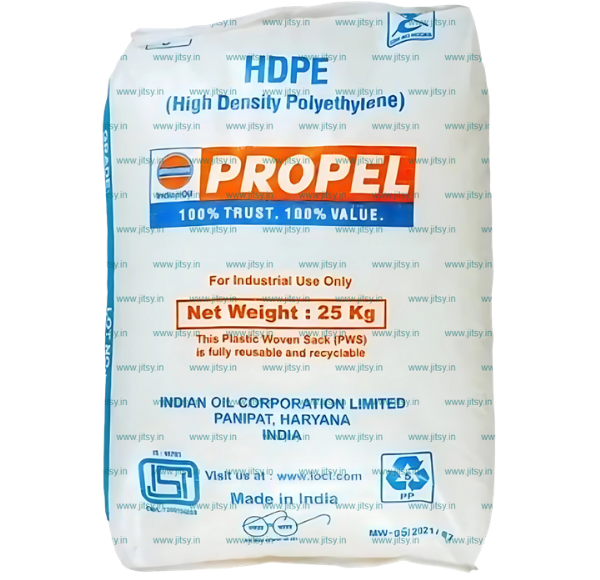
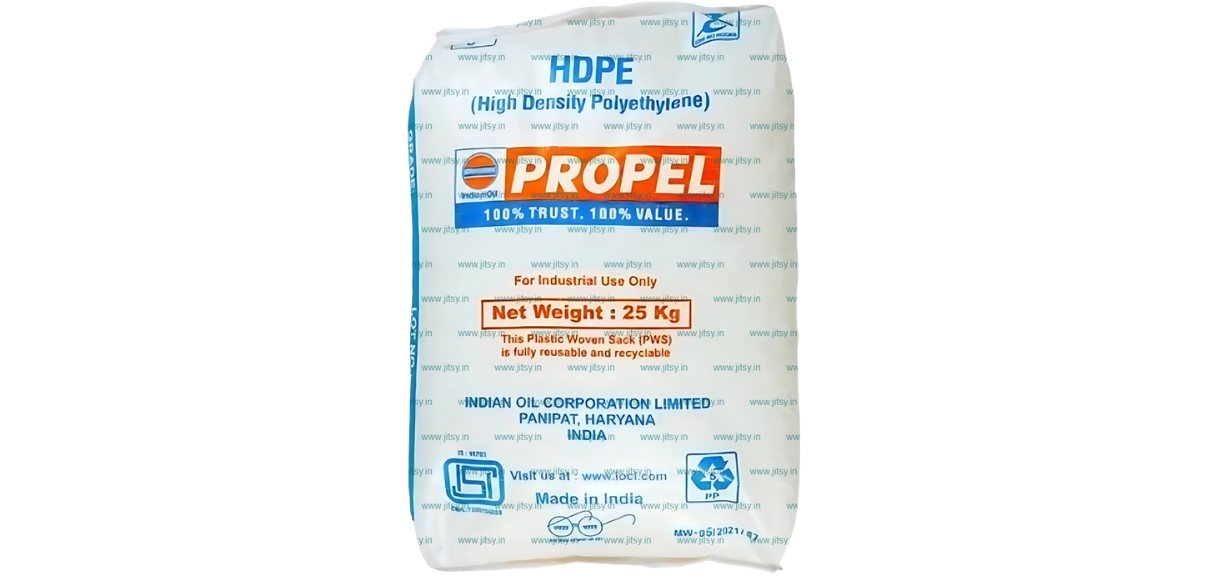
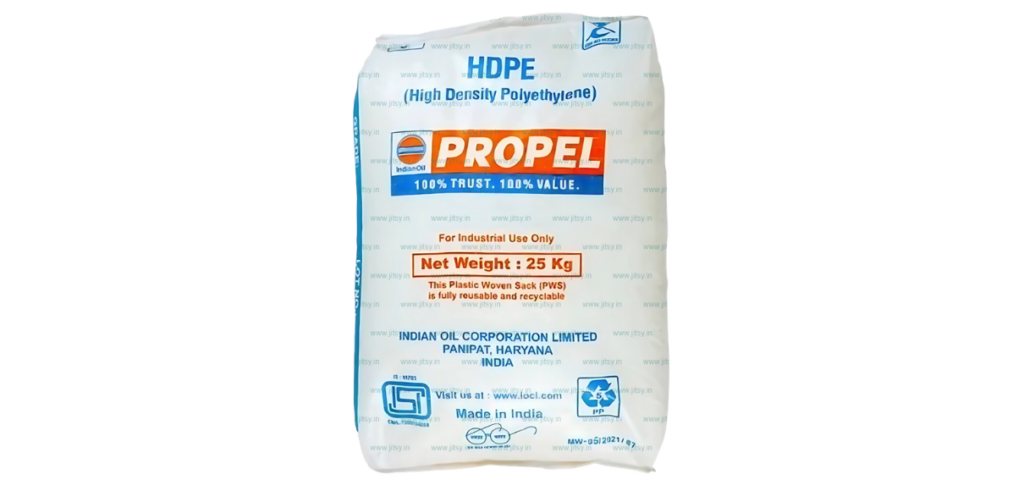
Propel 010E52 is an oriented tape and monofilament grade of high-density polyethylene manufactured by Indian Oil Corporation Ltd. (IOCL) under its Propel polymer brand. Produced using Nova Chemicals’ Sclairtech Solution Polymerization Technology at IOCL’s Panipat Naphtha Cracker Complex in Haryana, the grade is designed specifically for the production of raffia tapes, woven sack fabrics, tarpaulin, agricultural shade nets, and Raschel bags — the segment of HDPE processing defined by high-speed mechanical drawing of thin extruded profiles into oriented tapes, strips, or filaments with high tensile strength and dimensional stability. The grade is supplied as natural-coloured granules in 25 kg BIS-compliant raffia bags.
The grade designation communicates its processing family within the Propel system. The “01” prefix identifies it as a Sclairtech solution-polymerised grade — the same technology platform used for the Propel injection-moulding and film grades — which is distinct from the Hostalen slurry process used for IOCL’s bimodal blow-moulding and pipe grades. The “E” designates the oriented tape and monofilament processing family, setting 010E52 clearly apart from the “M” injection-moulding grades, the “B” blow-moulding grades, the “F” film grades, and the “P” pipe grades in the Propel portfolio. The “52” corresponds to a density classification of approximately 0.952 g/cm³.
IOCL’s technical datasheet describes three defining characteristics for the grade: excellent orientation characteristics, low water carry-over, and superior mechanical properties. Each of these addresses a specific processing or performance requirement in tape and monofilament extrusion. Excellent orientation characteristics refers to the ability of the melt to be stretched by mechanical drawing — typically at draw ratios of 5:1 to 8:1 or higher — without neck-in, breakage, or surface defects, so that the applied orientation converts into usable tenacity in the finished tape. Low water carry-over refers to the tendency of the granule surface to shed absorbed moisture before processing: HDPE is inherently low in moisture uptake, but in high-speed tape extrusion lines with water-bath quench systems, a grade’s surface characteristics and moisture affinity affect how cleanly the tape enters the drawing zone without surface imperfections from residual water. Superior mechanical properties refers to the combination of high ultimate tensile strength and very high elongation at break that makes oriented 010E52 tapes strong enough for the load-bearing roles of woven sacks and tarpaulins.
The Sclairtech solution process produces a narrow-to-moderate molecular weight distribution with good homogeneity. For oriented tape grades, this distribution controls the balance between processability and orientation efficiency: the molecular chains align consistently during drawing, producing tapes with predictable strength-to-denier relationships that converters rely on for consistent woven fabric density and weight. The 0.952 g/cm³ density reflects a degree of crystallinity appropriate for raffia tapes — high enough for stiffness and tensile strength in the oriented state, but not so high as to produce a melt that resists orientation or a tape that is brittle at room temperature.
Manufacturer
Propel 010E52 is produced by Indian Oil Corporation Ltd. (IOCL), India’s largest oil refining and petrochemicals company, at the Panipat Naphtha Cracker Complex in Haryana. The grade is developed and documented by IOCL’s Product Application and Development Centre (PADC), Panipat. IOCL supplies the grade to converters across India under the Propel brand through its authorised distributor network.
Technical Insights
The properties of Propel 010E52 are reported as film properties — measured on 40 μm blown film produced at 0.75 mm die gap and a blow-up ratio (BUR) of 2.75 — rather than as compression-moulded specimen values. This is the standard reporting convention for oriented tape and film grades because the processing geometry of a blown film approximates the biaxial stress state experienced during tape orientation, making these values more directly relevant to what a converter will achieve in production than isotropic compression-moulded specimens would be. Direct numeric comparison between 010E52’s film-method tensile and elongation values and the compression-moulded values reported for injection-moulding or blow-moulding grades in the same Propel series is not appropriate.
- Melt Flow Index — 0.90 g/10 min (ASTM D1238, 190 °C / 2.16 kg): The 2.16 kg test load distinguishes 010E52 from the blow-moulding and pipe grades in the Propel range, which are tested at 5 kg. At 0.90 g/10 min under 2.16 kg, 010E52 is a lower-MFI grade relative to the injection-moulding grades in the series (which range from 2.7 to 18 g/10 min at the same load), and a higher-MFI grade than the blown film grade HDPE 003F46 (approximately 0.30 g/10 min). The 0.90 g/10 min value is typical for oriented tape and raffia grades: the melt must have enough resistance to develop stable parison or die-swell behaviour as it exits the flat film die or annular die, preventing neck-in and ensuring a uniform tape cross-section enters the draw rolls. Too high an MFI produces a melt that flows too easily and sags or thins unevenly before the drawing zone stabilises; too low an MFI produces excessive back-pressure and processing temperatures that risk degradation of the thin tape profile.
- Density — 0.952 g/cm³ at 23 °C (ASTM D1505): At 0.952 g/cm³, 010E52 is the highest-density grade among IOCL’s Sclairtech-produced grades in the Propel series reviewed here. Higher density corresponds to higher crystallinity, and in an oriented tape this translates directly to higher stiffness in the drawn direction and stronger inter-chain packing that resists elongation before yield. For woven sacks carrying fertilisers or food grains at 25–50 kg per sack, and for tarpaulins resisting wind load and mechanical abrasion, this density-crystallinity relationship is what makes 010E52 mechanically competitive with other raffia grades at comparable denier.
- Tensile Strength at Yield — 21.5 MPa (MD) / 26.0 MPa (TD) (ASTM D882, 50 mm/min): The yield values for this grade show a transverse-direction advantage over machine direction — a consequence of the BUR 2.75 test film conditions, where the lateral inflation of the bubble stretches the TD more uniformly than the MD is stretched before the gauge length used in D882 testing. In a flat tape extrusion and drawing line, where the primary draw is uniaxial in the machine direction and TD relaxation is minimal, the effective tensile yield of the finished tape will reflect the orientation applied by the draw ratio and annealing conditions specific to the converter’s line. The yield values on the datasheet are reference points for grade selection, not the converter’s final tape specification.
- Ultimate Tensile Strength — 46.0 MPa (MD) / 45.5 MPa (TD) (ASTM D882, 50 mm/min): The UTS values are notably higher than the yield values and are close to balanced in MD and TD at film-test conditions. For woven sack and tarpaulin applications, ultimate tensile strength at high elongation determines the burst resistance of the woven structure and the resistance of the tarpaulin to progressive tearing from a puncture. The 46 MPa UTS in the test film indicates that 010E52 can sustain high stress before fracture, which at higher draw ratios in tape production translates into elevated tenacity in the finished tape.
- Elongation at Break — 1100% (MD) / 1250% (TD) (ASTM D882, 50 mm/min): These are the highest elongation-at-break values across the Propel grades reviewed in this series. The very high values in both directions confirm that 010E52 is a highly ductile, orientation-efficient grade at film conditions. For tape converters, high raw elongation in the undrawn film is a prerequisite for achieving high draw ratios — if the material breaks at lower elongation, the draw ratio is limited and the maximum tenacity achievable in the final tape is capped. The 1100–1250% values indicate that converters running 010E52 have substantial headroom to apply high draw ratios before approaching the failure limit of the material. The TD elongation exceeding MD elongation is consistent with the blown film test geometry.
- Dart Impact Strength — 1.5 g/μm (ASTM D1709, 38 mm dart, 66 cm drop height): The dart impact value is normalised per micron of film thickness, making it comparable across film gauges. At 1.5 g/μm, 010E52 delivers moderate puncture resistance at the test film condition. For woven sacks and wrapping fabrics, puncture resistance is relevant at the tape level before weaving, where breakage during winding or warping on the loom would reduce efficiency, and at the fabric level after weaving, where the interlaced tape structure distributes impact loads across multiple tape elements. The 1.5 g/μm value is lower than the 2 g/μm reported for the blown film grade HDPE 003F46, which is expected given 003F46’s lower density (0.946 g/cm³) and lower MFI; the higher crystallinity of 010E52 at 0.952 g/cm³ increases stiffness at some cost to dart impact relative to lower-density grades.
- Processing Temperature — 180–250 °C: The wide 180–250 °C processing window is specific to 010E52 as an oriented tape and raffia grade. The upper end of the range (well above the 180–215 °C range typical for injection-moulding grades) reflects the demands of flat film die or annular die systems used in tape extrusion, where the die must maintain a uniform melt temperature across the full die width or circumference to produce consistent tape thickness before drawing. The broad window gives converters operational flexibility to tune melt temperature against output rate, die geometry, and desired tape profile without approaching either the lower limit of acceptable melt uniformity or the upper limit of thermal stabiliser consumption.
All values are typical figures from IOCL’s “High Density Polyethylene – Oriented Tape & Monofilament – HDPE 010E52 Product Technical Datasheet” and are not specification limits. IOCL notes that values may change without prior notice; buyers should verify against the current grade sheet before final qualification.
Applications
Raffia Tapes for Woven Sacks — Fertilisers, Food Grains and Cement
The dominant application for Propel 010E52 is the production of raffia tapes for woven polypropylene-style sacks made from HDPE — used across India’s fertiliser, food grain, cement, sugar, and chemical packaging industries. In a raffia tape line, 010E52 granules are extruded as a continuous flat film or tubular film, slit into narrow tapes of defined width, and drawn through a hot-air oven or water bath at draw ratios that stretch the tape to several times its original length. The drawing process orients the polymer chains in the machine direction, converting the isotropic film into a high-tenacity tape with stiffness and strength far exceeding the undrawn state. IOCL explicitly recommends 010E52 for “raffia for woven sacks” — reflecting the grade’s design intent around the three properties IOCL highlights: excellent orientation characteristics, low water carry-over, and superior mechanical properties. The combination of 0.952 g/cm³ density and 0.90 g/10 min MFI delivers the melt stability and orientation efficiency that high-speed raffia lines require to maintain consistent tape denier, tensile strength, and on-loom weave efficiency for sacks that must carry 25–50 kg payloads through multiple handling, transport, and storage cycles without seam or fabric failure.
Wrapping Fabrics and Industrial Packaging
Propel 010E52 is recommended by IOCL for wrapping fabric production — a related but distinct application from woven sacks. HDPE wrapping fabrics are woven or laminated structures used to unitise and protect bulk goods on pallets, to wrap baled materials in logistics and agriculture, and to create woven protective covers for construction materials, pipes, and cable reels. The dimensional stability and moisture resistance of HDPE raffia tapes are critical in wrapping applications where the fabric must maintain tension around the wrapped load without creep relaxation, and where outdoor storage conditions demand resistance to rain, humidity, and temperature cycling without mechanical property loss. The high elongation at break and balanced MD/TD ultimate tensile strength of 010E52 support woven wrapping fabrics that resist progressive tearing if punctured by forklift tines, strapping corners, or sharp edges of the wrapped goods.
Tarpaulins for Agriculture, Construction and Industrial Use
IOCL lists tarpaulin as a primary application for 010E52. HDPE tarpaulins are manufactured as laminated woven fabrics — a base woven tape fabric coated or laminated with HDPE or LDPE film layers — for use in agricultural crop coverage, construction site protection, truck and vehicle covering, temporary shelters, and waterproofing applications. The tarpaulin fabric’s performance is driven first by the mechanical properties of the woven tape base layer: tensile strength, tear resistance, and elongation at break determine how the tarpaulin resists wind loading, edge tearing from grommets and fasteners, and repeated folding and unfolding in use. The high UTS of 010E52’s oriented tapes and the very high elongation at break — which contributes to energy absorption before failure — make the grade appropriate for the heavy-duty tarpaulin segment where the woven base fabric must carry significant structural loads. The 0.952 g/cm³ density supports tape stiffness and surface hardness that resist abrasion from ground contact and from mechanical fasteners.
Agricultural Shade Nets and Raschel Bags
Agricultural shade nets and Raschel bags are two structurally related applications where HDPE monofilament or narrow raffia tapes are knitted or woven into open-mesh structures. Shade nets are used in horticulture to regulate light intensity and temperature under polytunnels and open-field crop canopies, protecting vegetables, flowers, and seedlings from excess sunlight, hailstone damage, and bird damage. Raschel bags are knitted mesh packaging bags for onions, potatoes, citrus fruits, and other produce where ventilation and visibility of the product are required alongside adequate load-bearing strength. Both applications require tapes and monofilaments that can be processed at the narrow denier levels appropriate for mesh knitting and that retain mechanical integrity through multi-season outdoor UV exposure and repeated handling from harvest through retail. IOCL’s designation of 010E52 as a shade net and Raschel bag grade reflects the grade’s orientation efficiency at the finer tape dimensions these applications use, combined with the mechanical consistency that industrial knitting machines require for even mesh structures and acceptable yarn-breakage rates.
Monofilament for Industrial and Agricultural Netting
Beyond woven and knitted fabric structures, HDPE 010E52 is also used in monofilament extrusion — the production of continuous solid round or profiled filaments drawn from individual die holes or spinneret plates. HDPE monofilaments are used in horticultural support string, baling twine, industrial netting and mesh products, and rope construction. The same properties that make 010E52 effective for flat raffia tapes — MFI appropriate for stable single-hole die extrusion, orientation capability for high draw-ratio drawing, and high elongation allowing drawing to fine diameter without breakage — make the grade effective for monofilament production. Instamine identifies monofilament as a processing category for 010E52, and IOCL’s own product classification titles the grade as an “Oriented Tape and Monofilament” grade.
Comparable Alternatives
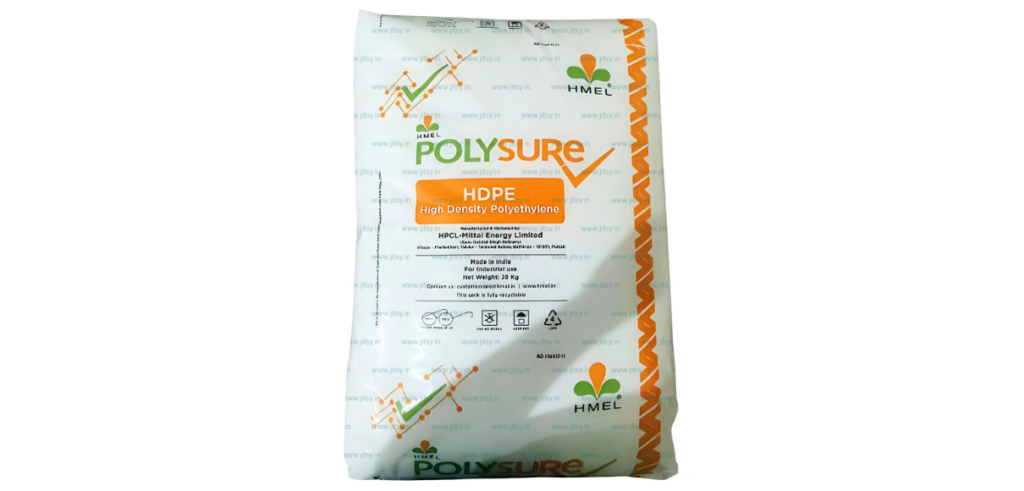
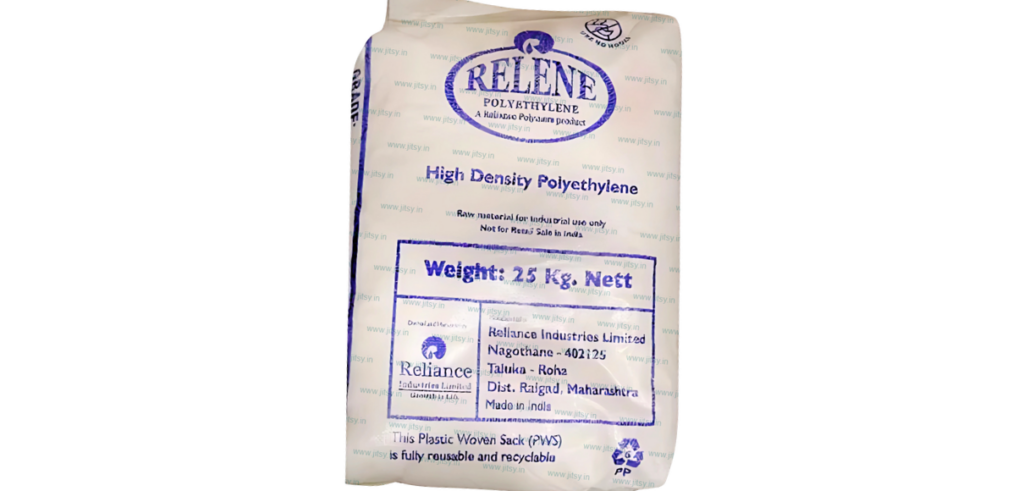
Reliance Relene E52009 is the most directly comparable grade to IOCL 010E52 in the Indian market. Reliance’s documentation describes E52009 as a high-density polyethylene grade with low gel content, excellent orientation characteristics, and negligible water carry-over — identical feature language to IOCL’s description of 010E52 — with density 0.952 g/cc and MFI 0.85 g/10 min at 190 °C / 2.16 kg. Both grades target raffia tapes and monofilaments for woven sacks and tarpaulins at essentially the same property level. The MFI difference (0.90 vs 0.85 g/10 min) is within typical production variability and would not be expected to produce a meaningful processing difference on most tape lines. Equivalence is not confirmed by either manufacturer; buyers should evaluate E52009 against their own line qualification data before substituting one for the other in a production programme.
Reliance Relene EE20 is a lower-MFI, lower-density raffia variant from Reliance, with MFI 1.45 g/10 min and density 0.945 g/cm³. The higher MFI of EE20 makes it better suited to low-denier tape production where higher flow rates and lower melt pressures reduce the risk of fine-tape breakage in drawing. The lower density (0.945 vs 0.952 g/cm³) means EE20 tapes will have lower stiffness and tensile yield in the drawn state compared to 010E52 tapes at the same draw ratio. For heavy-duty woven sack applications requiring maximum tenacity, 010E52’s higher density and lower MFI are the preferred combination. For lighter wrapping fabrics and low-denier shade nets where output rate and processing flexibility are prioritised over maximum tape strength, EE20 represents an alternative in the same manufacturer’s portfolio. Equivalence with 010E52 is not confirmed.
OPaL HDPE R5410 is OPaL’s raffia grade for woven sacks and tarpaulins, produced using Ineos gas-phase polymerisation technology. Market sources describe R5410 as having MFI 0.90 g/10 min at 190 °C / 2.16 kg and density 0.954 g/cm³ — almost identical resin properties to 010E52 at 0.952 g/cm³. The slightly higher density of R5410 (0.954 vs 0.952 g/cm³) would be expected to deliver marginally higher stiffness in the drawn tape, though the difference is small and within measurement variability. The production technology difference — Ineos gas phase versus Sclairtech solution polymerisation — will produce some difference in molecular weight distribution and crystallinity distribution that influences processing behaviour on specific tape lines. OPaL does not confirm R5410 as equivalent to IOCL 010E52; buyers should conduct line trials with each grade if switching.
GAIL HDPE Y50A010U is GAIL India’s raffia and monofilament grade, with MFI approximately 1.0 g/10 min and density approximately 0.950 g/cm³. It is positioned more strongly toward monofilament applications including fishing nets, mosquito nets, and tarpaulin tapes, rather than the heavier-denier woven sack tapes that are 010E52’s primary use. The slightly higher MFI of Y50A010U makes it more suited to the narrower die holes of monofilament spinnerets, where lower back-pressure reduces drawing tension variability. For high-tenacity raffia woven sacks, the combination of density and MFI in 010E52 and E52009 is more specific to that application than Y50A010U. Equivalence is not confirmed.
In all comparisons, no manufacturer confirms grade equivalence. Property comparisons are based on publicly available technical documentation. Converters should independently verify performance on their processing equipment before qualifying any alternative grade.
Common Search Variants
Buyers and engineers commonly search for this grade using terms such as IOCL HDPE raffia grade, Propel 010E52 granules, IOCL 010E52 woven sack grade, HDPE raffia 010E52, IOCL HDPE Propel oriented tape HDPE, and 010E52 technical datasheet. Frequent misspellings and alternate notations include 010 E 52, 010E 52, IOCL 10E52, Propel HD 010E52, and HDPE RAFFIA IOCL 010E52 grade — all refer to the same product.
















Reviews
Clear filtersThere are no reviews yet.