






Brand
 Bhansali Engineering Polymers LimitedBhansali Engineering Polymers Limited 3
 Borouge Pte LtdBorouge Pte Ltd 1
 Dongsung ChemicalDongsung Chemical 2
 Dow-MitsuiDow-Mitsui 4
 FPC Formosa Plastics CorporationFPC Formosa Plastics Corporation 1
 Gail India LimitedGail India Limited 32
 Haldia Petrochemicals LtdHaldia Petrochemicals Ltd 25
 Hanwha Solutions ChemicalHanwha Solutions Chemical 4
 Hanwha Total Energies PetrochemicalHanwha Total Energies Petrochemical 7
 HMEL - HPCL-Mittal Energy LimitedHMEL - HPCL-Mittal Energy Limited 55
 IOCL - Indian Oil Corporation LimitedIOCL - Indian Oil Corporation Limited 71
 Jiangsu Daoming Chemical Co LtdJiangsu Daoming Chemical Co Ltd 2
 LG ChemLG Chem 8
 Lotte ChemicalLotte Chemical 4
 LyondellBasell Industries NVLyondellBasell Industries NV 1
 Mangalore Refinery & Petrochemicals LimitedMangalore Refinery & Petrochemicals Limited 7
 Marcopolo International LLCMarcopolo International LLC 2
 Nouryon Functional ChemicalsNouryon Functional Chemicals 8
 ONGC Petro Additions LtdONGC Petro Additions Ltd 44
 Reliance Industries LimitedReliance Industries Limited 48
 SabicSabic 1
 Sipchem - Saudi International PetrochemicalSipchem - Saudi International Petrochemical 8
 SK Functional PolymerSK Functional Polymer 6
 The Dow Chemical CompanyThe Dow Chemical Company 3
 TPI Polene Public Company LimitedTPI Polene Public Company Limited 3
 VersalisVersalis 4
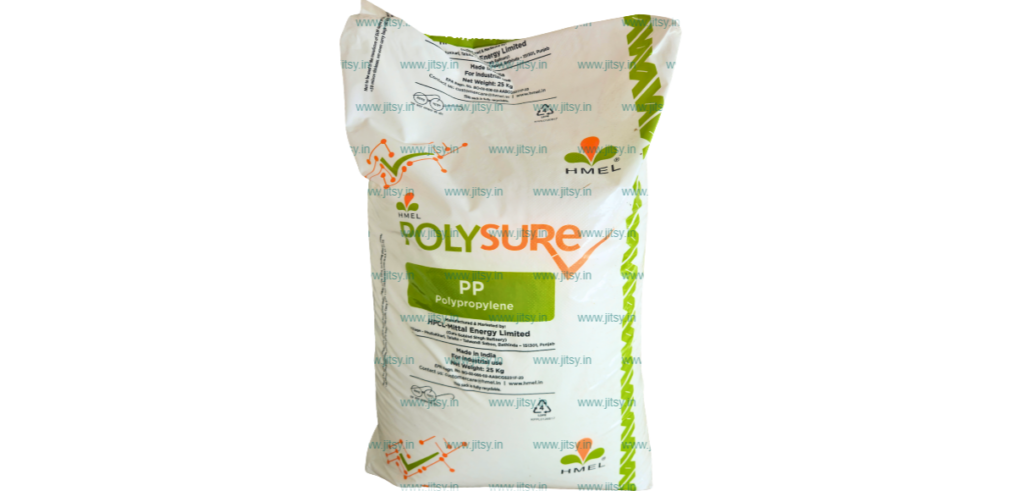
HMEL PP Polysure F08RR
HMEL Polysure F08RR is a high-performance polypropylene homopolymer produced by HMEL for cast film extrusion. Manufactured using advanced Spheripol-II/Novolen technology, it offers excellent clarity, processability, and heat-seal performance for metallizable and lamination films.
Technical Details
Melt Flow Index (230°C/2.16kg): 8 g/10min (ASTM D1238) Density: 0.90 g/cc (ASTM D1505) Tensile Yield Strength: 33 MPa (ASTM D638) Elongation at Yield: 10% (ASTM D638) Flexural Modulus: 1300 MPa (ASTM D790) Izod Impact @23°C: 35 J/m (ASTM D256) Rockwell Hardness: 105 (ASTM D785) Vicat Softening Point:154°C (ASTM D1525) HDT (0.455 MPa): 100°C (ASTM D648) Compliant with IS 10910, FDA/EU food-contact standards. Additives: antioxidants, slip/anti-block agents for film extrusionApplications:
Cast PP Films for Metallizing & Packaging
Polysure F08RR is engineered for CPP films in snacks, bakery, and food wraps, offering low neck-in for high-speed lines, uniform gauge, and superior gloss. Used in metallizable films, lamination substrates, overwraps, and cheese/monetary packaging. Delivers clarity and heat-seal performance better than generic homopolymers or impact copolymers. F08RR excels in high-speed extrusion environments where die-buildup and neck-in control are critical. Its processability supports output >500 kg/hr with minimal film defects, making it ideal for demanding converters requiring consistent optical quality and heat-seal initiation.Why Choose HMEL F08RR? Advantages Over Alternatives
F08RR stands out for low die-buildup, high output, and excellent optical properties. Compared to Reliance H070SG, Borouge HD601CF, and IOCL/OPaL P1350YG, it provides lower neck-in, consistent quality, and Delhi-focused supply. F08RR1 offers slip-modified performance for enhanced film slip; F10SR enables even higher speed for ultra-fast lines. Reliance H070SG is a 7 MFI general film grade with broader applications but lower clarity than F08RR. Borouge HD601CF delivers ultra-low neck-in but requires import logistics and longer lead times. IOCL P1350YG is cost-effective but lacks F08RR's optical premium. F08RR1 is HMEL's slip-modified variant for converters needing enhanced anti-block and film slip properties.Processing Guide for F08RR Cast Film Extrusion
Extrusion Temperature: 210–250°C Line Speed: Suitable for >500 kg/hr output Die Gap: Optimized for low neck-in (<5%) Film Thickness: 20–100 microns recommended F08RR's processability supports high-speed sheet extrusion with minimal adjustments. Die temperature control is critical for maintaining gloss and clarity. Chill roll temperature (20–50°C) ensures proper crystallization and gauge uniformity. Similar Grades: Polysure F08RR1, HD601CF Alternatives Explore F08RR1 for slip-modified needs, or Borouge HD601CF for ultra-low neck-in. Reliance and IOCL/OPaL offer broad market options, but F08RR targets Delhi/Punjab supply and faster support. F10SR is HMEL's higher MFI variant for even faster lines where output is prioritized over optical properties.
HMEL PP Polysure F08RR1
Polysure F08RR1 is a premium slip-modified polypropylene homopolymer (MFI 8) engineered by HMEL for high-speed cast PP film extrusion. Produced at the HPCL-Mittal Bathinda refinery using advanced Spheripol-II technology, F08RR1 delivers outstanding processability, low neck-in, and superior clarity, gloss, and heat-seal for metallizable films and packaging. Compliant with IS 10910 for food and pharma contact, it features a positive list of additives and is trusted by leading converters for demanding CPP lines.
Key Technical Insights:
- MFI 8 g/10min
- Tensile Yield 35 MPa
- Elongation at Yield 10%
- Flexural Modulus 1500 MPa
- Notched Izod @23°C 30 J/m
- Vicat 154°C
- HDT 100°C
Applications in Metallized CPP & Packaging
HMEL Polysure F08RR1 is optimized for cast PP film extrusion, especially where slip enhancement, high clarity, and heat-seal performance are critical. It powers metallizable films for snacks and bakery, lamination substrates for flexible packaging, garment and textile overwraps, and cheese/food wraps. Its slip-modified formulation ensures smooth processing at high line speeds, reduced die build-up, and excellent gauge stability, making it a preferred choice for converters targeting food-safe and visually demanding packaging.F08RR1 vs Alternatives Comparison
F08RR1 stands apart as a slip-modified, high-clarity cast film grade tailored for Delhi and North India converters. Compared to the base F08RR (no slip), F08RR1 offers enhanced anti-block and film slip, supporting faster winding and easier downstream handling. Borouge HD601CF is an import alternative with low neck-in but longer lead times; Reliance H070SG is a general film grade with lower clarity, while IOCL P1350YG is a cost-effective option but lacks the optical and slip performance of F08RR1. F10SR from HMEL provides higher MFI for ultra-fast lines but with different processing priorities.Processing Guide
For optimal processing, set extrusion temperatures between 210–250°C, target line speeds above 500 kg/hr, and maintain die gaps for minimal neck-in. Chill roll temperatures of 20–50°C help maximize film clarity and gauge control.
HMEL PP Polysure F10SR
Polysure F10SR is a Novolen-technology polypropylene homopolymer from HMEL, engineered for tubular water quench (TQPP) and cast film lines. With a melt flow index of 10.5 g/10min, F10SR offers superior slip, anti-block, clarity, and gloss, making it ideal for high-speed packaging film production. Produced at the HPCL-Mittal Bathinda refinery, it is fully compliant with IS 10910 and FDA 21 CFR 177.1520 for food and pharma contact. The grade is trusted by converters seeking consistent gauge, easy processability, and reliable optical properties on demanding lines.
Key Technical Insights:
- MFI 10.5 g/10min
- Density 0.905 g/cm³
- Tensile Yield Stress 34 MPa
- Tensile Yield Strain 9%
- Flexural Modulus 1500 MPa
- Notched Izod @23°C 4 kJ/m²
- Vicat 154°C
- HDT 95°C
Applications: TQPP Films for Packaging & Textiles
F10SR is optimized for general packaging films, textile and garment overwraps, bakery and bread wraps, and snack/grocery bags. Its high slip and anti-block performance ensure easy-open and smooth winding, while clarity and gloss deliver shelf appeal. The grade’s processability supports high-output lines, making it a preferred choice for converters running modern TQPP and cast film equipment for food, pharma, and retail packaging.Performance Advantages & Processing Tips
Polysure F10SR stands out for its exceptional processability, reduced die build-up, and stable gauge control at high speeds. The slip and anti-block additives minimize film sticking, supporting easy-open packs and efficient downstream handling. For best results, maintain extrusion temperatures between 210–250°C, line speeds above 500 kg/hr, and chill roll temperatures of 20–50°C. The grade’s balance of strength and flexibility ensures reliable performance across a range of film thicknesses and end-use requirements.F10SR vs Alternatives: Technical Comparison
F10SR is the specialist choice for Delhi converters seeking TQPP and cast film performance. Compared to HMEL F10SR1 (Spheripol variant), F08RR1 (cast focus), IOCL/OPaL 1100FS (cost alternative), Reliance H100EY (similar MFI), and FH10S (other brands), F10SR offers a unique blend of high MFI, slip, and optical clarity. F10SR1 is suited for Spheripol lines, while F08RR1 targets lower MFI cast film. IOCL and Reliance options provide cost and supply flexibility but may not match F10SR’s balance of processability and gloss.
HMEL PP Polysure F10SR1
Polysure F10SR1 is a Spheripol-II polypropylene homopolymer engineered by HMEL for tubular water quench (TQPP) film extrusion. With a melt flow index of 10 g/10min, it delivers superior slip, anti-block, easy-open, and high clarity/gloss for food, bakery, and textile packaging. Produced at HPCL-Mittal Bathinda with Spheripol-II process, F10SR1 is fully IS 10910/FDA 21 CFR 177.1520 compliant and trusted by converters demanding top TQPP processability, strength, and optical finish.
Key Technical Insights:
- MFI 10 g/10min
- Density 0.905 g/cm³
- Tensile Yield 34 MPa
- Flexural Modulus 1500 MPa
- Izod Notched 4 kJ/m²
- Vicat 154°C
- HDT 95°C
TQPP Applications & Processing
F10SR1 is tailored for high-speed TQPP film lines, excelling in snack, grocery, and bread packaging, textile and garment overwraps, and food/pharma wraps. Its high slip and anti-block properties enable easy-open packs and smooth winding. For optimal output, use extrusion temperatures of 210–250°C, line speeds above 500 kg/hr, and chill roll cooling between 20–50°C. The grade’s processability and strength ensure reliable performance across a range of film thicknesses and demanding end-use requirements.Advantages vs F10SR/Alternatives
F10SR1 is the Spheripol specialist for Delhi converters targeting TQPP films. Compared to F10SR (Novolen base), F10SR1 offers tailored processability for Spheripol lines and a similar MFI but with distinct slip and anti-block profiles. F08RR1 (lower MFI) is ideal for cast film focus, while IOCL 1100FS is a cost-effective TQPP option but may lack F10SR1’s optical and handling advantages. F10SR1’s positive list additives and food/pharma compliance set it apart for converters needing regulatory assurance and high-speed, high-clarity film output.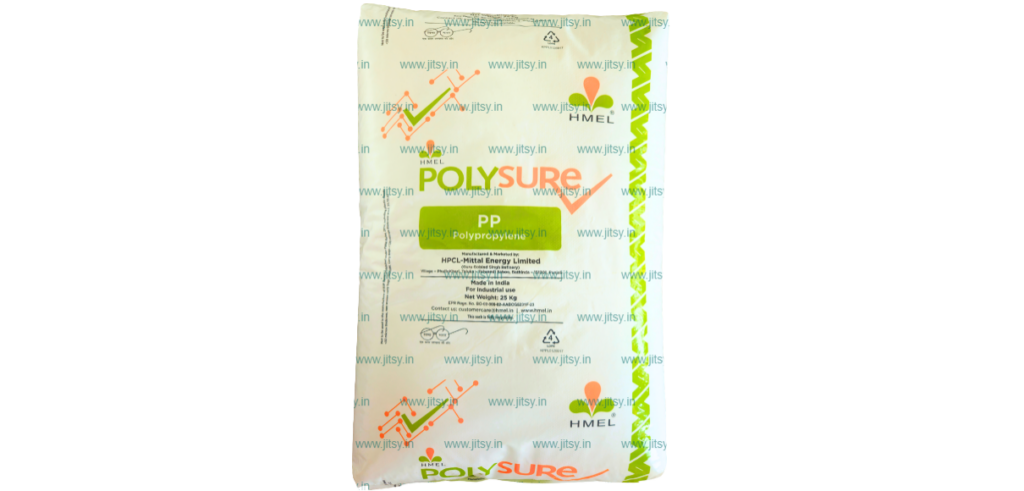
HMEL PP Polysure M06RR
HMEL PP Polysure M06RR is a polypropylene homopolymer injection and extrusion grade developed by HPCL-Mittal Energy Limited under its Polysure brand. Positioned for general-purpose moulded products and general plastics applications, this 6 MFI PP homopolymer is designed for converters who need a practical balance of flow, rigidity, process stability, and surface finish. HMEL markets M06RR and M06RR1 within its homopolymer portfolio for smooth processing and good aesthetics, making the grade relevant for manufacturers producing utility mouldings, rigid plastic parts, and extrusion-based products where dependable output matters.
HMEL is one of India’s major petrochemical producers, and its Polysure polypropylene range is manufactured using advanced Novolen and LyondellBasell technology platforms. Within the broader Polysure family, M06RR sits in the homopolymer segment, which is generally preferred when the application demands better stiffness, dimensional stability, and rigid-part performance compared with random or impact copolymer alternatives. For buyers searching for HMEL PP granules, Polysure M06RR supplier in India, or 6 MFI PP homopolymer injection grade, this material is positioned as a reliable, industry-aligned option for everyday production needs.
Deep Technical Insights
The most important fully verified technical identifier for HMEL Polysure M06RR is its melt flow index of 6 g/10 min, measured as per ASTM D1238. This places the grade in a useful processing window for general-purpose injection moulding and extrusion, where manufacturers often need a resin that is neither too high-flow nor too viscous. In practical terms, 6 MFI supports stable filling, controlled melt behaviour, and a workable balance between processability and part integrity. Compared with higher-MFI homopolymer grades, M06RR is better suited to applications where a slightly stronger, more controlled melt is preferred over ultra-fast filling. As a polypropylene homopolymer, M06RR is inherently aligned with rigid applications that benefit from good stiffness and clean surface appearance. HMEL specifically highlights smooth processing and good aesthetics, which is commercially important for moulders producing visible consumer or industrial parts. This makes the grade attractive for applications where appearance, repeatability, and machine-friendly processing are valued alongside cost-effective production. Since no public HMEL PTDS for M06RR currently provides verified tensile, flexural, impact, hardness, HDT, or exact processing-temperature data, the most accurate public technical positioning is based on the manufacturer’s confirmed grade classification, MFI, and application intent rather than unverified numerical claims.Applications and Industry Use Cases
General-Purpose Injection Moulded Products
HMEL PP Polysure M06RR is well suited for general-purpose injection moulded products where a balanced 6 MFI homopolymer helps deliver stable mould filling and rigid finished parts. It is relevant for utility components, small housings, everyday plastic articles, and industrial mouldings that need dependable processing without shifting tovery high-flow grades. For manufacturers targeting repeatable output and neat surface finish, M06RR fits well into standard injection moulding operations.General Plastics and Rigid Utility Parts
This grade is also suitable for general plastics applications where polypropylene homopolymer is selected for stiffness, dimensional consistency, and practical processing behaviour. It can support production of rigid non-fragile parts used in commercial, household, and light industrial segments. Because HMEL positions the grade for smooth processing and good aesthetics, it is especially relevant where the final product must look clean while still maintaining the structural advantages of PP Homopolymer.Extrusion Applications
HMEL explicitly positions M06RR for extrusion in addition to injection moulding, making it useful for processors handling general PP extrusion applications such as simple profiles and sections. A 6 MFI homopolymer can offer a workable melt strength profile for extrusion lines that require stable output and consistent appearance. This dual positioning increases the commercial value of M06RR for converters who operate mixed processing setups or want a versatile PP homopolymer grade across multiple product Categories.Industrial and Technical Plastic Components
For industrial buyers and converters, M06RR can be a practical choice for technical plastic parts where a homopolymer backbone is preferred for rigidity and dimensional stability. While the grade is not publicly positioned as a specialty engineering polymer, it offers a dependable middle-ground option for manufacturers who need a standard PP homopolymer with reliable processing behaviour. This makes it relevant for job shops, OEM vendors, and plastic processors serving broad industrial demand.Comparable Alternatives
The closest internal alternative within the HMEL Polysure range is M12RR or M12RR1, another polypropylene homopolymer grade but with a higher melt flow index of 12 g/10 min. Compared with M06RR, M12RR is better suited to thinner-wall parts, faster filling, and applications such as closures, furniture, and housewares where higher flow improves productivity. M06RR, by contrast, is the more balanced option when processors want general-purpose moulding and extrusion performance without moving into a higher-flow processing window. Among other Indian producers, IOCL P1030MG can be viewed as a lower-flow homopolymer alternative for applications needing stronger melt resistance and more controlled processing, while IOCL P1110MG is a higher-flow option for furniture and household items. Reliance Repol H110MA and Reliance AM120N are also higher-MFI PP homopolymer grades positioned for rigid packaging, furniture compounds, and industrial mouldings. The rationale behind choosing M06RR is straightforward: it fills the mid-flow general-purpose slot in the PP homopolymer ladder, making it useful for converters who need a practical balance of flow, rigidity, and versatility rather than a specialised high-flow or low-flow grade.
HMEL PP Polysure M06RR1
HMEL PP Polysure M06RR1 is a polypropylene homopolymer injection and extrusion grade developed by HPCL-Mittal Energy Limited under its Polysure brand. Officially positioned for general-purpose moulded products and general plastics applications, this 6 MFI PP homopolymer is designed for processors who need a dependable balance of flow, rigidity, surface finish, and production stability. HMEL highlights smooth processing and good aesthetics as the defining characteristics of M06RR1, making it a practical choice for converters producing rigid plastic parts, utility mouldings, and standard extrusion products.
HMEL is one of India’s leading petrochemical manufacturers, and the Polysure polypropylene range is produced using advanced Novolen and LyondellBasell technologies. Within the broader Polysure PP family, M06RR1 sits in the homopolymer segment, which is generally preferred for applications requiring better stiffness, dimensional consistency, and rigid-part performance than many impact or random copolymer alternatives. For buyers searching for HMEL Polysure M06RR1 supplier in India, 6 MFI PP homopolymer granules, or HMEL PP injection grade for general plastics, this grade is positioned as a reliable and technically aligned material for everyday Manufacturing.
Deep Technical Insights
The most important verified technical parameter for HMEL Polysure M06RR1 is its melt flow index of 6 g/10 min, measured as per ASTM D1238. This places the grade in a balanced processing range for both injection moulding and extrusion. In practical manufacturing terms, a 6 MFI PP homopolymer offers more controlled flow than high-MFI grades while still maintaining good mould filling and machine-friendly processing. This makes M06RR1 especially useful where processors want a stable resin for routine production rather than an ultra-fast thin-wall grade. As a polypropylene homopolymer, M06RR1 is naturally suited to rigid applications where stiffness, dimensional stability, and clean appearance are important. HMEL’s own positioning around smooth processing and good aesthetics is especially relevant for moulders producing visible finished parts, utility products, and general plastics components that must look consistent from batch to batch. Since public HMEL sources do not openly provide verified tensile strength, flexural modulus, impact strength, hardness, HDT, or exact processing temperatures for M06RR1, the most accurate technical presentation is to focus on the manufacturer-confirmed MFI, polymer family, process suitability, and application intent rather than publishing unverified numerical Values.Applications and Industry Use Cases
General-Purpose Injection Moulded Products
HMEL Polysure M06RR1 is well suited for general-purpose injection moulded products where a moderate-flow PP homopolymer helps achieve stable mould filling and rigidfinished parts. It is relevant for utility mouldings, small housings, everyday plastic articles, and standard industrial components where processors need reliable output without shifting to very high-flow grades. Its balanced flow profile supports repeatable production and good finished-part appearance.General Plastics and Utility Components
This grade is also suitable for general plastics applications where manufacturers prefer polypropylene homopolymer for its practical rigidity and dimensional consistency. It can be used in a wide range of non-fragile rigid parts across household, commercial, and light industrial segments. Because HMEL specifically promotes good aesthetics, M06RR1 is especially useful where the final product must maintain a neat, clean look along with dependable structural performance.Extrusion Applications
HMEL officially positions M06RR1 for extrusion as well as injection moulding, which expands its value for processors working across multiple production methods. In extrusion applications such as simple profiles and general PP sections, a 6 MFI homopolymer can offer a workable melt strength and stable output profile. This dual-use positioning makes M06RR1 commercially attractive for converters who want one versatile PP homopolymer grade for more than one processing route.Industrial and Technical Plastic Parts
For industrial converters and OEM vendors, M06RR1 can serve as a practical material for technical plastic parts where rigidity and predictable processing are more important than impact modification. While it is not positioned as a specialty engineering polymer, it offers a dependable middle-ground solution for manufacturers who want a standard PP homopolymer with smooth processing behaviour and broad usability across routine industrial applications.Comparable Alternatives
The closest internal alternative within the HMEL Polysure range is M12RR or M12RR1, another polypropylene homopolymer grade with a higher melt flow index of 12 g/10 min. Compared with M06RR1, M12RR1 is more suitable for thinner-wall parts, faster filling, and applications such as closures, furniture, toys, and housewares where higher flow improves cycle efficiency. M06RR1, on the other hand, is the more balanced option when processors need general-purpose moulding and extrusion performance without moving into a higher-flow processing window. Among other Indian producers, IOCL P1030MG can be considered a lower-flow homopolymer alternative for applications needing stronger melt resistance and more controlled processing, while IOCL P1110MG is a higher-flow option for furniture and household mouldings. Reliance Repol H110MA and Reliance AM120N are also higher-MFI PP homopolymer grades positioned for rigid packaging, industrial mouldings, and furniture compounds. The rationale behind assigning M06RR1 to general-purpose mouldings is clear: it occupies the practical mid-flow zone in the PP homopolymer ladder, making it suitable for converters who need a versatile balance of flow, rigidity, and appearance rather than a specialised high-flow or low-flow grade.
HMEL PP Polysure M12RR
Polysure M12RR is a premium Polypropylene Homopolymer manufactured by HPCL-Mittal Energy Ltd (HMEL) using advanced Novolen Gas Phase technology. Engineered for general purpose injection molding, M12RR delivers exceptional processability, low cycle times, and outstanding product aesthetics. Produced at HMEL's Bathinda refinery complex, M12RR is the trusted choice for furniture manufacturers, housewares converters, food packaging producers, and toy makers across North India. The grade combines a balanced 12 MFI with 1450 MPa flexural modulus for optimal stiffness-to-flow ratio, enabling fast, defect-free molding. Full compliance with IS 10910 and FDA 21 CFR 177.1520 makes M12RR ideal for food contact applications including rigid containers, caps, and closures.
Technical Insights & Specifications
- Melt Flow Index (ASTM D1238, 230°C/2.16 kg): 12 g/10 min, providing balanced melt flow suitable for controlled extrusion and molding processes requiring higher melt strength.
- Tensile Strength at Yield (ASTM D638): 35 MPa, ensuring strong mechanical performance and reliable structural stability in finished components.
- Tensile Elongation at Yield (ASTM D638): 10%, offering a balance between rigidity and flexibility during processing and end-use.
- Flexural Modulus – 1% Secant (ASTM D790A): 1450 MPa, indicating high stiffness and good dimensional stability in molded or extruded products.
- Notched Izod Impact Strength at 23°C (ASTM D256): 30 J/m, providing good resistance to sudden impact under standard conditions.
- Vicat Softening Temperature (ASTM D1525, 10N): 153°C, demonstrating strong thermal resistance for applications exposed to elevated temperatures.
- Heat Deflection Temperature (ASTM D648, 0.455 MPa): 95°C, enabling the material to maintain structural integrity and shape under moderate thermal loads.
Processing Guidelines
Barrel: 180–280°C (progressive) Mold: 30–40°C Injection Speed: Medium to High Back Pressure: 5–15 bar Screw Speed: 40–70 rpm Cooling Time: 15–30 seconds (part-dependent)Regulatory Compliance
IS 10910, IS 10909, FDA 21 CFR 177.1520Technical Strength
M12RR's Novolen Gas Phase formulation delivers a narrow molecular weight distribution, enabling consistent melt flow and minimal warpage across production runs. The 1450 MPa flexural modulus provides superior stiffness for structural applications while the 12 MFI ensures rapid mold filling and short cycle times (15–30 seconds). The 153°C Vicat softening point and 95°C heat deflection temperature enable processing at elevated barrel temperatures without degradation, supporting high-volume production. Low gel count and excellent color retention ensure superior product aesthetics—critical for consumer-facing furniture and housewares applications.Applications & Industry Use Cases
Furniture & Outdoor Applications
M12RR is widely used for monobloc hairs, cafeteria tables, garden furniture, and indoor seating components. The grade's low warpage and dimensional stability ensure consistent fit and assembly across high-volume production runs. With optional UV stabilizer packages, M12RR delivers excellent outdoor durability and color retention for extended exposure to sunlight and weather. The 95°C heat deflection temperature provides reliable performance in hot climates, making it ideal for tropical and subtropical markets across India.Food & Beverage Packaging
M12RR is the preferred choice for rigid food containers, butter boxes, dairy packaging, and dry food storage bins. Full IS 10910 and FDA 21 CFR 177.1520 compliance ensures safety for direct food contact. The grade's excellent barrier properties and low extractables make it suitable for milk, juice, and beverage containers. Superior adhesion to labels and printing inks enables high-quality graphics for retail shelf appeal.Caps, Closures & Beverage Accessories
The grade's fast cooling capability (15–20 second cycles) makes M12RR ideal for high-speed cap and closure production. 28mm and 38mm PCO (Preform Closure Outline) caps, mineral water closures, and flip-top caps benefit from M12RR's low warpage and dimensional precision. The 1450 MPa stiffness ensures reliable sealing and tamper-evidence integrity.Housewares & Consumer Products
Kitchen and bathroom applications including mixing bowls, colanders, utensil holders, drawer organizers, and storage caddies leverage M12RR's excellent aesthetics and dimensional stability. The low warpage ensures tight-fitting components for drawer inserts and modular storage systems. High gloss and color retention make products visually appealing for retail consumers.Toys & Educational Products
M12RR is FDA-compliant for child safety standards, making it suitable for building blocks, snap-fit assembly toys, dolls, figurines, and educational toys. The grade's excellent flow enables detailed feature molding while maintaining structural integrity for snap-fit assemblies and moving parts.Industrial Compounding
M12RR serves as a clean, stable carrier resin for masterbatch and additive concentrates. The grade's low gel count and consistent melt flow ensure excellent dispersion of colorants, UV stabilizers, and flame retardants. Talc-filled compounds (20–40% talc) are widely used for automotive under-hood components, providing enhanced stiffness and heat resistance.Alternatives & Comparative Overview
Several polypropylene grades provide performance comparable to M12RR, particularly for general-purpose injection molding and precision components. Key alternatives include:- M12RR1 – MFI 12, produced using Spheripol-II Controlled Rheology (CR) technology with a flexural modulus of ~1550 MPa. Used in general-purpose injection molding and precision applications. Compared to M12RR, it offers about 7% higher stiffness and reduced warpage.
- MH13 – MFI 13.5, manufactured using Ineos gas-phase technology, with a flexural modulus around ~1500 MPa. Commonly applied in household goods and packaging products. It provides slightly higher flow while maintaining similar application suitability.
- 1200MG – MFI 20, produced with IOCL Spheripol-II technology, featuring a flexural modulus near ~1600 MPa. Designed for thin-wall injection molding (TWIM) and houseware products, where higher MFI enables faster molding cycles.
- MI12NX – MFI 12, manufactured using OPaL Ineos technology, with a flexural modulus around ~1400 MPa. Used in appliances and furniture components. As an impact copolymer, it offers high impact strength (around 120 J/m) and anti-static properties.
- 3120MA – MFI 12, produced via IOCL Spheripol-II technology, with a flexural modulus of ~1450 MPa. Suitable for automotive and furniture applications. This grade is also an impact copolymer with anti-static characteristics.
M12RR Competitive Advantages
M12RR's Novolen Gas Phase technology delivers solvent-free production with consistent quality, narrow molecular weight distribution, and excellent batch-to-batch stability. The 1450 MPa flexural modulus provides superior stiffness for structural applications while maintaining low warpage for precision molding. Compared to M12RR1 (Spheripol-II), M12RR offers cost-effectiveness for general purpose applications; M12RR1 is preferred for tight-tolerance, low-warpage precision parts. Versus impact copolymers (MI12NX, 3120MA), M12RR's homopolymer stiffness excels in load-bearing furniture and structural components. For faster cycles, 1200MG (20 MFI) is available; for lower flow and better impact, impact copolymer variants are recommended.
HMEL PP Polysure M12RR1
Polysure M12RR1 is a high-precision Polypropylene Homopolymer manufactured by HPCL-Mittal Energy Ltd (HMEL) using advanced Spheripol-II technology. Engineered for injection molding applications demanding minimal warpage and tight tolerances, M12RR1 delivers exceptional processability, fast cycles, and outstanding product aesthetics. Produced at HMEL's Bathinda Spheripol-II unit, M12RR1 is the specialist grade for precision containers, threaded closures, snap-fit toys, and modular furniture. The grade’s 12 MFI and 1550 MPa flexural modulus enable both rapid mold filling and maximum stiffness, while Spheripol-II’s narrow molecular weight distribution ensures uniform shrinkage and minimal warpage. Full IS 10910, IS 16738:2018, and FDA 21 CFR 177.1520 compliance makes it suitable for food contact and pharma packaging.
Deep Technical Insights & Specifications
- Melt Flow Index (ASTM D1238, 230°C/2.16 kg): 12 g/10 min, offering balanced melt flow with good melt strength for stable injection molding processes.
- Tensile Strength at Yield (ASTM D638): 35 MPa, ensuring strong mechanical performance and reliable structural integrity in molded components.
- Tensile Elongation at Yield (ASTM D638): 12%, providing improved ductility and flexibility during processing and end-use.
- Flexural Modulus – 1% Secant (ASTM D790A): 1550 MPa, indicating high stiffness and excellent dimensional stability for precision molded parts.
- Notched Izod Impact Strength at 23°C (ASTM D256A): 30 J/m, delivering good resistance to sudden impact under standard conditions.
- Vicat Softening Temperature (ASTM D1525, 10N): 154°C, demonstrating strong thermal resistance for applications exposed to elevated temperatures.
- Heat Deflection Temperature (ASTM D648, 0.455 MPa): 100°C, enabling the material to maintain shape and performance under higher thermal loads.
Processing Guidelines
Barrel: 180–280°C (progressive) | Mold: 35–40°C (for minimal warpage) | Injection Speed: Medium to High | Back Pressure: 5–15 bar | Screw Speed: 40–70 rpm | Cooling Time: 15–30 seconds (part-dependent)Regulatory Compliance
IS 10910, IS 16738:2018, FDA 21 CFR 177.1520Technical Strength:
M12RR1’s Spheripol-II process delivers a narrow molecular weight distribution, ensuring uniform shrinkage and minimal warpage (±0.05mm tolerances). The 1550 MPa flexural modulus provides 7% higher stiffness than standard grades, enabling precise, load-bearing parts. The 100°C HDT and 154°C Vicat softening point allow use in high-heat environments and demanding applications. Excellent gloss and surface finish, plus stable melt flow, make M12RR1 ideal for precision, aesthetic, and functional parts.Applications & Industry Use Cases
Precision Food Containers
M12RR1 is preferred for snap-lid containers and tight-fit boxes where minimal warpage ensures proper sealing and consistent lid fit. The grade’s high stiffness and dimensional accuracy reduce leakage and customer complaints in food and pharma packaging.Threaded Caps & Closures
For 28mm/38mm PCO caps, flip-top closures, and threaded bottle caps, M12RR1’s minimal warpage and 1550 MPa stiffness guarantee leak-proof sealing and thread integrity. The grade supports high-speed, high-precision closure molding for beverages and personal care.Snap-Fit Toys & Modular Furniture
Snap-fit toys, building blocks, and modular furniture components benefit from M12RR1’s ±0.05mm tolerance and uniform shrinkage, ensuring consistent assembly force and reliable fit. The grade’s impact strength supports robust, child-safe designs.Premium Masterbatch Compounding
M12RR1 is an excellent carrier for color masterbatch and talc-filled compounds, offering clean melt, excellent dispersion, and batch-to-batch consistency for automotive, appliance, and electronics applications.Electronics & Medical Devices
Precision housings, diagnostic cassettes, and device enclosures in electronics and medical sectors leverage M12RR1’s dimensional stability and food/pharma compliance for critical, tight-tolerance parts.Alternatives & Comparative Overview
Several polypropylene grades provide alternatives to M12RR1, particularly for injection molding applications in furniture, housewares, and packaging. Key comparisons include:- M12RR – MFI 12, produced using Novolen GP technology with a flexural modulus of ~1450 MPa. Commonly used in furniture and houseware products. Compared to M12RR1, it is more cost-effective but offers slightly lower stiffness.
- MH13 – MFI 13.5, manufactured with Ineos gas-phase technology, delivering a flexural modulus around ~1500 MPa. Suitable for household goods and packaging applications. It provides slightly higher melt flow but somewhat less precision in molding performance.
- 1200MG – MFI 20, produced using IOCL Spheripol-II technology with a flexural modulus near ~1600 MPa. Designed for thin-wall injection molding (TWIM) and houseware applications, where higher MFI enables faster production cycles.
- P1100FS – MFI 10, manufactured using IOCL Spheripol-II technology, with a flexural modulus around ~1400 MPa. Used in furniture and packaging applications. It offers lower flow and slightly reduced stiffness compared to M12RR1.
- MI12NX – MFI 12, produced via OPaL Ineos technology, with a flexural modulus of ~1200 MPa. Applied in appliances and furniture components. As an impact copolymer, it provides higher impact resistance but lower stiffness relative to M12RR1.
M12RR1 Competitive Advantages:
Spheripol-II technology delivers 7% higher stiffness and ±0.05mm tolerances for minimal warpage, outperforming Novolen and gas-phase grades in precision applications. M12RR1’s 100°C HDT and 154°C Vicat softening point support hot-fill and high-heat uses. Ideal for high-value, dimensionally critical parts where cost-effectiveness is less important than performance.
HMEL PP Polysure M18NH
Polysure M18NH is a high-performance nucleated polypropylene homopolymer from HPCL-Mittal Energy Ltd (HMEL), produced via Spheripol-II technology at Bathinda, Punjab. Engineered for thin wall injection molding (TWIM), M18NH delivers superior stiffness (1700 MPa), excellent dimensional stability, reduced warpage, and fast cycle times. Proprietary nucleating agents ensure small spherulite size for enhanced product aesthetics and lower energy consumption. Fully compliant with IS 10910 (food contact), IS 16738:2018, and FDA 21 CFR 177.1520, M18NH is the preferred choice for Delhi NCR manufacturers of household goods, consumer products, and high-speed packaging.
Technical Insights & Specifications
Mechanical Properties (ASTM D4101 Injection-Molded Specimens):
- Melt Flow Index (230°C/2.16kg): 18 g/10 min (ASTM D1238) – Optimized for TWIM balance, enabling rapid mold filling without excessive flow
- Tensile Strength at Yield: 35 MPa (ASTM D638) – Provides durable structural integrity for household and packaging applications
- Tensile Elongation at Yield: 12% (ASTM D638) – Controlled deformation prevents brittleness and ensures product resilience
- Flexural Modulus (1% Secant): 1700 MPa (ASTM D790A) – Stiffness leader in TWIM portfolio, +6% higher than M20CR1 for superior stackability
- Notched Izod Impact (23°C): 35 J/m (ASTM D256A) – Drop resistance ensures durability during handling and transport
- Vicat Softening Point (10N): 151°C (ASTM D1525) – High heat resistance for hot-fill and thermal stability
- Heat Deflection Temperature (0.455 MPa): 110°C (ASTM D648) – Maintains shape integrity under stacking loads and hot-fill conditions
Processing Guidelines (TWIM Optimization)
- Barrel Temperature: 180–250°C progressive heating (Feed 180–200°C, Compression 200–230°C, Metering 230–250°C)
- Mold Temperature: 30–40°C for controlled cooling and optimal finish
- Injection Speed: High for thin wall (0.8–1.5mm) rapid fill
- Back Pressure: 10–20 bar for melt quality control
- Cooling Time: 6–10 seconds (nucleated fast crystallization)
- Total Cycle Time: 12–20 seconds (industry-leading for TWIM)
Technical Strength
M18NH's nucleated Spheripol-II design ensures minimal warpage through uniform crystallization and tight dimensional tolerances. The 1700 MPa flexural modulus provides excellent stackability and durability for both rigid packaging and household goods. Small spherulites created by nucleating agents deliver superior surface finish and glossy appearance. Fast cycle times (6–10 sec cooling) combined with energy efficiency make M18NH ideal for high-volume manufacturing runs, reducing per-unit production costs while maintaining consistent quality.Applications & Industry Use Cases
Thin Wall Injection Molded Containers
M18NH is optimized for yogurt cups, dairy pots, and food trays, supporting 16–32 cavity high-speed molds. The 18 MFI delivers rapid mold filling and 12–20 second cycles, while 1700 MPa stiffness ensures stackability and shape retention. Nucleated crystallization yields a smooth, glossy finish that enhances shelf appeal for food and FMCG packaging. The grade's food-contact compliance and fast cycle time make it ideal for high-volume dairy, yogurt, and dessert manufacturers seeking production efficiency and product quality.Household & Consumer Goods
Used extensively for kitchen storage containers, airtight food organizers, and furniture components, M18NH's high stiffness and dimensional precision allow for robust, durable products. Toys, hangers, and closet organizers benefit from drop resistance and product aesthetics, while low warpage ensures consistent quality in mass production. The nucleated finish provides a premium feel, differentiating consumer products in competitive markets. Energy efficiency during processing supports cost-effective manufacturing for high-volume household goods converters.Food Service & Retail Packaging
Disposable cutlery trays, retail display organizers, and stackable packaging utilize M18NH for its balance of fast cycle time, strength, and food safety. The grade's IS 10910 and FDA compliance makes it suitable for direct food contact and hot-fill applications, while energy efficiency supports sustainability goals for high-volume converters. Superior stiffness prevents deformation during stacking and transport, ensuring product integrity from factory to retail shelf.Alternatives & Comparative Analysis
M18NH vs M20CR1 (HMEL Polysure)
M20CR1 is designed for medical syringes and high-clarity applications with 20 MFI flow and 1600 MPa stiffness. M18NH outperforms M20CR1 by +6% in flexural modulus (1700 vs 1600 MPa), making it superior for structural thin wall parts requiring maximum rigidity. M20CR1 excels in transparency and medical compliance, while M18NH prioritizes stiffness and cycle time efficiency. Choose M18NH for household goods and rigid packaging; select M20CR1 for clarity-critical or medical applications.M18NH vs M50NR1 (HMEL Polysure)
M50NR1 is a high-flow grade (50 MFI) designed for ultra-high-speed thin wall injection molding with 1500 MPa stiffness. M50NR1 achieves faster cycles (5–8 sec) but sacrifices rigidity and finish quality. M18NH balances speed and strength, delivering 12–20 second cycles with superior stiffness (+6.7% vs M50NR1). Choose M50NR1 for maximum throughput in ultra-thin applications; select M18NH when structural integrity and product aesthetics are critical.M18NH vs 1200MC (IOCL Propel)
IOCL's 1200MC is a Spheripol-II 20 MFI grade with 1700 MPa stiffness, matching M18NH's rigidity. However, 1200MC is optimized for both syringes and TWIM, while M18NH features proprietary nucleation for superior cycle time and finish. 1200MC offers competitive pricing and availability; M18NH provides HMEL's quality consistency and nucleated design advantages. Both are interchangeable for TWIM applications; choose based on supplier preference and cost considerations.M18NH Competitive Advantage
M18NH is the stiffness and TWIM leader in the HMEL portfolio, offering the highest flexural modulus (1700 MPa) combined with proprietary nucleated design for minimal warpage and glossy finish. Unlike M50NR1, M18NH maintains excellent rigidity for structural parts. Unlike M20CR1, M18NH prioritizes stiffness over clarity. Compared to IOCL 1200MC, M18NH's nucleated design delivers superior cycle time and surface finish. Choose M18NH for applications where stacking, shape retention, energy efficiency, and product aesthetics are critical success factors. Please note: M18NH has been superseded by M18NH1 - superior alternative with improved performance metrics and cost efficiency. Explore full specifications, applications, and advantages to see how it delivers better value for your manufacturing needs.
HMEL PP Polysure M18NH1
Polysure M18NH1 is a nucleated polypropylene homopolymer manufactured by HPCL-Mittal Energy Ltd (HMEL) via advanced Spheripol-II technology at Bathinda. Designed as the primary commercial grade for thin wall injection molding (TWIM), M18NH1 delivers a unique combination of high stiffness, dimensional stability, and fast cycle times. Nucleating agents ensure small spherulite size for excellent product aesthetics, lower warpage, and reduced energy consumption. The product is fully compliant with IS 10910 (food contact), IS 16738:2018, and FDA 21 CFR 177.1520, making it the ideal choice for Delhi NCR’s leading TWIM and household goods manufacturers.
Deep Technical Insights & Specifications
M18NH1 features a melt flow index of 18 g/10 min (ASTM D1238), flexural modulus of 1700 MPa (ASTM D790A), tensile strength of 35 MPa, Vicat softening point of 151°C, HDT of 110°C, and notched Izod impact of 35 J/m. This grade’s nucleated design enables low cycle times (6–10 seconds cooling), superior surface gloss, and tight tolerances. Processing is optimized at a barrel temperature of 180–250°C, mold temperature of 30–40°C, high injection speed for thin wall 0.8–1.5 mm, and back pressure of 10–20 bar. The result is rapid filling and demolding, minimal warpage, and outstanding stackability for packaging and household products.Applications & Industry Use Cases
For thin wall injection molded containers, M18NH1 excels in yogurt cups, dairy pots, and food trays, supporting high-speed, multi-cavity production (16–32 cavity molds). Its high stiffness ensures containers retain shape and stack without deformation, while the nucleated finish delivers a glossy, attractive look. In household and consumer goods, M18NH1’s rigidity and dimensional stability make it ideal for kitchen storage containers, airtight organizers, furniture components, toys, and hangers—products that benefit from drop resistance and a premium surface feel. For food service and retail packaging, M18NH1’s food-contact compliance and rapid cycle times support efficient, safe, and sustainable mass production, with packaging that maintains integrity from factory to shelf.Alternatives & Comparative Analysis
M18NH1 and M18NH are process variants with identical technical specifications, both delivering 18 MFI flow and 1700 MPa stiffness. M18NH1 is the primary commercial grade for TWIM, while M18NH is often referenced interchangeably. Compared to HMEL’s M20CR1, M18NH1 offers +6% higher stiffness, making it better suited for stackable, rigid packaging and household items, whereas M20CR1 is preferred for clarity and medical applications. IOCL Propel 1200MC, with 20 MFI and similar stiffness, is a viable alternative for TWIM, but lacks the proprietary nucleated design of M18NH1, resulting in slightly longer cycle times and less glossy finish. IOCL 010F18A matches the flow but has marginally lower stiffness. Overall, M18NH1 stands out for its unique nucleated structure, fast cycles, and premium finish, filling a gap where no direct 18 MFI nucleated competitor exists in India.
HMEL PP Polysure M20CR
Polysure M20CR is a clarified, controlled rheology polypropylene homopolymer manufactured by HPCL-Mittal Energy Ltd (HMEL) via advanced Spheripol-II technology. Specially designed for medical syringes, high clarity consumer packaging, and multicavity thin wall injection molding, M20CR delivers superior transparency, fast cycle times, and excellent dimensional stability. Produced at HMEL's Bathinda Spheripol-II unit-I, M20CR features nucleating agents for crystal clarity and CR design for low warpage. Fully IS 10910, IS 16738:2018, and FDA 21 CFR 177.1520 compliant, M20CR is gamma sterilization compatible, making it the grade of choice for medical device and pharma packaging manufacturers in Delhi NCR and beyond.
Deep Technical Insights & Specifications
- Melt Flow Index (ASTM D1238, 230°C/2.16 kg): 20 g/10 min, enabling excellent flow characteristics for thin-wall injection molding and faster production cycles.
- Tensile Strength at Yield (ASTM D638): 34 MPa, providing reliable mechanical strength for molded industrial and consumer components.
- Tensile Elongation at Yield (ASTM D638): 12%, offering a balanced combination of rigidity and controlled flexibility during processing and use.
- Flexural Modulus – 1% Secant (ASTM D790A): 1600 MPa, indicating high stiffness and strong dimensional stability in thin-wall and precision molded parts.
- Notched Izod Impact Strength at 23°C (ASTM D256A): 35 J/m, delivering good resistance to sudden impact under standard conditions.
- Vicat Softening Temperature (ASTM D1525, 10N): 151°C, demonstrating reliable thermal resistance during high-temperature processing and application environments.
- Heat Deflection Temperature (ASTM D648, 0.455 MPa): 110°C, allowing the material to maintain structural integrity under elevated thermal loads.
Processing Guidelines (Thin Wall/Medical)
Barrel: 180–250°C (progressive) Mold: 30–40°C Injection Speed: High Back Pressure: 10–20 bar Cooling Time: 8–15 seconds (fast cycle)Regulatory Compliance
IS 10910, IS 16738:2018, FDA 21 CFR 177.1520, gamma sterilization compatibleTechnical Strength
M20CR’s Spheripol-II CR formulation delivers superior clarity, rapid crystallization, and low warpage. With a 1600 MPa flexural modulus, 110°C HDT, and nucleated structure, it enables multicavity high-speed molding with outstanding clarity and dimensional stability. Gamma compatibility ensures no yellowing or brittleness post-sterilization, meeting stringent medical and pharma standards.Applications & Industry Use Cases
Medical Syringe Manufacturing
M20CR is the preferred choice for 1–20ml disposable syringes, providing superior clarity for dosage visibility and stability under gamma sterilization (25–50 kGy). Its fast cooling and high stiffness support multicavity (64–128) high-speed syringe production, with drop resistance and consistent plunger fit.Pharmaceutical & Laboratory Packaging
Used in medicine bottles (ISBM), tablet blister trays, petri dishes, and diagnostic cassettes, M20CR delivers low extractables, high clarity, and dimensional precision. IS 10910 and FDA compliance make it ideal for sensitive pharma and lab consumables.High Clarity Consumer Products
M20CR’s nucleated structure provides crystal clarity for cosmetic jars, serum droppers, and transparent yogurt/dessert cups. The 151°C Vicat softening point and 110°C HDT enable hot-fill packaging and microwaveable trays.Multicavity Thin Wall Packaging
Yogurt pots, pharma trays, and food service containers benefit from M20CR’s 20 MFI fast fill and low cycle times (8–12 sec), supporting high-volume, high-precision production with minimal warpage and excellent mold release.Alternatives & Comparative Overview
Several polypropylene grades provide comparable performance to M20CR, particularly for thin-wall injection molding and clarity-focused applications such as medical and packaging components.- M20CR1 – MFI 20, produced using Spheripol-II Controlled Rheology (CR) technology with superior clarity and a flexural modulus of ~1600 MPa. Used in syringes and clarity-based thin-wall injection molding (TWIM). It is considered an identical twin grade with nearly the same specifications and performance as M20CR.
- M50NR – MFI 50, manufactured using Spheripol-II technology, offering good clarity and a flexural modulus of ~1500 MPa. Suitable for TWIM and compounding applications. Compared to M20CR, it provides higher flow for faster processing but slightly lower clarity.
- M18NH – MFI 18, produced using Spheripol-II technology, with medium clarity and a flexural modulus around ~1550 MPa. Applied in thin-wall containers. It offers lower melt flow and reduced clarity compared to M20CR.
- P20R – MFI 20, manufactured with IOCL Spheripol-II technology, delivering good clarity and a flexural modulus near ~1550 MPa. Used in medical and clarity-focused applications. As a reactor-based grade, it typically provides slightly less clarity than CR-modified grades like M20CR.
- RH20 – MFI 20, produced using OPaL Ineos gas-phase technology, with medium clarity and a flexural modulus of ~1550 MPa. Suitable for medical containers and packaging. Its gas-phase polymerization leads to lower clarity compared to CR-based grades.
M20CR Competitive Advantages
M20CR’s clarified, controlled rheology design delivers best-in-class clarity, low cycle time, and gamma sterilization stability. Compared to reactor and gas-phase alternatives, M20CR offers superior transparency, lower extractables, and medical-grade dimensional stability. For maximum speed, M50NR is available (less clarity); for thin wall balance, M18NH is an option. Please note: M20CR has been superseded by M20CR1 - superior alternative with improved performance metrics and cost efficiency. Explore full specifications, applications, and advantages to see how it delivers better value for your manufacturing needs.
HMEL PP Polysure M20CR1
Polysure M20CR1 is a premium clarified, controlled rheology polypropylene homopolymer engineered by HPCL-Mittal Energy Ltd (HMEL) using advanced Spheripol-II technology. Manufactured at HMEL's Bathinda Spheripol-II Unit-II (500 KTA capacity), M20CR1 is specifically formulated for medical syringe barrels and plungers (1–20ml disposable syringes), high-clarity pharmaceutical and cosmetic packaging, and multicavity thin wall injection molding applications. The grade features proprietary nucleating agents for crystal clarity, controlled rheology design for minimal warpage, and narrow molecular weight distribution for superior dimensional stability. M20CR1 delivers exceptional processability with 20 MFI flow, enabling 64–128 cavity high-speed production while maintaining medical-grade transparency and compliance. Fully certified under IS 10910 (Indian pharma plastics standard), IS 16738:2018, and FDA 21 CFR 177.1520, M20CR1 is gamma sterilization compatible (25–50 kGy per ISO 11137), making it the preferred choice for medical device manufacturers across India including Delhi NCR, Noida, Gurgaon, and Manesar medical clusters.
Deep Technical Insights & Specifications
Complete Property Profile (ASTM D4101 Injection-Molded Specimens)
- Melt Flow Index (ASTM D1238, 230°C/2.16 kg): 20 g/10 min – Supports fast filling in multi-cavity molds and is well suited for thin-wall injection molding applications.
- Tensile Strength at Yield (ASTM D638): 34 MPa – Provides strong structural integrity, important for medical device and precision molded components.
- Tensile Elongation at Yield (ASTM D638): 12% – Ensures controlled deformation without brittleness, improving durability during handling and use.
- Flexural Modulus – 1% Secant (ASTM D790A): 1600 MPa – Delivers high stiffness and rigidity, beneficial for syringe barrels and precision medical parts.
- Notched Izod Impact Strength at 23°C (ASTM D256A): 35 J/m – Offers good drop resistance and handling durability in manufacturing and end-use environments.
- Vicat Softening Temperature (ASTM D1525, 10N): 151°C – Demonstrates strong heat resistance, suitable for hot-fill or high-temperature processing conditions.
- Heat Deflection Temperature (ASTM D648, 0.455 MPa): 110°C – Maintains structural stability under elevated temperatures, supporting hot-fill or sterilization-compatible applications.
Processing Parameters (Multicavity Thin Wall Optimization)
Barrel Temperature Profile Feed: 180–200°C Compression: 200–230°C Metering: 230–250°C Nozzle: 240–250°CMold & Injection Parameters
Mold Temperature: 30–40°C (controlled cooling for clarity) | Injection Speed: High (fast fill for 0.8–1.5mm walls) | Injection Pressure: 800–1200 bar | Back Pressure: 10–20 bar | Screw Speed: 50–100 rpm | Cooling Time: 8–15 seconds | Cycle Time: 15–30 seconds totalDrying Recommendation
Not mandatory (moisture <0.05%), but 80°C for 2 hours recommended if stored>30 days in humid conditions.Material Performance Characteristics
Optical & Clarity Properties
Haze: 12–15% (nucleated crystallization with Millad-type clarifiers) | Transparency: Superior to standard homopolymer (rivals random copolymer) | Gloss: High surface finish for premium medical devicesDimensional Stability
Warpage: Minimal (CR design + narrow MWD) Shrinkage: 1.5–2.0% isotropic Tolerance: ±0.05–0.1mm achievable in precision moldingGamma Sterilization Compatibility (ISO 11137 Medical Standard)
Dose Range: 15–25 kGy (standard), up to 50 kGy validated Property Retention: >95% tensile/flexural post-irradiation No Yellowing: Stable clarifying agents prevent discoloration No Embrittlement: Impact strength maintained >90% at 50 kGyRegulatory Extractables
Xylene Solubles: <0.5% (specification <2.5%) | Medical Compliance: Low extractables for FDA/IS 10910 pharma contact | Biocompatibility: ISO 10993 cytotoxicity/sensitization compliantTechnical Strength & Spheripol-II Advantages
M20CR1's Spheripol-II CR formulation delivers superior clarity through nucleated crystallization while maintaining low warpage via controlled rheology and narrow molecular weight distribution. The 1600 MPa flexural modulus provides excellent syringe barrel rigidity, while 35 J/m notched Izod impact ensures drop resistance during handling and transport. With 110°C HDT and 151°C Vicat softening point, M20CR1 supports both hot-fill packaging and autoclave sterilization (alternative to gamma). Gamma sterilization stability (>95% property retention at 25 kGy) with zero yellowing or embrittlement distinguishes M20CR1 from standard 20 MFI grades, meeting stringent ISO 11137 medical device standards. The 20 MFI flow enables 8–12 second cooling cycles in 64–128 cavity multicavity molds, supporting high-speed production economics while maintaining medical-grade dimensional precision (±0.05–0.1mm tolerance). Low xylene solubles (<0.5%) ensure minimal extractables for FDA 21 CFR 177.1520 and IS 10910 pharma compliance.Applications & Industry Use Cases
Medical Syringe Manufacturing (Primary Application)
M20CR1 is the preferred material for 1–20ml disposable medical syringes, serving as both barrel and plunger material. The superior clarity enables dosage scale visibility for medical professionals, while the 1600 MPa flexural modulus provides structural integrity for repeated plunger actuation. Multicavity production (64–128 cavities) achieves 12–20 second cycle times, supporting high-volume syringe manufacturers in Delhi NCR (Noida, Gurgaon, Manesar medical clusters). Gamma sterilization compatibility (25–50 kGy per ISO 11137) ensures stability post-irradiation with no property loss, critical for sterile medical device supply chains. FDA 21 CFR 177.1520 and IS 10910 compliance guarantee pharmaceutical safety for insulin, vaccine, and injectable drug delivery.High-Clarity Pharmaceutical & Cosmetic Packaging
M20CR1 delivers crystal clarity (12–15% haze) for ISBM (Injection Stretch Blow Molding) medicine bottles (30–250ml), enabling liquid visibility for patient compliance and dosage verification. Pharmaceutical blister base trays, tablet containers, and diagnostic cassettes benefit from low extractables (<0.5% xylene solubles) and biocompatibility testing per ISO 10993. Cosmetic packaging—luxury cream jars, serum droppers, premium closures—leverages M20CR1's glass-like transparency at polypropylene economics, differentiating high-end product positioning. Laboratory consumables (petri dishes, test tube racks, pipette tip boxes) utilize M20CR1's dimensional precision and clarity for sample visibility.Multicavity Thin Wall Injection Molding (TWIM)
Yogurt cups (100–500ml, 16–32 cavity molds), dessert containers, and food service packaging achieve 8–12 second cooling cycles with M20CR1's 20 MFI and nucleated crystallization. Pharmaceutical trays (sterile instrument packaging, medical device trays) benefit from low warpage (CR design) and tight tolerance capability (±0.05–0.1mm). Transparent storage boxes, kitchenware, and consumer products leverage M20CR1's fast cycle time for high-volume production economics while maintaining premium clarity and dimensional stability. Threaded Closures & Medical Fittings: Pharmaceutical bottle caps, child-resistant closures (CRC), and tamper-evident caps utilize M20CR1's low warpage for tight thread tolerances and consistent sealing. Luer lock connectors, IV line components, and medical tubing fittings demand precision molding and biocompatibility—both delivered by M20CR1's controlled rheology and ISO 10993 compliance.Alternatives & Comparative Analysis
IOCL Propel 1200MC (Direct Competitor – Spheripol-II, 20 MFI)
IOCL's 1200MC is a transparent PP homopolymer using identical Spheripol-II technology with 20 MFI flow. Tensile strength is slightly higher (40 vs 34 MPa, +18%), and flexural modulus is marginally stiffer (1700 vs 1600 MPa, +6%). Both grades offer identical notched Izod impact (35 J/m), HDT (110°C), and VST (150–151°C). Clarity and gamma sterilization compatibility are equivalent. Key Difference: M20CR1 carries Polysure premium brand positioning and HMEL quality consistency; 1200MC offers marginally higher stiffness for applications requiring maximum rigidity. Selection: For medical syringes, both are interchangeable; for cosmetic/premium packaging, M20CR1 brand premium justifies choice; for structural thin wall requiring maximum stiffness, 1200MC slight advantage.HMEL Polysure M50NR1 (Higher MFI Alternative – 50 MFI)
M50NR1 is a high-flow Spheripol-II homopolymer with 50 MFI (2.5× faster flow than M20CR1). Designed for ultra-high-speed thin wall injection molding, M50NR1 achieves 5–8 second cooling cycles vs M20CR1's 8–12 seconds. Trade-off: M50NR1 has lower mechanical properties (flexural modulus ~1500 MPa vs M20CR1's 1600 MPa) and reduced clarity vs M20CR1's nucleated design. Selection:M50NR1 for maximum throughput yogurt cups and ultra-thin wall products (0.5–0.8mm); M20CR1 for medical syringes requiring strength + clarity balance.HMEL Polysure M18NH (Lower MFI Alternative – 18 MFI)
M18NH is a controlled rheology homopolymer with 18 MFI (10% lower flow than M20CR1). Slightly higher flexural modulus (~1650 MPa) and slower cooling (12–18 sec) make it suitable for applications prioritizing stiffness over cycle time. Selection: M18NH for thin wall containers requiring maximum structural rigidity; M20CR1 for balanced medical syringe performance (flow + strength + clarity).OPaL RH20 (Gas Phase Alternative – 20 MFI)
OPaL's RH20 uses Ineos gas phase technology (different from Spheripol-II loop). While offering 20 MFI and medical-grade compliance, RH20 lacks M20CR1's nucleated clarity and CR warpage control. Suitable for general medical containers but inferior for high-clarity cosmetic or precision multicavity applications. Selection: M20CR1 for clarity-critical applications; RH20 for cost-sensitive general medical use.Reliance Repol Portfolio (Absent Direct Equivalent)
Reliance lacks a direct 20 MFI clarified syringe-grade homopolymer. Reliance's 12 MFI general injection grades (M12MK, M12RK) are lower flow; random copolymers (SR20NC) are copolymers, not homopolymers. Selection: M20CR1 is the superior choice for medical syringes requiring homopolymer clarity + compliance.Grade Selection Decision Matrix
- Medical Syringes (1–20 ml): M20CR1 – Provides excellent clarity, regulatory compliance, gamma sterilization stability, and balanced mechanical strength, making it suitable for precision medical components.
- ISBM Medicine Bottles: M20CR1 – Offers superior clarity, low extractables, and regulatory compatibility, supporting pharmaceutical packaging requirements.
- Pharmaceutical Trays: M20CR1 or 1200MC – Both grades support thin-wall molding with good clarity and low warpage, ideal for medical tray manufacturing.
- Cosmetic & Premium Packaging: M20CR1 – Preferred for high transparency and premium visual appeal, supporting brand-focused packaging designs.
- High-Speed Yogurt Cups: M50NR1 – Higher melt flow (MFI 50) enables maximum throughput and faster cycle times, typically around 5–8 seconds in high-speed thin-wall molding.
- Structural Thin-Wall Components: M18NH or 1200MC – Selected where higher stiffness and structural stability are required.
- Cost-Sensitive Medical Applications: 1200MC – Provides competitive pricing with reliable performance, making it suitable for cost-optimized medical packaging.
- General Medical Containers: RH20 – A budget-friendly alternative offering acceptable performance, though with slightly lower clarity compared to premium grades.
HMEL PP Polysure M50NR
Polysure M50NR is a high-flow nucleated polypropylene homopolymer manufactured by HPCL-Mittal Energy Ltd (HMEL) via Spheripol-II technology at Bathinda. Engineered for ultra-high-speed thin wall injection molding (TWIM), M50NR delivers rapid mold filling, exceptionally fast cycle times (4–8 seconds), and energy-efficient production. With a melt flow index of 50 g/10 min, M50NR is optimized for 128+ cavity molds producing yogurt cups, dairy containers, and food service trays at maximum throughput. Nucleating agents ensure small spherulite formation for excellent surface finish and minimal warpage. Fully compliant with IS 10910 (food contact), IS 16738:2018, and FDA 21 CFR 177.1520, M50NR is the preferred choice for Delhi NCR's high-volume dairy packaging and food service manufacturers seeking production speed without compromising quality.
Deep Technical Insights & Specifications
M50NR delivers a melt flow index of 50 g/10 min (ASTM D1238), flexural modulus of 1500 MPa (ASTM D790A), tensile strength of 32 MPa, Vicat softening point of 150°C, HDT of 105°C, and notched Izod impact of 32 J/m. The high MFI enables rapid mold filling for ultra-thin walls (0.4–0.8 mm), while nucleated crystallization ensures fast cooling (4–8 seconds) and glossy finish. Processing parameters include a barrel temperature of 180–230°C, mold temperature of 30–40°C, very high injection speed for ultra-thin wall rapid fill, and back pressure of 10–20 bar. The result is industry-leading cycle times (8–15 seconds total), reduced specific energy consumption, and consistent part quality across 128+ cavity production runs.Applications & Industry Use Cases
For yogurt and dairy container production, M50NR excels in high-speed, multi-cavity molding of 500ml yogurt pots, 150–300g dairy takeaway containers, and stackable food service trays. The 50 MFI flow enables rapid mold filling for ultra-thin walls (0.6–0.8 mm), while nucleated crystallization delivers a glossy, premium finish that enhances shelf appeal. Cycle times of 8–15 seconds support high-volume production economics, enabling manufacturers to maximize output per machine per shift. In food service and retail packaging, M50NR's fast cycles and food-contact compliance make it ideal for disposable takeaway containers, meal prep trays, and stackable packaging that requires both speed and structural integrity. The nucleated design minimizes warpage, ensuring consistent stacking and shape retention from production through retail display. For high-speed consumer packaging applications, M50NR supports rapid production of lightweight, stackable products where energy efficiency and throughput are critical success factors.Alternatives & Comparative Analysis
M50NR and M50NR1 are process variants with identical technical specifications, both delivering 50 MFI flow and 1500 MPa stiffness for ultra-high-speed TWIM. Compared to HMEL's M18NH1, M50NR offers 2.8× higher flow (50 vs 18 MFI), enabling faster cycles (4–8 sec vs 6–10 sec) but with slightly lower stiffness (1500 vs 1700 MPa). Choose M50NR for maximum throughput in ultra-thin applications; select M18NH1 when structural rigidity is prioritized. HMEL's M65NR1 is an even higher-flow grade (65 MFI) for extreme-speed applications but sacrifices additional stiffness. IOCL Propel P1200MG, with 20 MFI and 1700 MPa stiffness, is optimized for balance between flow and strength, making it suitable for general TWIM but not for ultra-high-speed 128+ cavity production. M50NR stands out as the speed specialist, filling the gap for manufacturers requiring maximum production throughput with nucleated finish quality. Please note: M50NR has been superseded by M50NR1 - superior alternative with improved performance metrics and cost efficiency. Explore full specifications, applications, and advantages to see how it delivers better value for your manufacturing needs.
HMEL PP Polysure M50NR1
HMEL's Polysure M50NR1 is a premium-grade, nucleated polypropylene homopolymer engineered specifically for high-speed thin wall injection molding (TWIM) applications. Manufactured using HMEL's proprietary Spheripol-II technology, M50NR1 delivers superior melt flow (50 MFI) combined with exceptional stiffness (1500 MPa flexural modulus) and rapid cooling characteristics—making it the preferred choice for dairy packaging, yogurt cups, food service containers, and high-cavity mold production across North India.
As a process variant of M50NR, M50NR1 maintains identical technical specifications while being optimized for commercial TWIM operations, particularly in 128+ cavity molds where cycle time reduction and warpage elimination are critical. HMEL, a joint venture between HPCL and Mittal Energy, brings decades of petrochemical expertise and ISO-certified manufacturing to every batch, ensuring consistent quality, regulatory compliance (IS 10910, IS 16738:2018, FDA 21 CFR 177.1520), and reliable supply to manufacturers across Delhi NCR, Noida, Gurgaon, and Manesar.
Technical Data - ASTM Property Specifications & Technical Strengths
M50NR1 achieves a melt flow index (MFI) of 50 g/10 min at 230°C/2.16 kg, establishing it as a high-flow resin ideal for rapid cavity fill in ultra-thin wall applications. This elevated flow rate, combined with nucleated structure, enables cycle times as low as 4–8 seconds in 128-cavity molds—a significant advantage over standard 50 MFI non-nucleated grades. Flexural modulus reaches 1500 MPa (ASTM D790A), delivering robust stiffness for thin-wall containers without brittleness. Tensile elongation at yield stabilizes at 10% (ASTM D638), ensuring balanced strength-to-flexibility performance during high-speed injection and ejection. Notched Izod impact strength measures 25 J/m (ASTM D256A), providing adequate toughness for handling and transport of finished products. Vicat softening temperature of 150°C (ASTM D1525) and heat deflection temperature (HDT) of 105°C at 0.45 MPa (ASTM D648) confirm M50NR1's thermal stability for food contact applications and post-molding processes. The nucleated structure—achieved through Spheripol-II polymerization—creates uniform crystalline domains that accelerate cooling, reduce warpage, and enhance surface gloss and dimensional accuracy compared to non-nucleated 50 MFI alternatives.Processing Parameters & Nucleated Advantages
Barrel Temperature Range: 180–230°C (optimal 200–220°C for consistent melt viscosity and reduced shear degradation) Mold Temperature: 30–40°C (nucleated structure supports rapid cooling without surface defects) Injection Speed: High (optimized for 128+ cavity fills in 3–5 seconds) Back Pressure: Moderate (40–80 bar to maintain nucleation benefits and prevent shear-induced property loss) The nucleated crystalline architecture of M50NR1 delivers three distinct technical advantages: (1) Accelerated Cooling—nucleation sites reduce cooling time by 30–40% versus non-nucleated 50 MFI grades, enabling 4–8 second cycles in high-cavity molds; (2) Warpage Elimination—uniform crystal growth minimizes shrinkage variation and part distortion, critical for stackable yogurt cups and dairy containers; (3) Enhanced Aesthetics—nucleation produces superior surface gloss, dimensional consistency, and visual appeal without post-molding treatment.Applications
Ultra-Thin Wall Yogurt & Dairy Packaging (0.4–0.8 mm)
M50NR1 dominates the high-speed yogurt cup and dairy packaging segment, where 128-cavity molds and ultra-thin walls (0.4–0.8 mm) demand both rapid fill and minimal warpage. The 50 MFI flow rate ensures complete cavity fill within 3–5 seconds, while the nucleated structure cools parts to ejection temperature in 4–8 seconds total cycle time. For 500 ml yogurt pots with 0.6 mm walls in 128-cavity molds, M50NR1 achieves 45–60 parts per minute production rates, delivering 2,700–3,600 parts per hour per machine—translating to significant throughput gains over lower-MFI alternatives. Dairy manufacturers across India including Noida, Gurgaon IMT, and Manesar rely on M50NR1 for consistent part quality, reduced scrap rates, and predictable cycle times. The 1500 MPa flexural modulus provides adequate stiffness for stackable containers without brittleness during handling, while the nucleated surface finish eliminates post-molding cosmetic defects common with non-nucleated grades. Food contact compliance (FDA 21 CFR 177.1520, IS 10910) ensures regulatory clearance for direct food contact without migration concerns.High-Speed Food Service & Takeaway Containers (64–96 Cavity)
Food service operators and contract manufacturers producing disposable takeaway containers, meal trays, and hinged-lid systems benefit from M50NR1's balanced flow-to-stiffness profile. In 64–96 cavity molds for 300–750 ml containers with 0.5–0.7 mm walls, M50NR1 delivers 30–45 parts per minute per machine, with minimal gate vestige and flash. The nucleated structure reduces post-molding deflashing labor and improves first-pass quality rates. Thermal stability (105°C HDT) supports hot-fill applications where containers receive boiling liquids or steam-sterilization post-molding. The 10% tensile elongation at yield prevents brittle failure during aggressive handling, while the 25 J/m notched Izod impact strength ensures durability through distribution chains. Regional food service clusters in Delhi NCR and North India increasingly specify M50NR1 for cost-effective, high-volume production without sacrificing part quality or regulatory compliance.Masterbatch & Compounding Base Resin
M50NR1 serves as a premium base resin for masterbatch manufacturers and compounders producing color concentrates, UV-stabilized compounds, and functional additives. The 50 MFI flow rate facilitates rapid dispersion of pigments, additives, and reinforcing fibers during twin-screw compounding, reducing residence time and thermal degradation. The nucleated structure remains stable through compounding, allowing downstream converters to blend M50NR1 compounds with virgin or recycled PP without losing nucleation benefits. Compounders targeting TWIM applications value M50NR1 for its consistent melt behavior, predictable additive uptake, and minimal viscosity drift across multiple processing cycles. The 1500 MPa flexural modulus provides a stiff baseline for fiber-reinforced compounds, while the 150°C Vicat softening temperature supports thermal processing without resin softening or flow loss.M50NR1 vs M65NR1 vs M18NH1: Comparative Performance & Selection Guide
M50NR1 (50 MFI) – Ultra-High-Speed TWIM Specialist
M50NR1 is engineered for maximum throughput in 128+ cavity molds where cycle time is the primary constraint. The 50 MFI flow rate enables 3–5 second cavity fill, with nucleated cooling reducing total cycle to 4–8 seconds. Flexural modulus of 1500 MPa provides adequate stiffness for thin-wall containers without brittleness. This grade is ideal for high-volume yogurt cups, dairy pots, and food service containers where production speed and part consistency directly impact profitability.M65NR1 (65 MFI) – Maximum-Flow Ultra-Thin Wall Specialist
HMEL's M65NR1 elevates MFI to 65 g/10 min, targeting ultra-thin walls (0.3–0.5 mm) and extreme cavity counts (144+ molds). Cavity fill accelerates to 2–4 seconds, enabling cycle times as low as 3–6 seconds in optimized molds. Flexural modulus drops slightly to ~1450 MPa, but remains adequate for thin-wall stiffness. M65NR1 is chosen when maximum throughput and ultra-thin wall capability outweigh stiffness requirements—typically in premium yogurt cups and specialized dairy packaging where wall thickness reduction cuts material cost per partM50NR1 vs M65NR1 Decision
Choose M50NR1 if part stiffness, stackability, and moderate wall thickness (0.5–0.8 mm) are priorities. Choose M65NR1 if ultra-thin walls (0.3–0.5 mm), maximum cavity count, and absolute cycle time minimization are critical, accepting slightly lower stiffness.M18NH1 (18 MFI) – Stiffness-Focused General-Purpose TWIM
HMEL's M18NH1 is a nucleated 18 MFI grade optimized for general-purpose thin wall injection molding where stiffness and warpage control outweigh cycle time. Flexural modulus reaches ~1700 MPa (6% higher than M50NR1), delivering superior rigidity for thicker walls (0.8–1.2 mm) and larger containers. Cycle times extend to 8–12 seconds due to lower flow, but nucleation still provides rapid cooling and minimal warpage. M18NH1 is preferred for household items, kitchenware, storage containers, and consumer products where part stiffness, durability, and stackability are non-negotiable. The lower MFI reduces material throughput but improves surface finish and dimensional consistency in lower-cavity molds (32–64 cavity).M50NR1 vs M18NH1 Decision
Choose M50NR1 for high-speed, high-volume, thin-wall production (yogurt cups, dairy pots, 128+ cavity). Choose M18NH1 for moderate-speed, stiffness-critical applications with thicker walls and lower cavity counts.Energy Savings & Specific Energy Reduction
The nucleated structure and rapid cooling of M50NR1 reduce specific energy consumption (kWh per kg of molded part) by 15–25% compared to non-nucleated 50 MFI alternatives. Lower mold temperatures (30–40°C vs. 45–55°C) reduce chiller load, while shorter cycle times (5–8 seconds vs. 10–15 seconds) increase machine utilization. For a 128-cavity mold producing 3,000 parts per day, M50NR1 delivers annual energy savings of ₹2–4 lakh per machine.
HMEL PP Polysure M65NR
HMEL Polysure M65NR is a next-generation nucleated polypropylene homopolymer engineered for ultra-high flow requirements in compounding, masterbatch production, and multi-cavity thin wall injection molding (TWIM). Produced using Spheripol-II technology, M65NR offers an exceptional melt flow index (65 g/10 min) paired with high stiffness (1350 MPa flexural modulus) and rapid cooling for industry-leading productivity in 256+ cavity molds. Its narrow molecular weight distribution ensures consistent processing, reduced warpage, and excellent part aesthetics, making it the preferred choice for high-volume manufacturing in Delhi NCR and Across India
HMEL, a JV between HPCL and Mittal Energy, maintains ISO-certified production and full regulatory compliance (IS 10910, IS 16738, FDA CFR 177.1520), delivering reliable, food-safe resins to India's leading converters and compounders.
M65NR Technical Specifications – ASTM Properties & Processing Insights
M65NR achieves a 65 MFI (ASTM D1238), enabling ultra-high melt flow for rapid fill in 256+ cavity molds and compounding extruders. Flexural modulus of 1350 MPa (ASTM D790A) delivers robust stiffness for thin-wall containers and housewares. Tensile strength at yield is 32 MPa, with 10% elongation at yield (ASTM D638), balancing strength and flexibility for demanding applications. Notched Izod impact strength is 25 J/m (ASTM D256A), ensuring toughness for handling and transport. Vicat softening point stands at 150°C and HDT at 100°C, supporting hot-fill and post-molding thermal processes. The nucleated structure, achieved via Spheripol-II, accelerates cooling, reduces cycle times, and enhances dimensional accuracy versus non-nucleated grades.Processing Parameters
Barrel temperature 180–230°C, mold 30–40°C. High injection speed and moderate back pressure (40–80 bar) are recommended to maximize nucleation benefits and minimize shear degradation.Applications
Compounding & Masterbatch Base Resin
M65NR is the benchmark base resin for color masterbatch and additive compounding. Its 65 MFI delivers rapid pigment and additive dispersion, minimizing residence time and thermal stress in twin-screw extruders. Compounders benefit from the nucleated structure, which remains stable during blending and downstream molding, ensuring consistent performance in TWIM and consumer applications.Multi-Cavity TWIM (256+ Cavities)
For ultra-thin wall (0.3–0.6 mm) yogurt cups, dairy containers, and food service trays, M65NR's ultra-high flow enables complete fill in 2–4 seconds, with cycle times as low as 3–6 seconds. In 256-cavity molds, manufacturers achieve record throughput, reduced scrap, and uniform part quality. The nucleated structure delivers rapid cooling, minimal warpage, and superior surface finish, supporting high-speed, high-volume production for Delhi NCR's leading packaging hubs.Housewares & Consumer Products
M65NR is ideal for kitchen storage, appliances, and high-volume consumer goods requiring thin walls and high stiffness. The 1350 MPa modulus ensures durability without brittleness, while the nucleated structure supports flawless aesthetics and dimensional stability. Manufacturers in Noida, Gurgaon, and Manesar rely on M65NR for consistent, scalable production of everyday essentials.Comparative Analysis & Grade Selection M65NR vs M50NR1 vs CM65NR
M65NR (65 MFI) – Ultra-High Flow, Maximum Productivity
M65NR is engineered for absolute throughput in extreme-cavity molds (256+), where cycle time and pigment/additive dispersion are critical. The 65 MFI enables the fastest fill and cooling rates, making it unmatched for high-speed TWIM and masterbatch compounding. Flexural modulus is slightly lower than M50NR1 but remains ideal for ultra-thin wall and consumer applications.M50NR1 (50 MFI) – Balanced Flow and Stiffness
M50NR1 offers a lower MFI (50), delivering higher stiffness (1500 MPa) and is preferred for applications where wall thickness is moderate (0.5–0.8 mm) and part rigidity is a priority. It is the go-to for 128-cavity molds and stackable containers.CM65NR – Impact Copolymer Alternative
CM65NR is an impact copolymer grade (also 65 MFI) designed for applications needing enhanced impact strength, such as automotive components and industrial packaging. While flow is similar, CM65NR provides extra toughness at the expense of some stiffness and clarity, making it suitable for heavy-duty or outdoor products. Selection Guide: Choose M65NR for ultra-high flow, maximum-cavity TWIM and masterbatch compounding; M50NR1 for higher stiffness and moderate cavities; CM65NR for impact-critical applications.256-Cavity TWIM Process Guide (M65NR Optimized)
For 256-cavity molds, set injection pressure to 1300–1700 bar and holding pressure to 700–1000 bar. Cooling times drop to 3–6 seconds thanks to nucleation, with ejection at 90–100°C. Mold temperatures of 30–40°C are optimal for rapid part release and minimal warpage. Energy savings of 15–25% are typical due to reduced cycle times and lower chiller loads. Please note: M65NR has been superseded by M70NR1 - superior alternative with improved performance metrics and cost efficiency. Explore full specifications, applications, and advantages to see how it delivers better value for your manufacturing needs.
HMEL PP Polysure M65NR1
HMEL Polysure M65NR1 is a best-in-class nucleated polypropylene homopolymer specifically engineered for ultra-high flow performance in compounding, masterbatch production, and multi-cavity thin wall injection molding (TWIM). Made using Spheripol-II technology, M65NR1 delivers a remarkable melt flow index (65 g/10 min) with high stiffness (1350 MPa flexural modulus) and fast cooling, setting the benchmark for 256+ cavity molding and high-volume masterbatch compounding. Its narrow molecular weight distribution ensures consistent processing, reduced warpage, and excellent product aesthetics, making it the go-to resin for x NCR’s leading converters and manufacturers.
As a flagship product from HMEL (HPCL-Mittal Energy), M65NR1 is manufactured in ISO-certified facilities and meets all key regulatory standards (IS 10910, IS 16738:2018, FDA CFR 21.177.1520) for food, pharma, and drinking water contact.
M65NR1 Technical Data
M65NR1 achieves a true 65 MFI (ASTM D1238), enabling ultra-high melt flow for rapid fill in 256+ cavity molds and twin-screw extruders. Flexural modulus is 1350 MPa (ASTM D790A), delivering the right balance of stiffness for thin-wall containers and housewares. Tensile strength at yield is 32 MPa, with 10% elongation at yield (ASTM D638), ensuring both strength and flexibility. Notched Izod impact is 25 J/m (ASTM D256A), giving toughness for handling and transport. Thermal properties include a Vicat softening point of 150°C and HDT of 100°C, supporting hot-fill and post-molding thermal processing. The nucleated structure accelerates cooling, reduces cycle times, and improves dimensional accuracy versus non-nucleated grades.Processing
Barrel 180-230°C, Mold 30-40°C. High injection speed and moderate back pressure (40–80 bar) recommended to maximize nucleation benefits and minimize shear degradation.Applications
Compounding & Masterbatch Base Resin
M65NR1 is the gold standard for color masterbatch and additive compounding. Its 65 MFI yields rapid pigment/additive dispersion, reducing residence time and thermal stress in twin-screw extruders. The nucleated structure remains stable during blending and downstream molding, ensuring consistent performance for converters targeting high-speed TWIM and consumer applications.Multi-Cavity TWIM (256+ Cavities)
For ultra-thin wall (0.3–0.6 mm) yogurt cups, dairy containers, and food service trays, M65NR1’s ultra-high flow enables complete fill in 2–4 seconds, with cycle times as low as 3–6 seconds. In 256-cavity molds, manufacturers achieve industry-leading throughput, minimal scrap, and uniform part quality. The nucleated structure ensures rapid cooling, low warpage, and a superior surface finish—vital for high-speed, high-volume production in Delhi NCR’s packaging clusters.Housewares & Consumer Products
M65NR1 is ideal for kitchen storage, appliances, and high-volume consumer goods requiring thin walls and reliable stiffness. The 1350 MPa modulus ensures everyday durability, while the nucleated structure supports flawless aesthetics and dimensional stability. Manufacturers in Noida, Gurgaon, and Manesar rely on M65NR1 for scalable, consistent production of essential consumer items.Comparative Analysis & Grade Selection M65NR1 vs M65NR vs CM65NR vs M50NR1
M65NR1 (65 MFI)
Engineered for ultra-high flow and productivity in extreme-cavity molds (256+), M65NR1 is unmatched for high-speed TWIM and masterbatch compounding. Flexural modulus is slightly lower than M50NR1 but remains ideal for ultra-thin wall and consumer applications.M65NR (65 MFI)
Identical specs to M65NR1—both are Spheripol-II nucleated, with M65NR1 as the primary commercial designation for injection molding and compounding.CM65NR (65 MFI Impact Copolymer)
CM65NR is designed for impact-critical applications (automotive, industrial packaging). While flow is similar, CM65NR provides extra toughness at the expense of some stiffness and clarity.M50NR1 (50 MFI)
Lower flow, higher stiffness (1500 MPa), preferred for 128-cavity molds and stackable containers. Use M65NR1 for maximum speed, M50NR1 for higher rigidity. Selection Guide: Choose M65NR1 for ultra-high flow, 256+ cavity TWIM, and masterbatch compounding. M50NR1 for higher stiffness and moderate cavities. CM65NR for impact-critical, heavy-duty goods.Ultra-High Flow Process Guide (M65NR1)
For 256-cavity molds, set injection pressure to 1300–1700 bar, holding pressure to 700–1000 bar. Cooling times drop to 3–6 seconds, with ejection at 90–100°C. Mold temperatures of 30–40°C are optimal for rapid part release and minimal warpage. Energy savings of 15–25% are typical due to reduced cycle times and lower chiller loads. Please note: M65NR1 has been superseded by M70NR1 - superior alternative with improved performance metrics and cost efficiency. Explore full specifications, applications, and advantages to see how it delivers better value for your manufacturing needs.
HMEL PP Polysure M70NR1
HMEL PP Polysure M70NR1 is a polypropylene homopolymer injection grade developed by HPCL-Mittal Energy Limited under the Polysure brand for ultra-high-flow moulding applications. Officially positioned for multi-cavity moulding, thin-wall injection moulding, housewares, and compounding, this 70 MFI PP homopolymer is designed for processors who need extremely fast cavity filling, low cycle times, and smooth production performance. HMEL highlights excellent flowability and low cycle time as the defining characteristics of M70NR1, making it a strong choice for high-output manufacturing environments where productivity and repeatability are critical.
HMEL is one of India’s major petrochemical producers, and its Polysure polypropylene portfolio is built on advanced Novolen and Spheripol-II technology platforms. Within the broader Polysure homopolymer ladder, M70NR1 sits in the ultra-high-flow segment alongside other NR-series grades used for thin-wall and multi-cavity moulding. For buyers searching for HMEL Polysure M70NR1 supplier in India, 70 MFI PP homopolymer granules, or high-flow PP grade for TWIM and housewares, this grade is positioned as a premium productivity-focused option for converters serving large-volume consumer and industrial plastic applications.
Deep Technical Insights
The most important verified technical parameter for HMEL Polysure M70NR1 is its melt flow index of 70 g/10 min as per ASTM D1238. This places the grade firmly in the ultra-high-flow PP homopolymer category, where rapid mould filling and reduced injection time are major advantages. In practical manufacturing terms, a 70 MFI grade is especially useful in multi-cavity and thin-wall moulds where lower viscosity helps the melt reach all cavities quickly and consistently. This directly supports lower cycle times, better productivity, and smoother operation in high-speed injection moulding setups. HMEL specifically positions M70NR1 for multi-cavity moulding, TWIM, housewares, and compounding, which shows that the grade is intended for processors who prioritise speed, output, and flow efficiency. As part of the Polysure homopolymer family, M70NR1 also benefits from the rigid-part characteristics associated with PP homopolymers, making it suitable for thin-wall consumer products and compound formulations that still require practical stiffness. Since public HMEL sources do not openly provide verified tensile strength, flexural modulus, impact strength, hardness, HDT, or exact processing temperatures for M70NR1, the most accurate technical presentation is to focus on the manufacturer-confirmed MFI, application intent, and flow-driven performance rather than publishing unverified numerical values.Applications and Industry Use Cases
Multi-Cavity Thin-Wall Injection Moulding
HMEL Polysure M70NR1 is especially suited for multi-cavity thin-wall injection moulding where extremely fast filling and short cycle times are essential for commercial success. In high-cavity moulds used for small plastic parts, lids, containers, and similar products,the ultra-high-flow nature of this grade helps maintain cavity balance and supports efficient production at scale. This makes it highly relevant for converters focused on throughput, consistency, and reduced machine time per part.Housewares and Consumer Utility Products
The grade is also well aligned with housewares and thin-wall consumer products where manufacturers need a material that can process quickly while still delivering clean surface appearance and repeatable part quality. It is suitable for domestic utility items, lightweight storage products, and fast-moving plastic articles produced in large volumes. HMEL’s emphasis on excellent flowability makes M70NR1 particularly attractive where productivity and visual consistency must go together.Compounding and Masterbatch Applications
M70NR1 is positioned by HMEL for compounding, which gives it value beyond finished moulded parts. In compounding and masterbatch production, a very high-flow PP homopolymer can improve dispersion, reduce processing load, and support smoother extrusion behaviour. This makes the grade useful as a base resin for additive concentrates, colour masterbatches, and filled PP systems where process efficiency Matters.High-Output Industrial Plastic Processing
For industrial processors running high-speed injection operations, M70NR1 offers a practical solution where machine productivity is a major decision factor. It is relevant for plants that operate large mould sets, high-cavity tools, and output-driven production schedules. In such environments, the grade’s ultra-high-flow profile can help improve mould filling efficiency and reduce overall cycle pressure in demanding production Conditions.Comparable Alternatives
Within the HMEL Polysure range, the closest alternatives to M70NR1 are M65NR or M65NR1 and M50NR1. M65NR1, with a melt flow index of 65, is a closely related high-flow homopolymer for multi-cavity moulding, thin-wall injection moulding, housewares, and compounding. It is typically the better fit when a processor wants very high flow but may prefer slightly more melt control than a 70 MFI grade. M50NR1, at 50 MFI, is a lower-flow option in the same family and can be preferred where slightly higher stiffness and a more balanced processing profile are needed. Across other Indian producers, publicly available homopolymer grades from IOCL and Reliance are generally positioned in lower MFI ranges such as 11 or 12 for furniture, rigid packaging, and general injection moulding. Grades like IOCL P1110MG, Reliance Repol H110MA, and Reliance AM120N are useful comparison points, but they are not direct 70 MFI matches. The rationale behind choosing M70NR1 is clear: it is not a general-purpose PP homopolymer but a specialised ultra-high-flow grade intended for converters who need maximum productivity, faster filling, and low cycle times in thin-wall and multi-cavity applications.
HMEL PP Polysure R03RR
HMEL PP Polysure R03RR is a polypropylene homopolymer tape-extrusion grade produced by HMEL using Novolen gas-phase technology for raffia, monofilament, and woven-sack applications. It offers extremely low water-carry-over, high tenacity, and excellent processability for high-speed tape and monofilament lines.
R03RR vs R03RR1 and other HMEL PP homopolymer grades
R03RR (Novolen) is ideal for raffia/tape extrusion, while R03RR1 (Spheripol-II) targets similar applications with alternate technology. Both are part of HMEL's woven-sack/tape PP portfolio.Technical Properties & Processing
- Melt Flow Index (230°C/2.16kg):4–3.5 g/10 min (ASTM D1238)
- Tensile Strength at Yield: ≈34 MPa (ASTM D638)
- Elongation at Yield: ≈9% (ASTM D638)
- Flexural Modulus: 1500 MPa (ASTM D790)
- Vicat Softening Point: 154°C (ASTM D1525)
- HDT (0.455 MPa): 95°C (ASTM D648)
- Processing Window: Cylinder 200–260°C, line-specific
- No metal stearates/slip agents; extremely low water-carry-over
Applications & Industry Use Cases
Raffia Tape & Woven-Sack Applications
Polysure R03RR is optimized for high-speed tape extrusion and woven-sack manufacturing, delivering strong, ductile tapes for food-grade and industrial sacks.Monofilaments, Ropes, Strapping & Leno Bags
The grade provides stable draw-down, low breakage, and excellent tenacity for monofilament yarns, ropes, strapping, and mesh-style packaging.Thermoforming and Structural Webbing Uses
R03RR supports thermoformed bands, straps, and structural webbing applications that demand high stiffness and ductility.Performance Advantages of Polysure R03RR
R03RR delivers extremely low water-carry-over, reducing bubbles and line instability. Its high stiffness and ≈9% elongation balance enable tear-resistant tapes and ropes, while its processability ensures smooth, stable production on modern raffia lines.Comparison to Other PP Tape / Raffia Grades in India
- Polysure R03RR (HMEL): Novolen, 3.4–3.5 MFI, tape/raffia/monofilament
- R03RR1 (HMEL): Spheripol-II, similar applications, alternate tech
- IOCL 1030RG / AS030N (Propel): Homopolymer, ~3.3 MFI, tape/raffia
- Reliance H030SG (Repol): Homopolymer, raffia grade
- HR003 (MRPL): Tape/raffia, low water-carry-over
HMEL PP Polysure R03RR1
HMEL PP Polysure R03RR1 is a polypropylene homopolymer tape-extrusion grade produced by HMEL using Spheripol-II technology for raffia, monofilament, and woven-sack applications. It features extremely low water-carry-over, high tenacity, and excellent processability for high-speed tape and monofilament lines.
R03RR1 vs R03RR and other HMEL PP homopolymer grades
R03RR1 (Spheripol-II) is tailored for high-speed raffia/tape extrusion and monofilament, while R03RR (Novolen) targets similar applications with alternate technology. Both are part of HMEL's woven-sack/tape PP range.Technical Properties & Processing
- Melt Flow Index (230°C/2.16kg):4–3.5 g/10 min (ASTM D1238)
- Tensile Strength at Yield: ≈34 MPa (ASTM D638)
- Elongation at Yield: ≈9% (ASTM D638)
- Flexural Modulus: 1500 MPa (ASTM D790)
- Vicat Softening Point: 154°C (ASTM D1525)
- HDT (0.455 MPa): 95°C (ASTM D648)
- Processing Window: Cylinder 200–260°C, line-specific
- No metal stearates/slip agents; extremely low water-carry-over
Applications & Industry Use Cases
Raffia Tape & Woven-Sack Applications
Polysure R03RR1 is engineered for high-speed tape extrusion and woven-sack manufacturing, yielding strong, ductile tapes for food-grade and industrial sacks.Monofilaments, Ropes, Strapping & Leno Bags
The grade delivers stable draw-down, low breakage, and high tenacity for monofilament yarns, ropes, strapping, and mesh-style packaging.Thermoforming and Structural Webbing Uses
R03RR1 supports thermoformed bands, straps, and webbing applications needing high stiffness and ductility.Performance Advantages of Polysure R03RR1
R03RR1 features extremely low water-carry-over, minimizing bubbles and line instability. Its high stiffness and ≈9% elongation balance enable tear-resistant tapes and ropes, while its processability ensures smooth, stable production on modern raffia lines.Comparison to Other PP Tape / Raffia Grades in India
- Polysure R03RR1 (HMEL): Spheripol-II, 3.4–3.5 MFI, tape/raffia/monofilament
- R03RR (HMEL): Novolen, similar applications, alternate tech
- IOCL 1030RG / AS030N (Propel): Homopolymer, ~3.3 MFI, tape/raffia
- Reliance H030SG (Repol): Homopolymer, raffia grade
- HR003 (MRPL): Tape/raffia, low water-carry-over
HMEL PP Polysure T03NR
HMEL PP POLYSURE T03NR is a nucleated, anti-static polypropylene homopolymer thermoforming grade produced by HMEL using Novolen technology for disposable cups, food trays, and rigid packaging. T03NR delivers fast cycles, high stiffness, clarity, and gloss, with anti-static properties for premium packaging and houseware applications.
T03NR vs T03NR1 (Novolen vs Spheripol-II)
T03NR (Novolen) is optimized for thermoforming, while T03NR1 (Spheripol-II) offers similar applications with alternate technology. Both are part of HMEL’s thermoforming PP range.Technical Properties & Processing
- Melt Flow Index (230°C/2.16kg):5 g/10 min (ASTM D1238)
- Density:90 g/cm³ (ASTM D1505)
- Tensile Strength @ Yield: 35 MPa (ASTM D638)
- Flexural Modulus: 1500 MPa (ASTM D790)
- Notched Izod Impact (23°C): 40 J/m (ASTM D256)
- Vicat Softening Point: 154°C (ASTM D1525)
- Processing: Sheet extrusion/thermoforming: melt 210–250°C, mould 20–50°C; injection: 210–250°C, high speed, holding pressure 200–500 bar
- Additives: Nucleating agent (fast cycles, high stiffness), anti-static agent (reduced dust)
Applications & Industry Use Cases
Disposable Cups, Glasses & Food Containers
T03NR is engineered for high-speed thermoforming of disposable cups, glasses, and food containers, providing clarity, gloss, and rigidity for consumer and food-service packaging.Thermoformed Trays, Lids & Rigid Packaging
The grade supports sheet extrusion and thermoforming of trays, lids, and rigid packaging for food, houseware, and industrial uses, offering fast cycles and dimensional stability.Injection Moulding for Thin-Walled Containers
T03NR’s nucleator and anti-static package make it suitable for injection moulded thin-walled containers and multicavity mouldings, supporting high productivity and reduced cycle time.Performance Advantages of T03NR
T03NR’s nucleator accelerates crystallisation, reducing cycle time, and increasing productivity. Its anti-static agent minimises dust attraction, while high stiffness (1500 MPa flexural modulus) supports thin-wall, rigid parts. Superior clarity and gloss make it ideal for premium packaging and houseware.Competitor Comparison & Alternatives in India
- T03NR (HMEL): Novolen, MFI 3.5, nucleated, anti-static, thermoforming
- T03NR1 (HMEL): Spheripol-II, similar use, alternate tech
- Reliance H200MA: Thin-walled, multicavity, high clarity
- Luban HP2106N: Thermoforming/furniture/houseware
- IOCL Propel/OPaL Opalene: Thermoforming homopolymers
