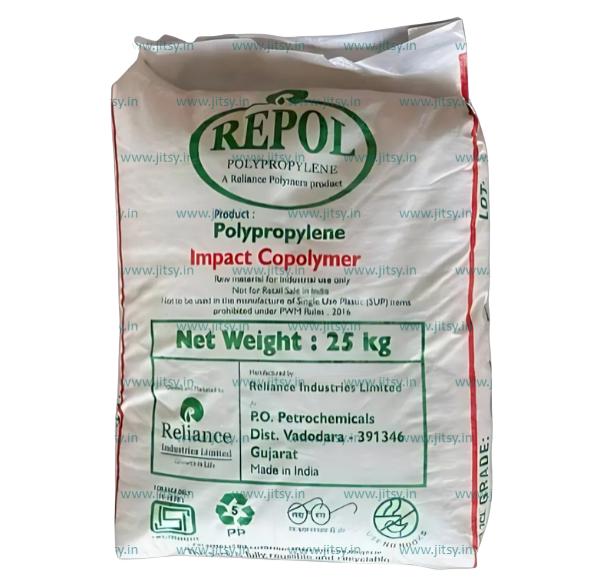
Reliance PP Repol H350EG is a high-flow polypropylene homopolymer developed by Reliance Industries Limited under the Repol brand for extrusion coating and lamination applications. It is designed for processors who need smooth melt flow, low neck-in, strong substrate adhesion, and consistent coating quality on polypropylene woven fabrics and related packaging substrates. For buyers searching for Reliance H350EG TDS, PP homopolymer extrusion coating grade, or high MFI polypropylene for woven sack lamination, this grade is a commercially relevant and technically strong option.
Manufactured within Reliance’s established polypropylene portfolio, Repol H350EG is positioned as a specialized coating-grade PP homopolymer that supports high-speed line performance and premium coated surface quality. Its application profile makes it especially suitable for woven sack coating, industrial packaging laminates, technical fabric coating, and selected food-contact packaging structures where finish, adhesion, and process consistency are important.
Manufacturer and Brand Background
Reliance Industries Limited is one of India’s largest integrated petrochemical manufacturers and a major supplier of polypropylene to domestic and export markets. The Repol brand covers a broad range of polypropylene homopolymers and copolymers developed for raffia, film, injection molding, fibre, non-woven, BOPP, and coating applications.
Within this portfolio, Repol H350EG belongs to the extrusion coating and lamination family. It is designed for converters who need a polypropylene homopolymer that can run efficiently at high coating speeds while maintaining stable melt behavior, clean edge control, and dependable bonding on polypropylene woven fabrics and similar substrates.
Polymer Design and Grade Positioning
H350EG is positioned as a high-MFI extrusion coating grade with a strong focus on flow behavior and coating performance. The grade is known for excellent flow characteristics, low neck-in, good surface finish, high gloss, and strong adhesion to substrate. These are critical performance factors in coating and lamination lines where coat weight control, edge stability, appearance quality, and bond strength directly affect productivity and finished product performance.
Compared with more general-purpose polypropylene homopolymer grades, H350EG is optimized for coating efficiency rather than broad injection or fibre use. Its design intent is to support thin, uniform coatings at high line speeds and to deliver a smoother, more commercially acceptable coated surface on woven packaging and technical substrates.
Technical Properties and Material Performance
Reliance PP Repol H350EG is widely associated with a melt flow rate of around 38 g/10 min, placing it in the high-flow category of polypropylene homopolymer coating grades. This high MFI helps the material process easily through extrusion coating equipment, enabling stable melt curtain formation and efficient coating at faster operating speeds.
The density is approximately 0.90 g/cm³, which is standard for polypropylene homopolymer. Technical references associated with this application family indicate tensile yield stress around 37 MPa, flexural modulus near 1520 MPa, Vicat softening point around 155°C, and heat deflection temperature close to 104°C. Some market references also indicate elongation at yield around 9 percent and notched Izod impact around 24 J/m, reinforcing the profile of a rigid, high-flow PP homopolymer with suitable stiffness and thermal resistance for coating applications.
From a processor’s point of view, the main technical strength of H350EG is not just high flow, but controlled coating behavior. The grade supports low neck-in, which helps reduce trim waste and improve width control. It also contributes to good gloss and surface finish, which are important in woven sack and laminated packaging applications where appearance and printability matter.
Processing Guidance
H350EG is intended for extrusion coating and lamination on polypropylene woven fabrics and similar substrates. In practical processing environments, high-flow behavior allows the material to form a stable melt curtain and maintain more consistent coating thickness across the web. Coating lines typically operate with melt temperatures in the broader range of approximately 230°C to 280°C, depending on machine design, output target, substrate, and coating thickness.
Die temperatures are generally maintained to support curtain stability, while chill roll temperatures are adjusted to promote rapid solidification, surface smoothness, and gloss. The grade’s low neck-in behavior is particularly useful for converters trying to improve edge control, reduce material loss, and maintain visual consistency across high-speed production runs. Actual settings should always be optimized based on line configuration and end-use requirements.
Applications and Industry Use Cases
Coated PP Woven Sacks
Reliance PP Repol H350EG is highly suitable for extrusion coating of polypropylene woven sacks used in cement, fertilizer, grains, sugar, chemicals, and other bulk packaging applications. Its high-flow profile helps create thin and uniform coatings, while low neck-in improves edge control and reduces waste. Strong adhesion to woven PP fabric also supports better laminate integrity and more dependable packaging performance.
Industrial Packaging and Technical Fabric Coating
The grade is also relevant for industrial packaging structures, technical coated fabrics, tarpaulins, protective covers, and related woven applications where surface quality and bond strength are important. H350EG helps converters achieve a smoother coated finish with better gloss, making it useful in applications where both visual appearance and functional coating performance matter.
Flexible Packaging and Lamination Structures
In lamination and flexible packaging applications, H350EG can be used where polypropylene homopolymer is suitable for coating and bonding functions. Its easy flow and stable processability support efficient line operation, while its finish characteristics help improve the overall look and usability of laminated packaging structures. This makes it commercially relevant for converters producing packaging materials that require consistent coating quality and reliable substrate bonding.
Food-Related and Regulated Packaging Uses
Because this grade family is commonly associated with food-contact acceptable compliance positioning, H350EG is also relevant for selected food-related packaging structures where polypropylene coating is appropriate and end-use validation is completed. For converters serving foodgrain, FMCG, and regulated packaging markets, this adds practical value beyond basic coating performance.
Performance Advantages
One of the biggest advantages of H350EG is its high melt flow rate. This enables faster processing, smoother coating behavior, and easier formation of thin coating layers compared with lower-MFI polypropylene homopolymer grades. For high-speed coating lines, this can translate into better productivity and more stable output.
Low neck-in is another important differentiator. In extrusion coating, excessive neck-in can reduce usable width and increase trim waste. H350EG is designed to help control this behavior, making it a more efficient choice for converters coating polypropylene woven fabrics and other width-sensitive substrates.
The grade also stands out for its excellent adhesion and good surface finish. Strong bonding helps reduce delamination risk, while gloss and smoothness improve the appearance of the finished coated structure. This is especially useful in woven sack packaging, industrial laminates, and technical fabric applications where both performance and presentation matter.
Comparable Alternatives
Within the Reliance Repol portfolio, H350EC is the closest internal comparison point. It shares a similar application family and high-flow profile, making it a logical alternative where converters are evaluating extrusion coating and lamination grades. H350EG is typically positioned as a dedicated coating-grade homopolymer focused on flow, adhesion, gloss, and low neck-in, while H350EC is often referenced as a closely related grade with comparable technical behavior.
H350FG and H350FH are also relevant comparisons, but they are more strongly associated with fibre, filament, and non-woven applications. While H350FG may be used in some coating-related contexts, H350EG is the more direct choice when the primary requirement is coating polypropylene woven fabrics and achieving strong lamination performance rather than optimizing fibre spinning.
Compared with Indian alternatives from HMEL, IOCL, and OPaL, H350EG stands out as a high-MFI polypropylene homopolymer for converters prioritizing coating speed, edge control, gloss, and adhesion. Mid-flow alternatives may be selected where a different coating thickness profile or broader application flexibility is needed, but H350EG is the stronger fit when high-speed extrusion coating performance is the main objective.
The rationale behind H350EG is straightforward: it is assigned to applications where high flow, low neck-in, smooth coating quality, and strong substrate adhesion are more important than the broader performance balance offered by general-purpose polypropylene homopolymer grades.





















Reviews
Clear filtersThere are no reviews yet.