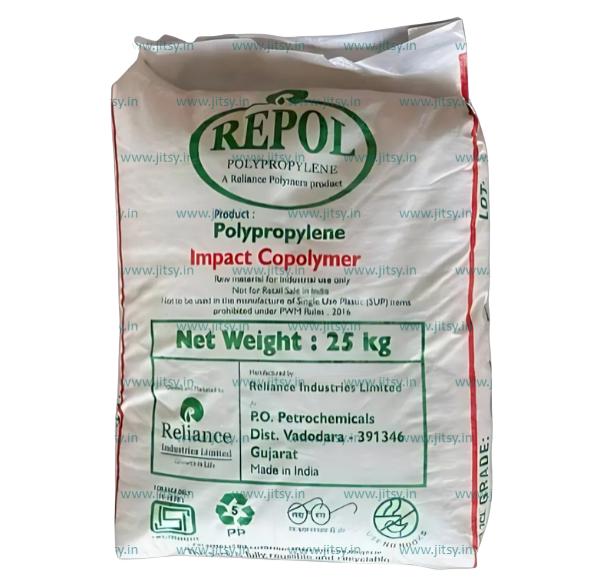
Reliance PP Repol AM120N is a general-purpose polypropylene homopolymer developed by Reliance Industries Limited for injection moulded products that require a practical balance of flow, stiffness, toughness, processability, and regulatory suitability. Positioned within the Repol polypropylene portfolio, AM120N is widely used for industrial mouldings, furniture compounds, houseware, rigid utility products, and other medium-to-thick wall injection applications where consistent molding behavior and dependable mechanical performance are important.
This grade is manufactured by Reliance Industries Limited, one of India’s largest polymer producers, using advanced Unipol polypropylene technology at its Gujarat facilities. Under the Repol brand, Reliance supplies a broad range of polypropylene homopolymers, random copolymers, and impact copolymers for packaging, industrial, consumer, and automotive sectors. Within that range, AM120N is positioned as a dependable PP homopolymer injection moulding grade for converters looking for a clean, versatile resin that performs well across general-purpose applications and also works effectively as a compounding and blending base for furniture and household plastic products.
About Manufacturer
Reliance Industries Limited has a strong reputation in polypropylene manufacturing, with large-scale supply capability across India and export markets. The Repol brand is well established in the polymer industry for serving processors in injection moulding, extrusion, blow moulding, film, fibre, and compounding applications. That brand strength matters commercially because buyers are not only selecting a polymer grade, but also supply consistency, technical support credibility, and portfolio continuity.
AM120N fits into the Repol homopolymer family as a medium-flow injection moulding grade intended for broad industrial usability. It is not positioned as a narrow specialty grade; instead, it is designed to be commercially flexible and technically stable across multiple end-use segments. That makes it especially relevant for manufacturers who need one reliable PP homopolymer grade for recurring production across furniture, crates, bins, containers, and houseware.
Technical Insights and Material Performance
Reliance PP Repol AM120N has a melt flow rate of 12 g/10 min at 230°C/2.16 kg, which places it in a highly usable range for general-purpose injection moulding. This MFI level supports good cavity filling without becoming overly thin-flowing, making it suitable for medium-to-thick wall mouldings, practical production cycles, and a wide range of molded geometries. For processors, this means AM120N offers a strong balance between flow efficiency and part integrity.
The density is approximately 0.90 g/cm³, consistent with polypropylene homopolymer materials. Typical mechanical values include tensile strength at yield of 37 MPa, elongation at yield of 12 percent, flexural modulus of 1450 MPa, notched Izod impact strength of 30 J/m at 23°C, and heat deflection temperature of 105°C at 455 kPa. Together, these values position AM120N as a rigid, general-purpose PP injection grade with enough toughness for routine industrial and consumer applications, while still maintaining the stiffness needed for furniture components, storage products, and molded utility items.
From a material selection perspective, the technical strength of AM120N lies in its balance rather than extremity. It is not a very low-flow heavy-duty grade, nor a very high-flow thin-wall specialty grade. Instead, it occupies a commercially valuable middle ground. The 12 MFI flow profile supports smooth processing, the 1450 MPa flexural modulus provides useful structural rigidity, and the 30 J/m impact level helps prevent the grade from becoming too brittle in practical use. The HDT of 105°C also gives it added relevance for molded products exposed to moderate heat during service.
Processing Characteristics
AM120N is recommended for injection moulding and is suited to general-purpose molded products across furniture, industrial, and houseware sectors. Reliance’s guidance indicates a melt temperature range of 210°C to 260°C and a mould temperature range of 30°C to 50°C. These conditions are practical for standard PP injection moulding setups and allow processors to optimize flow, cooling, surface finish, and cycle stability depending on part design and tooling.
In production, the grade’s medium-flow nature helps maintain a good balance between fill performance and dimensional control. Compared with lower-flow grades, AM120N can fill molds more easily and support better productivity in multi-cavity or moderately complex parts. Compared with higher-flow grades, it offers better control in thicker sections and can reduce the risk of excessive flash or over-fluid behavior in certain applications. This makes it a dependable choice for processors who need a stable, repeatable PP homopolymer for varied product lines.
Applications and Industry Use Cases
General-Purpose Industrial Mouldings
Reliance PP Repol AM120N is well suited for industrial mouldings such as crates, bins, pallets, totes, storage containers, and utility handling products. These applications require a practical mix of stiffness, toughness, and processability, especially where production volumes are high and part geometry must remain consistent. Its balanced MFI and mechanical profile make it a strong option for manufacturers producing durable molded items for logistics, warehousing, and industrial handling.
Furniture Compounds and Molded Furniture Components
AM120N is particularly relevant to the furniture industry because it is suitable both as a direct injection moulding resin and as a compounding base or blending material for furniture compounds. It can be used in molded furniture parts such as chair backs, armrests, table components, organizers, and storage structures. For furniture processors, the grade offers a useful balance of rigidity and process consistency, while also supporting color, filler, and additive incorporation in compound formulations.
Houseware and Consumer Utility Products
The grade is widely applicable in houseware products such as buckets, basins, tubs, kitchen utility items, organizers, and general household molded articles. In these applications, manufacturers typically need a resin that can process smoothly, maintain acceptable stiffness, and deliver dependable part quality without requiring specialty-grade economics. AM120N fits that need well, making it a practical PP homopolymer choice for everyday consumer plastic goods.
Rigid Containers and Utility Packaging
AM120N can also be used in rigid containers and non-flexible packaging components where the emphasis is on molded shape retention, processability, and regulatory suitability. Its food-contact aligned compliance profile adds value for packaging and utility applications where safe-use standards are important. For converters making molded packaging or storage articles, this grade offers a reliable balance of mechanical performance and commercial versatility.
Masterbatch, Filler and Compounding Base Resin
A major advantage of AM120N is its suitability as a base resin for compounding, filler loading, and masterbatch blending. Processors in the furniture and household plastics sectors often need a polypropylene homopolymer with stable rheology and broad compatibility for formulation work. AM120N serves that role effectively, making it attractive not only to direct molders but also to compounders supplying downstream plastic manufacturers.
Performance Advantages of Reliance PP Repol AM120N
One of the main advantages of AM120N is its balanced 12 MFI flow profile. This gives processors enough flow for efficient injection moulding while still maintaining control in medium and thicker wall sections. It is a practical middle-ground grade for manufacturers who do not want the slower fill of lower-MFI homopolymers or the overly high flow of thin-wall oriented grades.
Its mechanical balance is another strength. With 37 MPa tensile strength, 1450 MPa flexural modulus, and 30 J/m impact strength, the grade performs well in applications that need rigidity without becoming too fragile for routine use. This makes it especially suitable for furniture compounds, industrial molded products, and houseware where both structure and day-to-day durability matter.
The grade also offers a commercial advantage through regulatory readiness. Compliance references such as IS 10910, IS 16738:2018, and FDA 21 CFR 177.1520 support its use in food-contact and regulated molded applications, subject to final article testing. For converters, this can simplify qualification for certain packaging and utility end uses.
Alternatives and Comparable Grades
Within the Reliance Repol portfolio, AM650N is a relevant alternative when higher flow is needed for thinner-wall parts or faster filling requirements. However, for general-purpose industrial mouldings and furniture compounds, AM120N often provides a better balance between flow and section control. AM010N sits at the lower-flow end and is more suitable where thicker sections or different processing priorities matter, rather than standard injection moulding versatility.
Compared with H110MA, AM120N is also a useful benchmark. Both are PP homopolymer injection grades, but AM120N is positioned more clearly as a broad general-purpose grade and compounding base, while H110MA is often associated with rigid containers, thermoware, and specific molded product categories. Buyers selecting between the two should consider whether they need a more general industrial/furniture-oriented resin base or a grade aligned more closely with specific molded article performance.
Against comparable PP homopolymer injection grades from HMEL, IOCL, and OPaL, AM120N competes well on its combination of balanced MFI, broad application range, compounding suitability, and food-contact aligned compliance. Many competing grades may offer similar flow ranges, but AM120N is especially attractive when the buyer wants a versatile, mainstream Reliance grade that can serve both direct moulding and compound-based production programs.
The rationale behind the assigned grade is straightforward: AM120N is best selected where a manufacturer needs a stable, medium-flow PP homopolymer for general injection moulding, furniture compounds, industrial products, and houseware without moving into narrow specialty grades. It is a practical production resin built for flexibility, repeatability, and broad commercial relevance.





















Reviews
Clear filtersThere are no reviews yet.