








Brand
 Borouge Pte LtdBorouge Pte Ltd 1
 Dongsung ChemicalDongsung Chemical 2
 Dow-MitsuiDow-Mitsui 3
 FPC Formosa Plastics CorporationFPC Formosa Plastics Corporation 1
 Haldia Petrochemicals LtdHaldia Petrochemicals Ltd 15
 Hanwha Solutions ChemicalHanwha Solutions Chemical 4
 Hanwha Total Energies PetrochemicalHanwha Total Energies Petrochemical 7
 HMEL - HPCL-Mittal Energy LimitedHMEL - HPCL-Mittal Energy Limited 45
 IOCL - Indian Oil Corporation LimitedIOCL - Indian Oil Corporation Limited 14
 Jiangsu Daoming Chemical Co LtdJiangsu Daoming Chemical Co Ltd 2
 LG ChemLG Chem 8
 Lotte ChemicalLotte Chemical 4
 LyondellBasell Industries NVLyondellBasell Industries NV 1
 Marcopolo International LLCMarcopolo International LLC 2
 Nouryon Functional ChemicalsNouryon Functional Chemicals 8
 ONGC Petro Additions LtdONGC Petro Additions Ltd 30
 Reliance Industries LimitedReliance Industries Limited 40
 SabicSabic 1
 Sipchem - Saudi International PetrochemicalSipchem - Saudi International Petrochemical 8
 SK Functional PolymerSK Functional Polymer 6
 The Dow Chemical CompanyThe Dow Chemical Company 3
 TPI Polene Public Company LimitedTPI Polene Public Company Limited 3
 VersalisVersalis 4
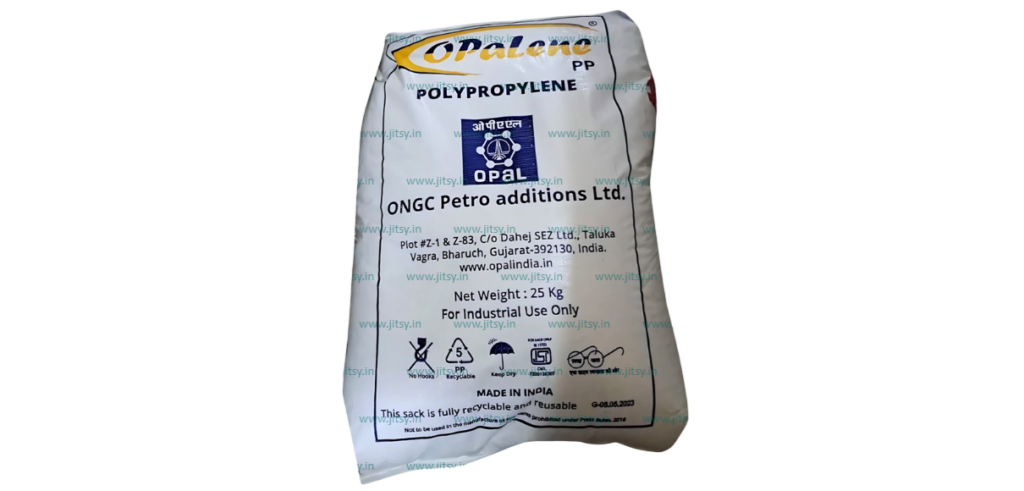
OPaL PPCP Opalene EI01N
Opalene EI01N is a nucleated, high-melt-strength polypropylene impact copolymer (PPCP) produced by ONGC Petro additions Ltd (OPaL) using advanced INEOS gas-phase technology. Engineered for extrusion and blow-moulding, EI01N delivers a unique balance of rigidity, impact strength, and melt strength—making it ideal for corrugated/twin-wall sheets, pipes, thermoformed trays, and blow-moulded containers. The grade is optimized for converters seeking high performance, dimensional stability, and process consistency.
Deep Technical Insights
Opalene EI01N’s heterophasic block copolymer structure, created via INEOS gas-phase polymerization, features a semi-crystalline PP matrix and a finely dispersed rubber phase. This architecture delivers high melt strength for stable extrusion and blow-moulding, while maintaining robust impact resistance and flexural modulus. Nucleation accelerates crystallization, reduces cycle times, and improves dimensional stability—crucial for multi-cavity extrusion lines and complex profiles. The grade’s low moisture absorption, stain resistance, and solvent resistance ensure reliable performance in industrial, agricultural, and packaging environments.Applications & Industry Use Cases
Corrugated / Twin-Wall Sheets: EI01N is ideal for PP hollow boards used in industrial packaging, logistics, signage, and construction. Its high melt strength supports stable sheet extrusion, while impact resistance protects against drops and stacking loads. Corrugated Pipes & Fittings: The grade’s stiffness and toughness enable durable pipes and fittings for drainage, cable ducts, and water management, withstanding burial, installation, and mechanical stress. Thermoformed Products & Blow-Moulded Containers: EI01N excels in rigid trays, industrial bottles, and containers formed by thermoforming or blow-moulding, offering lightweight designs with strong impact and stacking performance.Performance Advantages of Opalene EI01N PPCP
Opalene EI01N delivers superior melt strength for extrusion and blow-moulding, ensuring stable parison and sheet behaviour. Its impact resistance (150 J/m Izod) and flexural modulus (1,100 MPa) support load-bearing, stackable products. The grade’s nucleation reduces cycle times and warpage, while its chemical and stain resistance, low moisture uptake, and recyclability make it a sustainable, high-performance choice for converters and OEMs.
OPaL PPCP Opalene EI02N
Opalene EI02N is a high-stiffness polypropylene impact copolymer (PPCP) from ONGC Petro additions Ltd (OPaL), engineered for load-bearing, structurally demanding applications. Manufactured using advanced INEOS gas-phase technology at OPaL's Dahej complex, EI02N combines exceptional rigidity with impact resistance and light-weighting potential, making it ideal for crates, pallets, furniture frames, automotive housings, and industrial enclosures.
Deep Technical Insights
Opalene EI02N features a heterophasic polypropylene architecture—a semi-crystalline PP matrix with finely dispersed ethylene-propylene rubber phase—delivering high impact strength while maintaining structural rigidity. The INEOS gas-phase polymerization process ensures consistent melt flow index, tight morphological control, and minimal property variation across batches, supporting converters in high-cavity tooling and complex mould designs. EI02N's engineered stiffness-impact balance enables wall-thickness reduction and weight savings compared to homopolymer PP or lower-stiffness PPCP grades, while maintaining durability under stacking, drop impact, and repeated handling.Applications & Industry Use Cases
Crates, Pallets & Industrial Bins: EI02N is engineered for returnable transport packaging (RTP), industrial storage bins, and stackable crates where high stiffness prevents deflection under load and impact resistance resists drops and rough handling. Its chemical resistance supports use in detergent, food and agricultural logistics. Furniture & Load-Bearing Components: Ideal for chair frames, table legs, structural supports, and modular furniture systems requiring both rigidity and impact toughness. EI02N's light density enables thinner-wall designs without sacrificing strength. Automotive & Appliance Parts: Used in interior panels, protective housings, technical enclosures, and non-structural automotive components, EI02N delivers dimensional stability, thermal performance, and the impact resistance needed for long-term durability.Performance Advantages of Opalene EI02N PPCP
Opalene EI02N stands out for its exceptional stiffness-impact balance, enabling converters to design lighter, thinner-walled parts without compromising structural integrity. Its INEOS gas-phase pedigree ensures consistent mechanical properties, predictable cycle times, and excellent surface finish. EI02N's chemical resistance, moisture inertness, and recyclability position it as a sustainable choice for industrial, packaging, furniture, and automotive manufacturers seeking performance and environmental responsibility.
Opal PPCP Opalene MI03
Opal PPCP Opalene MI03 is a heterophasic polypropylene impact copolymer engineered for high-performance injection molding applications. Manufactured by OPaL using advanced Ineos Gas Phase polymerization, MI03 delivers a unique balance of toughness, flow, and processability. This grade is tailored for demanding automotive, furniture, and industrial components where impact strength, dimensional stability, and regulatory compliance are essential.
Deep Technical Insights
Opal MI03 features a two-phase microstructure with isotactic polypropylene matrix and finely dispersed ethylene-propylene rubber domains. The Ineos Gas Phase process ensures uniform particle morphology, batch-to-batch consistency, and minimal fines generation. This architecture enables simultaneous high stiffness and toughness, making MI03 ideal for applications requiring both structural rigidity and impact absorption. Compliance with IS 10910 and FDA standards ensures suitability for food contact and medical-grade uses.Applications & Industry Use Cases
Automotive: MI03 is widely used in interior and exterior components such as dashboard panels, door trims, bumpers, battery trays, and engine covers. Its high impact resistance and lightweight properties contribute to vehicle safety and fuel efficiency. Furniture: The grade is perfect for chair frames, table legs, storage containers, and outdoor furniture, offering durability, stackability, and excellent surface finish. Its natural color base allows for easy masterbatch colorant integration. Industrial Molding: MI03 excels in manufacturing industrial crates, paint pails, toolboxes, and chemical storage containers. Its chemical resistance and low shrinkage ensure precision and long-term performance in harsh environments.Technical Authority & Industry Leadership
Opal MI03 stands out through its advanced manufacturing technology, delivering superior consistency and morphological control versus conventional polymerization. The grade’s optimized injection molding parameters support rapid cycle times and excellent mold reproduction. Detailed compliance with Indian and global standards, including IS 10910 and FDA CFR Title 21, positions MI03 as a benchmark for quality and safety in the polypropylene copolymer market.
OPaL PPCP Opalene MI08N
OPaL Opalene MI08N is a heterophasic polypropylene (PP) block copolymer (PPCP), natural coloured and nucleated, produced using Ineos Gas Phase technology. MI08N offers faster moulding cycles thanks to nucleation, a robust impact–stiffness balance for long-lasting durability, and antistatic properties for clean processing and dust-resistant surfaces. It is engineered for injection moulding of crates, paint pails, luggage, and furniture, making it a top choice for OEMs and moulders in Delhi/NCR and across India seeking productivity and performance.
Specifications
Physical & Mechanical Properties
- Melt Flow Index: 8 g/10 min (230°C/2.16 kg)
- Density:90 g/cm³
- Flexural Modulus: 1200 MPa
- Notched Izod Impact (23°C): 120 J/m
- Heat Deflection Temperature: 90°C
Deep Technical Insights
- Nucleated morphology: Accelerates crystallization, enabling faster demoulding and higher productivity in multi-cavity tools.
- Antistatic agent: Reduces dust attraction, supporting clean painting and assembly—vital for furniture and packaging.
- Impact–stiffness synergy: 120 J/m impact and 1200 MPa modulus ensure products withstand drops, stacking, and daily handling.
- Ineos Gas Phase process: Delivers batch-to-batch consistency and reliable mechanicals for demanding OEM and industrial applications.
Applications
Crates & Paint Pails
MI08N is ideal for crates and stackable paint pails, providing the impact resistance and modulus needed to survive transport, stacking, and rough industrial use. The antistatic property helps keep surfaces clean and free from dust during storage and filling.Luggage
For injection-moulded luggage shells, MI08N’s impact–stiffness balance ensures robust protection against drops and knocks, while nucleation supports fast cycles and high-volume production.Furniture
Chairs, tables, and modular furniture benefit from MI08N’s structural strength and clean finish, with antistatic properties supporting painting and assembly in dust-prone environments.Processing
- Barrel temperature: 180–230°C
- Mould temperature: Standard for PP copolymers
- Processing tips: Medium flow and nucleation support efficient multi-cavity moulding and rapid demoulding; antistatic aids in dust-free production
- Cycle time: Optimized for productivity in high-volume furniture, crate, and pail moulding
Opal PPCP Opalene MI120X
Opalene MI120X is a polypropylene block copolymer (PPCP) impact grade from ONGC Petro-Additions Ltd (OPaL), produced using advanced Ineos gas-phase technology for injection moulding. As part of OPaL’s MI series, MI120X is a high-flow, nucleated PPCP granule, optimized for fast cycles, glossy finish, and balanced stiffness-impact performance. It’s engineered for demanding applications in appliances, furniture, automotive interiors, housewares, luggage, and industrial crates—where drop resistance, process speed, and premium appearance are essential. MI120X is a go-to choice for moulders seeking an OPaL alternative to Reliance Repol or Haldia Halene grades, with the added advantage of Delhi/NCR-based supply and technical support.
Specifications
Physical & Rheological Properties
- Melt Flow Index: ~12–20 g/10 min (230°C/2.16 kg) – high-flow for thin-wall, multi-cavity tools
- Density:90 g/cm³ – lightweight, ideal for consumer plastics
- HSN Code: 39023000 – Propylene copolymers in primary forms
- CAS Number: 9010-79-1 – Polypropylene block copolymer
Mechanical Properties
- Tensile Strength at Yield: ~27 MPa – strong for load-bearing and structural parts
- Flexural Modulus: ~1300 MPa – rigid yet tough, supports furniture and appliance housings
- Notched Izod Impact (23°C): ~120 J/m – superior impact resistance, minimizes breakage
- Rockwell Hardness: R80 – resists scratches, preserves glossy look
Thermal Properties
- Heat Deflection Temp (0.46 MPa): ~100°C – suitable for appliance housings, interiors
- Compliance: Meets IS 10910 (food/pharma contact), FDA 21 CFR 177.1520, IS 16738
Functional Features
Opalene MI120X is engineered for productivity, durability, and aesthetics. Its high-flow, nucleated morphology and balanced mechanics make it a versatile performer for high-output moulding and premium applications.Applications
Appliances & Housewares
MI120X is widely used for appliance housings, crates, carriers, and kitchenware. Its high flow enables thin-wall, multi-cavity moulding, while impact strength and gloss ensure products are both durable and attractive. Anti-static properties help keep surfaces cleaner.Furniture & Luggage
Ideal for chairs, tables, storage bins, and luggage shells, MI120X combines stiffness and impact resistance for long service life. Its processability supports rapid cycles and excellent surface finish, making it a favorite for premium and mass-market furniture.Automotive & Industrial
For automotive interiors, trims, and industrial bins, MI120X’s toughness and rigidity withstand vibration, drops, and daily handling. Its nucleated structure allows for faster production and consistent quality.Processing
- Barrel temperature: 180–220°C
- Mould temperature: 30–50°C
- High-speed injection: Leverage flow for thin-wall, complex parts
- Defect troubleshooting:
- Short shots: Increase speed/pressure
- Sink marks: Raise packing pressure
- Warpage: Ensure balanced cooling
Advantages
- Faster cycles: Nucleated morphology cuts cycle times by 10–20% vs standard PPCP
- Premium finish: Gloss and anti-static for consumer appeal
- Toughness: Outperforms homopolymers in impact, resists drops and cracks
- Versatility: Suitable for everything from kitchenware to automotive trims
- GEO advantage: Delhi/NCR supply, pan-India logistics, and technical support
OPaL PPCP Opalene MI12NX
ONGC PPCP Opalene MI12NX is a polypropylene impact copolymer (PPCP) developed by ONGC Petro additions (OPaL) for injection molding. This grade delivers robust impact strength and balanced mechanical properties, making it ideal for durable molded parts across appliance, automotive, and industrial sectors. Buyers include injection molders, OEMs, compounders, and traders seeking reliable B2B polymer supply for demanding applications.
Key Features & Benefits of Opalene MI12NX
- Good impact resistance for tough parts
- Balanced stiffness and flexibility
- Excellent processability for injection molding
- Consistent quality and batch traceability
- Versatile for industrial and appliance use
Technical Properties & Processing Guidelines
Material Properties of Opalene MI12NX
- Mechanical: Balanced impact and stiffness for durable, high-performance parts
- Thermal: Suitable for appliance, automotive, and industrial applications
- Rheological: Engineered for smooth flow and efficient molding cycles
- Compliance: Meets industry standards for B2B polymer supply (verify per application)
Recommended Processing Conditions
- Barrel temp: 180–230°C (typical)
- Mold temp: 30–60°C (typical)
- Store in dry, dust-free area below 50°C
- Refer to datasheet for machine/part-specific settings
Typical Applications of ONGC PPCP Opalene MI12NX
Opalene MI12NX is widely used in appliance components (such as washing machine parts, refrigerator bins), industrial products (containers, crates, housings), automotive accessories, and general injection-molded goods requiring impact resistance. Its balanced mechanical profile and reliable processability make it a preferred choice for manufacturers targeting quality, durability, and efficient production.
OPaL PPCP Opalene MI15
OPaL Opalene MI15 is a heterophasic polypropylene block copolymer (PPCP) engineered via Ineos gas-phase technology for demanding automotive exterior applications. MI15 delivers very high impact resistance, balanced stiffness, and high flow for easy processing—making it ideal for bumper fascia, air dams, exterior trim, and other high-impact auto parts. Its natural colour, anti-gas fading properties, and IS 10910 compliance add to its appeal for OEMs and Tier-1 suppliers in India. MI15 is optimized for fast cycles, complex moulds, and long-term durability in automotive environments.
Specifications
Physical Properties
- Melt Flow Index: 15 g/10 min (230°C/2.16 kg) – high flow for complex, thin-wall auto parts
- Density:90 g/cm³ – lightweight for automotive and exterior use
Mechanical Properties
- Tensile Strength at Yield: ~27 MPa – robust for structural and exterior applications
- Flexural Modulus: ~1200–1300 MPa – balanced stiffness for dimensional stability
- Notched Izod Impact (23°C): ~150+ J/m – very high impact for crash and drop resistance
Key Technical Insights
- Heterophasic morphology: Ensures toughness and low-temperature impact resistance
- Anti-gas fading: Maintains colour and properties under UV and exhaust exposure
- IS 10910 compliance: Suitable for food/pharma contact if required by the application
Automotive Applications
Opalene MI15 is purpose-built for automotive exterior parts where impact resistance and stiffness are non-negotiable. Its high MFI enables fast, uniform mould filling—crucial for large, complex bumper fascia and air dams. The grade’s toughness protects against low-temperature impacts, while its anti-gas fading ensures long-term colour and property retention in exposed environments. MI15 is also used for exterior trims and technical parts where both mechanical and cosmetic performance are essential. Its compliance with IS 10910 makes it a reliable choice for applications that may require regulatory documentation.Processing
- Barrel temperature: 180–240°C
- Mould temperature: 30–50°C
- Processing tips: High flow supports thin-wall and multi-cavity tools; optimize packing and cooling for best surface finish and dimensional accuracy
- Cycle time: Fast cycles possible with proper mould and machine setup
Deep Technical Insights
- Ineos gas-phase technology: Delivers reproducible heterophasic morphology for superior impact and stiffness
- Anti-gas fading: Prevents property loss and yellowing from exhaust/UV exposure
- OEM suitability: Balanced properties and compliance position MI15 as a strong candidate for automotive approval and use in global supply chains
OPaL PPCP Opalene MI44N
OPaL Opalene MI44N is provisionally described as a nucleated polypropylene impact copolymer (PPCP) with an estimated melt flow index in the 40–50 g/10 min range. Produced by ONGC Petro additions Ltd (OPaL), MI44N is engineered for injection moulding and compounding applications requiring high flow, medium impact strength, and dimensional stability. While official TDS and database listings for MI44N are limited, its designation and MFI band suggest suitability for appliance parts, automotive components, thin-wall injection moulded products, and masterbatch compounding. MI44N is typically supplied as natural granules in 25 kg bags, aligning with industry packaging standards.
Functional Features
Opalene MI44N is designed for converters and OEMs seeking high-flow processability, nucleated crystallisation for low warpage, and a balanced mechanical profile. Its reactor-grade consistency (inferred from OPaL’s product line) supports efficient, reliable production and traceability for B2B buyers.Detailed Technical Specifications (Provisional, Typical for 40–50 MFI PPCP)
- Melt Flow Index: ~44 g/10 min (estimated)
- Density: ~0.90 g/cm³
- Tensile Strength at Yield: ~25 MPa
- Elongation at Yield: ~7%
- Flexural Modulus: ~1150 MPa
- Notched Izod Impact (23°C): ~65 J/m
- Heat Deflection Temp (0.455 MPa): ~100°C
- Vicat Softening Point (10N): ~145°C
Applications & Industry Use Cases
Appliances & White Goods
MI44N is suitable for appliance housings, AC grills, washing machine internals, and other white goods components where high flow, dimensional stability, and moderate impact resistance are critical.Automotive
Automotive compounders and OEMs may use MI44N for interior and exterior trims, non-structural parts, and compounds where a balance of stiffness and impact is required.Thin-Wall Injection Moulding (TWIM)
The high MFI and nucleated structure support efficient thin-wall moulding of containers, tubs, and utility products, reducing cycle times and supporting complex geometries.Compounding
As a base resin for filler and masterbatch compounding, MI44N’s processability and reactor-grade uniformity support efficient dispersion and consistent mechanical properties.Performance Advantages
Compared to lower-MFI or non-nucleated PPCP, MI44N (provisionally) offers faster cycles, lower warpage, and superior thin-wall filling. Its technical profile is competitive with Repol B400MN (38 MFI), IOCL Propel 3400MN (40 MFI), and Haldia M340 (40 MFI) for thin-wall, appliance, and compounding uses.Compliance, Packaging & Storage
Food Contact Compliance: Assumed, but documentation should be requested for regulated uses. Packaging: Natural granules in 25 kg bags. Storage Guidelines: Store dry, below 50°C, away from sunlight and moisture.
OPaL PPCP Opalene MI70N
OPaL Opalene MI70N is a high-flow, nucleated polypropylene impact copolymer (PPCP) developed by ONGC Petro additions Ltd (OPaL) using advanced Ineos Gas Phase technology. Engineered as a 70 MFI heterophasic block copolymer, MI70N excels in thin-walled injection moulding (TWIM), compounding, and demanding industrial applications. Its nucleated formulation delivers low warpage, fast crystallisation, and excellent dimensional stability, while its natural-grade purity ensures compliance and performance for regulated markets. MI70N is supplied as natural granules in robust 25 kg bags, with recommended storage in dry, UV-protected environments to maintain optimal quality.
Functional Features (Industry Authority)
Opalene MI70N is designed for converters seeking exceptional processability and part performance. The high melt flow rate (70 g/10 min) enables rapid mould filling in thin-wall and complex geometries, reducing cycle times and energy consumption. Nucleation technology minimizes warpage and shrinkage, supporting precision in snap-fits and visible components. The grade’s balanced impact and stiffness profile, coupled with excellent electrical and alkali resistance, makes it ideal for automotive, appliance, and industrial applications. MI70N’s compliance with IS 10910, IS 16738:2018, and FDA CFR 21 177.1520 ensures regulatory confidence for food, pharma, and drinking water contact.Applications & Industry Insights
Thin-Walled Injection Moulding
MI70N’s high MFI and nucleation deliver outstanding performance in thin-walled containers, cups, and packaging, where rapid mould filling and high gloss are essential. The grade’s low warpage and dimensional accuracy ensure reliable snap-fits and consistent part quality, even in challenging geometries.Appliances & Consumer Durables
Appliance manufacturers rely on MI70N for housings, internal components, and covers that demand chemical resistance, low warpage, and robust impact performance. Its processability supports high-cavitation tooling and complex part designs, making it a preferred material for white goods and small appliances.Automotive & Industrial Parts
In automotive and industrial sectors, MI70N is valued for its electrical and alkali resistance, supporting the production of under-hood components, connectors, housings, and compounded parts. Its balance of stiffness and impact strength enables reliable performance in both functional and aesthetic applications.Compounding & Masterbatch
As a base resin for masterbatches and mineral-filled compounds, MI70N’s high flow supports efficient dispersion and process consistency, enabling the creation of custom PPCP blends for specialized requirements.Performance Advantages
Compared to lower-MFI PPCP grades, MI70N offers superior processability, faster cycle times, and reduced risk of short-shots in thin-wall and long-flow-path parts. Its nucleation delivers lower warpage and improved surface quality, which is especially valuable for visible and precision-moulded components. MI70N’s electrical and alkali resistance further differentiates it from competitor grades, making it suitable for applications where environmental durability is critical.Compliance & Documentation
Opalene MI70N is certified to IS 10910 for food, pharma, and drinking water contact, and aligns with IS 16738:2018 and FDA CFR 21 177.1520 standards. Each batch is supplied with a Technical Data Sheet (TDS), Safety Data Sheet (SDS), Certificate of Analysis (COA), and regulatory compliance letters upon request. This robust documentation supports regulatory submissions and quality assurance for converters and OEMs.Packaging & Storage
MI70N is delivered in strong 25 kg bags, designed for safe handling and storage. To preserve material quality, store bags in dry, covered spaces below 50°C, away from direct sunlight and moisture. JITSY provides pan-India logistics, rapid dispatch from regional warehouses, and export-ready documentation for international buyers.
OPaL PPRCP Opalene ER00V
OPaL Opalene ER00V is a state-of-the-art polypropylene random copolymer (PPRCP) engineered by ONGC Petro additions Limited for PPR pipe extrusion and thermoforming. With an MFI of 0.3 g/10 min, robust impact resistance, and ISO 15874/DIN 8077/IS 10910 compliance, ER00V delivers long-term hydrostatic strength, flexibility, and chemical resistance for hot and cold water piping systems. Its molecular design and processability make it a trusted choice for high-performance, corrosion-free plumbing and industrial piping.
ER00V’s random copolymer structure, incorporating ethylene into the propylene backbone, reduces crystallinity, enhances impact resistance, and lowers melting point for efficient processing. Its high flexibility (≥400% strain at break), 23 MPa tensile yield, and ≥55 kJ/m² Charpy impact rating ensure resilience under pressure and temperature cycling. The grade’s low thermal conductivity, smooth internal surface, and built-in thermal stabilizers guarantee energy efficiency, hygiene, and 50+ years of service life in demanding applications. Certified under IS 10910, ISO 15874, and DIN 8077/8078, ER00V meets global potable water and food contact safety standards.
Applications and Industry Use Cases
Hot & Cold Water Piping Systems
ER00V is the preferred resin for residential, commercial, and institutional hot and cold water plumbing. Its thermal stability (up to 95°C), pressure rating capability (PN10–PN25), and corrosion immunity make it ideal for long-lasting, leak-proof piping networks.Industrial Fluid Transport
The grade’s chemical resistance and dimensional stability support safe, efficient fluid handling in chemical, food, and pharmaceutical manufacturing plants, even under aggressive conditions.Sheet Thermoforming
ER00V’s balanced flow and thermal performance enable production of thermoformed sheets for packaging, laboratory ware, and industrial trays requiring clarity and impact resistance.Specialized Applications
It is also used in HVAC, radiant heating, and agricultural irrigation systems, where reliability, flexibility, and resistance to scaling and biofilm are critical.Comparable Alternatives: Analysis & Grade Rationale
- Borealis Borstar Grades: European benchmark for PPR pipes, premium pricing, advanced technical support. ER00V matches performance but offers local supply and cost efficiency.
- Hyosung Topilene R200P: Asian competitor with similar impact and service life; ER00V’s domestic production ensures shorter lead times and tailored technical support.
- Reliance AER003N: Comparable in MFI and pressure rating; ER00V offers enhanced flexibility and lower crystallinity for improved low-temp performance.
- Grade Rationale: ER00V’s grade assignment is based on its ultra-low MFI, high impact, and multi-standard compliance, making it ideal for critical piping and thermoforming applications in India and export markets.
OPal PPRCP OPaLene ER02N
OPaLene ER02N is a clarified, high-clarity polypropylene random copolymer (PP-RCP) manufactured by ONGC Petro additions Limited (OPaL) using advanced INEOS Gas Phase Polymerization Technology at Dahej, Gujarat. This food- and pharma-grade resin is engineered for blow molding and extrusion, offering outstanding transparency, balanced stiffness-impact properties, and anti-static performance. OPaL, a joint venture of ONGC, GAIL, and GSPC, is a government-backed leader in India’s polymer sector, ensuring supply reliability and consistent quality.
Deep Technical Insights: OPaLene ER02N Data Sheet
- Melt Flow Index (MFI):0 g/10 min (ASTM D1238)
- Density:90 g/cm³ (ASTM D1505)
- Tensile Strength at Yield: 32 MPa (ASTM D638)
- Elongation at Yield: 12% (ASTM D638)
- Flexural Modulus: 1400 MPa (ASTM D790A)
- Notched Izod Impact: 100 J/m (ASTM D256)
- Rockwell Hardness: R80 (ASTM D785)
- Heat Deflection Temp: 100°C (ASTM D648)
- Processing Temp Range: 180–230°C
- Appearance: Transparent, clarified granules
Applications & Industry Use Cases
Transparent Bottles & Containers
OPaLene ER02N is ideal for sports bottles, baby bottles, medical and cosmetic bottles, and dairy containers. Its clarity and drop-impact resistance make it perfect for premium packaging and consumer safety.Pharmaceutical & Medical Packaging
Trusted for pharmaceutical bottles, lab containers, and sterile packaging, ER02N combines chemical resistance, clarity, and sterilization capability, supporting regulatory compliance for healthcare applications.Food Contact Packaging
The grade’s food-safe certification, moisture barrier, and high clarity make it a top choice for edible oil bottles, beverage containers, and microwaveable trays, meeting modern consumer and regulatory demands.Thermoformed & Extruded Products
ER02N delivers excellent formability for thermoformed food trays, clamshells, and transparent sheets. It is widely used in POS displays, protective covers, and extruded profiles needing visual appeal and strength.Stationery & Consumer Goods
From transparent folders and pen barrels to storage boxes and display cases, ER02N is valued for its clarity, toughness, and anti-static properties in consumer and office products.Alternatives & Comparative Analysis
Comparable Grades:- Reliance Repol SR20NC (2.0 MFI, blow molding)
- IOCL Propel 2120MC (injection, higher MFI)
- Haldia Halene-P B202S (1.9 MFI, blow molding)
Opal PPRCP Opalene MR12C
Opal PPRCP Opalene MR12C is a clarified polypropylene random copolymer (PPRCP) manufactured by ONGC Petro additions Limited (OPaL) using INEOS gas-phase polymerisation technology at Dahej. MR12C delivers high clarity, balanced stiffness and impact, anti-static properties, and food-contact compliance (IS 10910). It is positioned for injection moulding and ISBM applications in premium packaging, houseware, and clear plastic goods.
MR12C is a flagship random copolymer in the Opalene MR series, offering converters a reliable, high-clarity, and process-friendly PPRCP for regulated packaging and household applications.
Technical Specifications and Material Properties
- Melt Flow Index: ~12 g/10 min (230°C/2.16 kg)
- Tensile Yield Strength: ~33 MPa
- Clarity/Gloss: High, clarified
- Stiffness–Impact Balance: Good modulus and toughness
- Processing: Injection/ISBM, typical barrel 190–250°C
- Anti-static: Yes
- Food-contact Compliance: IS 10910
Applications and Industry Use Cases
High-Clarity Rigid Containers and Houseware
MR12C is ideal for injection-moulded and ISBM rigid food containers, kitchenware, and household storage products demanding clarity, gloss, and safe food contact.ISBM Bottles and General Plastics
The grade excels in ISBM bottles and jars for food, personal care, and beverages, combining visual appeal with easy demoulding and anti-static finish for shelf hygiene.When to Prefer PPRCP Over PPCP/Homo PP
MR12C should be chosen over generic PP homopolymer or PPCP when high clarity, gloss, and safe food-contact compliance are required, especially for premium packaging and regulated applications.Alternative and Comparable PPRCP Grades in India
- Opalene MR12C (OPaL): High clarity, anti-static, IS 10910, injection + ISBM
- Reliance Repol SRX100: Ultra-high clarity, antistatic, houseware & ISBM
- Reliance Repol SRM100NC: High-clarity containers, syringes
- IOCL Propel 2120MC: Clarified random copolymer for containers & ISBM
- HMEL Polysure RM12CR: High-clarity containers, labware, ISBM, low cycle time
OPal PPRCP Opalene MR20K
OPalene MR20K by ONGC Petro additions Limited is a next-gen polypropylene random copolymer engineered for injection molding and ISBM. Designed for demanding food packaging, medical devices, and consumer goods, it delivers glass-like transparency, excellent rigidity, and anti-static properties. Its melt flow index of 12 g/10 min ensures fast cycle times and superior mold filling, making it the preferred choice for high-volume, high-clarity applications.
Manufactured using Spheripol II technology, MR20K’s random copolymer structure disrupts crystallinity, maximizing optical clarity and flexibility. The grade’s advanced nucleating agents deliver high gloss and uniform wall thickness, while anti-static properties reduce dust attraction. IS 10910 certification and FDA CFR 21.177.1520 compliance guarantee safe use in food, pharma, and drinking water applications. Chemical resistance, low moisture absorption, and robust dimensional stability make MR20K a leader among Indian and global PP-RCP grades.
Applications and Industry Use Cases
Food Packaging
MR20K is ideal for transparent food containers, microwaveable boxes, yogurt cups, and deli trays. Its clarity allows consumers to inspect contents easily, while food-grade certification ensures regulatory confidence for manufacturers and exporters.Medical and Healthcare
This grade is widely used for syringes, medical vials, specimen containers, and lab consumables. Its sterilization resistance and biocompatibility make it perfect for components exposed to autoclaving and chemical sterilants.Household and Consumer Goods
MR20K powers high-clarity kitchenware, storage organizers, and cosmetic packaging, offering both durability and superior aesthetics for daily-use products.ISBM Bottles & Personal Care
The material’s processability and clarity make it the go-to for clear condiment bottles, pharmaceutical bottles, and personal care packaging produced via ISBM.Automotive Interiors
MR20K finds niche use in automotive interiors for transparent gauge covers and dashboard components where rigidity and gloss are valued.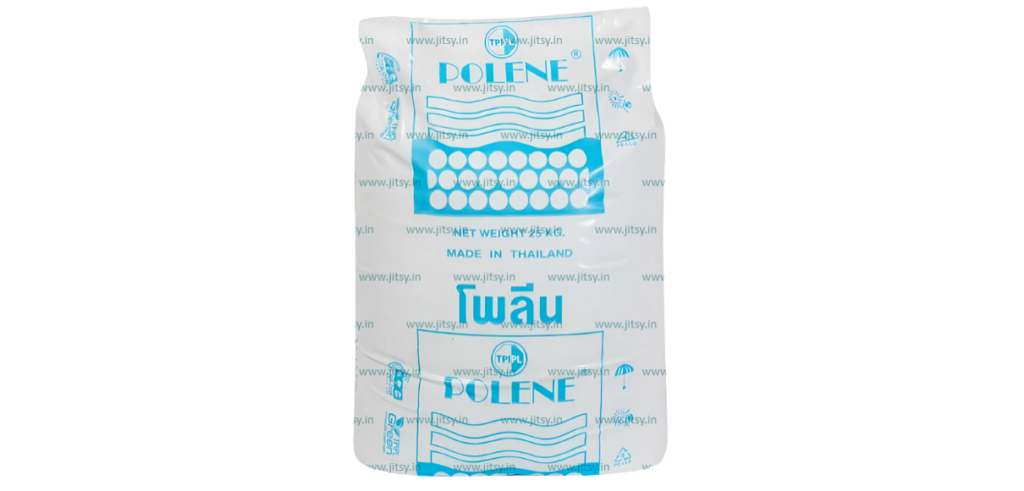
Polene EVA MV1055
Polene EVA MV1055 is a premium, additive-free, LDPE-based ethylene-vinyl acetate (EVA) copolymer engineered for foam sheets, injection molding, hot melt adhesive (HMA), cable coating, and extrusion coating. Manufactured by TPI Polene (Thailand) via proprietary LDPE-EVA process, MV1055 features 28% vinyl acetate, MFI 8 g/10 min, density 0.953 g/cm³, melting temperature 70°C, Vicat 49°C, Shore D 19 (ultra-soft), tensile strength at break 23 MPa, and ultimate elongation 840%. Its clean, additive-free formulation (no slip/no antiblock), uniform VA/MI, and strict contaminant control enable superior foamability, excellent elasticity, and outstanding low-temperature flexibility for Indian footwear, injection, adhesive, and cable coating industries.
Functional Features & Technical Authority
- Superior-Elasticity: Exceptional 840% elongation ensures flexible, cushioning foam and soft injection products.
- Medium-Flow: MFI 8 provides controlled processing for foam density, injection molding, and HMA.
- Additive-Free: Pure EVA with no slip or antiblock agents, enabling easy customization and clean foam surfaces.
- Ultra-Soft: Shore D 19 delivers maximum comfort in foam footwear and flexible injection products.
- Low-Temperature: Maintains flexibility and resilience in cold-weather and outdoor conditions.
- Uniform VA/MI: Consistent batch-to-batch performance for reliable foam and injection quality.
- Strict Contaminant Control: Low gel level ensures defect-free, clean foam and molded products.
- Regulatory Compliance: Meets FDA 21 CFR 177.1350, EU 10/2011, RoHS, ASTM D1238/D1505/D638/D1525.
Applications
Foam Sheets for Footwear (Primary)
Polene EVA MV1055 is optimized for foam soles, midsoles, and bases for athletic shoes, sandals, and comfort foam sheets. Its 28% VA delivers flexibility and comfort, MFI 8 enables controlled foam density, and the additive-free, ultra-soft formulation provides maximum cushioning and rebound. The 840% elongation ensures long-lasting flexibility, while Shore D 19 softness is ideal for direct skin contact and comfort. Good low-temperature resistance means foam remains flexible in cold climates.- Athletic shoe foam soles
- Foam midsoles and bases
- Sandal bases and comfort foam sheets
- Crosslinked foam products
Injection Molding & Hot Melt Adhesive
MV1055’s medium flow and ultra-soft, additive-free nature make it ideal for injection molded cap liners, flexible containers, and consumer goods, as well as hot melt adhesive sticks and cartridges. The formulation ensures excellent adhesion, soft flexibility, and reliable low-temperature sealability. Uniform VA/MI and low gel ensure defect-free injection and adhesive products.- Cap liners, flexible containers
- Injection molded toys/accessories
- HMA sticks/cartridges
Cable Coating & Extrusion Coating
MV1055 is suited for flexible cable insulation, extrusion coating for packaging, and lamination adhesives. Its elasticity and low-temperature resilience provide durable, flexible protection for cables and packaging.- Cable coating/insulation
- Extrusion coating for packaging
- Lamination adhesives
Polene EVA N8038
Polene EVA N8038 is a premium 18% ethylene vinyl acetate (EVA) copolymer resin from TPI Polene Public Company Limited (Thailand), produced via advanced high-pressure polymerization. Engineered for foam shoes, sheets, extrusion, cable jacketing, and industrial applications, N8038 stands out for its exceptional low-temperature resistance, superior elasticity, and reliable processability. Its tightly controlled molecular structure ensures batch-to-batch consistency, high mechanical strength, and outstanding foaming performance - making it the trusted choice for manufacturers seeking quality, compliance, and versatility.
In-Depth Product Description
Polene EVA N8038 is produced via high-pressure polymerization, resulting in a soft, flexible thermoplastic copolymer with outstanding uniformity and mechanical properties. The 18 wt% vinyl acetate content is foam-optimized, providing a perfect balance of elasticity and low-temperature performance. N8038 is supplied as natural/white pellets (25 kg bags) and contains a standard thermal stabilizer package-no slip/antiblock additives, making it ideal for custom additive integration. The resin is FDA and EU food-contact compliant, RoHS/REACH certified, and meets global safety and labeling standards. Its low melting point (86°C) enables energy-efficient processing and fast cycle times, while excellent filler and blowing agent compatibility make it suitable for diverse industrial formulations.Applications
Foam Shoes & Midsoles (55% Market Share)
- Compression/injection molded EVA soles, midsoles, sandals, slippers, orthopedic insoles
- Delivers lightweight, resilient, and comfortable foam with uniform cell structure
- Maintains flexibility down to -40°C-ideal for outdoor and cold-climate footwear
- Used by leading Indian and global footwear brands and contract converters
Foam Sheets & Cushioning (25% Market Share)
- Sports/yoga mats, protective packaging, equipment padding, anti-fatigue mats, acoustic panels
- Enables precise density control (40-150 kg/m³), excellent resilience, and long-term durability
- Non-hygroscopic and stable in humid or variable climates
Extrusion Coating & Cable Insulation (12% Market Share)
- Flexible cable jacketing, industrial control cables, extrusion coatings for protective layers
- Maintains flexibility in extreme cold; suitable for halogen-free flame-retardant cables
- Used in both domestic and export cable applications
Injection Molding & Consumer Goods (5% Market Share)
- Flexible connectors, grips, appliance covers, vibration dampers, soft enclosures, toys
- Supports complex geometries and delivers high mechanical strength and flexibility
Hot-Melt Adhesives & Specialty Compounds (3% Market Share)
- Base resin for hot-melt adhesives, custom EVA blends, color/formulation masterbatches
- No slip/antiblock additives - ideal for custom compounding and specialty formulations
Polene EVA SV1055
Polene EVA SV1055 is a high-performance, LDPE-based ethylene-vinyl acetate (EVA) copolymer designed for hot melt adhesive (HMA), cast film (solar PV), foam, cable coating, and multi-purpose polymer applications. Engineered by TPI Polene (Thailand) using a proprietary LDPE-EVA process, SV1055 features 28% vinyl acetate, MFI 20 g/10 min, density 0.952 g/cm³, melting temperature 69°C, Vicat 48°C, Shore D 25, tensile strength 17 MPa, and ultimate elongation 860%. Its built-in thermal stabilizer, no slip/no antiblock formulation, uniform VA/MI, and strict contaminant control deliver excellent adhesion, outstanding mechanical flexibility, and reliable processing for demanding Indian manufacturing, packaging, footwear, cable, and solar sectors.
Functional Features & Technical Authority
- Superior-Adhesion: High 28% VA polarity ensures strong, reliable bonding to paper, cardboard, plastic, leather, fabric, and metal substrates.
- Fast-Processing: MFI 20 enables efficient, rapid extrusion and application across HMA, film, and foam production.
- Flexible-Durable: Exceptional 860% elongation provides outstanding elasticity and mechanical durability in all end-use applications.
- Thermal-Stable: Built-in thermal stabilizer prevents oxidative degradation, extending shelf life and ensuring consistent performance.
- Multi-Purpose: Clean, no slip/no antiblock formulation is ideal for adhesives, cast film, foam, and cable coating without compromise.
- Uniform VA/MI: Consistent batch-to-batch performance ensures reliable quality across high-volume production.
- Strict Contaminant Control: Low gel level for defect-free, clean end products in all applications.
- Regulatory Compliance: Meets FDA 21 CFR 177.1350, EU 10/2011, RoHS, ASTM D1238/D1505/D638/D1525/D3418.
Applications
Hot Melt Adhesive Formulations (Primary)
Polene EVA SV1055 is explicitly engineered for hot melt adhesive applications across packaging, assembly, and specialty bonding. With 28% VA high polarity, MFI 20 balanced processing, and built-in thermal stabilizer, SV1055 delivers excellent wetting, strong bonds, and reliable flow in both manual and automated HMA systems.
HMA Glue Sticks & Cartridges:
SV1055 is ideal for office and craft adhesive sticks, cartridge-based application systems, and rapid dispensing equipment. The balanced MFI 20 enables smooth extrusion without viscosity constraints, while 28% VA ensures strong adhesion to diverse substrates. Thermal stabilizer protection ensures long shelf life and consistent performance in storage.Packaging Adhesives:
Perfect for carton sealing, edge banding, lamination, and flexible packaging. SV1055's excellent adhesion and low-temperature sealability (Vicat 48°C) enable reliable bonding in temperature-variable environments. The 860% elongation provides flexibility for dynamic packaging applications.Assembly Adhesives:
Ideal for footwear assembly, furniture bonding, and product assembly lines. SV1055's strong adhesion and mechanical flexibility ensure durable joints that withstand stress and environmental exposure. Thermal stability ensures consistent performance across production batches.Cable Coating & Insulation:
SV1055 is suitable for electrical cable insulation, protective coating, and semi-conductive layers. The clean formulation (no slip/antiblock) ensures uniform coating without surface defects, while thermal stabilizer protection provides long-term durability.Why Polene SV1055 Fits HMA:
- 28% VA high polarity – excellent adhesion to all substrate types without tie-layer polymers
- MFI 20 balanced – optimized melt viscosity for efficient HMA application
- Thermal stabilizer additive – built-in stability ensuring longer-lasting, consistent adhesive compounds
- Good low-temperature sealability (Vicat 48°C) – reliable bonding in temperature-variable applications
- 860% elongation – excellent flexibility for durable adhesive joints
Cast Film & Photovoltaic Applications
SV1055 is engineered for cast film production, particularly solar PV encapsulation and protective film applications. Its clean formulation (no slip/antiblock), exceptional elasticity, and thermal stability make it ideal for demanding film applications requiring optical clarity and long-term durability.Solar PV Encapsulation Film:
SV1055 is suitable for photovoltaic module encapsulation, where long-term thermal cycling, UV exposure, and mechanical stress are critical. The 860% elongation provides flexibility to accommodate thermal expansion/contraction, while thermal stabilizer protection ensures 25+ year module lifespan. No slip/antiblock formulation maintains optical clarity essential for light transmission.General Cast Film:
Ideal for protective packaging film, lamination film, and multi-layer structures. SV1055's clean surface (no migration) ensures defect-free, transparent film with excellent optical properties. Good mechanical properties (17 MPa tensile) maintain film integrity under stress.Extrusion Coating:
Perfect for protective coating on packaging, paper, and specialty materials. MFI 20 enables efficient coating application, while thermal stabilizer ensures stable processing at elevated temperatures.Why Polene SV1055 Fits Cast Film:
- Excellent elasticity (860%) – flexible, durable film in thermal cycling and environmental stress
- No slip, No antiblock – clean surface without migration for clear optical properties
- Good thermal stability – reliable performance in solar module long-term deployment
- Good mechanical properties – maintains structure under thermal and UV stress
- Uniform VA/MI – consistent batch-to-batch film quality
Foam Sheets & Injection Molded Products
SV1055 is engineered for foam sheet production, injection molding, and specialty polymer applications. Its exceptional elasticity, good mechanical properties, and thermal stability enable comfortable, durable foam products for footwear and consumer applications.Foam Sheets for Footwear:
SV1055 is ideal for shoe soles, midsoles, insoles, and cushioning layers. The 860% elongation provides comfort and flexibility, while 17 MPa tensile strength ensures durability under repeated stress. Good low-temperature resistance (Vicat 48°C) maintains flexibility in cold conditions.Foam Sandals & Casual Footwear:
Perfect for lightweight foam bases in sandals and casual shoes. SV1055's elasticity and mechanical properties create comfortable, durable foam structures that withstand daily wear.Injection Molded Products:
Suitable for caps, liners, consumer goods, and specialty applications. MFI 20 enables efficient injection molding, while thermal stability ensures consistent part quality.Why Polene SV1055 Fits Foam & Injection:
- Excellent elasticity – comfortable, flexible foam for footwear
- Good mechanical properties – durable foam structure
- Good low-temperature resistance – flexibility in cold conditions
- Thermal stabilizer – reliable processing and long-term durability
- Clean formulation – defect-free foam and molded products
Reliance PP Repol AM120N
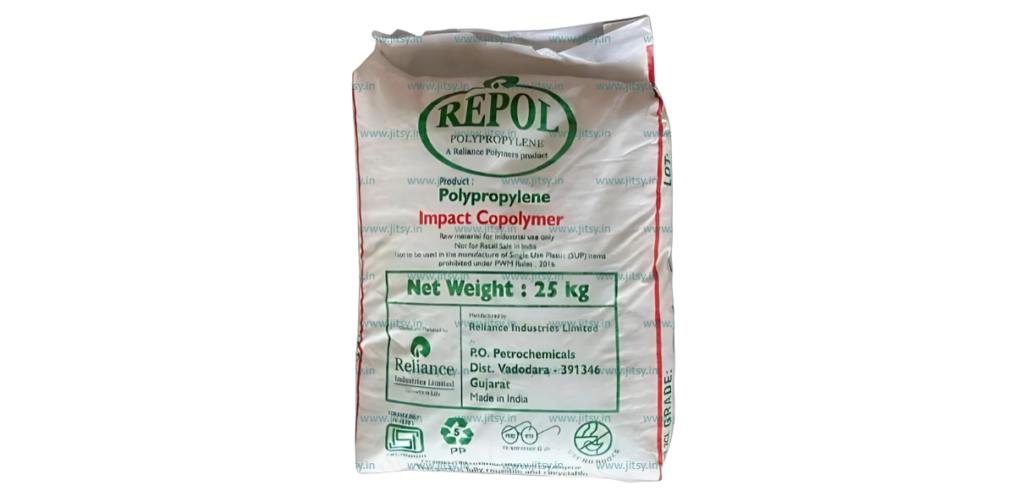
Reliance PP Repol AM120N is a general-purpose polypropylene homopolymer developed by Reliance Industries Limited for injection moulded products that require a practical balance of flow, stiffness, toughness, processability, and regulatory suitability. Positioned within the Repol polypropylene portfolio, AM120N is widely used for industrial mouldings, furniture compounds, houseware, rigid utility products, and other medium-to-thick wall injection applications where consistent molding behavior and dependable mechanical performance are important.
This grade is manufactured by Reliance Industries Limited, one of India’s largest polymer producers, using advanced Unipol polypropylene technology at its Gujarat facilities. Under the Repol brand, Reliance supplies a broad range of polypropylene homopolymers, random copolymers, and impact copolymers for packaging, industrial, consumer, and automotive sectors. Within that range, AM120N is positioned as a dependable PP homopolymer injection moulding grade for converters looking for a clean, versatile resin that performs well across general-purpose applications and also works effectively as a compounding and blending base for furniture and household plastic products.
About Manufacturer
Reliance Industries Limited has a strong reputation in polypropylene manufacturing, with large-scale supply capability across India and export markets. The Repol brand is well established in the polymer industry for serving processors in injection moulding, extrusion, blow moulding, film, fibre, and compounding applications. That brand strength matters commercially because buyers are not only selecting a polymer grade, but also supply consistency, technical support credibility, and portfolio continuity. AM120N fits into the Repol homopolymer family as a medium-flow injection moulding grade intended for broad industrial usability. It is not positioned as a narrow specialty grade; instead, it is designed to be commercially flexible and technically stable across multiple end-use segments. That makes it especially relevant for manufacturers who need one reliable PP homopolymer grade for recurring production across furniture, crates, bins, containers, and houseware.Technical Insights and Material Performance
Reliance PP Repol AM120N has a melt flow rate of 12 g/10 min at 230°C/2.16 kg, which places it in a highly usable range for general-purpose injection moulding. This MFI level supports good cavity filling without becoming overly thin-flowing, making it suitable for medium-to-thick wall mouldings, practical production cycles, and a wide range of molded geometries. For processors, this means AM120N offers a strong balance between flow efficiency and part integrity. The density is approximately 0.90 g/cm³, consistent with polypropylene homopolymer materials. Typical mechanical values include tensile strength at yield of 37 MPa, elongation at yield of 12 percent, flexural modulus of 1450 MPa, notched Izod impact strength of 30 J/m at 23°C, and heat deflection temperature of 105°C at 455 kPa. Together, these values position AM120N as a rigid, general-purpose PP injection grade with enough toughness for routine industrial and consumer applications, while still maintaining the stiffness needed for furniture components, storage products, and molded utility items. From a material selection perspective, the technical strength of AM120N lies in its balance rather than extremity. It is not a very low-flow heavy-duty grade, nor a very high-flow thin-wall specialty grade. Instead, it occupies a commercially valuable middle ground. The 12 MFI flow profile supports smooth processing, the 1450 MPa flexural modulus provides useful structural rigidity, and the 30 J/m impact level helps prevent the grade from becoming too brittle in practical use. The HDT of 105°C also gives it added relevance for molded products exposed to moderate heat during service.Processing Characteristics
AM120N is recommended for injection moulding and is suited to general-purpose molded products across furniture, industrial, and houseware sectors. Reliance’s guidance indicates a melt temperature range of 210°C to 260°C and a mould temperature range of 30°C to 50°C. These conditions are practical for standard PP injection moulding setups and allow processors to optimize flow, cooling, surface finish, and cycle stability depending on part design and tooling. In production, the grade’s medium-flow nature helps maintain a good balance between fill performance and dimensional control. Compared with lower-flow grades, AM120N can fill molds more easily and support better productivity in multi-cavity or moderately complex parts. Compared with higher-flow grades, it offers better control in thicker sections and can reduce the risk of excessive flash or over-fluid behavior in certain applications. This makes it a dependable choice for processors who need a stable, repeatable PP homopolymer for varied product lines.Applications and Industry Use Cases
General-Purpose Industrial Mouldings
Reliance PP Repol AM120N is well suited for industrial mouldings such as crates, bins, pallets, totes, storage containers, and utility handling products. These applications require a practical mix of stiffness, toughness, and processability, especially where production volumes are high and part geometry must remain consistent. Its balanced MFI and mechanical profile make it a strong option for manufacturers producing durable molded items for logistics, warehousing, and industrial handling.Furniture Compounds and Molded Furniture Components
AM120N is particularly relevant to the furniture industry because it is suitable both as a direct injection moulding resin and as a compounding base or blending material for furniture compounds. It can be used in molded furniture parts such as chair backs, armrests, table components, organizers, and storage structures. For furniture processors, the grade offers a useful balance of rigidity and process consistency, while also supporting color, filler, and additive incorporation in compound formulations.Houseware and Consumer Utility Products
The grade is widely applicable in houseware products such as buckets, basins, tubs, kitchen utility items, organizers, and general household molded articles. In these applications, manufacturers typically need a resin that can process smoothly, maintain acceptable stiffness, and deliver dependable part quality without requiring specialty-grade economics. AM120N fits that need well, making it a practical PP homopolymer choice for everyday consumer plastic goods.Rigid Containers and Utility Packaging
AM120N can also be used in rigid containers and non-flexible packaging components where the emphasis is on molded shape retention, processability, and regulatory suitability. Its food-contact aligned compliance profile adds value for packaging and utility applications where safe-use standards are important. For converters making molded packaging or storage articles, this grade offers a reliable balance of mechanical performance and commercial versatility.Masterbatch, Filler and Compounding Base Resin
A major advantage of AM120N is its suitability as a base resin for compounding, filler loading, and masterbatch blending. Processors in the furniture and household plastics sectors often need a polypropylene homopolymer with stable rheology and broad compatibility for formulation work. AM120N serves that role effectively, making it attractive not only to direct molders but also to compounders supplying downstream plastic manufacturers.Performance Advantages of Reliance PP Repol AM120N
One of the main advantages of AM120N is its balanced 12 MFI flow profile. This gives processors enough flow for efficient injection moulding while still maintaining control in medium and thicker wall sections. It is a practical middle-ground grade for manufacturers who do not want the slower fill of lower-MFI homopolymers or the overly high flow of thin-wall oriented grades. Its mechanical balance is another strength. With 37 MPa tensile strength, 1450 MPa flexural modulus, and 30 J/m impact strength, the grade performs well in applications that need rigidity without becoming too fragile for routine use. This makes it especially suitable for furniture compounds, industrial molded products, and houseware where both structure and day-to-day durability matter. The grade also offers a commercial advantage through regulatory readiness. Compliance references such as IS 10910, IS 16738:2018, and FDA 21 CFR 177.1520 support its use in food-contact and regulated molded applications, subject to final article testing. For converters, this can simplify qualification for certain packaging and utility end uses.Alternatives and Comparable Grades
Within the Reliance Repol portfolio, AM650N is a relevant alternative when higher flow is needed for thinner-wall parts or faster filling requirements. However, for general-purpose industrial mouldings and furniture compounds, AM120N often provides a better balance between flow and section control. AM010N sits at the lower-flow end and is more suitable where thicker sections or different processing priorities matter, rather than standard injection moulding versatility. Compared with H110MA, AM120N is also a useful benchmark. Both are PP homopolymer injection grades, but AM120N is positioned more clearly as a broad general-purpose grade and compounding base, while H110MA is often associated with rigid containers, thermoware, and specific molded product categories. Buyers selecting between the two should consider whether they need a more general industrial/furniture-oriented resin base or a grade aligned more closely with specific molded article performance. Against comparable PP homopolymer injection grades from HMEL, IOCL, and OPaL, AM120N competes well on its combination of balanced MFI, broad application range, compounding suitability, and food-contact aligned compliance. Many competing grades may offer similar flow ranges, but AM120N is especially attractive when the buyer wants a versatile, mainstream Reliance grade that can serve both direct moulding and compound-based production programs. The rationale behind the assigned grade is straightforward: AM120N is best selected where a manufacturer needs a stable, medium-flow PP homopolymer for general injection moulding, furniture compounds, industrial products, and houseware without moving into narrow specialty grades. It is a practical production resin built for flexibility, repeatability, and broad commercial relevance.
Reliance PP Repol AM650N
Reliance PP Repol AM650N is a high-flow polypropylene homopolymer developed by Reliance Industries Limited for high-speed injection moulding applications that demand rapid cavity filling, stable processing, and efficient output in thin-wall and multi-cavity production environments. Positioned within the Repol homopolymer portfolio, AM650N is especially suited for TWIM containers, intricate long-flow-path parts, appliance components, automotive mouldings, and masterbatch or compounding applications where very high melt flow is commercially valuable.
Manufactured by Reliance Industries Limited using Unipol polypropylene process technology, Repol AM650N is designed for processors who need faster fill, shorter cycle potential, and better productivity than standard medium-flow PP homopolymer grades can offer. For buyers searching for Reliance AM650N, high-flow PP homopolymer injection grade, PP for thin-wall injection moulding, or polypropylene for multi-cavity moulding in India, this grade is one of the most relevant choices in the Reliance injection moulding range.
The commercial significance of AM650N lies in its very high melt flow rate and antistatic formulation. It is not intended as a general-purpose rigid moulding grade for thicker sections. Instead, it is assigned to applications where fast mould filling, repeatable cavity performance, and efficient compounding behavior matter more than maximum structural rigidity. That makes it highly suitable for thin-wall packaging, rapid-cycle moulding, and masterbatch manufacturing.
Manufacturer and Brand Background
Reliance Industries Limited is one of India’s largest integrated petrochemical producers and a major supplier of polypropylene to domestic and export markets. The company’s Repol brand covers a wide range of polypropylene homopolymers, random copolymers, impact copolymers, and specialty grades for injection moulding, fibre, film, extrusion, and technical applications. Within this portfolio, AM650N occupies a specialized position as a high-flow PP homopolymer for injection moulding and compounding. It is designed for processors who run high-output lines, thin-wall moulds, and multi-cavity tools, and for compounders who need a base resin with strong flow behavior for pigment, filler, and additive incorporation. This positioning makes it distinct from lower-flow grades such as AM120N or H110MA and more production-oriented than standard general-purpose injection resins.Technical Insights and Material Performance
Reliance PP Repol AM650N has a melt flow rate of 65 g/10 min at 230°C/2.16 kg, which places it firmly in the high-flow category for polypropylene homopolymer injection moulding. This is the defining technical characteristic of the grade. Such a high MFI enables the melt to travel quickly through thin sections, long flow paths, and multi-cavity moulds, supporting fast filling and reduced resistance during injection. For TWIM containers and high-output moulding operations, this can translate into shorter cycle potential and improved productivity. The density is approximately 0.90 g/cm³. Typical mechanical performance includes tensile strength at yield of 35 MPa, elongation at yield of 12 percent, flexural modulus of 1350 MPa, notched Izod impact strength of 25 J/m at 23°C, heat deflection temperature of 105°C at 455 kPa, and Shore D hardness of 70. These values show that although AM650N is a very high-flow grade, it still maintains a useful balance of rigidity, strength, and handling toughness for thin-wall and technical molded products. A key functional advantage is the antistatic additive package. Static charge build-up can create dust attraction and handling issues in molded parts, especially in appliance, automotive, packaging, and compounded applications. By reducing static accumulation, AM650N helps improve part cleanliness and handling quality in downstream operations. From a grade-selection perspective, the technical strength of AM650N is not about maximum stiffness or impact resistance. Its real value is its ability to combine very high flow with acceptable mechanical performance and antistatic functionality. That makes it especially effective in rapid-cycle injection moulding, long-flow-path parts, and masterbatch production where process efficiency is a major priority.Processing Characteristics and Injection Moulding Window
AM650N is recommended for injection moulding and is particularly suitable for thin-wall injection moulded containers, multi-cavity tools, and intricate molded parts. A typical processing window includes melt temperatures around 210°C to 260°C and mould temperatures around 20°C to 40°C, depending on tool design, wall thickness, cycle requirements, and machine setup. Its high MFI allows the resin to fill cavities quickly and efficiently, which is especially useful in TWIM applications where short cycle times and rapid mould filling are critical. In multi-cavity moulding, the grade helps reduce filling resistance and supports more uniform cavity performance. In compounding and masterbatch production, the same high-flow behavior supports good dispersion and mixing of pigments, fillers, and additives. Because of its flow level, AM650N is best chosen where filling speed and productivity are more important than the higher stiffness associated with lower-flow PP homopolymer grades. It is a process-driven grade designed for output-focused manufacturing.Applications and Industry Use Cases
TWIM Containers and Thin-Wall Packaging
Reliance PP Repol AM650N is highly suitable for thin-wall injection moulded containers used in food packaging, consumer packaging, and utility storage applications. Its very high flow helps fill thin sections quickly and cleanly, making it ideal for fast-cycle moulding where productivity and part consistency are essential. For manufacturers of cups, tubs, boxes, and lightweight rigid packaging, this grade offers a strong process advantage.Multi-Cavity Injection Moulding
AM650N performs especially well in multi-cavity moulds where balanced filling and repeatable production are critical. Small parts, closures, lids, and technical components produced in high-cavity tools benefit from its rapid flow behavior, which supports efficient filling across cavities and helps maintain output in high-volume manufacturing environments.Intricate Long-Flow-Path Parts
For molded articles with narrow sections, detailed geometry, or longer flow lengths, AM650N offers a clear advantage over lower-flow PP homopolymers. It can move through complex mould paths more easily, which helps reduce filling-related issues in technical injection mouldings, appliance parts, and automotive components.Appliance and Automotive Components
The grade is relevant for selected appliance and automotive injection moulded parts where fast production, clean surfaces, and good dimensional repeatability are important. It can be used in components such as trim parts, fittings, small housings, clips, and utility mouldings that benefit from high flow and antistatic performance during handling and assembly.Masterbatch and Compounding Base Resin
AM650N is also a strong base resin for masterbatch and compounding applications. Its high MFI supports efficient shear mixing with pigments, fillers, and additives, making it useful for color concentrates, additive compounds, and specialty formulations. For compounders, this grade offers a practical balance of processability, consistency, and regulatory alignment.Performance Advantages
The biggest advantage of AM650N is its exceptional flow. With an MFI of 65, it is far better suited to TWIM and high-speed multi-cavity moulding than lower-flow grades such as AM120N or H200MA. This makes it highly attractive for processors focused on fast fill, reduced cycle time potential, and high-volume output. Its antistatic additive package adds another practical benefit. In molded packaging, appliance parts, and compounded materials, reduced static build-up can improve handling, reduce dust attraction, and support cleaner finished parts. This is especially useful where appearance and downstream processing matter. AM650N also offers a useful mechanical balance for a high-flow grade. While it is not intended for heavy-duty structural applications, its tensile strength, flexural modulus, and HDT remain strong enough for many thin-wall and technical molded products. This balance is what makes it commercially valuable: it delivers speed without becoming too weak for practical use.Alternatives and Comparable Grades
Within the Reliance Repol portfolio, AM120N is a much lower-flow alternative positioned for general-purpose injection moulding, furniture compounds, and industrial molded products. It offers better suitability for medium-to-thick wall applications but cannot match the filling speed and rapid-cycle potential of AM650N. Buyers should choose AM650N when thin-wall moulding and high-speed output are the main priorities. H200MA is another internal comparison, with an MFI of 20 and antistatic functionality. It is suitable for thin-wall containers and multi-cavity moulding, but it operates in a more moderate flow range. AM650N is the stronger choice when the mould demands much faster filling, longer flow capability, or more aggressive cycle optimization. H200MK also has an MFI of 20, but it is clarified and antistatic, making it more suitable for syringes, clear rigid articles, and applications where visual clarity matters. AM650N is not a clarity-focused grade; it is a speed- and process-focused grade for TWIM, multi-cavity, and compounding applications. Compared with high-flow PP homopolymer grades from HMEL, IOCL, and OPaL, AM650N competes strongly because it combines very high flow, antistatic performance, food-contact aligned compliance, and masterbatch suitability within the Reliance portfolio. The rationale behind the assigned grade is clear: AM650N is selected when the processor needs a high-flow PP homopolymer optimized for rapid filling, thin-wall injection moulding, and compounding efficiency rather than a lower-flow general-purpose resin.
Reliance PP Repol AS030N
Reliance Repol AS030N is a polypropylene homopolymer raffia grade developed by Reliance Industries Limited for raffia tape extrusion applications used in plastic woven sacks, monofilaments, carpet backing, industrial packaging and geotextiles. For buyers searching for Reliance Repol AS030N, AS030N PP raffia grade, or 3 MFI polypropylene homopolymer for woven sacks, this grade is positioned as a dependable option for converters that need stable processing, strong tape performance and consistent woven fabric output.
According to the Reliance TDS, Repol AS030N is recommended for raffia tapes used in plastics woven sack and is designed with a low water carry-over additive package. This is important in raffia processing because reduced water carry-over can improve drying efficiency after the water bath, support cleaner downstream handling and help maintain more stable tape quality during continuous production.
Reliance Industries Limited is one of India’s largest polymer manufacturers, and the Repol PP portfolio includes raffia, fibre, BOPP film, injection moulding and compounding grades used across industrial applications. Within this range, AS030N belongs to the raffia and monofilament family, where processors need a practical balance of processability, mechanical strength and consistency for woven fabric conversion. The grade is supplied as virgin polypropylene homopolymer granules and carries BIS Designation Code IS 10951-1-TB-A. In the Indian market, it is relevant for woven sack manufacturers, raffia tape extrusion units, monofilament processors, carpet backing converters and technical textile manufacturers looking for a proven Reliance raffia grade with reliable line behaviour.
Technical Insights
Repol AS030N combines a melt flow rate of 3 g/10 min with a density of 0.90 g/cc, making it suitable for tape extrusion where controlled melt flow and orientation are important. The grade also shows 35 MPa tensile strength at yield, 12% elongation at yield, 1400 MPa flexural modulus, 70 Shore D hardness, 44 J/m notched Izod impact at 23°C, and 105°C heat deflection temperature at 0.455 MPa. This property profile makes AS030N a practical choice for processors that want good tape strength, stable woven fabric performance and dependable conversion across sack and technical textile applications. The tensile and modulus values support stiffness and dimensional stability, while the impact performance helps maintain practical toughnessin woven end-use structures. Reliance also provides indicative processing guidance for raffia tape extrusion, including extrusion temperatures of 220–260°C, water bath temperatures of 30–50°C, and stretching temperatures around 155°C. These reference conditions make AS030N relevant for buyers looking for AS030N raffia processing guidance, PP homopolymer for tape extrusion, or polypropylene raffia grade for woven sack manufacturing.Applications and Industry Use Cases
Plastic Woven Sacks
Repol AS030N is primarily recommended for plastic woven sacks, where raffia tapes are converted into fabrics used for packaging cement, fertilisers, grains, animal feed and other bulk materials. Its combination of processability and mechanical strength helps manufacturers produce woven sack fabrics that perform reliably during filling, stacking, transport and storage.Monofilaments and Raffia Conversion
The grade is also suitable for monofilament-related conversion where processors need a polypropylene homopolymer with stable extrusion behaviour and consistent downstream handling. This makes AS030N relevant for applications where orientation control, line consistency and balanced mechanical output are important to finished product quality.Carpet Backing
In carpet backing applications, AS030N supports the production of raffia tapes used in woven backing structures that provide dimensional support and structural integrity. For converters supplying carpet backing materials, the grade offers a useful balance of stiffness, process consistency and woven fabric performance.Industrial Packaging Fabrics
Industrial packaging applications such as wrapping fabrics, utility woven materials and heavy-duty packaging structures also align well with AS030N. Processors in this segment typically need a raffia grade that can run efficiently on tape extrusion lines while delivering woven fabrics with practical strength and durability.Geotextiles
AS030N is relevant for woven geotextile applications used in soil stabilisation, separation and civil engineering support layers. Because the grade is designed for raffia tape extrusion and woven fabric production, it fits technical textile applications where process consistency and mechanical reliability are important.Comparable Alternatives and Grade Positioning
In the Indian raffia market, Repol AS030N is commonly compared with Reliance Repol H030SG, Reliance Repol SS35N, IOCL PP1030RG, and HMEL R03RR. All of these grades fall within a similar melt flow range and are positioned for raffia tapes, woven sacks and related woven fabric applications. Within the Reliance portfolio, H030SG and SS35N are the closest comparisons because they also sit around 3.0 MFI and serve overlapping raffia applications. Buyers comparing AS030N with these grades are usually evaluating processing familiarity, supply preference and subtle differences in end-use fit rather than major differences in polymer family. IOCL PP1030RG is a direct market alternative with a slightly higher MFI around 3.3, making it relevant for converters comparing line behaviour and tape orientation performance. HMEL R03RR is another practical alternative in the same selection bandfor woven sack and raffia applications. The rationale for selecting AS030N usually comes from its Reliance positioning, low water carry-over design, and suitability for both woven sacks and monofilament-oriented conversion.
Reliance PP Repol H030SG
Reliance Repol H030SG is a polypropylene homopolymer raffia grade developed by Reliance Industries Limited for tape extrusion applications. It is recommended for making raffia tapes used in woven fabrics for sacking, carpet backing, industrial packaging and geotextile applications. For buyers searching for H030SG PP raffia grade, 3 MFI polypropylene homopolymer, or polypropylene raffia tape grade in India, this grade is positioned as a dependable option for converters that need stable extrusion, good tape strength and consistent woven fabric performance.
Manufactured under the Repol PP portfolio, H030SG is produced using the Unipol PP process, a gas-phase fluidised bed reactor technology known for consistent polymer quality and process stability. In practical terms, this matters to woven sack and raffia tape manufacturers because line consistency, low defect generation and predictable orientation behaviour directly affect output, tape quality and loom performance.
