






Brand
 Bhansali Engineering Polymers LimitedBhansali Engineering Polymers Limited 1
 Borouge Pte LtdBorouge Pte Ltd 1
 Dongsung ChemicalDongsung Chemical 2
 Dow-MitsuiDow-Mitsui 3
 FPC Formosa Plastics CorporationFPC Formosa Plastics Corporation 1
 Haldia Petrochemicals LtdHaldia Petrochemicals Ltd 15
 Hanwha Solutions ChemicalHanwha Solutions Chemical 4
 Hanwha Total Energies PetrochemicalHanwha Total Energies Petrochemical 7
 HMEL - HPCL-Mittal Energy LimitedHMEL - HPCL-Mittal Energy Limited 45
 IOCL - Indian Oil Corporation LimitedIOCL - Indian Oil Corporation Limited 14
 Jiangsu Daoming Chemical Co LtdJiangsu Daoming Chemical Co Ltd 2
 LG ChemLG Chem 8
 Lotte ChemicalLotte Chemical 4
 LyondellBasell Industries NVLyondellBasell Industries NV 1
 Mangalore Refinery & Petrochemicals LimitedMangalore Refinery & Petrochemicals Limited 7
 Marcopolo International LLCMarcopolo International LLC 2
 Nouryon Functional ChemicalsNouryon Functional Chemicals 8
 ONGC Petro Additions LtdONGC Petro Additions Ltd 30
 Reliance Industries LimitedReliance Industries Limited 40
 SabicSabic 1
 Sipchem - Saudi International PetrochemicalSipchem - Saudi International Petrochemical 8
 SK Functional PolymerSK Functional Polymer 6
 The Dow Chemical CompanyThe Dow Chemical Company 3
 TPI Polene Public Company LimitedTPI Polene Public Company Limited 3
 VersalisVersalis 4
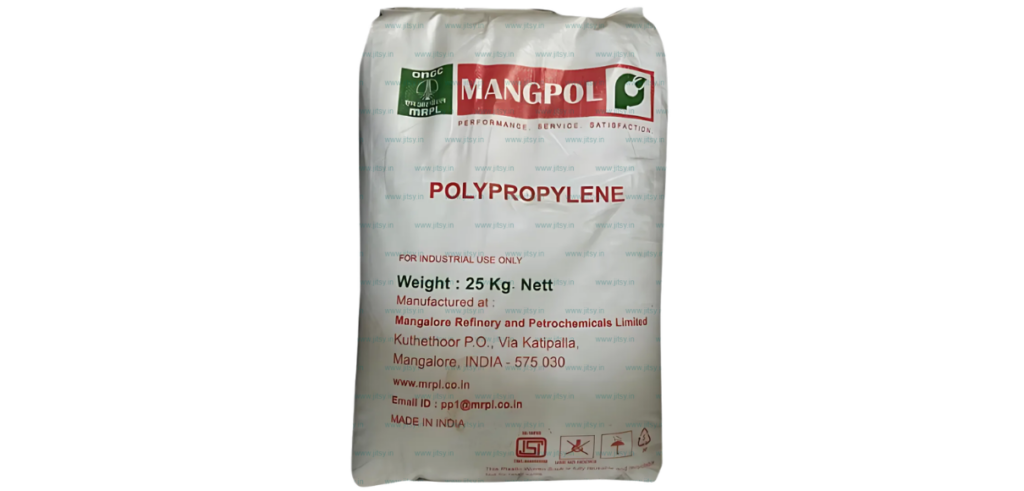
MRPL PP Mangpol HM012T
MRPL PP Mangpol HM012T is a polypropylene homopolymer general-purpose injection moulding grade manufactured by Mangalore Refinery and Petrochemicals Limited using solvent-free gas-phase polymerization with Novolen Technology. Developed for rigid packaging, caps and closures, furniture, household articles, and compounding, this grade is known for superior process stability, high rigidity, low cycle time, and excellent product aesthetics.
Mangpol HM012T is the baseline general-purpose injection moulding grade in MRPL’s polypropylene homopolymer portfolio. It is designed for moulders that need a dependable balance of flow, stiffness, thermal performance, and surface finish across a wide range of rigid PP applications. MRPL’s Novolen gas-phase technology supports low gel levels, smooth processing, lot-to-lot consistency, and reliable conversion performance, making HM012T suitable for both standard and high-volume injection moulding operations.
Technical Insights
MRPL HM012T typically offers a melt flow index of 12 g/10 min at 230°C/2.16 kg, making it a practical choice for general-purpose injection moulding where balanced flow and part strength are important. Typical performance values associated with this grade class include tensile strength at yield around 35 MPa, tensile elongation at yield around 8%, flexural modulus near 1400 MPa, Izod impact strength around 28 J/m, Vicat softening point of 154°C, and heat deflection temperature around 100°C. This combination gives processors a material that moulds efficiently while maintaining stiffness, dimensional stability, and good finished-part appearance. Recommended processing guidance generally includes barrel temperatures in the 180–280°C range and mould temperatures around 30–40°C. These characteristics help reduce cycle time, improve productivity, and support consistent output in applications where appearance, rigidity, and processing stability matter.Applications
General-Purpose Injection Moulded Items
Mangpol HM012T is well suited for a broad range of general-purpose injection moulded products where manufacturers need a stable and versatile polypropylene homopolymer. Its balanced flow and stiffness make it useful for everyday industrial and commercial moulding applications requiring reliable processing and durable finished parts.Caps and Closures
For caps and closures, HM012T offers the rigidity and moulding consistency needed for repeatable production and good dimensional control. It supports efficient cycle times and clean part formation, making it relevant for packaging converters looking for PP injection moulding granules for closure applications in India.Furniture Components
This grade is also suitable for moulded furniture parts where stiffness, structural integrity, and surface appearance are important. Manufacturers of plastic chairs, utility components, and related furniture items can benefit from its high rigidity and dependable moulding behavior.Household Articles
HM012T performs well in household and houseware applications such as storage items, utility containers, and everyday consumer products. Its combination of process stability and good aesthetics makes it attractive for visible consumer-facing parts where finish quality matters alongside strength.Compounding Base Material
As a 12 MFI polypropylene homopolymer, HM012T is also relevant as a base resin for compounding. It can be used in formulations where processors need a stable injection-grade PP matrix for filler loading, masterbatch blending, or customized downstream performance targets.Comparable Alternatives
Within the MRPL range, HM012T is positioned as the standard general-purpose injection grade, while HM020 offers higher flow for thinner-wall and multi-cavity moulding, HM065 is better suited to very high-flow thin-wall or compounding needs, and HM012CT is intended where clarified appearance or transparency is required. Compared with HT003, HM012T is clearly optimized for injection moulding rather than thermoforming. Against broader Indian market alternatives, HM012T competes with grades such as OPaL MH13 or MH12N and IOCL or Reliance Repol H110MA / 110NA used in injection moulding, rigid packaging, and housewares. HM012T is a strong fit for buyers seeking MRPL-origin PP homopolymer with dependable rigidity, good aesthetics, and compliance-oriented documentation for regulated or quality-sensitive applications.
MRPL PP Mangpol HM025AR
MRPL PP Mangpol HM025AR is a controlled rheology polypropylene homopolymer developed for injection moulding applications that demand a strong balance of stiffness, flowability, and surface quality. Manufactured by Mangalore Refinery and Petrochemicals Limited using solvent-free gas phase polymerization with Novolen Technology, this grade is especially suited for thin wall injection moulding, multi cavity moulding, furniture parts, lamp housings, and intricate designer components with long flow paths.
Mangpol HM025AR sits in MRPL’s injection moulding portfolio between standard general-purpose grades and higher-flow thin wall grades. It is engineered for processors that need better mould filling than conventional injection grades without moving into ultra-high-flow territory. A key advantage of this grade is its additive package, which includes antistatic and nucleating agents. This helps reduce static charge build-up, improve crystallization behavior, increase hardness, and enhance resistance to heat deflection, while also supporting better control over scratches and weld lines in finished moulded parts.
Technical Insights
MRPL HM025AR typically delivers a melt flow index of 24 g/10 min at 230°C/2.16 kg, making it highly suitable for thin wall and multi cavity moulding where efficient filling and shorter cycle times are important. Typical mechanical and thermal values include tensile strength at yield around 36 MPa, tensile elongation at yield around 10%, flexural modulus of 1700 MPa, Izod impact strength of 30 J/m, Vicat softening point of 150°C, and heat deflection temperature of 120°C. This property profile makes HM025AR a strong choice for moulders seeking a polypropylene homopolymer with high stiffness, good flow, and improved thermal resistance. The nucleating system helps deliver faster crystallization and better part rigidity, while the antistatic feature improves handling and end-use performance in selected applications. Typical processing guidance includes melt temperatures around 200–240°C and mould temperatures in the 20–50°C range. These characteristics support faster mould cycles, reliable cavity filling, and improved finish in complex mould geometries.Applications
Thin Wall Injection Moulding
Mangpol HM025AR is particularly well suited for thin wall injection moulding where processors need a material that flows efficiently into narrow sections while still maintaining stiffness in the final part. Its controlled rheology and 24 MFI profile help improve mould filling, reduce cycle pressure challenges, and support high-output production in demanding moulding environments.Multi Cavity Moulding
For multi cavity moulding, HM025AR offers the consistency and flow balance needed to fill multiple cavities with better uniformity. This makes it relevant for converters producing high-volume moulded components where repeatability, dimensional consistency, and efficient cycle times are critical to productivity and scrap control.Furniture Components
This grade is also a strong fit for moulded furniture parts that require rigidity, hardness, and good surface appearance. Its high flexural modulus and improved scratch resistance make it useful for visible and functional components in plastic furniture, utility products, and structural moulded items.Lamp Housings and Designer Parts
HM025AR performs well in lamp housings and intricate designer parts with long flow paths, where both mouldability and aesthetics matter. The grade’s flow characteristics help reach complex mould sections, while its weld line and scratch-control benefits support better finished-part quality in consumer-facing applications.Comparable Alternatives
Within the MRPL range, HM012T is a lower-flow general-purpose injection grade better suited for standard rigid moulded products, while HM020 is another thin wall option with slightly lower flow than HM025AR. HM065 moves into much higher flow territory and is better suited for very thin wall moulding or compounding, whereas HM012CT is intended for clarified or transparent injection moulding applications. HM025AR stands out where moulders specifically want a controlled rheology grade with a balance of stiffness, flow, scratch control, and thermal performance. In the broader Indian market, HM025AR can be compared with OPaL MH25N, OPaL MH23, and IOCL or Reliance Repol H210MA type grades used in high-flow injection moulding. Compared with these alternatives, HM025AR offers a strong value proposition for buyers seeking MRPL-origin polypropylene with antistatic and nucleated performance, especially for thin wall, furniture, and intricate moulded applications.
MRPL PP Mangpol HM065AT
MRPL PP Mangpol HM065AT is a polypropylene homopolymer injection moulding grade developed by Mangalore Refinery and Petrochemicals Limited using solvent-free Novolen gas phase technology. Designed for processors that need very high flow, fast filling, and stable part formation, HM065AT is widely suited for thin wall injection moulding, multi cavity moulding, compounding, and masterbatch applications.
Mangpol HM065AT is positioned in MRPL’s high-flow injection moulding portfolio as an ultra-high flow grade for demanding moulding environments. Compared with standard injection grades, it is engineered to deliver faster cavity filling, shorter cycle times, and better dimensional consistency in thin wall and complex moulded parts. MRPL’s Novolen gas phase process supports low gel content, smooth processing, and dependable lot-to-lot quality, making HM065AT relevant for high-output converters that prioritize productivity and repeatability.
Technical Insights
MRPL HM065AT typically offers a melt flow index of 65 g/10 min at 230°C/2.16 kg, which places it in the ultra-high flow category for polypropylene homopolymer injection grades. Typical physical and mechanical values include density of 0.90 g/cm³, tensile strength at yield around 35 MPa, tensile elongation at yield around 8%, flexural modulus near 1400 MPa, and Izod impact strength around 28 J/m. Thermal properties include a Vicat softening point of 150°C and heat deflection temperature around 105°C. This combination makes HM065AT particularly attractive where moulders need excellent flow without losing the stiffness and dimensional stability expected from a homopolymer PP grade. Typical processing guidance includes barrel temperatures around 190–230°C, die temperatures around 220–250°C, and mould temperatures in the 10–30°C range. These settings support rapid mould filling, reduced cycle time, and efficient production in thin wall and multi cavity applications. The grade is also useful in compounding and masterbatch production where high flow can improve mixing, dispersion, and downstream process efficiency.Applications
Thin Wall Injection Moulding
Mangpol HM065AT is highly suitable for thin wall injection moulding where very fast flow is required to fill narrow sections before freeze-off. This makes it a strong option for thin wall containers, lids, and packaging parts where converters need high productivity, lower cycle times, and consistent mould filling across demanding geometries.Multi Cavity Moulding
For multi cavity moulding, HM065AT helps improve filling balance and repeatability across multiple cavities. Its ultra-high flow profile supports efficient production of high-volume moulded items where output speed, dimensional consistency, and reduced rejection rates are critical for commercial performance.Compounding Applications
HM065AT is also relevant as a base resin for compounding operations. Its high flow can support better filler incorporation, smoother processing, and easier formulation handling, making it useful for processors developing customized polypropylene compounds for industrial applications.Masterbatch Production
In masterbatch manufacturing, this grade offers advantages in dispersion and processability due to its strong flow characteristics. It can help improve pigment or additive distribution while supporting efficient extrusion and downstream conversion, especially where a high-flow PP carrier resin is preferred.Comparable Alternatives
Within the MRPL portfolio, HM012T is a lower-flow general-purpose injection grade, while HM025AR is a controlled rheology option that balances stiffness and flow for thin wall and furniture applications. HM020 is another thin wall grade, but HM065AT clearly moves into a much higher flow range for faster filling, shorter cycles, and compounding-oriented use cases. This makes HM065AT the better fit when mould geometry is demanding or output speed is a top priority. In the broader market, HM065AT can be compared with OPaL MH55N, IOCL Repol H410FB, and Reliance Repol H410FB type grades used in high-flow injection moulding. Compared with these alternatives, HM065AT is especially relevant for buyers seeking MRPL-origin polypropylene homopolymer for thin wall packaging, multi cavity housewares, and compounding applications where ultra-high flow and dimensional stability are key selection factors.
MRPL PP Mangpol HR003
MRPL PP Mangpol HR003 is a polypropylene homopolymer raffia grade manufactured by Mangalore Refinery and Petrochemicals Limited using solvent-free gas phase polymerization with Novolen Technology. It is developed for extrusion-based raffia processing where converters need smooth line performance, reliable tape formation, and a practical balance between tenacity and toughness.
This grade is positioned for woven sacks, FIBC, monofilament, leno bags, ropes, and yarns, making it highly relevant for industrial packaging, agricultural packaging, woven conversion, and bulk handling applications. For buyers searching MRPL PP Mangpol HR003, HR003 raffia grade, PP raffia raw material, or polypropylene for woven sacks in India, this grade fits high-intent procurement and technical evaluation requirements.
Mangalore Refinery and Petrochemicals Limited (MRPL) markets its polypropylene range under the Mangpol PP brand. Its Novolen gas-phase polypropylene plant is designed to produce a broad range of homopolymer grades with strong lot-to-lot consistency, low gel content, smooth processing at high line speed, and dependable product quality. This manufacturing background strengthens HR003’s positioning for raffia processors looking for stable extrusion performance and reliable conversion behavior.
Technical Description and Performance Insights
MRPL PP Mangpol HR003 is built for raffia extrusion where melt behavior and orientation response directly affect tape quality and downstream conversion. Its melt flow index of 3.5 g/10 min makes it suitable for processors who need a controlled flow profile for stretched tape production, helping maintain a workable balance between extrusion stability and mechanical performance. The grade delivers tensile strength at yield of 34 MPa and tensile elongation at yield of 9 percent, which supports its use in applications where tapes and filaments must perform reliably during weaving, stitching, bag conversion, and end-use handling. A flexural modulus of 1500 MPa contributes to structural stiffness, while Izod impact strength of 35 J/m helps improve toughness in practical packaging environments. From a thermal perspective, HR003 offers a Vicat softening point of 154°C and heat deflection temperature of 100°C. These values support processing robustness and dimensional reliability in industrial raffia applications. The official positioning around excellent processability, low water carryover, and a strong tenacity-toughness balance makes this grade especially relevant for woven packaging manufacturers comparing domestic PP raffia grades.Processing Guidance
MRPL recommends barrel temperatures in the range of 220–280°C and die temperatures of 260–280°C for efficient extrusion. Quench temperature guidance is 30–40°C, while oven temperature is recommended at 155–160°C. These processing conditions are aligned with raffia tape production where stable extrusion, proper quenching, and effective orientation are critical for final tape quality.Applications
Woven Sacks for Industrial Packaging
MRPL PP Mangpol HR003 is widely suited for raffia tapes used in woven sacks for fertilizers, cement, polymer granules, sugar, food grains, and other bulk materials. In these applications, processors need polypropylene homopolymer grades that support strong tape formation, weaving consistency, and dependable bag performance during storage, stacking, and transport.FIBC and Jumbo Bag Applications
For FIBC and jumbo bag manufacturing, HR003 offers the type of raffia performance needed for heavy-duty bulk packaging. Its balance between tenacity and toughness makes it relevant for converters producing tapes and woven structures that must withstand demanding industrial handling conditions.Monofilament, Ropes and Yarn Conversion
Mangpol HR003 is also suitable for monofilament, ropes, and yarn-based applications where extrusion consistency and mechanical reliability are important. Manufacturers evaluating PP homopolymer grades for filament-oriented products can consider this grade where stable processing and durable end-use behavior are both priorities.Leno Bags for Agricultural Packaging
In leno bag applications, HR003 supports the production of woven packaging used for vegetables, fruits, and agricultural produce. This makes it relevant for converters targeting breathable packaging formats that still require good tape integrity, process consistency, and practical toughness during logistics and handling.General Raffia and Woven Fabric Uses
Beyond standard sacks and bags, this grade is relevant for general raffia tapes and woven fabric applications across industrial packaging segments. Buyers looking for a polypropylene raffia grade in India for extrusion-based woven conversion can position HR003 as a practical material choice for stable production and broad application utility.Comparable Alternatives and Grade Positioning
Within the MRPL portfolio, HR003 is clearly positioned as a raffia grade, while other Mangpol grades serve film, thermoforming, injection molding, and yarn or fiber applications. This distinction matters because raffia processors need a grade optimized for tape extrusion and woven conversion rather than a higher-flow film or molding resin. Compared with domestic alternatives such as OPaL RH03 and Repol B210R-type raffia grades, MRPL PP Mangpol HR003 competes in the low-MFI PP homopolymer raffia segment used for woven sacks, FIBC, and oriented tape applications. Its differentiation comes from the Novolen technology platform, the official emphasis on low water carryover, and its balanced tenacity-toughness profile. The rationale behind HR003’s assigned grade positioning is straightforward: it is designed for extrusion-led raffia applications where processors need dependable line behavior, strong tape conversion, and reliable end-use performance. It should be preferred when the application is woven packaging or industrial raffia rather than film packaging or injection molded products.
MRPL PP Mangpol HR005T
MRPL PP Mangpol HR005T is a polypropylene homopolymer raffia grade manufactured by Mangalore Refinery and Petrochemicals Limited using solvent-free gas phase polymerization with Novolen Technology. It is designed for converters looking for a dependable PP raffia grade for high-speed extrusion lines, general-purpose wrapping, and packaging conversion where process consistency and balanced mechanical performance are critical.
Mangpol HR005T is positioned as a general-purpose raffia and wrapping grade within the MRPL polypropylene portfolio. For buyers searching MRPL PP Mangpol HR005T, HR005T PP raffia grade, Mangpol HR005T supplier, or polypropylene homopolymer for wrapping in India, this grade offers a practical combination of extrusion efficiency, low water carryover, and stable end-use performance.
About the Manufacturer
Mangalore Refinery and Petrochemicals Limited (MRPL) markets its polypropylene range under the Mangpol PP brand. Its 440 KTA Novolen gas-phase polypropylene plant uses Ziegler-Natta catalyst technology and is known for low gel content, smooth processing at high line speed, excellent lot-to-lot consistency, and strong organoleptic characteristics. This manufacturing profile supports HR005T’s positioning as a reliable raffia grade for converters that prioritize throughput, consistency, and process stability.Technical Description and Performance Insights
MRPL PP Mangpol HR005T is engineered for extrusion-led raffia and wrapping applications where stable melt flow and line efficiency are important. Its melt flow index of 4.5 g/10 min at 230°C/2.16 kg gives it a slightly higher-flow profile than lower-MFI raffia grades, which can support smoother processing and improved throughput on high-speed lines. The grade delivers tensile strength at yield of 34 MPa and tensile elongation at yield of 9 percent, making it suitable for applications where tapes and converted structures need a dependable balance of strength and controlled flexibility. A flexural modulus of 1400 MPa supports stiffness in converted packaging formats, while Izod impact strength of 30 J/m contributes to toughness during handling, winding, and downstream use. From a thermal standpoint, HR005T offers a Vicat softening point of 150°C and heat deflection temperature of 90°C. These values support stable processing and practical dimensional performance in raffia and wrapping applications. The official positioning around excellent processability, low water carryover, and a strong tenacity-toughness balance makes HR005T relevant for processors comparing PP homopolymer raffia grades for high-speed extrusion.Processing Guidance
MRPL recommends barrel temperatures of 220–280°C and die temperatures of 260–280°C for extrusion processing. Quench temperature is guided at 30–40°C, while oven temperature is recommended at 155–160°C. These conditions are important for converters seeking stable tape formation, controlled orientation, and efficient line performance in raffia and wrapping production.Applications
General Purpose Raffia Extrusion
MRPL PP Mangpol HR005T is suitable for general-purpose raffia extrusion where processors need a polypropylene homopolymer grade that runs efficiently on high-speed lines. Its flow profile and processability make it useful for converters focused on stable output, consistent tape behavior, and practical production economics.Wrapping and Packaging Conversion
HR005T is positioned for wrapping applications where smooth extrusion and balanced mechanical properties are important. In packaging conversion, this makes the grade relevant for manufacturers looking for a dependable PP raffia raw material that can support consistent processing and usable end-product toughness.High-Speed Extrusion Lines
One of the key strengths of Mangpol HR005T is its suitability for high-speed extrusion. Converters operating faster lines often need a grade with controlled flow, low carryover, and stable processing behavior, and HR005T fits this requirement well within the general-purpose raffia segment.Industrial Packaging Uses
Beyond wrapping, HR005T can be considered for broader industrial packaging applications where raffia-type conversion is needed. It is especially relevant for manufacturers seeking a PP homopolymer grade that balances throughput and mechanical reliability without moving into film-specific or injection-moulding resin categories.General Conversion Applications
Because HR005T is positioned as a general-purpose grade, it can serve converters who need flexibility across wrapping and raffia-led packaging uses. This makes it a practical choice for buyers evaluating domestic polypropylene grades for stable supply, process consistency, and broad conversion relevance.Comparable Alternatives
Within the MRPL portfolio, HR005T is positioned as a general-purpose raffia and wrapping grade, while HR003 is more specifically aligned with woven sacks, FIBC, monofilament, and leno bag applications. This means HR005T is better suited where converters want slightly higher flow and high-speed processing support, while HR003 is a more application-specific raffia grade for woven packaging structures. Compared with MRPL film grades such as HF003 and HF010, HR005T is clearly not a film-focused resin. It is also distinct from injection moulding grades like HM012T and high-flow yarn or fibre grades such as HY035R and HY035UR. Its assigned grade logic is centered on extrusion-led raffia and wrapping applications rather than molding, film, or fibre production. Against broader Indian market alternatives such as OPaL RH03 and Repol B210R-type raffia grades, HR005T competes as a PP homopolymer raffia grade for converters who value processability, throughput, and balanced tenacity and toughness. Its differentiation comes from MRPL’s Novolen technology platform, the official emphasis on low water carryover, and its suitability for high-speed extrusion lines.
MRPL PP Mangpol HY035UR
MRPL PP Mangpol HY035UR is a controlled-rheology polypropylene homopolymer fibre grade manufactured by Mangalore Refinery and Petrochemicals Limited using solvent-free Novolen gas phase polymerization. Designed for non-woven, extrusion lamination, medical apparel, baby hygiene, packaging, and diaper applications, this high-flow PP grade is built for converters that need stable processing, clean fibre formation, and reliable end-product performance.
Mangpol HY035UR sits in MRPL’s fibre and non-woven grade basket alongside HY035R and is positioned for high-speed spunbond and related conversion lines. The grade is recognized as a 35 MFI polypropylene homopolymer with controlled rheology, making it suitable where smooth flow, consistent web formation, and dependable mechanical balance are critical. MRPL’s polypropylene portfolio is produced through Novolen gas phase technology with Ziegler-Natta catalyst systems, supporting low gel content, lot-to-lot consistency, and good organoleptic characteristics.
Technical Insights
MRPL HY035UR is understood as a fibre-grade PP homopolymer with a melt flow index of about 35 g/10 min at 230°C/2.16 kg. In the closely aligned HY035R class, typical performance values include tensile strength at yield around 33 MPa, tensile elongation at yield around 8%, flexural modulus around 1300 MPa, Izod impact strength around 28 J/m, and Vicat softening point near 152°C. This property profile gives processors a useful balance of flow, stiffness, and thermal resistance for lightweight non-woven structures and extrusion-lamination applications. From a processing standpoint, the grade is suited to fibre spinning and non-woven conversion where stable melt behavior matters. Typical operating guidance includes barrel temperatures around 195–235°C, die heater temperatures around 235–240°C, and quench air temperatures around 15–18°C. The controlled-rheology profile helps support high-speed throughput, while low gel tendency reduces the risk of spinneret blockage and surface defects. A related product-family advantage is resistance to gas fading, which is valuable where appearance retention and shade stability matter in hygiene and medical non-woven products.Applications
Non-Woven Spunbond
Mangpol HY035UR is highly suitable for spunbond non-woven production used in industrial and consumer applications. Its high-flow fibre-grade profile helps converters achieve stable filament formation, uniform web structure, and efficient processing on high-speed lines. This makes it a strong fit for non-woven manufacturers seeking polypropylene granules for consistent spunbond output in India.Medical Apparels and Surgical Fabrics
This MRPL PP grade is well positioned for medical apparel applications such as gowns, drapes, mask layers, and other disposable healthcare fabrics. The combination of controlled rheology, process consistency, and clean conversion behavior supports manufacturers that require dependable non-woven performance for medical and hygiene-oriented production.Baby Hygiene and Diaper Structures
HY035UR is also relevant for baby hygiene products including diaper components and related absorbent hygiene structures. Its flow behavior supports lightweight non-woven layers, while its mechanical balance helps maintain fabric integrity in demanding end uses. For diaper and hygiene converters, this makes the grade attractive where softness, processability, and production stability are all important.Packaging and Extrusion Lamination
In packaging and extrusion lamination applications, Mangpol HY035UR offers the flow profile needed for efficient coating and lamination operations. It is suitable for converters looking for polypropylene homopolymer grades for laminated packaging structures where smooth processing, thermal stability, and reliable line performance are key selection factors.Comparable Alternatives
Within MRPL’s own portfolio, HY035UR is clearly differentiated from low-MFI raffia and film grades such as HR003 and HF010, which are designed for woven sacks and film packaging rather than fibre and non-woven conversion. It also differs from injection grades like HM012T and HM065, which target moulded articles and thin-wall parts instead of spunbond or lamination lines. Against market alternatives, HY035UR can be compared with OPaL RH38, OPaL RH25X, and IOCL fibre-oriented polypropylene grades. RH38 is typically positioned strongly for spunbond non-woven applications, while RH25X is more associated with fibre and filament uses. HY035UR stands out for buyers specifically seeking MRPL-origin material with Novolen gas phase processing characteristics, strong non-woven suitability, and product-family alignment with gas-fading resistance and compliance-oriented documentation logic.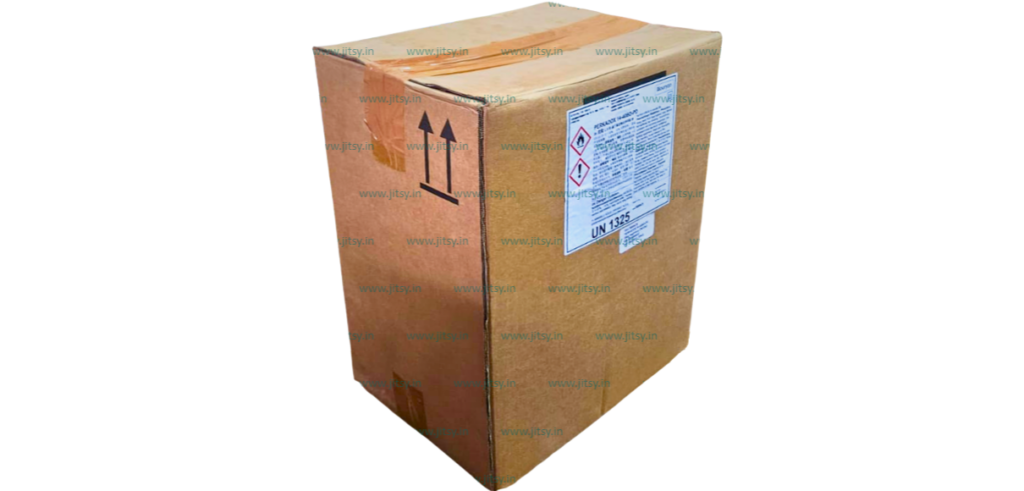
Nouryon DCP Perkadox 14‑40B
Nouryon Perkadox 14‑40B is a bifunctional organic peroxide—di(tert‑butylperoxyisopropyl) benzene (BIPB)—formulated at 40% active content on an inert carrier (powder or granules). Unlike traditional dicumyl peroxide (DCP), this BIPB-based crosslinking agent offers a smell-free processing experience with lower odor emissions, making it ideal for premium rubber, cable, footwear, and specialty plastics manufacturers. This design ensures safe handling, accurate dosing, and excellent dispersion in elastomer and polyolefin compounds across Delhi NCR, Mumbai, Ahmedabad, Pune, Kolkata and other industrial clusters.
Perkadox 14‑40B serves as a superior alternative to standard DCP (dicotyl peroxide) for applications requiring reduced odor, improved scorch safety, and consistent crosslinking performance in EVA foams, XLPE cable insulation, rubber vulcanization, and polyethylene crosslinking.
Functional Features & Technical Detail
- 40% Active BIPB (Smell-Free Peroxide): Ensures efficient crosslinking in rubbers and polyolefins at lower peroxide loadings with minimal odor—a key advantage over traditional DCP.
- Carrier-Based Formulation: Off-white powder/granules improve flow, reduce dusting, and make dosing safer and more accurate compared to pure dicumyl peroxide.
- Bifunctional Peroxide Chemistry: Efficiently crosslinks NR, EPDM, HNBR, FKM, CPE, EVA, and other elastomers outperforming generic DCP in scorch safety.
- Excellent Scorch Safety: Allows longer mixing times and one-step processing for many compounds, reducing production complexity versus dicumyl peroxide systems.
- Proven Processing Window: Well-documented curing and safe processing temperatures for robust, reproducible results in Indian manufacturing environments.
- Low Odor, High Performance: Ideal for indoor processing, worker comfort, and compliance with Indian workplace safety standards.
Applications
Nouryon Perkadox 14‑40B (BIPB crosslinking agent) is trusted by Indian and global processors for:- Rubber Crosslinking & Vulcanization: Used in natural rubber, EPDM, HNBR, FKM, and specialty elastomers for automotive hoses, seals, gaskets, and under-the-hood parts. Outperforms traditional DCP in scorch safety and odor control.
- Polyolefin & EVA Crosslinking: Key for XLPE cable insulation, EVA/PE foam, footwear soles, and thermoplastic elastomer (TPE) parts—delivering superior heat, compression set, and mechanical strength with reduced smell compared to dicumyl peroxide.
- Industrial & Automotive: Enables high-performance hoses, rollers, and technical rubber articles across Delhi NCR, Mumbai, and Ahmedabad manufacturing hubs.
- Wire & Cable Insulation: Crosslinks PE and EVA in insulation and jacketing for enhanced thermal and chemical resistance—a smell-free alternative to DCP-based systems.
Related Products & Technical Alternatives to DCP
Other Nouryon Smell free Dicumyl Peroxides
Beyond Perkadox 14‑40B, Nouryon offers several related peroxides for rubber and polyolefin crosslinking:- Perkadox 14‑EP40: Granular 40% BIPB formulation (smell-free alternative to DCP) with similar application range.
- Perkadox BC‑40B/BC‑40BD: 40% dicumyl peroxide (DCP) formulations on inert carrier for traditional crosslinking.
Complementary Additives for Rubber & Polyolefin Compounds
Perkadox 14‑40B is typically used in combination with:- Fillers and reinforcing agents (e.g., carbon black, silica) for mechanical tuning.
- Antioxidants and stabilizers to protect peroxide-cured polymers against thermal and oxidative degradation.
- Plasticizers, co-agents, and processing aids that refine flow, cure density, and surface finish in final parts.
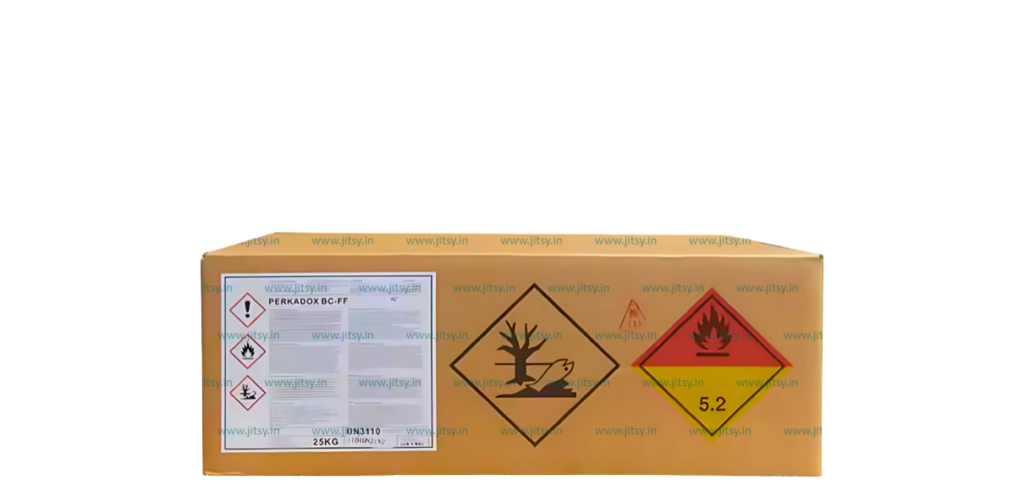
Nouryon DCP Perkadox BC‑FF
Nouryon DCP Perkadox BC‑FF is a high-purity, crystalline dicumyl peroxide (DCP, CAS 80‑43‑3) engineered for reliable crosslinking and polymerization. It is widely used as:
- A crosslinking agent for natural and synthetic rubbers (EPDM, EPR, silicone), polyolefins (PE, EVA), and thermoplastic elastomers.
- A polymerization initiator for styrene and styrenic copolymers.
- A key additive in EVA/PE foam, wire & cable, and molded rubber/plastic parts.
Key Features and Benefits
- High purity (≥99%) for consistent cure and crosslinking.
- Crystalline, free-flowing form for easy dosing and dispersion.
- Versatile initiator/crosslinker for rubbers, polyolefins, and styrene (co)polymers.
- Excellent scorch safety and moderate cure rate for safe processing.
- Brand assurance from Nouryon, a global leader in organic peroxides with local production in India.
Functional Features (Technical Highlights)
- Consistent Assay: ≥99% purity and active oxygen content.
- Controlled Bulk Density: 660–705 kg/m³ for predictable mixing.
- Optimized Decomposition: Reliable half-life and activation energy for process safety.
- Multi-Industry Approval: Used in rubber, plastics, cables, footwear, and foam.
- India-Ready Compliance: Supplied with TDS/SDS, regulatory support, and local logistics.
Applications
Nouryon DCP Perkadox BC‑FF is trusted by Indian and global manufacturers for:- Rubber Vulcanization: Crosslinking natural rubber, EPDM, EPR, and silicone for automotive, footwear, and industrial use.
- Polyolefin Crosslinking: Creating crosslinked PE/EVA foams, wire & cable insulation, and heat-resistant parts.
- Styrene (Co)Polymerization: Initiating polymerization in mass styrene and copolymer processes.
- EVA/PE Foam Production: Enhancing resilience, durability, and thermal stability in footwear and sports goods.
- Automotive & Infrastructure: Used in molded seals, gaskets, pipes, and high-performance profiles.
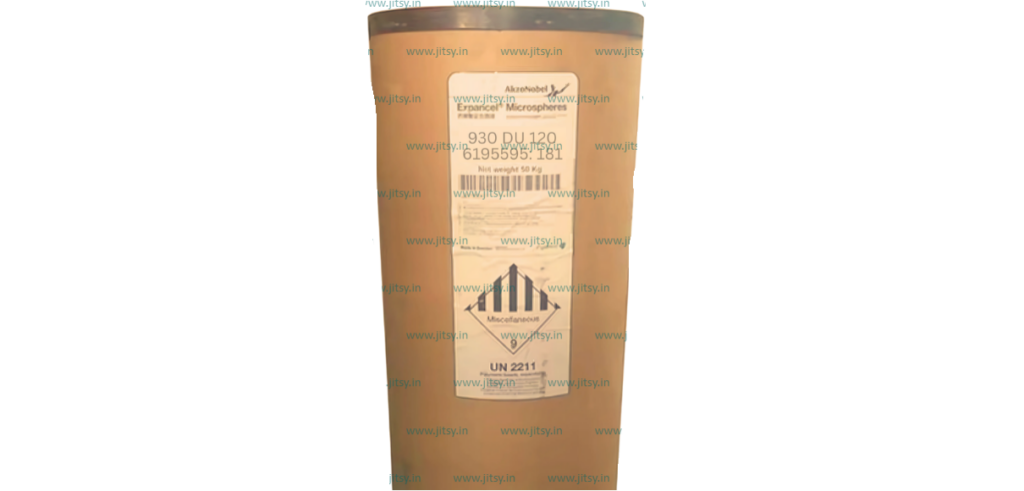
Nouryon Expancel 031 DU 40
Nouryon Expancel 031 DU 40 is a high-performance dry, unexpanded thermoplastic microsphere blowing agent and lightweight filler engineered for thermoplastics, PVC plastisols, underbody coatings, adhesives, porous ceramics, construction materials, printing inks, and technical textiles. As a leading supplier in India, JITSY provides Expancel 031 DU 40 to all major industrial clusters backed by technical expertise, local stock, and compliant logistics.
Expancel 031 DU 40 features a robust acrylonitrile-based shell filled with volatile gas, expanding physically in a controlled temperature window (Tstart 80–95 °C, Tmax 120–135 °C). This enables fine, uniform cell structures, significant density reduction, and improved insulation and mechanical properties—without chemical residues or process disruption.
Functional Features & Technical Authority
Expancel 031 DU 40 is engineered for:- Dry, unexpanded microspheres: Free-flowing powder for easy dosing and uniform dispersion.
- Low expansion onset: Expands from as low as 80 °C, ideal for low-to-medium temperature processes including textile screen printing and puff printing inks.
- 40 µm expanded particle size: Delivers smooth surfaces, fine cell structure, and controlled texture in coatings, ceramics, and 3D effect inks.
- Very low expanded density: Achieves substantial weight reduction and material savings per unit volume.
- Closed-cell, compressible structure: Improves insulation, cushioning, impact resistance, and acoustic damping.
Applications & Industry Use
Expancel 031 DU 40 is widely applied in:- Thermoplastics & PVC Plastisols: Enables lightweight, flexible parts with fine, uniform cell structures for automotive, appliance, and industrial plastics. Reduces density and enhances insulation and impact resistance.
- Underbody Coatings, Paints & Inks: Used in automotive underbody coatings, high-build paints, and especially in puff printing inks for textiles and 3D effect screen printing inks. Delivers density reduction, matting, texture control, and the signature raised “puff” or 3D tactile effect for fashion and branding applications.
- Adhesives, Sealants, Putties & Porous Ceramics: Lowers density, improves gap-filling, reduces shrinkage and cracking, and forms controlled porosity for thermal insulation in ceramics.
- Construction Materials & Technical Textiles: Adds bulk, softness, and improved insulation to mortars, boards, and coated fabrics without increasing weight. Enhances crack resistance and acoustic performance in building products.
- Puff Additive for Textile Printing: As a specialty puff additive, Expancel 031 DU 40 is widely used by Indian textile printers for producing high-quality, soft, and durable raised prints on garments, t-shirts, and fashion textiles.
Nouryon Expancel 909 DU 80
Nouryon Expancel 909 DU 80 is a premium dry, unexpanded thermoplastic microsphere blowing agent and lightweight filler designed for advanced silicone rubber, coatings, plastics, construction materials, and technical textiles. As a leading supplier in India, JITSY delivers Expancel 909 DU 80 to all major industrial hubs backed by local technical support, regulatory guidance, and traceable documentation.
Nouryon Expancel 909 DU 80 features a robust acrylonitrile - based shell filled with volatile gas, expanding physically in a controlled temperature window (Tstart 118 - 128 °C, Tmax 172 - 187 °C). This enables precise density reduction, surface control, and matting effects without chemical residues, making it ideal for demanding Indian manufacturing environments.
Functional Features & Technical Authority
Nouryon Expancel 909 DU 80 is engineered for:- Dry, unexpanded microspheres: Free flowing powder for easy dosing and dispersion.
- Controlled physical expansion: Expands sharply in the 118 - 187 °C range, ideal for silicone vulcanization, coatings, and construction.
- 80 µm expanded particle size: Delivers fine to medium texture, matting, and smoothness in coatings and elastomers.
- Very low expanded density: Enables significant weight savings and cost reduction per unit volume.
- Closed cell, compressible structure: Enhances resilience, impact absorption, and crack resistance in coatings and sealants.
Applications & Industry Use
Nouryon Expancel 909 DU 80 is widely applied in:- Silicone Rubber & Elastomers: Reduces weight in automotive, electrical, and industrial silicone parts, improves cushioning and insulation, and supports closed cell structure without loss of flexibility.
- Coatings & Paints: Used in automotive underbody, industrial, and architectural coatings for density reduction, matting, micro texture, and improved stone chip resistance. Enables lower VOC, better film build, and antislip properties.
- Plastics & Construction Materials: Lowers density in molded plastics, profiles, and composite panels. Improves sag control, shrinkage, and spreadability in putties, mortars, and joint compounds.
- Technical Textiles & Specialty Surfaces: Adds bulk, tactile effects, and matting to coated fabrics, nonwovens, and specialty finishes especially where fine texture and low weight are critical.
Nouryon Expancel 920 DU 20
Nouryon Expancel 920 DU 20 is a high-performance, dry, unexpanded thermoplastic microsphere blowing agent and lightweight filler engineered for artificial leather, PVC plastisols, adhesives, weather strips, coatings, and construction materials. As an authorized JITSY distributor, we supply Nouryon Expancel 920 DU 20 to processors and manufacturers in Delhi NCR, Mumbai, Ahmedabad, Chennai, and industrial hubs across India—helping you achieve fine, uniform 20 µm-class cells for lightweight, resilient, and smooth-surface products.
Nouryon Expancel 920 DU 20 is a DU-grade (dry, unexpanded) thermoplastic microsphere supplied as a free-flowing powder of hollow polymer spheres with a gas core. When heated, the shell softens and the gas expands, inflating the particles into stable, closed-cell structures—delivering both blowing agent and lightweight filler benefits for advanced polymer, coating, and construction systems.
Key Features and Benefits
- Fine, uniform cell size: Expanded ~20 µm, ideal for smooth finishes and thin coatings
- Controlled expansion: Mid-range window (start ~118–145 °C, peak ~152–175 °C) for precise process integration
- Low density: Achieves significant weight reduction in artificial leather, PVC plastisols, and adhesives
- Shrinkage and surface control: Minimizes after-sinking, improves insulation, and limits shrinkage in foamed layers
- Solvent and temperature resistance: Suitable for alkaline, PVC, and solvent-based systems—no water content
Functional Features (Technical Authority)
- Physical expansion (not chemical): Clean, residue-free foaming
- Tiny cell structure: For smooth, resilient, and flexible end-products
- Closed-cell network: Enhanced insulation and acoustic damping
- Consistent cell population: Reliable bulk density and surface quality
- Optimized for Indian processing: Matches local curing and foaming lines
Applications & Industry Use
Nouryon Expancel 920 DU 20 is widely applied in:- Artificial leather and flexible coatings: Generates fine, uniform foams beneath the surface, improving hand feel, insulation, and surface smoothness for premium synthetic leather and coated textiles.
- PVC plastisols and underbody sealants: Delivers lightweight, resilient, and shrinkage-controlled foams for automotive, flooring, and technical textile applications.
- Adhesives, weather strips, and construction materials: Supports gap-filling, acoustic/thermal insulation, and weight reduction in automotive, building, and industrial products.
- Technical textiles, paints, and coatings: Used for lightweighting, surface modification, and shrinkage control in high-performance coatings and thin decorative layers.
- Other polymer systems: Ideal where very fine, discrete cells are needed for smoothness, flexibility, or thin foam layers.
Advantages vs Other Microspheres & Blowing Agents
- Sharper process control: Expands physically, not chemically—no decomposition byproducts
- Finer texture: 20 µm cell size for premium surfaces
- Superior insulation: Closed-cell network for thermal/acoustic performance
- Weight savings: Outperforms mineral fillers in density reduction
- Flexible selection: Choose 920 DU 20 for thin, smooth foams; higher-numbered DU grades for coarser effects
Handling, Storage & Safety
- Industrial hygiene: Use dust control, ventilation, PPE
- Storage: Keep sealed, cool, dry; avoid heat, humidity, and heavy compression
- Processing: Add after pigment/filler dispersion; avoid excess shear before expansion; optimize heating profile for full expansion before cooling
Why Source Nouryon Expancel 920 DU 20 from JITSY in India
- Local inventory: Fast supply to Delhi NCR, Mumbai, Ahmedabad, Chennai, and all major clusters
- Technical support: Application guidance for artificial leather, PVC plastisols, adhesives, and construction
- Traceability: Batch documentation, direct access to Nouryon technical data
- Collaboration: Global sourcing and best practices for Indian processors
Nouryon Expancel 920 DU 40
Nouryon Expancel 920 DU 40 is the industry’s preferred thermoplastic expandable microsphere blowing agent and lightweight filler for puff plastisol inks, textile printing inks, and raised garment effects. As an authorized/stocking distributor, JITSY supplies Nouryon Expancel 920 DU 40 to ink manufacturers, screen printers, and industrial formulators across India. We offer local stock, technical support, and batch traceability for both high-volume and specialty applications.
Nouryon Expancel 920 DU 40 is engineered for:
- Puff plastisol inks and textile screen printing (delivering uniform, soft, raised effects with a premium hand feel)
- PVC plastisols, underbody sealants, putties, polyurethane and acrylic caulks, weather strips, printing inks, coatings, and construction materials (enabling weight reduction, improved elasticity, and controlled expansion)
Key Features and Benefits Across Puff Ink, Plastisols and Sealants
- Uniform expansion: Consistent, stable puff height and smooth, 3D raised effect in textile prints
- Soft, elastic hand feel: Lightweight, compressible, and resilient puff prints for fashion and sportswear
- Closed-cell structure: Excellent wash durability, low after-sinking, and high recovery after deformation
- Low density: Significant weight reduction and material savings in inks, sealants, and construction materials
- Versatile compatibility: Works in PVC plastisols, solvent-based sealants, and non-aqueous coatings
Technical Specifications of Nouryon Expancel 920 DU 40
DU Grade and Chemical Nature
- DU = Dry, Unexpanded: Powder form for non-aqueous systems; expands only during user’s process
- Thermoplastic shell: Acrylonitrile-based, encapsulating a hydrocarbon gas
- No water content: Perfect for PVC plastisols, puff inks, and solvent-borne sealants
Expansion Temperature Window and 40 µm Expanded Particle Size
- Expansion onset: ~121 °C; max expansion: up to ~178 °C—matches typical puff ink curing and PVC plastisol gelling
- Expanded particle size: ~40 µm—yields smooth, rounded, uniform puff or foam structure
Density, Cell Structure and Mechanical Behaviour
- Very low expanded density—drives weight savings and high coverage
- Uniform, closed-cell microstructure—gives softness, resilience, and low shrinkage
- Improved vibration and sound absorption in automotive and construction sealants
Forms, Handling Characteristics and Storage Stability
- Supplied as: Dry, free-flowing white powder
- Storage: Cool, dry, sealed; avoid moisture and excessive compression
- Shelf life: Maintains expansion performance when properly stored
Puff Ink and Textile Printing Applications
Puff Plastisol Inks for Garment and Textile Printing
Nouryon Expancel 920 DU 40 is the industry standard for puff plastisol inks in India’s fashion, sportswear, and branding segments. It produces a stable, uniform puff height with soft, cushiony hand feel, and is compatible with typical screen printing, mesh counts (32–43T), and curing profiles (140–160 °C, 1–2 min).Raised Logos, Lettering and Graphic Effects
Delivers crisp, tactile 3D effects for logos, lettering, and graphics on cotton, blends, and technical textiles—favoured by exporters in Tiruppur, Ludhiana, Surat, and Mumbai.Process Guidelines for Puff Ink
- Ink formulation: Disperse DU powder into plastisol base; adjust viscosity for optimal laydown
- Mesh/film build: Medium mesh, generous deposit for best puff
- Curing: Oven/tunnel dryer or flash cure at 140–160 °C for 1–2 min; avoid overcuring
- Troubleshooting: Our technical team can advise on pinhole prevention, puff uniformity, and wash durability
Other End‑Use Applications Suggested by Manufacturer
PVC Plastisols and Underbody Sealants
- Lightweight, elastic underbody coatings and seam sealers for automotive and construction
- Uniform cell structure, low shrinkage, and easy sanding
Putties, Polyurethane and Acrylic Sealants
- Used in high-build putties, PU sealants, and acrylic caulks for shock/vibration absorption, easy application, and low after-sinking
Printing Inks, Weather Strips and Coatings
- Enhances density reduction and resilience in specialty inks, weather strips, and industrial coatings
Construction Materials and Polymer Systems
- Provides insulation, weight reduction, and crack resistance in mortars, boards, and composite systems
Advantages of Nouryon Expancel 920 DU 40 vs Chemical Blowing Agents and Conventional Fillers
Benefits in Puff Ink and Textile Printing
- Physical expansion: No chemical by-products, odor, or color change
- Uniform, soft, lightweight puff: Unmatched by mineral fillers or chemical agents
- Superior durability & wash fastness: Closed-cell structure resists compression and flexing
Benefits in PVC Plastisols, Sealants and Underbody Coatings
- Low after-sinking and shrinkage: Maintains build and smoothness over time
- Easy sanding and rework: Ideal for automotive and construction applications
Selection vs Other Expancel Grades
- 920 DU 40: Best for mid-to-high temp curing, fine puff, and soft hand feel
- 031/051/053 DU 40: For lower temp or different texture
- 930 DU 120/909 DU 80: For coarser, higher-build effects
Nouryon Expancel 930 DU 120
Nouryon Expancel 930 DU 120 is a high performance, dry, unexpanded thermoplastic microsphere blowing agent and lightweight filler engineered for PVC plastisols, coatings, sealants, plastics, and construction materials.
Nouryon Expancel 930 DU 120 features a unique polymer shell and encapsulated gas, expanding physically under heat to reduce density, control film build, and enhance surface finish without chemical decomposition by-products. Its expansion window (Tstart 117 - 127 °C, Tmax 189 - 204 °C) is tailored to Indian processing cycles in coatings, plastisols, and sealants, enabling precise process control and reliable weight reduction.
Functional Features & Technical Authority
Nouryon Expancel 930 DU 120 is defined by:- Dry, unexpanded microspheres: Free-flowing white powder for easy dosing and dispersion.
- Physical expansion: Expands with heat, no chemical residues or gas by-products.
- 120 µm class particle size: Balances bulk and surface smoothness in coatings and plastisols.
- Very low expanded density: Enables substantial weight savings and cost reduction.
- Robust shell chemistry: Acrylonitrile based copolymer for resilience and compressibility.
Applications & Industry Use
Nouryon Expancel 930 DU 120 is widely applied in:- PVC Plastisols & Thermoplastics: Reduces density in automotive underbody coatings, molded parts, and flexible profiles. Delivers lighter, more energy-efficient products with excellent impact resistance and controlled surface texture.
- Coatings & Underbody Systems: Used in automotive seam sealers, anti-slip industrial floors, and high-build paints to enhance film build, stone-chip resistance, and sanding properties. Lowers VOC per litre and improves surface finish for OEM and refinish lines.
- Sealants, Putties & Construction: Optimizes yield, sag control, and workability in building putties, caulks, and repair mortars. Minimizes cracking and shrinkage in thick applications and supports easier vertical/overhead use.
- Technical Textiles & Specialty Surfaces: Adds bulk, softness, and texture in textile coatings and specialty finishes (when process temperatures fit DU 120 expansion window).
- Lightweight Composites: Used in specialty foams and composite panels for precise density control and improved compressibility.
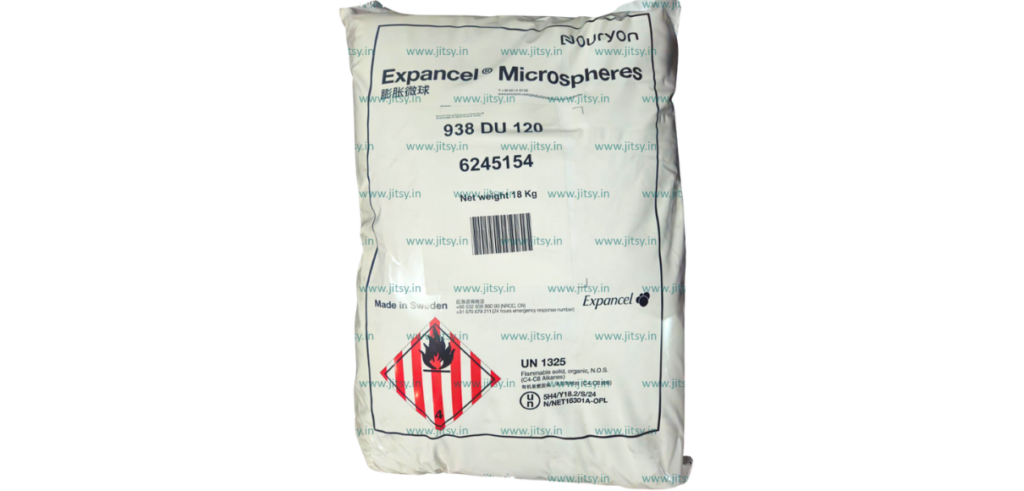
Nouryon Expancel 938 DU 120
Nouryon Expancel 938 DU 120 is a specialty dry, unexpanded thermoplastic microsphere blowing agent and lightweight filler engineered for advanced plastics, coatings, sealants, and construction materials.
Nouryon Expancel 938 DU 120’s unique dual action - physical expansion under heat and ultra lightweight filling; enables consistent density reduction, better surface finish, and improved mechanical properties in demanding applications. Its expansion profile (Tstart 120 - 132 °C, Tmax 192 - 210 °C) is tailored for Indian processing conditions in plastics, foams, coatings, and putties.
Product Description & Technical Details
Nouryon Expancel 938 DU 120 is an expandable microsphere which consists of dry, unexpanded thermoplastic microspheres: each is a copolymer shell encapsulating a volatile gas. When heated, the shell softens and the gas expands, multiplying the microsphere’s volume and creating a foaming effect in the host material. The “DU 120” designation means:- DU: Dry, unexpanded (expands only during processing)
- 938: Specific shell/gas chemistry for defined expansion and resilience
- 120: Expands to ~120 µm class particle size, ideal for bulk and smoothness
- Physical, residue free expansion (no chemical by-products)
- Low expanded density (≤7.5 kg/m³)
- Mid to high process temperature compatibility (Tstart 120 - 132 °C, Tmax 192 - 210 °C)
- Stable, free flowing powder for easy handling and dosing
Applications
Plastics & Polymeric Foams
Nouryon Expancel 938 DU 120 is widely used in PVC, EVA, and other thermoplastic compounds to achieve lightweight, low density profiles in shoe soles, automotive parts, and molded technical components. Its 120 µm class expansion delivers uniform cell structure, cushioning, and significant weight reduction (up to 30%) without sacrificing mechanical strength. Indian plastics processors use this grade for cost savings, energy efficiency, and improved product performance.Coatings & Underbody Systems
In automotive underbody coatings, industrial paints, and protective finishes, Nouryon Expancel 938 DU 120 acts as a physical blowing agent and lightweight filler. It reduces dry film density, enhances stone chip resistance, and improves surface smoothness. The grade’s expansion window is ideally suited to the baking/curing cycles used in Indian OEM and refinish operations. It also helps lower VOC per litre and minimizes cracking in thick films.Construction Putties, Joint Fillers & Sealants
Nouryon Expancel 938 DU 120 is a performance additive in construction putties, joint compounds, caulks, and repair mortars. It reduces compound weight, improves sag resistance, and makes application easier especially for vertical and overhead surfaces. In cementitious and gypsum based putties, it helps control shrinkage and cracking while maintaining smooth troweling and workability. For sealant manufacturers, it optimizes yield, flexibility, and cost per volume.Specialty Foams & Lightweight Composites
This grade is also used in specialty foam systems (e.g., for automotive, footwear, building insulation) and lightweight composite panels, where precise density control and improved compressibility are required. Its thermoplastic, closed cell structure ensures resilience and durability in demanding environments.
OPaL PP Opalene EH03N
OPaL PP Opalene EH03N is a polypropylene homopolymer thermoforming grade manufactured by ONGC Petro additions Limited under the OPaLene PP portfolio. Produced using Ineos Gas Phase polymerization technology, EH03N is a nucleated, high-stiffness grade developed for thermoformed cups and containers, rigid food containers, trays and selected general-purpose injection moulding applications.
EH03N is especially relevant for rigid packaging converters that need a PP homo grade with good optical properties, dimensional stability and reliable forming performance. Its positioning makes it suitable for businesses manufacturing dairy cups, food-service containers, trays, lids and other rigid packaging formats where appearance, stiffness and process consistency directly affect output quality.
Manufacturer Snapshot
ONGC Petro additions Limited is a major Indian petrochemical producer based at Dahej, Gujarat, with a large integrated polymer and petrochemical complex. EH03N sits within the OPaLene PP range as a documented manufacturer-backed grade, which is important for buyers looking for verified technical positioning, food-contact declarations and dependable sourcing confidence rather than thin distributor-only listings.Technical Insights and Product Performance
OPaL PP Opalene EH03N has a melt flow index of 3.0 g/10 min at 230°C/2.16 kg, which places it in a balanced processing range for thermoforming and rigid packaging applications where shape retention and sheet performance matter more than very high flow. Its density of 0.90 g/cm³ is consistent with polypropylene homopolymer grades used in rigid food packaging and thermoformed structures. From a mechanical perspective, EH03N delivers tensile strength at yield of 35 MPa and elongation at yield of 10%, giving processors a useful balance between rigidity and workable forming behavior. A flexural modulus of 1500 MPa supports the high-stiffness profile required for cups, trays and containers that need to hold shape during filling, stacking and transport. The grade also offers notched Izod impact strength of 40 J/m, Rockwell hardness of 95 on the R scale, Vicat softening point of 150°C and heat deflection temperature of 100°C. These values reinforce its suitability for rigid thermoformed packaging where dimensional stability, surface quality and practical heat resistance are important. Its nucleated structure further supports stiffness development and improved visual appearance in finished parts.Applications
Thermoformed Cups and Containers
EH03N is strongly suited for thermoformed cups and containers used in dairy, food-service and consumer packaging. Its high stiffness and good optical properties help converters produce parts with better shape retention, cleaner appearance and dependable wall integrity, making it a practical choice for cups, tubs and similar rigid packaging formats.Rigid Food Containers and Trays
For rigid food containers and trays, EH03N offers the kind of stiffness and dimensional performance required in packaging that must remain stable during handling, sealing, stacking and distribution. This makes it relevant for takeaway trays, ready-food containers, dairy packs and other food-contact packaging where presentation and structural consistency both matter.General-Purpose Injection Moulding
Although positioned primarily as a thermoforming grade, EH03N also has relevance in selected general-purpose injection moulding applications where processors want a PP homopolymer with stiffness-focused performance and good surface appearance. It can be considered for rigid molded items where optical quality and part rigidity are more important than impact-dominant performance.Compliance and Regulatory Positioning
EH03N carries a manufacturer-declared compliance profile that supports its use in regulated packaging discussions. The grade is stated to meet IS 10910 for safe use in contact with foodstuffs, pharmaceuticals and drinking water, while its additives conform to IS 10909 positive-list requirements. It is also declared compliant with FDA 21 CFR 177.1520 for olefin polymers. For food packaging buyers, this strengthens the grade’s relevance, although final application suitability should always be validated for the exact structure and end-use.Comparable Alternatives
EH03N competes most directly with Indian polypropylene homopolymer grades used in thermoforming and rigid packaging. Among the closest references is Haldia Petrochemicals T103, which is also positioned for thermoforming cups and containers. Buyers comparing EH03N with T103 will typically look at stiffness profile, optical appearance, thermoforming behavior and supply preference rather than relying on one property alone. A second comparison point is the IOCL 1110MAS and 1110MG family, though these are more commonly associated with injection moulding applications for rigid parts and household items. Compared with those grades, EH03N stands out more clearly when the requirement is thermoformed packaging with nucleated, stiffness-oriented performance and better packaging-focused positioning. The rationale behind EH03N’s assigned grade identity is clear: its MFI, nucleated structure, stiffness profile and optical positioning align with thermoformed cups, trays and rigid food containers rather than raffia, film or high-flow thin-wall injection applications.
OPaL PP Opalene FH03
OPaL PP Opalene FH03 is a polypropylene homopolymer BOPP film grade manufactured by ONGC Petro additions Limited under the OPaLene PP brand for general-purpose, co-extruded, biaxially oriented polypropylene, and metallisable BOPP film applications. Produced using Ineos Gas Phase polymerization technology, this grade is designed to deliver excellent processability, low water carry-over, strong clarity and gloss, and good mechanical strength for packaging film conversion. For buyers searching for OPaL PP Opalene FH03, FH03 BOPP film grade, polypropylene homopolymer for metallisable BOPP film, or flexible packaging PP homopolymer in India, this grade is a technically relevant and commercially strong option.
ONGC Petro additions Limited is an Indian petrochemical producer with a dedicated polypropylene portfolio marketed under the OPaLene PP brand. The company manufactures from its Dahej OPAL base in Gujarat and positions FH03 within its mainstream PP homopolymer basket as a film-grade resin rather than a general-purpose moulding or raffia material. That distinction matters because BOPP film manufacturers need a different balance of melt flow, orientation behavior, optical quality, and puncture resistance than converters working in injection moulding, nonwoven, or woven packaging segments. FH03 is assigned specifically to those BOPP and packaging film requirements.
Deep Technical Insights
The technical profile of Opalene FH03 places it in the classic low-MFI BOPP film-grade category. The grade has a melt flow index of 3.4 g/10 min, which is well suited to biaxial orientation processes where balanced melt strength and drawability are more important than the very high flow associated with nonwoven or extrusion coating grades. This flow level supports stable film formation and orientation behavior on BOPP lines. Its density of 0.90 g/cm³ is typical of polypropylene homopolymer and supports lightweight packaging structures. The grade also offers tensile strength at yield of 35 MPa and elongation at yield of 12 percent, indicating a balanced mechanical profile for film applications where strength and controlled stretch behavior both matter. A flexural modulus of 1400 MPa contributes to stiffness and handling performance in finished film structures, while notched Izod impact strength of 35 J/m supports toughness and puncture resistance in packaging use. Rockwell hardness of 90 on the R scale and a heat deflection temperature of 95°C further reinforce the grade’s balanced physical profile. For converters, these values indicate that FH03 is not simply an orientation-friendly resin, but one that also supports usable film stiffness, handling stability, and packaging integrity. One of the most commercially important strengths of FH03 is its low water carry-over. In BOPP film processing, this can help improve process stability and support better film quality across tenter-frame operations. The grade is also described as offering excellent clarity and gloss, which makes it especially suitable for visually sensitive packaging formats such as snack food overwraps, cigarette overwraps, adhesive tape films, and plain textile packaging films. Its good mechanical strength and puncture resistance further improve its commercial value. Flexible packaging films must often balance appearance with durability, and FH03 is positioned to support that balance. This is why the grade fits well into general-purpose BOPP, co-extruded film, and metallisable BOPP applications rather than being treated as a broad commodity PP resin.Performance Benefits for BOPP Film Converters
FH03 is designed to translate its datasheet profile into practical film-line benefits. The moderate melt flow supports orientation, the stiffness profile helps with film handling, and the puncture resistance contributes to packaging integrity. For BOPP processors, this combination is important because film grades are selected not just by a single number, but by how consistently they perform during extrusion, orientation, winding, and end use. The clarity and gloss profile makes the grade especially attractive for packaging formats where appearance matters. In consumer-facing packaging, visual quality can directly influence product presentation. Combined with low water carry-over and good processability, FH03 offers a strong balance of line efficiency and finished-film quality.Applications and Industry Use Cases
General-Purpose BOPP Film
Opalene FH03 is primarily designed for general-purpose BOPP film production where balanced orientation behavior, clarity, and mechanical performance are essential. In these applications, processors need a polypropylene homopolymer that can run reliably on tenter-frame lines while delivering commercially acceptable film quality for packaging use.Co-Extruded BOPP Film Structures
The grade is also suitable for co-extruded BOPP film structures where process consistency and film balance matter across layered packaging formats. Its combination of processability, stiffness, and optical quality makes it relevant for converters producing more advanced flexible packaging constructions.Metallisable BOPP Films
FH03 is a strong candidate for metallisable BOPP films used in higher-value packaging formats. In these applications, clarity, gloss, and stable film production are important because the base film must support both visual quality and downstream converting performance.Snack Food and FMCG Packaging
Because of its packaging-focused performance profile and compliance positioning, FH03 is well suited for snack food packs, FMCG overwraps, and related consumer packaging films. In these segments, converters often need a film-grade PP homopolymer that combines appearance, stiffness, and reliable packaging performance.Cigarette Overwrap, Adhesive Tape and Textile Packaging
The grade is also relevant for cigarette overwrap, adhesive tape film, and plain textile packaging films where optical quality and process consistency are important. These applications benefit from the grade’s clarity, gloss, and mechanical balance, making FH03 a practical choice for converters serving multiple packaging segments.Comparable Alternatives
Within the Indian market, FH03 competes most directly with IOCL 1030FG and Haldia Halene-P F103 because all three are polypropylene homopolymer film grades positioned around BOPP, co-extruded film, and packaging applications. These grades operate in a similar commercial category, but the right choice can still depend on converter preference, availability, line behavior, and application emphasis. Compared with IOCL 1030FG, FH03 shares a similar BOPP and metallisable film positioning, making both relevant for general-purpose and co-extruded film applications. Compared with Haldia Halene-P F103, FH03 also sits in the low-MFI BOPP film-grade zone where orientation performance, optical quality, and packaging relevance are central. FH03’s key differentiators include its OPaL manufacturer identity, Ineos Gas Phase technology background, low water carry-over positioning, and strong application fit across snack food packaging, cigarette overwrap, adhesive tape, and textile packaging. The rationale behind assigning FH03 to BOPP and packaging film applications is technically clear. Its 3.4 MFI profile supports orientation, its 1400 MPa flexural modulus supports film handling, and its clarity, gloss, and puncture resistance support packaging performance. It is not a film grade for cast film, nonwoven, or injection moulding routes. It is a purpose-built PP homopolymer for BOPP and related flexible packaging applications.
OPaL PP Opalene FH08S
OPaL PP Opalene FH08S is a polypropylene homopolymer cast film grade manufactured by ONGC Petro additions Limited under the OPaLene PP portfolio. Produced for packaging-focused film conversion, this natural-colored high-stiffness grade contains slip and antiblock additives and is positioned for cast films, snack food packaging, cheese wraps and general flexible packaging applications.
FH08S is especially relevant for film processors and packaging converters looking for a PP homopolymer grade that offers a practical balance of flow, stiffness, optical presentation and controlled film handling. In commercial terms, it fits applications where openability, reduced blocking, smooth conversion and packaging appearance matter as much as basic film formation.
Manufacturer Snapshot
ONGC Petro additions Limited is a major Indian petrochemical producer with a broad polypropylene portfolio marketed under the OPaLene PP brand. FH08S is part of OPaL’s documented film-grade basket, which gives buyers stronger confidence in grade identity, technical positioning and application fit compared with thin trader listings or copied datasheet pages.Technical Insights and Product Performance
OPaL PP Opalene FH08S has a melt flow index of 8.0 g/10 min at 230°C/2.16 kg, placing it in a medium-flow range suitable for cast film processing where converters need workable melt behavior without moving into unrelated high-flow application families. Its density of 0.90 g/cm³ is typical of polypropylene homopolymer grades used in packaging film structures. From a mechanical perspective, FH08S offers tensile strength at yield of 35 MPa and elongation at yield of 10%, supporting a stiffness-oriented profile for packaging films that need controlled handling and practical structural performance. A flexural modulus of 1450 MPa reinforces its high-stiffness positioning, which is useful where film feel, machinability and finished-pack appearance are important. The grade also shows notched Izod impact strength of 35 J/m, Rockwell hardness of 95 on the R scale, Vicat softening point of 150°C and heat deflection temperature of 95°C. These values support its role as a packaging-oriented cast film grade rather than a raffia, thermoforming or BOPP-specialized material. The slip additive helps improve film handling and opening behavior, while the antiblock additive helps reduce film-to-film sticking during winding, storage and downstream conversion.Applications
Cast Films
FH08S is designed for cast polypropylene film applications where processors need stable conversion, controlled film handling and a stiffness profile suited to packaging use. Its additive package makes it relevant for cast-film lines where ease of unwinding, reduced blocking and smoother downstream processing are commercially important.Snack Food Packaging
For snack food packaging, FH08S offers a useful combination of film processability, packaging stiffness and handling support through slip and antiblock additives. This makes it suitable for packaging formats where machinability, film opening and presentable pack appearance contribute directly to production efficiency and shelf-facing quality.Cheese Wraps
FH08S is also positioned for cheese-wrap applications, where film usability and controlled surface behavior matter. In these packaging formats, the additive system helps support cleaner film separation and more reliable handling, while the homopolymer base contributes to stiffness and overall packaging performance.General Flexible Packaging
In broader flexible packaging use, FH08S serves converters looking for a PP cast film grade that bridges technical performance and practical packaging needs. It is relevant for packaging operations that require a dependable film-grade polypropylene homopolymer for food and non-food packaging structures where smooth conversion and handling consistency are priorities.Compliance and Regulatory Positioning
FH08S carries a manufacturer-declared compliance profile that is important for food and packaging buyers. The grade is stated to meet IS 10910 requirements for safe use in contact with foodstuffs, pharmaceuticals and drinking water, while the product and additives comply with IS 10909 positive-list requirements. It is also declared compliant with FDA 21 CFR 177.1520 for olefin polymers. For packaging applications, final suitability should still be validated at the finished-article level.Comparable Alternatives
FH08S is best understood as a cast-film packaging grade, and that distinction matters when comparing it with adjacent Indian film grades. One relevant comparison is IOCL Propel 1100FS, which is positioned more clearly as a TQPP film grade with slip and antiblock additives for food packaging and garment bags. Buyers choosing between FH08S and 1100FS should compare not just melt flow, but also the target film family, processing route and end-use packaging format. Another close comparison is Haldia Petrochemicals Halene-P F110, which also serves TQ film applications with slip and antiblock additives. Compared with such grades, FH08S is more directly framed around cast film and flexible packaging use, which can matter for processors aligning grade choice with line type and packaging structure. A third internal comparison is OPaL FH03, which is positioned as a BOPP film grade for general-purpose, co-extruded and metallisable BOPP films. This makes FH03 a different fit from FH08S. The rationale behind FH08S is its medium-flow cast-film profile, additive package and packaging-focused stiffness, which align it more naturally with cast film conversion than with BOPP-oriented applications.
OPaL PP Opalene FH10S
OPaL PP Opalene FH10S is a polypropylene homopolymer film grade manufactured by ONGC Petro additions Limited under the OPaLene PP portfolio. Produced using Ineos Gas Phase polymerization technology, this natural-colored high-stiffness grade is specifically positioned for Tubular Water Quench films used in textile packaging, snack food packaging, grocery packaging, general-purpose packaging and bread bags.
FH10S is designed for packaging converters that need a PP homopolymer with higher flow for easy processing, excellent gloss and clarity, and a slip-antiblock additive package that supports film handling and openability. In commercial terms, it fits packaging operations where visual appeal, smooth conversion and practical bag usability all matter.
Manufacturer Snapshot
ONGC Petro additions Limited is a major Indian petrochemical producer with a documented polypropylene portfolio marketed under the OPaLene PP brand. FH10S is listed in OPaL’s official film-grade basket as a 10 MFI packaging film grade with slip and antiblock additives, giving buyers stronger confidence in technical identity, compliance backing and application fit than generic trader-only listings.Technical Insights and Product Performance
OPaL PP Opalene FH10S has a melt flow index of 10.0 g/10 min at 230°C/2.16 kg, placing it in a higher-flow packaging film category suited to Tubular Water Quench processing and related film applications where easier melt flow supports efficient conversion. Its density of 0.90 g/cm³ is typical of polypropylene homopolymer grades used in packaging film structures. From a mechanical standpoint, FH10S offers tensile strength at yield of 35 MPa and elongation at yield of 10%, which helps maintain a stiffness-oriented profile for packaging films that need usable strength and controlled handling. A flexural modulus of 1500 MPa supports film stiffness and contributes to the crisp feel and structural behavior valued in packaging bags and consumer-facing film applications. The grade also shows notched Izod impact strength of 35 J/m, Rockwell hardness of 95 on the R scale, Vicat softening point of 150°C and heat deflection temperature of 95°C. These values reinforce its fit as a packaging film grade rather than a raffia or thermoforming material. The slip additive improves film movement and bag opening, while the antiblock additive helps reduce sticking between film layers during winding, storage and downstream packaging use. Excellent gloss and clarity further strengthen its relevance for packaging where appearance matters.Applications
Textile Packaging
FH10S is well suited for textile packaging films where clarity, gloss and easy film handling are important. Packaging for garments and textile products often benefits from films that open cleanly, run smoothly on conversion lines and present products attractively, making FH10S a practical fit for this segment.Snack Food Packaging
For snack food packaging, FH10S offers a useful combination of packaging stiffness, optical appeal and additive-supported handling. This helps converters produce films that are easier to process, more usable in packaging operations and better aligned with consumer-facing pack presentation.Grocery Packaging and Bread Bags
FH10S is also positioned for grocery packaging and bread bags, where ease of opening, controlled film behavior and general packaging usability matter in day-to-day operations. Its higher-flow processing profile and slip-antiblock system support packaging efficiency in these high-volume bag applications.General-Purpose Packaging Films
In broader general-purpose packaging use, FH10S serves converters looking for a PP homopolymer TQ film grade that balances processability, film clarity and packaging performance. It is relevant for businesses producing utility packaging films where stable conversion and practical end-use handling are both important.Compliance and Regulatory Positioning
FH10S carries a strong manufacturer-declared compliance profile for regulated packaging discussions. OPaL states that the grade meets IS 10910 requirements for safe use in contact with foodstuffs, pharmaceuticals and drinking water, while also conforming to IS 10909 positive-list requirements and FDA 21 CFR 177.1520 for olefin polymers. For food and consumer packaging, this supports specification confidence, although final suitability should still be validated at the finished-article level.Comparable Alternatives
FH10S is most directly comparable to Indian PP homopolymer film grades such as IOCL Propel 1100FS and Haldia Petrochemicals Halene-P F110. All three are packaging-oriented film grades with slip and antiblock additives, so buyers typically compare them based on film process route, packaging focus, handling behavior and sourcing preference rather than only on melt flow. Compared with IOCL 1100FS, FH10S sits in a similar TQ film and packaging-use space, especially for food packaging and garment or utility bag applications. Against Haldia F110, FH10S again competes in the same broad family of packaging film grades where openability, film handling and packaging usability are key buying factors. FH10S also differs from OPaL FH08S in a meaningful way. FH10S is explicitly positioned around Tubular Water Quench and packaging bag applications, while FH08S is more directly framed as a cast film grade for snack food packaging, cheese wraps and flexible packaging. The rationale behind FH10S is its higher-flow TQ film profile, packaging clarity and additive-supported usability for bag and packaging film conversion.
OPAL PP Opalene MH12N
OPAL PP Opalene MH12N is a polypropylene homopolymer injection molding grade manufactured by ONGC Petro Additions Ltd. under the OPaLene PP brand. This high-stiffness grade is formulated with nucleated and antistatic additives to support faster molding cycles, good dimensional stability, and easy processing across rigid packaging, closures, lids, over caps, furniture parts, and houseware applications.
ONGC Petro Additions Ltd. is a major Indian petrochemical producer with an established polypropylene portfolio manufactured using advanced gas phase technology. For buyers searching for OPAL PP Opalene MH12N, MH12N PP grade, nucleated PP injection molding grade, or antistatic polypropylene for closures and rigid packaging, this grade offers a strong balance of stiffness, flow, and productivity for industrial molding operations.
Opalene MH12N is engineered for injection molders who need a polypropylene homopolymer grade that combines structural stiffness with practical processing efficiency. Its melt flow index of 12 g/10 min supports balanced mold filling without pushing the grade into very high-flow thin-wall territory, making it suitable for molded parts that require both shape retention and consistent cycle performance.
What makes MH12N commercially valuable is its additive package. Nucleation supports faster crystallization, which helps shorten molding cycles and improve productivity, while the antistatic feature helps reduce dust attraction during handling and downstream use. This combination makes MH12N a strong fit for processors manufacturing closures, lids, furniture components, housewares, and rigid packaging products where clean appearance, dimensional accuracy, and repeatable molding behavior matter.
Technical Insights
OPAL PP Opalene MH12N has a melt flow index of 12 g/10 min at 230°C/2.16 kg, which gives it a balanced flow profile for injection molding applications that need reliable cavity filling without sacrificing stiffness. The density of 0.90 g/cm³ is consistent with polypropylene homopolymer material identity and supports its classification as a rigid molding resin. From a mechanical standpoint, MH12N delivers tensile strength at yield of 35 MPa, elongation at yield of 8%, flexural modulus of 1500 MPa, and Rockwell hardness of R95. This property set is important for molders looking for a high-stiffness PP homopolymer for structural consumer and packaging parts. The grade is especially relevant where rigidity, dimensional stability, and predictable part performance are more important than impact-modified behavior. The technical strength of MH12N lies in how its nucleated and antistatic formulation improves real-world molding performance. Nucleation helps accelerate crystallization, which can support faster cycle times and better dimensional consistency, while antistatic performance helps reduce dust attraction and improves handling in packaging and consumer product environments. For injection molders, these are practical production advantages rather than just additive claims.Applications
Closures and Lids
OPAL PP Opalene MH12N is well suited for closures and lids where molders need a polypropylene homopolymer grade with good stiffness, dimensional stability, and efficient cycle performance. Its balanced flow helps support smooth molding, while the nucleated formulation contributes to faster production in high-volume packaging applications.Over Caps
For over caps, MH12N offers a useful combination of rigidity and processability. This makes it relevant for converters producing parts that need consistent fit, clean molding behavior, and reliable part geometry. The antistatic feature also adds value where appearance and dust control are important in finished packaging components.Furniture Components
MH12N is a practical choice for molded furniture components that require structural stiffness and shape retention. Its high-stiffness homopolymer profile supports applications where dimensional accuracy and part integrity matter, making it suitable for consumer and utility furniture parts produced through injection molding.Housewares and Consumer Products
In housewares and consumer products, MH12N supports manufacturers looking for a rigid polypropylene injection molding grade with dependable processing and clean handling. The grade is relevant for everyday molded items where stiffness, surface cleanliness, and production efficiency influence both manufacturing performance and finished-product quality.Rigid Packaging
For rigid packaging containers and molded packaging parts, MH12N provides the combination of flow, stiffness, and additive support needed for efficient production. It is especially useful where packaging manufacturers want a nucleated PP grade for faster cycles and an antistatic PP grade for improved handling and appearance.Comparable Alternatives
Within the OPaL portfolio, MH12N sits as a nucleated antistatic high-stiffness injection molding grade with a clear focus on rigid molded applications. Compared with OPaL MH13, MH12N is closely aligned in injection molding use, but MH12N is more clearly differentiated by its nucleated and antistatic positioning for closures, lids, over caps, and rigid packaging where cycle speed and clean handling are important. Compared with common Indian alternatives such as Reliance or IOCL injection molding grades in the same MFI range, MH12N stands out because it combines balanced flow with a productivity-oriented additive package. Many comparable grades may offer stiffness, but MH12N adds a stronger rationale for processors who specifically need faster crystallization, improved dimensional stability, and reduced dust attraction in molded parts. The rationale behind MH12N is straightforward: it is assigned as a polypropylene homopolymer injection molding grade for converters who need a practical combination of stiffness, processability, and additive-driven production efficiency. It should be selected when the application requires more than a standard molding resin and the buyer values faster cycles, cleaner handling, and reliable part geometry.
OPAL PP Opalene MH13
OPAL PP Opalene MH13 is a polypropylene homopolymer injection molding grade manufactured by ONGC Petro Additions Ltd. under the OPaLene PP brand. Produced using Ineos gas phase polymerization technology, this natural colored high stiffness grade is designed for easy processing, good dimensional stability, and faster molding cycles across household articles, consumer products, and rigid packaging applications.
ONGC Petro Additions Ltd. is a major Indian petrochemical manufacturer with an established polypropylene portfolio supported by official technical data sheets and food contact declarations. For buyers searching for OPAL PP Opalene MH13, MH13 PP injection molding grade, high stiffness polypropylene for household articles, or rigid packaging PP homopolymer India, this grade offers a practical balance of flow, stiffness, and molding efficiency for industrial converters.
