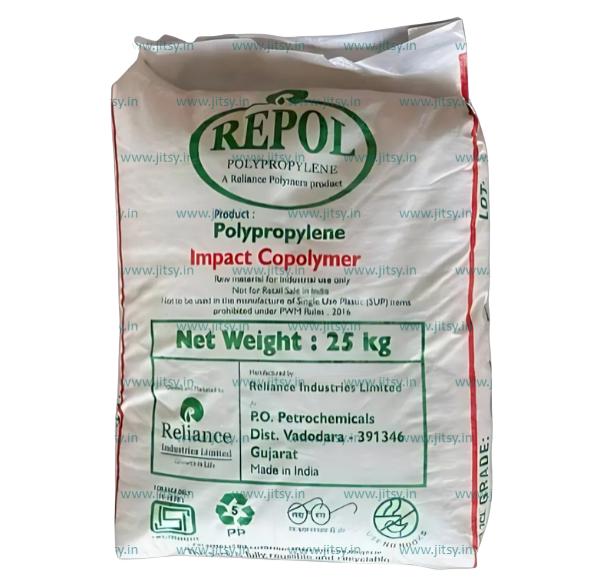
Reliance PP Repol AM650N is a high-flow polypropylene homopolymer developed by Reliance Industries Limited for high-speed injection moulding applications that demand rapid cavity filling, stable processing, and efficient output in thin-wall and multi-cavity production environments. Positioned within the Repol homopolymer portfolio, AM650N is especially suited for TWIM containers, intricate long-flow-path parts, appliance components, automotive mouldings, and masterbatch or compounding applications where very high melt flow is commercially valuable.
Manufactured by Reliance Industries Limited using Unipol polypropylene process technology, Repol AM650N is designed for processors who need faster fill, shorter cycle potential, and better productivity than standard medium-flow PP homopolymer grades can offer. For buyers searching for Reliance AM650N, high-flow PP homopolymer injection grade, PP for thin-wall injection moulding, or polypropylene for multi-cavity moulding in India, this grade is one of the most relevant choices in the Reliance injection moulding range.
The commercial significance of AM650N lies in its very high melt flow rate and antistatic formulation. It is not intended as a general-purpose rigid moulding grade for thicker sections. Instead, it is assigned to applications where fast mould filling, repeatable cavity performance, and efficient compounding behavior matter more than maximum structural rigidity. That makes it highly suitable for thin-wall packaging, rapid-cycle moulding, and masterbatch manufacturing.
Manufacturer and Brand Background
Reliance Industries Limited is one of India’s largest integrated petrochemical producers and a major supplier of polypropylene to domestic and export markets. The company’s Repol brand covers a wide range of polypropylene homopolymers, random copolymers, impact copolymers, and specialty grades for injection moulding, fibre, film, extrusion, and technical applications.
Within this portfolio, AM650N occupies a specialized position as a high-flow PP homopolymer for injection moulding and compounding. It is designed for processors who run high-output lines, thin-wall moulds, and multi-cavity tools, and for compounders who need a base resin with strong flow behavior for pigment, filler, and additive incorporation. This positioning makes it distinct from lower-flow grades such as AM120N or H110MA and more production-oriented than standard general-purpose injection resins.
Technical Insights and Material Performance
Reliance PP Repol AM650N has a melt flow rate of 65 g/10 min at 230°C/2.16 kg, which places it firmly in the high-flow category for polypropylene homopolymer injection moulding. This is the defining technical characteristic of the grade. Such a high MFI enables the melt to travel quickly through thin sections, long flow paths, and multi-cavity moulds, supporting fast filling and reduced resistance during injection. For TWIM containers and high-output moulding operations, this can translate into shorter cycle potential and improved productivity.
The density is approximately 0.90 g/cm³. Typical mechanical performance includes tensile strength at yield of 35 MPa, elongation at yield of 12 percent, flexural modulus of 1350 MPa, notched Izod impact strength of 25 J/m at 23°C, heat deflection temperature of 105°C at 455 kPa, and Shore D hardness of 70. These values show that although AM650N is a very high-flow grade, it still maintains a useful balance of rigidity, strength, and handling toughness for thin-wall and technical molded products.
A key functional advantage is the antistatic additive package. Static charge build-up can create dust attraction and handling issues in molded parts, especially in appliance, automotive, packaging, and compounded applications. By reducing static accumulation, AM650N helps improve part cleanliness and handling quality in downstream operations.
From a grade-selection perspective, the technical strength of AM650N is not about maximum stiffness or impact resistance. Its real value is its ability to combine very high flow with acceptable mechanical performance and antistatic functionality. That makes it especially effective in rapid-cycle injection moulding, long-flow-path parts, and masterbatch production where process efficiency is a major priority.
Processing Characteristics and Injection Moulding Window
AM650N is recommended for injection moulding and is particularly suitable for thin-wall injection moulded containers, multi-cavity tools, and intricate molded parts. A typical processing window includes melt temperatures around 210°C to 260°C and mould temperatures around 20°C to 40°C, depending on tool design, wall thickness, cycle requirements, and machine setup.
Its high MFI allows the resin to fill cavities quickly and efficiently, which is especially useful in TWIM applications where short cycle times and rapid mould filling are critical. In multi-cavity moulding, the grade helps reduce filling resistance and supports more uniform cavity performance. In compounding and masterbatch production, the same high-flow behavior supports good dispersion and mixing of pigments, fillers, and additives.
Because of its flow level, AM650N is best chosen where filling speed and productivity are more important than the higher stiffness associated with lower-flow PP homopolymer grades. It is a process-driven grade designed for output-focused manufacturing.
Applications and Industry Use Cases
TWIM Containers and Thin-Wall Packaging
Reliance PP Repol AM650N is highly suitable for thin-wall injection moulded containers used in food packaging, consumer packaging, and utility storage applications. Its very high flow helps fill thin sections quickly and cleanly, making it ideal for fast-cycle moulding where productivity and part consistency are essential. For manufacturers of cups, tubs, boxes, and lightweight rigid packaging, this grade offers a strong process advantage.
Multi-Cavity Injection Moulding
AM650N performs especially well in multi-cavity moulds where balanced filling and repeatable production are critical. Small parts, closures, lids, and technical components produced in high-cavity tools benefit from its rapid flow behavior, which supports efficient filling across cavities and helps maintain output in high-volume manufacturing environments.
Intricate Long-Flow-Path Parts
For molded articles with narrow sections, detailed geometry, or longer flow lengths, AM650N offers a clear advantage over lower-flow PP homopolymers. It can move through complex mould paths more easily, which helps reduce filling-related issues in technical injection mouldings, appliance parts, and automotive components.
Appliance and Automotive Components
The grade is relevant for selected appliance and automotive injection moulded parts where fast production, clean surfaces, and good dimensional repeatability are important. It can be used in components such as trim parts, fittings, small housings, clips, and utility mouldings that benefit from high flow and antistatic performance during handling and assembly.
Masterbatch and Compounding Base Resin
AM650N is also a strong base resin for masterbatch and compounding applications. Its high MFI supports efficient shear mixing with pigments, fillers, and additives, making it useful for color concentrates, additive compounds, and specialty formulations. For compounders, this grade offers a practical balance of processability, consistency, and regulatory alignment.
Performance Advantages
The biggest advantage of AM650N is its exceptional flow. With an MFI of 65, it is far better suited to TWIM and high-speed multi-cavity moulding than lower-flow grades such as AM120N or H200MA. This makes it highly attractive for processors focused on fast fill, reduced cycle time potential, and high-volume output.
Its antistatic additive package adds another practical benefit. In molded packaging, appliance parts, and compounded materials, reduced static build-up can improve handling, reduce dust attraction, and support cleaner finished parts. This is especially useful where appearance and downstream processing matter.
AM650N also offers a useful mechanical balance for a high-flow grade. While it is not intended for heavy-duty structural applications, its tensile strength, flexural modulus, and HDT remain strong enough for many thin-wall and technical molded products. This balance is what makes it commercially valuable: it delivers speed without becoming too weak for practical use.
Alternatives and Comparable Grades
Within the Reliance Repol portfolio, AM120N is a much lower-flow alternative positioned for general-purpose injection moulding, furniture compounds, and industrial molded products. It offers better suitability for medium-to-thick wall applications but cannot match the filling speed and rapid-cycle potential of AM650N. Buyers should choose AM650N when thin-wall moulding and high-speed output are the main priorities.
H200MA is another internal comparison, with an MFI of 20 and antistatic functionality. It is suitable for thin-wall containers and multi-cavity moulding, but it operates in a more moderate flow range. AM650N is the stronger choice when the mould demands much faster filling, longer flow capability, or more aggressive cycle optimization.
H200MK also has an MFI of 20, but it is clarified and antistatic, making it more suitable for syringes, clear rigid articles, and applications where visual clarity matters. AM650N is not a clarity-focused grade; it is a speed- and process-focused grade for TWIM, multi-cavity, and compounding applications.
Compared with high-flow PP homopolymer grades from HMEL, IOCL, and OPaL, AM650N competes strongly because it combines very high flow, antistatic performance, food-contact aligned compliance, and masterbatch suitability within the Reliance portfolio. The rationale behind the assigned grade is clear: AM650N is selected when the processor needs a high-flow PP homopolymer optimized for rapid filling, thin-wall injection moulding, and compounding efficiency rather than a lower-flow general-purpose resin.























Reviews
Clear filtersThere are no reviews yet.