





Brand
 Borouge Pte LtdBorouge Pte Ltd 1
 Haldia Petrochemicals LtdHaldia Petrochemicals Ltd 7
 HMEL - HPCL-Mittal Energy LimitedHMEL - HPCL-Mittal Energy Limited 7
 IOCL - Indian Oil Corporation LimitedIOCL - Indian Oil Corporation Limited 3
 LyondellBasell Industries NVLyondellBasell Industries NV 1
 ONGC Petro Additions LtdONGC Petro Additions Ltd 8
 Reliance Industries LimitedReliance Industries Limited 15
 Sipchem - Saudi International PetrochemicalSipchem - Saudi International Petrochemical 1
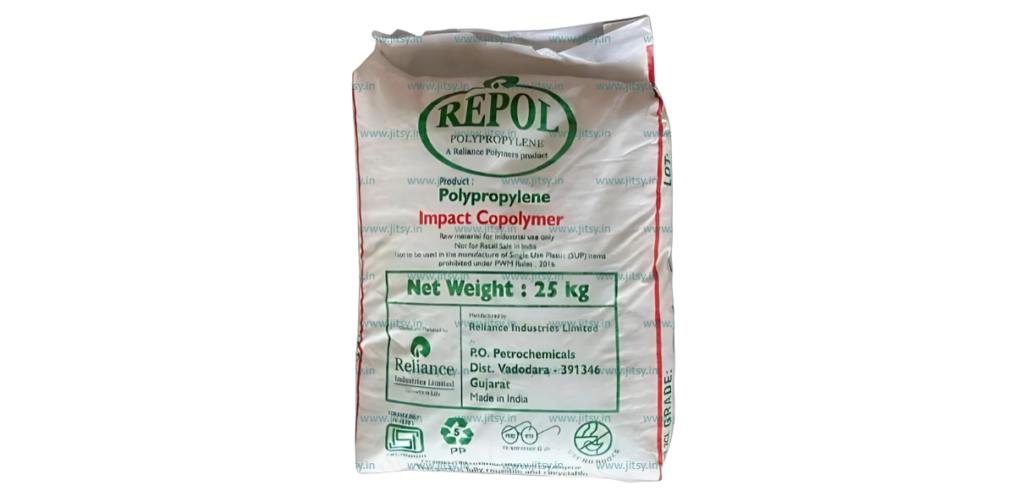
Reliance PPCP Repol MI3530
Reliance Repol MI3530 is a polypropylene impact copolymer (PPCP) designed for injection molding where medium impact strength, high stiffness, and dimensional stability are required. With a low melt flow index of 3 g/10 min, MI3530 is ideal for crates, furniture, textile components, automotive trims, and general industrial molding. Its medium-impact, medium-flow profile makes it a workhorse for thick-section, load-bearing parts where toughness and rigidity are both critical.
Technical specifications
Physical & mechanical properties
- Melt Flow Rate (230°C/2.16 kg): 3 g/10 min
- Density:90 g/cc
- Tensile strength at yield: 26 MPa
- Elongation at yield: 10–12%
- Flexural modulus (1% secant): 1100 MPa
- Notched Izod impact (23°C): ≈115 J/m
- Shore D Hardness: 69
Thermal properties
- Heat Deflection Temperature (0.455 MPa): ≈95°C
Regulatory & food contact
- Complies with IS 10910, IS 16738:2018, FDA 177.1520, EU 10/2011 and other global standards for food, pharma, and drinking water contact.
Deep technical insights
- Low-MFI advantage: MI3530’s 3 g/10 min MFI is engineered for moderate wall thickness parts, maximizing impact and rigidity while minimizing warpage and flow marks.
- Mechanical synergy: Flexural modulus of 1100 MPa and ≈115 J/m impact make MI3530 ideal for crates, bins, and furniture that must survive drops, stacking, and heavy loads.
- Thermal reliability: HDT ≈95°C ensures structural integrity in warm environments, such as logistics, automotive interiors, and industrial settings.
- Dimensional consistency: Reactor-grade dispersion and process stability deliver repeatable, batch-to-batch performance for OEM and high-volume production.
Applications
Crates & industrial packaging
MI3530 is the preferred grade for industrial crates, beverage crates, logistics bins, pallets, and boxes. Its stiffness and impact balance provide reliable stacking, drop resistance, and long-term durability in logistics and warehousing.Furniture
For chair shells, backs, arms, legs, bases, drawers, and fittings, MI3530 delivers the load-bearing stiffness and toughness needed for institutional and consumer furniture.Textile & textile support components
MI3530 is used for bobbins, cones, spools, and textile machine components, where dimensional stability and moderate impact are essential.Automotive components
Well-suited for interior and non-critical exterior trims, panels, and under-seat structures, MI3530 offers medium impact and high rigidity for automotive applications.General industrial molded parts
MI3530’s mechanical profile supports housings, covers, machine guards, and appliance sub-components, delivering ruggedness and dimensional stability.Processing guidelines
- Melt temperature: 190–240°C
- Mold temperature: 20–50°C
- Injection speed: Medium (prevents flow marks in thicker sections)
- Packing pressure: Standard for PP; ensure adequate holding time for ribs and bosses in crates and furniture
- Cooling time: Adjust vs wall thickness for best dimensional stability
- Design tip: MI3530’s low-MFI is best for thicker, high-strength parts. For thin-wall or ultra-short cycles, consider B220MN or high-MFI alternatives.
Performance advantages vs alternatives
- MI3530 vs higher-MFI grades: Superior for thick-walled crates, furniture, and textile components; better dimensional stability and lower risk of flow marks.
- MI3530 vs B030MG/B120MA/B220MN: MI3530 is the robust, medium-impact workhorse for crates/furniture; B220MN is optimized for thin-wall, high-cavity, and very short cycles.
- MI3530 vs competitors: Consistent mechanicals, regulatory compliance, and global RIL supply chain set MI3530 apart from generic trader-supplied PPCP.
Reliance PPCP Repol MI7035
Reliance Repol MI7035 is a polypropylene impact copolymer (PPCP) engineered for the high-speed extrusion compression moulding (ECM) process, making it the preferred material for moulded caps & closures where fast cycles, process reliability, and regulatory compliance are critical. MI7035 delivers the ideal combination of MFI (7 g/10 min), high flexural modulus (1300 MPa), robust impact strength (Izod 115 J/m), and thermal stability (HDT 115°C). Its natural colour and Shore D 68 hardness ensure both visual appeal and durability. MI7035 conforms to IS 10910, making it suitable for food and pharma contact applications.
Specifications
Physical & Mechanical Properties
- Melt Flow Index: 7 g/10 min (230°C/2.16 kg)
- Density:90 g/cm³
- Flexural Modulus: 1300 MPa
- Notched Izod Impact (23°C): 115 J/m
- Heat Deflection Temperature: 115°C
- Shore D Hardness: 68
Deep Technical Insights
- Optimized for ECM: MI7035’s MFI and modulus enable rapid filling, fast demoulding, and high output rates in extrusion compression moulding, minimizing cycle times and maximizing plant productivity.
- Impact–stiffness synergy: 115 J/m impact and 1300 MPa modulus ensure caps & closures withstand drop tests, capping torque, and transport without cracking.
- Thermal stability: HDT 115°C allows for reliable use in hot-fill, steam, or sterilization environments.
- Regulatory assurance: IS 10910 compliance means MI7035 is safe for food, beverage, and pharmaceutical packaging.
Applications
Caps & Closures
MI7035 is purpose-built for high-speed ECM production of caps and closures for bottles, jars, and containers. Its processability supports multi-cavity, high-throughput operations, while mechanical strength ensures closures maintain integrity during capping, shipping, and end-use.Food & Pharma Packaging
The grade’s regulatory compliance and clean natural colour make it suitable for closures used in food, beverage, and pharmaceutical bottles, providing peace of mind for safety and quality.Processing
- Barrel temperature: 180–240°C
- Mould temperature: Standard for ECM applications
- Processing tips: 7 MFI supports rapid filling and short cycles; ensure balanced cooling for dimensional accuracy and surface finish
- Cycle time: Optimized for high-speed, continuous ECM operations
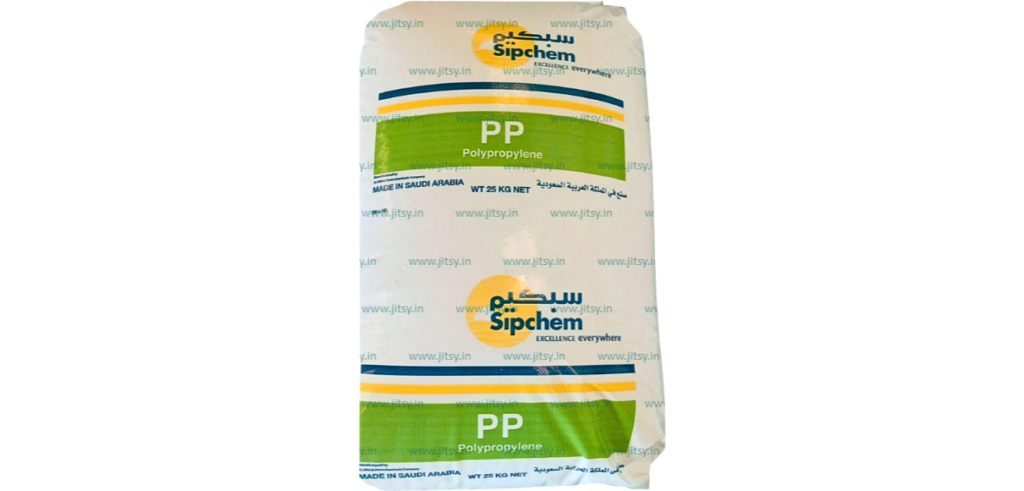
Sipchem PPCP Sahara C 700 HT
Sipchem Sahara C 700 HT is a nucleated heterophasic polypropylene impact copolymer (PPCP) engineered for advanced injection moulding. With an outstanding melt flow index of 70 g/10 min, this grade is purpose-built for thin-walled, high-output applications. Sahara C 700 HT’s nucleation technology ensures rapid crystallisation and dimensional stability, while antistatic additivation delivers dust-free handling and improved hygiene—crucial for food packaging and consumer products. Supplied as natural granules (density 0.9 g/cm³), it is fully compliant with EU 10/2011 and other major food-contact regulations, making it a trusted solution for converters and OEMs worldwide.
