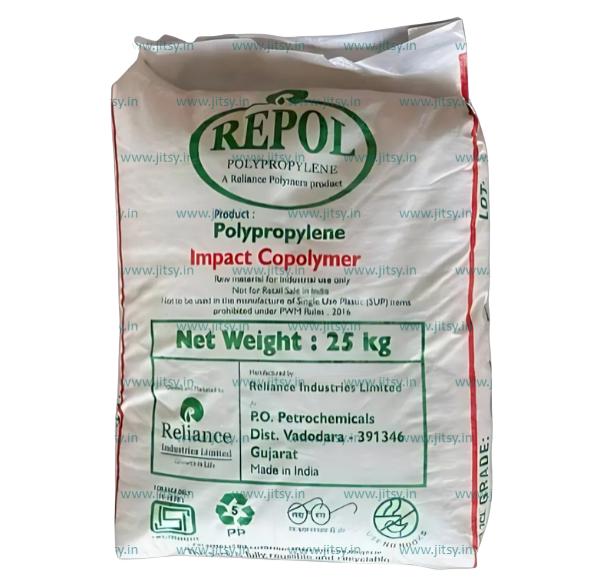
Reliance PP Repol H200MA is a polypropylene homopolymer injection moulding grade developed by Reliance Industries Limited for applications that require high flow, stable processing, good stiffness, and cleaner molded surfaces. It is formulated with an antistatic agent and is especially suited for thin-wall containers, intricate molded parts, and multi-cavity production where fast filling, repeatability, and appearance matter. For buyers searching for Reliance H200MA, PP homopolymer for thin-wall packaging, or high-flow PP injection grade for long flow paths, this grade is a strong and commercially proven option.
Manufactured by Reliance Industries Limited in Gujarat using Unipol polypropylene technology, Repol H200MA belongs to the Repol homopolymer portfolio for injection moulding applications. Reliance is one of India’s most established polymer producers, and the Repol brand is widely used across packaging, industrial, consumer, and technical plastic processing sectors. Within that portfolio, H200MA is positioned as a high-flow, antistatic PP homopolymer for converters who need efficient mould filling and consistent part quality in demanding injection moulding environments.
What makes H200MA commercially relevant is its balance of flow and rigidity. It is not a low-flow structural grade intended for thicker rigid parts, and it is not a specialty clarified grade focused on transparency. Instead, it is designed for mainstream high-productivity injection moulding where processors need dependable cavity filling, stable cycles, and molded parts that resist dust attraction during handling and storage.
Manufacturer and Brand Background
Reliance Industries Limited has a strong footprint in polypropylene manufacturing and serves both domestic and international markets with a broad range of polymer grades. The Repol brand covers polypropylene homopolymers, random copolymers, impact copolymers, and specialty grades for injection moulding, extrusion, film, fibre, and blow moulding.
Within this wider portfolio, H200MA is a focused injection moulding grade intended for processors making thin-wall packaging, technical molded components, and small parts produced in multi-cavity tools. Its antistatic formulation adds practical value in applications where surface cleanliness and reduced static build-up improve appearance, packing, and downstream handling.
Technical Insights and Material Performance
Reliance PP Repol H200MA has a melt flow rate of 20 g/10 min at 230°C/2.16 kg, which places it in the high-flow range for polypropylene homopolymer injection moulding. This flow level is especially useful for parts with long flow paths, thin sections, and complex geometries where lower-MFI grades may struggle to fill efficiently. In production, this helps support faster mould filling, improved cavity balance, and better suitability for multi-cavity tools.
The grade delivers tensile strength at yield of 32 MPa, elongation at yield of 11 percent, flexural modulus of 1.65 GPa, and notched Izod impact strength of 27 J/m at 23°C. These values show that H200MA retains the stiffness expected from PP homopolymer while still offering enough toughness for general-use injection moulded parts. The flexural modulus is particularly important for maintaining rigidity in thin-wall containers and lightweight molded products where structural shape must be preserved without excessive material use.
A major technical advantage of H200MA is its antistatic additive. Static charge build-up can attract dust and affect the appearance and handling of molded parts, especially in packaging and small technical components. By reducing static accumulation, H200MA helps keep surfaces cleaner and more commercially presentable. This is useful in thin-wall food packaging, consumer molded items, and technical parts that are packed, stacked, or handled in high volumes.
The grade also offers good color stability and consistent processability, which are important in repetitive production environments. For manufacturers running long batches or multi-cavity moulds, stable rheology and predictable molding behavior help reduce variation and improve output consistency.
Processing Characteristics and Moulding Window
H200MA is recommended for injection moulding and is especially well suited to articles with intricate long flow paths and multi-cavity moulding requirements. A typical processing window includes melt temperatures around 210°C to 250°C and mould temperatures around 20°C to 50°C, depending on part geometry, mould design, machine capability, and cycle requirements.
Its 20 MFI flow profile helps the melt move efficiently through narrow gates and longer flow channels, making it easier to produce thin-wall parts and small complex components. Compared with lower-flow PP homopolymers, H200MA can improve mould filling and reduce the risk of short shots in demanding geometries. At the same time, it maintains enough stiffness for rigid molded performance, which is why it is used in packaging and technical injection applications rather than only ultra-thin specialty parts.
Applications and Industry Use Cases
Thin-Wall Containers and Packaging
Reliance PP Repol H200MA is highly suitable for thin-wall containers used in foodservice, retail packaging, and general molded packaging applications. Its high flow helps fill lightweight sections efficiently, while its stiffness supports shape retention in the final part. The antistatic package also helps reduce dust attraction, which improves the appearance and handling of molded packaging articles.
Multi-Cavity Injection Mouldings
H200MA performs well in multi-cavity moulding where repeatability, balanced filling, and high production efficiency are critical. In these setups, processors need a resin that can flow consistently across multiple cavities without sacrificing part rigidity. This makes the grade a strong option for high-volume molded components, caps, closures, and small packaging-related products.
Intricate Long Flow Path Parts
For molded articles with narrow sections, detailed geometry, or longer flow lengths, H200MA offers a practical processing advantage over lower-flow PP homopolymers. It can fill more complex moulds with greater ease, helping manufacturers produce technical injection mouldings and consumer components with fewer filling-related issues.
Consumer and Utility Molded Products
The grade is also relevant for general consumer goods and utility molded products where high productivity and clean molded surfaces are important. It can be used for lightweight rigid articles, small containers, and molded components that benefit from stable processing and a good balance of flow and stiffness.
Packaging Components and Closures
Because of its flow behavior and suitability for multi-cavity production, H200MA can be used in packaging components such as lids, closures, and other small rigid parts. These applications benefit from efficient mould filling, repeatable cycle performance, and reduced static-related dust pick-up during storage and transport.
Performance Advantages
The biggest strength of H200MA is its combination of high flow and antistatic performance. Many PP homopolymer grades offer stiffness, but H200MA is better optimized for processors who need fast cavity filling in thin-wall or intricate moulds while also maintaining cleaner molded surfaces.
Its 20 MFI profile gives it a clear advantage over lower-flow grades such as 11 MFI homopolymers when the application involves long flow paths or multi-cavity tools. This makes it more suitable for lightweight packaging, small technical parts, and high-output injection moulding lines.
The antistatic package is another practical differentiator. In packaging and consumer products, reduced static build-up helps minimize dust attraction and improves the visual quality of parts. Combined with good color stability and consistent processability, this makes H200MA a dependable production resin for converters focused on efficiency and finish quality.
Alternatives and Comparable Grades
Within the Reliance Repol portfolio, H110MA is a lower-flow alternative with an MFI around 11, making it more suitable for rigid containers, houseware, and molded products where flow demand is lower and section control is more important than fast filling. Buyers choosing between H110MA and H200MA should generally select H200MA when the mould has longer flow paths, thinner walls, or multi-cavity production demands.
H200MK is the closest internal comparison in terms of flow, as it also has an MFI of 20. However, H200MK is a more specialized clarified and antistatic grade intended for syringes, clear rigid articles, and applications where transparency and gloss are important. H200MA is the better fit when the requirement is high-flow antistatic performance without the need for clarified optical properties.
Compared with high-flow PP homopolymer injection grades from HMEL, IOCL, and OPaL, H200MA stands out because of its combination of antistatic functionality, good stiffness, and suitability for thin-wall multi-cavity moulding. Many competing grades may offer similar flow, but H200MA is particularly relevant for converters who want a Reliance grade optimized for mainstream packaging and technical injection applications.
The rationale behind the assigned grade is straightforward: H200MA is selected when the processor needs a high-flow, antistatic PP homopolymer for thin-wall packaging, intricate molded parts, and multi-cavity tools rather than a lower-flow rigid molding grade or a clarified specialty resin.





















Reviews
Clear filtersThere are no reviews yet.