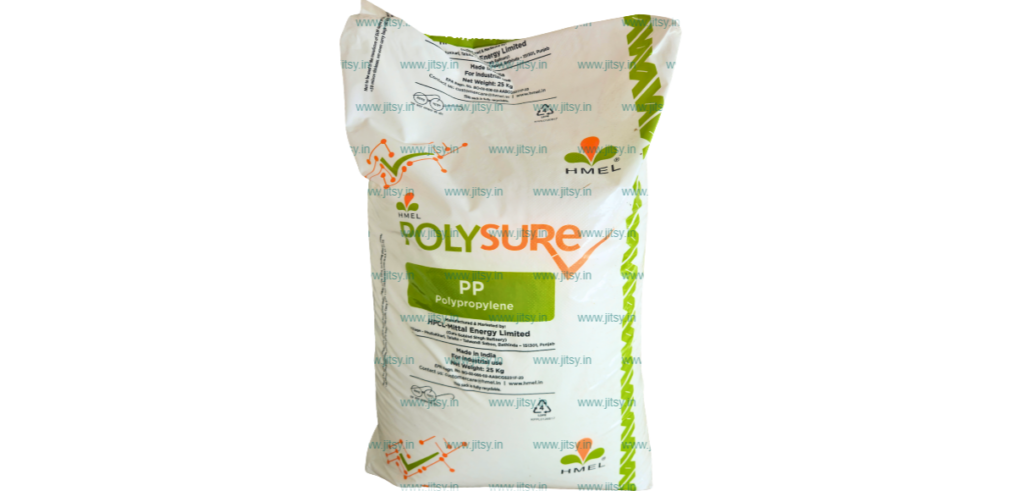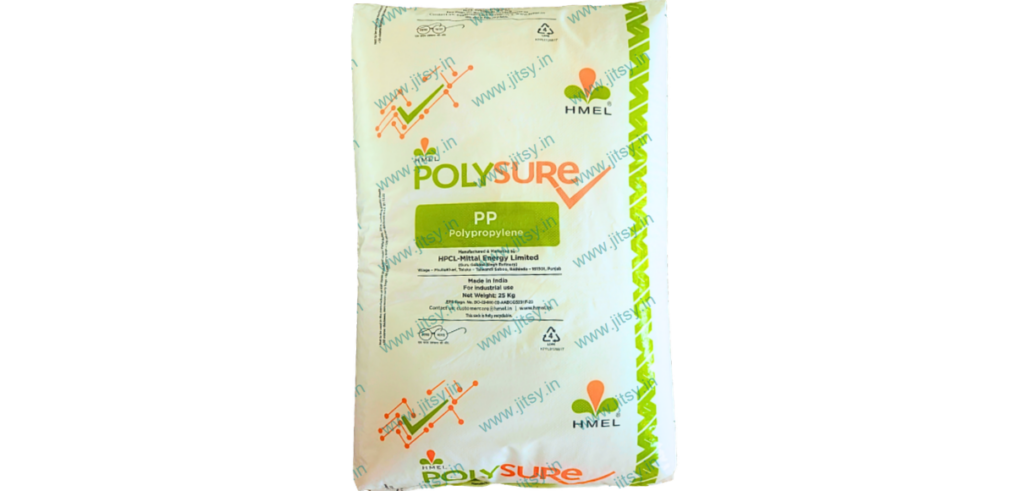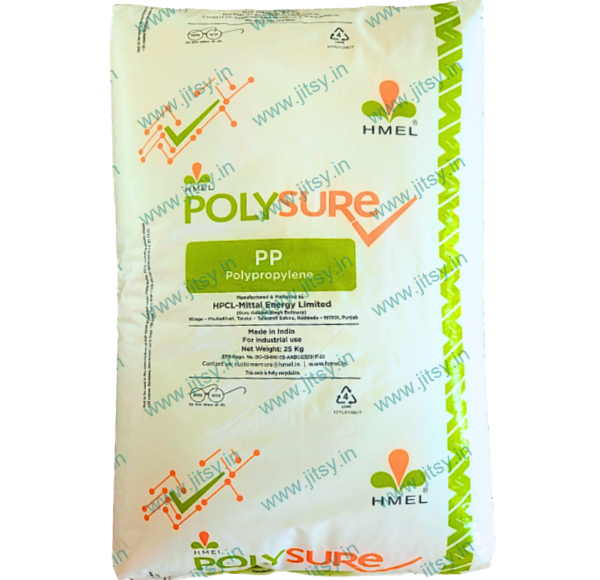
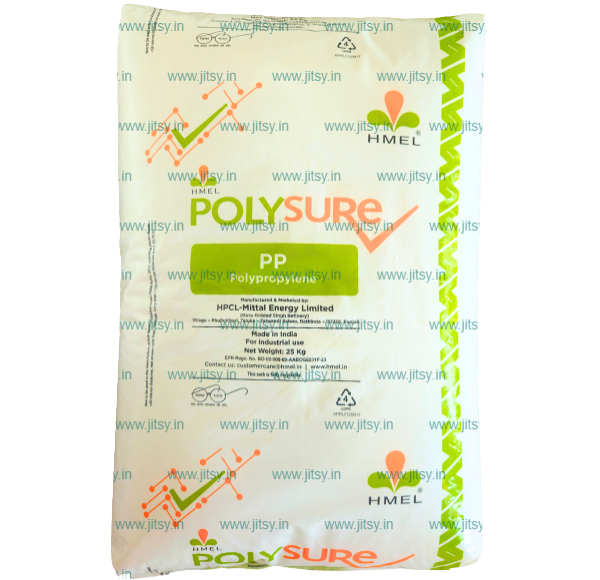
HMEL PP Polysure E35RR

Polysure E35RR is a premium Controlled Rheology Polypropylene Homopolymer engineered by HPCL-Mittal Energy Ltd (HMEL) using advanced Spheripol-II technology. Specifically formulated for extrusion coating and lamination, E35RR delivers exceptional processability with minimal neck-in, outstanding bonding strength to diverse substrates, and superior surface finish. Manufactured at HMEL’s Bathinda refinery complex, Polysure E35RR is the trusted choice for liquid packaging cartons, woven sack lamination, flexible packaging, and industrial coating applications across North India. The grade combines regulatory compliance (IS 10910, FDA 21 CFR 177.1520) with proven field performance in high-speed production environments.

Technical Insights & Specifications – E35RR

E35RR Technical Properties (ASTM Tested):

  • Melt Flow Index (ASTM D1238, 230°C/2.16 kg): 35 g/10 min, supporting smooth flow and efficient processing in extrusion and coating applications.
  • Tensile Strength at Yield (ASTM D638): 35 MPa, delivering strong mechanical performance and reliable structural stability in finished products.
  • Tensile Elongation at Yield (ASTM D638): 9%, providing balanced rigidity with controlled deformation under stress.
  • Flexural Modulus – 1% Secant (ASTM D790A): 1500 MPa, indicating high stiffness and excellent dimensional stability.
  • Notched Izod Impact Strength at 23°C (ASTM D256A): 25 J/m, offering moderate resistance to sudden impact.
  • Vicat Softening Temperature (ASTM D1525, 10N): 150°C, reflecting strong thermal resistance suitable for heat-exposed applications.
  • Heat Deflection Temperature (ASTM D648, 0.455 MPa): 95°C, enabling the material to maintain shape and mechanical performance under elevated temperatures.

Processing Guidelines for Extrusion Coating:Barrel Temperature: 180–250°C | Die Temperature: 250–270°C | Air Gap: 150–250 mm | Line Speed Capability: >600 m/min

Technical Strength & Differentiators:E35RR’s Spheripol-II controlled rheology design delivers a narrow molecular weight distribution, enabling superior low neck-in performance—a critical advantage for high-speed coating lines operating above 600 m/min. The 1500 MPa flexural modulus (highest in its MFI class) ensures rigid, durable coated products. Superior adhesion to paper, foil, and woven substrates is achieved through optimized surface chemistry, eliminating delamination issues common with reactor-based alternatives. The 150°C Vicat softening point allows processing at elevated temperatures without degradation, enabling faster cycle times and higher throughput.

Applications & Industry Use Cases

Liquid Packaging Carton Coating

E35RR is the preferred grade for coating paperboard used in milk, juice, and beverage cartons. The low neck-in characteristic ensures uniform coating thickness across the entire web width, preventing edge defects that compromise package integrity. At 20–30 gsm coating weight, E35RR provides excellent moisture barriers while maintaining FDA compliance for food contact. The superior bonding to paperboard eliminates delamination during filling and transport, critical for aseptic packaging lines operating at high speeds.

Woven Sack Lamination

For 50 kg cement, fertilizer, and feed bags, E35RR delivers robust lamination at 15–25 gsm coating weight. The controlled rheology enables high-speed lamination (>800 m/min) without edge buildup, reducing material waste and increasing production efficiency. The 1500 MPa flexural modulus provides excellent sack stiffness and handle, improving consumer perception and reducing damage during storage and transport.

Flexible Packaging Foil Lamination

E35RR excels in flexible packaging applications, bonding strongly to aluminum foil for snack packaging, coffee pouches, and pharmaceutical laminates. The low neck-in ensures consistent coating across narrow web widths, while superior adhesion prevents foil delamination during filling and sealing operations. Processing at 250–270°C die temperature enables rapid quenching and high-speed production without compromising coating quality.

Industrial & Technical Coating

E35RR is used for tarpaulin coating on woven fabrics, geotextile lamination for civil engineering applications, and breathable waterproof barriers in medical nonwovens. The grade’s excellent bonding to diverse substrates and high heat resistance (95°C HDT) make it suitable for demanding industrial environments where coating durability is paramount.

Alternatives & Comparative Overview

Several polypropylene grades provide comparable performance to E35RR, particularly for extrusion coating and lamination applications. The following alternatives differ in processing technology, stiffness, and coating behavior:

  • E35RR1MFI 35, produced using Spheripol-II Controlled Rheology (CR) technology with a flexural modulus of ~1500 MPa. Primarily used in coating and lamination applications. It offers nearly identical specifications to E35RR, typically representing a variant production grade.
  • P1350EGMFI 35, manufactured using IOCL Spheripol-II technology with a flexural modulus of ~1200 MPa. Suitable for coating and nonwoven applications. Being reactor-based, it generally provides less controlled rheology and may exhibit slightly higher neck-in during coating compared to E35RR.
  • 1350EGMFI 35, also produced via IOCL Spheripol-II technology with a flexural modulus around ~1200 MPa. Used in extrusion coating applications, with production typically from Gujarat and Panipat facilities, offering performance similar to P1350EG.
  • RH35MFI 35, manufactured using OPaL Ineos gas-phase technology, with a flexural modulus near ~1200 MPa. Applied in coating and nonwoven sectors. Its gas-phase polymerization results in different flow and processing characteristics compared to Spheripol-based grades.
  • E07RRMFI 7, produced using HMEL Spheripol-II CR technology, with a flexural modulus of ~1600 MPa. Designed for heavy extrusion coating applications, where lower MFI supports thicker coatings and higher melt strength.

These alternatives allow processors to select grades based on coating thickness requirements, melt flow behavior, stiffness, and processing technology, helping optimize production efficiency and end-product performance.

E35RR Competitive Advantages

E35RR’s Spheripol-II controlled rheology delivers superior low neck-in compared to reactor-based alternatives (P1350EG, 1350EG), enabling consistent coating at line speeds exceeding 600 m/min. The 1500 MPa flexural modulus—highest in the 35 MFI coating category—ensures superior product stiffness and durability. Unlike gas phase grades (RH35), Spheripol-II CR provides optimized adhesion chemistry specifically tuned for paper, foil, and woven substrates. For heavy coating applications requiring lower flow, E07RR (7 MFI) is available; for lighter coating or multi-purpose use, E25RR (25 MFI) offers alternative throughput options.

Please note: E35RR has been superseded by E35RR1 – superior alternative with improved performance metrics and cost efficiency. Explore full specifications, applications, and advantages to see how it delivers better value for your manufacturing needs.

CAS Number

HSN Code

Need Technical guidance?

Access free official copy of Technical Data Sheet published by Manufacturer

Why buy HMEL PP Polysure E35RR from JITSY?

  • Direct import & verified sourcing
  • Authorised channel–led supply
  • Pan-India B2B delivery
  • Transparent pricing & documentation
  • Mobile app–enabled procurement
  • Full compliance (RoHS, BIS/ISI, EPR, GST)
  • Batch traceability

FAQs

Frequently Asked Questions

What does low neck-in mean and why is it important for E35RR?
Low neck-in refers to minimal edge buildup during extrusion coating—a critical advantage when processing at high speeds (>600 m/min). E35RR’s controlled rheology prevents the polymer from narrowing excessively at the die exit, ensuring uniform coating thickness across the entire web width and eliminating edge defects that compromise product quality and yield.
E35RR’s Spheripol-II formulation includes optimized surface chemistry that promotes strong adhesion to polar substrates (paper, woven) and non-polar surfaces (foil) without additional adhesive layers. The 35 MPa tensile strength and 1500 MPa flexural modulus ensure the coating remains bonded during filling, sealing, and transport, preventing delamination issues.
Yes, E35RR fully complies with IS 10910 and FDA 21 CFR 177.1520, making it safe for direct food contact in aseptic packaging. The grade delivers the moisture barrier and bonding strength required for milk, juice, and beverage cartons, with proven performance in high-temperature sterilization environments.
E35RR and E35RR1 are essentially identical in technical specifications and performance. E35RR1 represents a variant production run or slight process optimization from HMEL’s Spheripol-II unit, but both deliver the same 35 MFI, 1500 MPa flex modulus, and coating performance characteristics.
E35RR uses Spheripol-II controlled rheology, while P1350EG is reactor-based. E35RR delivers superior low neck-in at high speeds due to its narrow molecular weight distribution, making it ideal for 600+ m/min lines. P1350EG, while suitable for coating, exhibits higher neck-in and requires slower line speeds, making E35RR the preferred choice for demanding high-speed production.
For paperboard coating, maintain barrel temperature at 180–250°C and die temperature at 250–270°C. These parameters ensure optimal melt flow, consistent coating thickness, and rapid quenching for fast web speeds. Air gap of 150–250 mm is typical, adjusted based on line speed and desired coating weight
Liquid packaging manufacturers (milk cartons, juice boxes), flexible packaging converters (snack bags, coffee pouches), woven sack producers (cement, fertilizer bags), and industrial coating specialists in Delhi-NCR, Gurgaon, and Noida gain maximum benefit from E35RR’s low neck-in, superior bonding, and high-speed capability, reducing waste and increasing production efficiency.

What Customers Say

0 reviews
0
0
0
0
0

There are no reviews yet.

Be the first to review “HMEL PP Polysure E35RR”

Related Articles