



Bestsellers
Nouryon Expancel 909 DU 80
Nouryon Expancel 909 DU 80 is a premium dry, unexpanded thermoplastic microsphere blowing agent and lightweight filler designed for advanced silicone rubber, coatings, plastics, construction materials, and technical textiles. As a leading supplier in India, JITSY delivers Expancel 909 DU 80 to all major industrial hubs backed by local technical support, regulatory guidance, and traceable documentation.
Nouryon Expancel 909 DU 80 features a robust acrylonitrile - based shell filled with volatile gas, expanding physically in a controlled temperature window (Tstart 118 - 128 °C, Tmax 172 - 187 °C). This enables precise density reduction, surface control, and matting effects without chemical residues, making it ideal for demanding Indian manufacturing environments.
Functional Features & Technical Authority
Nouryon Expancel 909 DU 80 is engineered for:- Dry, unexpanded microspheres: Free flowing powder for easy dosing and dispersion.
- Controlled physical expansion: Expands sharply in the 118 - 187 °C range, ideal for silicone vulcanization, coatings, and construction.
- 80 µm expanded particle size: Delivers fine to medium texture, matting, and smoothness in coatings and elastomers.
- Very low expanded density: Enables significant weight savings and cost reduction per unit volume.
- Closed cell, compressible structure: Enhances resilience, impact absorption, and crack resistance in coatings and sealants.
Applications & Industry Use
Nouryon Expancel 909 DU 80 is widely applied in:- Silicone Rubber & Elastomers: Reduces weight in automotive, electrical, and industrial silicone parts, improves cushioning and insulation, and supports closed cell structure without loss of flexibility.
- Coatings & Paints: Used in automotive underbody, industrial, and architectural coatings for density reduction, matting, micro texture, and improved stone chip resistance. Enables lower VOC, better film build, and antislip properties.
- Plastics & Construction Materials: Lowers density in molded plastics, profiles, and composite panels. Improves sag control, shrinkage, and spreadability in putties, mortars, and joint compounds.
- Technical Textiles & Specialty Surfaces: Adds bulk, tactile effects, and matting to coated fabrics, nonwovens, and specialty finishes especially where fine texture and low weight are critical.
Nouryon Expancel 920 DU 20
Nouryon Expancel 920 DU 20 is a high-performance, dry, unexpanded thermoplastic microsphere blowing agent and lightweight filler engineered for artificial leather, PVC plastisols, adhesives, weather strips, coatings, and construction materials. As an authorized JITSY distributor, we supply Nouryon Expancel 920 DU 20 to processors and manufacturers in Delhi NCR, Mumbai, Ahmedabad, Chennai, and industrial hubs across India—helping you achieve fine, uniform 20 µm-class cells for lightweight, resilient, and smooth-surface products.
Nouryon Expancel 920 DU 20 is a DU-grade (dry, unexpanded) thermoplastic microsphere supplied as a free-flowing powder of hollow polymer spheres with a gas core. When heated, the shell softens and the gas expands, inflating the particles into stable, closed-cell structures—delivering both blowing agent and lightweight filler benefits for advanced polymer, coating, and construction systems.
Key Features and Benefits
- Fine, uniform cell size: Expanded ~20 µm, ideal for smooth finishes and thin coatings
- Controlled expansion: Mid-range window (start ~118–145 °C, peak ~152–175 °C) for precise process integration
- Low density: Achieves significant weight reduction in artificial leather, PVC plastisols, and adhesives
- Shrinkage and surface control: Minimizes after-sinking, improves insulation, and limits shrinkage in foamed layers
- Solvent and temperature resistance: Suitable for alkaline, PVC, and solvent-based systems—no water content
Functional Features (Technical Authority)
- Physical expansion (not chemical): Clean, residue-free foaming
- Tiny cell structure: For smooth, resilient, and flexible end-products
- Closed-cell network: Enhanced insulation and acoustic damping
- Consistent cell population: Reliable bulk density and surface quality
- Optimized for Indian processing: Matches local curing and foaming lines
Applications & Industry Use
Nouryon Expancel 920 DU 20 is widely applied in:- Artificial leather and flexible coatings: Generates fine, uniform foams beneath the surface, improving hand feel, insulation, and surface smoothness for premium synthetic leather and coated textiles.
- PVC plastisols and underbody sealants: Delivers lightweight, resilient, and shrinkage-controlled foams for automotive, flooring, and technical textile applications.
- Adhesives, weather strips, and construction materials: Supports gap-filling, acoustic/thermal insulation, and weight reduction in automotive, building, and industrial products.
- Technical textiles, paints, and coatings: Used for lightweighting, surface modification, and shrinkage control in high-performance coatings and thin decorative layers.
- Other polymer systems: Ideal where very fine, discrete cells are needed for smoothness, flexibility, or thin foam layers.
Advantages vs Other Microspheres & Blowing Agents
- Sharper process control: Expands physically, not chemically—no decomposition byproducts
- Finer texture: 20 µm cell size for premium surfaces
- Superior insulation: Closed-cell network for thermal/acoustic performance
- Weight savings: Outperforms mineral fillers in density reduction
- Flexible selection: Choose 920 DU 20 for thin, smooth foams; higher-numbered DU grades for coarser effects
Handling, Storage & Safety
- Industrial hygiene: Use dust control, ventilation, PPE
- Storage: Keep sealed, cool, dry; avoid heat, humidity, and heavy compression
- Processing: Add after pigment/filler dispersion; avoid excess shear before expansion; optimize heating profile for full expansion before cooling
Why Source Nouryon Expancel 920 DU 20 from JITSY in India
- Local inventory: Fast supply to Delhi NCR, Mumbai, Ahmedabad, Chennai, and all major clusters
- Technical support: Application guidance for artificial leather, PVC plastisols, adhesives, and construction
- Traceability: Batch documentation, direct access to Nouryon technical data
- Collaboration: Global sourcing and best practices for Indian processors
Nouryon Expancel 920 DU 40
Nouryon Expancel 920 DU 40 is the industry’s preferred thermoplastic expandable microsphere blowing agent and lightweight filler for puff plastisol inks, textile printing inks, and raised garment effects. As an authorized/stocking distributor, JITSY supplies Nouryon Expancel 920 DU 40 to ink manufacturers, screen printers, and industrial formulators across India. We offer local stock, technical support, and batch traceability for both high-volume and specialty applications.
Nouryon Expancel 920 DU 40 is engineered for:
- Puff plastisol inks and textile screen printing (delivering uniform, soft, raised effects with a premium hand feel)
- PVC plastisols, underbody sealants, putties, polyurethane and acrylic caulks, weather strips, printing inks, coatings, and construction materials (enabling weight reduction, improved elasticity, and controlled expansion)
Key Features and Benefits Across Puff Ink, Plastisols and Sealants
- Uniform expansion: Consistent, stable puff height and smooth, 3D raised effect in textile prints
- Soft, elastic hand feel: Lightweight, compressible, and resilient puff prints for fashion and sportswear
- Closed-cell structure: Excellent wash durability, low after-sinking, and high recovery after deformation
- Low density: Significant weight reduction and material savings in inks, sealants, and construction materials
- Versatile compatibility: Works in PVC plastisols, solvent-based sealants, and non-aqueous coatings
Technical Specifications of Nouryon Expancel 920 DU 40
DU Grade and Chemical Nature
- DU = Dry, Unexpanded: Powder form for non-aqueous systems; expands only during user’s process
- Thermoplastic shell: Acrylonitrile-based, encapsulating a hydrocarbon gas
- No water content: Perfect for PVC plastisols, puff inks, and solvent-borne sealants
Expansion Temperature Window and 40 µm Expanded Particle Size
- Expansion onset: ~121 °C; max expansion: up to ~178 °C—matches typical puff ink curing and PVC plastisol gelling
- Expanded particle size: ~40 µm—yields smooth, rounded, uniform puff or foam structure
Density, Cell Structure and Mechanical Behaviour
- Very low expanded density—drives weight savings and high coverage
- Uniform, closed-cell microstructure—gives softness, resilience, and low shrinkage
- Improved vibration and sound absorption in automotive and construction sealants
Forms, Handling Characteristics and Storage Stability
- Supplied as: Dry, free-flowing white powder
- Storage: Cool, dry, sealed; avoid moisture and excessive compression
- Shelf life: Maintains expansion performance when properly stored
Puff Ink and Textile Printing Applications
Puff Plastisol Inks for Garment and Textile Printing
Nouryon Expancel 920 DU 40 is the industry standard for puff plastisol inks in India’s fashion, sportswear, and branding segments. It produces a stable, uniform puff height with soft, cushiony hand feel, and is compatible with typical screen printing, mesh counts (32–43T), and curing profiles (140–160 °C, 1–2 min).Raised Logos, Lettering and Graphic Effects
Delivers crisp, tactile 3D effects for logos, lettering, and graphics on cotton, blends, and technical textiles—favoured by exporters in Tiruppur, Ludhiana, Surat, and Mumbai.Process Guidelines for Puff Ink
- Ink formulation: Disperse DU powder into plastisol base; adjust viscosity for optimal laydown
- Mesh/film build: Medium mesh, generous deposit for best puff
- Curing: Oven/tunnel dryer or flash cure at 140–160 °C for 1–2 min; avoid overcuring
- Troubleshooting: Our technical team can advise on pinhole prevention, puff uniformity, and wash durability
Other End‑Use Applications Suggested by Manufacturer
PVC Plastisols and Underbody Sealants
- Lightweight, elastic underbody coatings and seam sealers for automotive and construction
- Uniform cell structure, low shrinkage, and easy sanding
Putties, Polyurethane and Acrylic Sealants
- Used in high-build putties, PU sealants, and acrylic caulks for shock/vibration absorption, easy application, and low after-sinking
Printing Inks, Weather Strips and Coatings
- Enhances density reduction and resilience in specialty inks, weather strips, and industrial coatings
Construction Materials and Polymer Systems
- Provides insulation, weight reduction, and crack resistance in mortars, boards, and composite systems
Advantages of Nouryon Expancel 920 DU 40 vs Chemical Blowing Agents and Conventional Fillers
Benefits in Puff Ink and Textile Printing
- Physical expansion: No chemical by-products, odor, or color change
- Uniform, soft, lightweight puff: Unmatched by mineral fillers or chemical agents
- Superior durability & wash fastness: Closed-cell structure resists compression and flexing
Benefits in PVC Plastisols, Sealants and Underbody Coatings
- Low after-sinking and shrinkage: Maintains build and smoothness over time
- Easy sanding and rework: Ideal for automotive and construction applications
Selection vs Other Expancel Grades
- 920 DU 40: Best for mid-to-high temp curing, fine puff, and soft hand feel
- 031/051/053 DU 40: For lower temp or different texture
- 930 DU 120/909 DU 80: For coarser, higher-build effects
Nouryon Expancel 930 DU 120
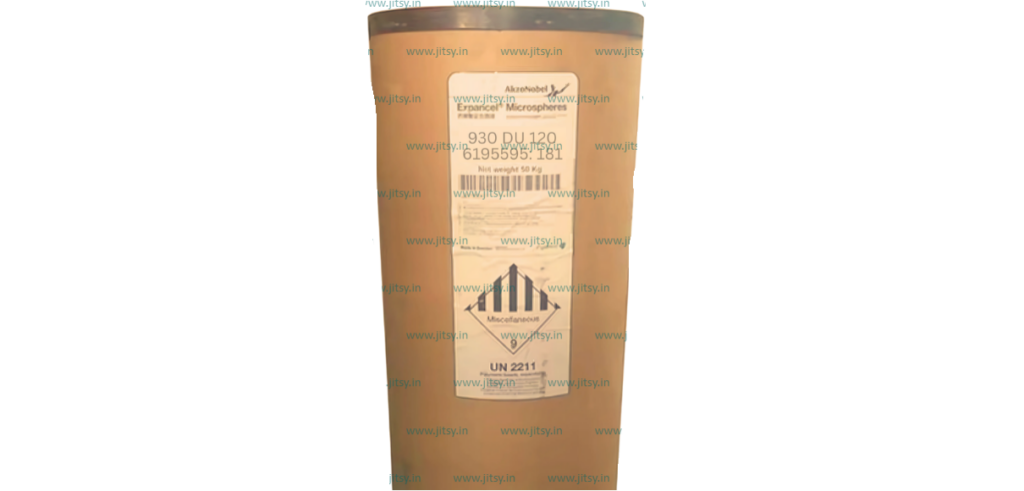
Nouryon Expancel 930 DU 120 is a high performance, dry, unexpanded thermoplastic microsphere blowing agent and lightweight filler engineered for PVC plastisols, coatings, sealants, plastics, and construction materials.
Nouryon Expancel 930 DU 120 features a unique polymer shell and encapsulated gas, expanding physically under heat to reduce density, control film build, and enhance surface finish without chemical decomposition by-products. Its expansion window (Tstart 117 - 127 °C, Tmax 189 - 204 °C) is tailored to Indian processing cycles in coatings, plastisols, and sealants, enabling precise process control and reliable weight reduction.
Functional Features & Technical Authority
Nouryon Expancel 930 DU 120 is defined by:- Dry, unexpanded microspheres: Free-flowing white powder for easy dosing and dispersion.
- Physical expansion: Expands with heat, no chemical residues or gas by-products.
- 120 µm class particle size: Balances bulk and surface smoothness in coatings and plastisols.
- Very low expanded density: Enables substantial weight savings and cost reduction.
- Robust shell chemistry: Acrylonitrile based copolymer for resilience and compressibility.
Applications & Industry Use
Nouryon Expancel 930 DU 120 is widely applied in:- PVC Plastisols & Thermoplastics: Reduces density in automotive underbody coatings, molded parts, and flexible profiles. Delivers lighter, more energy-efficient products with excellent impact resistance and controlled surface texture.
- Coatings & Underbody Systems: Used in automotive seam sealers, anti-slip industrial floors, and high-build paints to enhance film build, stone-chip resistance, and sanding properties. Lowers VOC per litre and improves surface finish for OEM and refinish lines.
- Sealants, Putties & Construction: Optimizes yield, sag control, and workability in building putties, caulks, and repair mortars. Minimizes cracking and shrinkage in thick applications and supports easier vertical/overhead use.
- Technical Textiles & Specialty Surfaces: Adds bulk, softness, and texture in textile coatings and specialty finishes (when process temperatures fit DU 120 expansion window).
- Lightweight Composites: Used in specialty foams and composite panels for precise density control and improved compressibility.
Nouryon Expancel 938 DU 120
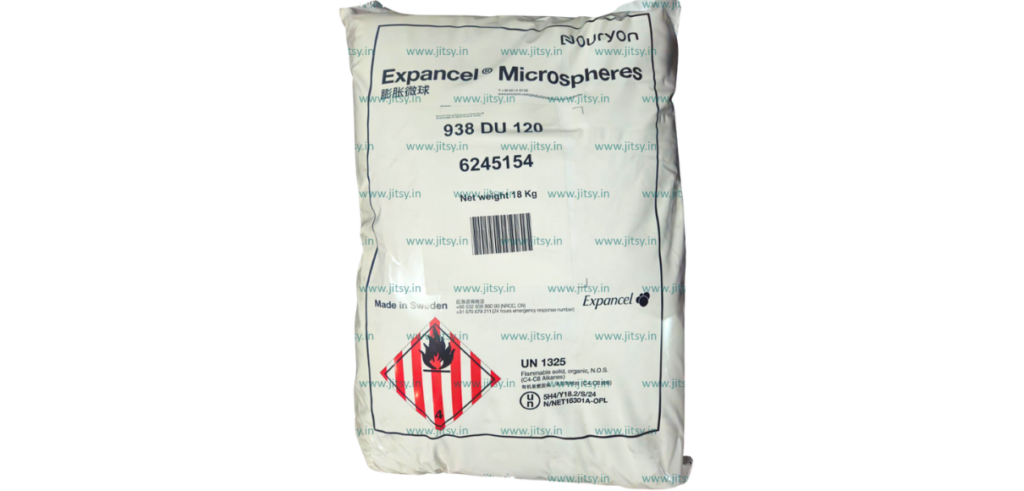
Nouryon Expancel 938 DU 120 is a specialty dry, unexpanded thermoplastic microsphere blowing agent and lightweight filler engineered for advanced plastics, coatings, sealants, and construction materials.
Nouryon Expancel 938 DU 120’s unique dual action - physical expansion under heat and ultra lightweight filling; enables consistent density reduction, better surface finish, and improved mechanical properties in demanding applications. Its expansion profile (Tstart 120 - 132 °C, Tmax 192 - 210 °C) is tailored for Indian processing conditions in plastics, foams, coatings, and putties.
Product Description & Technical Details
Nouryon Expancel 938 DU 120 is an expandable microsphere which consists of dry, unexpanded thermoplastic microspheres: each is a copolymer shell encapsulating a volatile gas. When heated, the shell softens and the gas expands, multiplying the microsphere’s volume and creating a foaming effect in the host material. The “DU 120” designation means:- DU: Dry, unexpanded (expands only during processing)
- 938: Specific shell/gas chemistry for defined expansion and resilience
- 120: Expands to ~120 µm class particle size, ideal for bulk and smoothness
- Physical, residue free expansion (no chemical by-products)
- Low expanded density (≤7.5 kg/m³)
- Mid to high process temperature compatibility (Tstart 120 - 132 °C, Tmax 192 - 210 °C)
- Stable, free flowing powder for easy handling and dosing
Applications
Plastics & Polymeric Foams
Nouryon Expancel 938 DU 120 is widely used in PVC, EVA, and other thermoplastic compounds to achieve lightweight, low density profiles in shoe soles, automotive parts, and molded technical components. Its 120 µm class expansion delivers uniform cell structure, cushioning, and significant weight reduction (up to 30%) without sacrificing mechanical strength. Indian plastics processors use this grade for cost savings, energy efficiency, and improved product performance.Coatings & Underbody Systems
In automotive underbody coatings, industrial paints, and protective finishes, Nouryon Expancel 938 DU 120 acts as a physical blowing agent and lightweight filler. It reduces dry film density, enhances stone chip resistance, and improves surface smoothness. The grade’s expansion window is ideally suited to the baking/curing cycles used in Indian OEM and refinish operations. It also helps lower VOC per litre and minimizes cracking in thick films.Construction Putties, Joint Fillers & Sealants
Nouryon Expancel 938 DU 120 is a performance additive in construction putties, joint compounds, caulks, and repair mortars. It reduces compound weight, improves sag resistance, and makes application easier especially for vertical and overhead surfaces. In cementitious and gypsum based putties, it helps control shrinkage and cracking while maintaining smooth troweling and workability. For sealant manufacturers, it optimizes yield, flexibility, and cost per volume.Specialty Foams & Lightweight Composites
This grade is also used in specialty foam systems (e.g., for automotive, footwear, building insulation) and lightweight composite panels, where precise density control and improved compressibility are required. Its thermoplastic, closed cell structure ensures resilience and durability in demanding environments.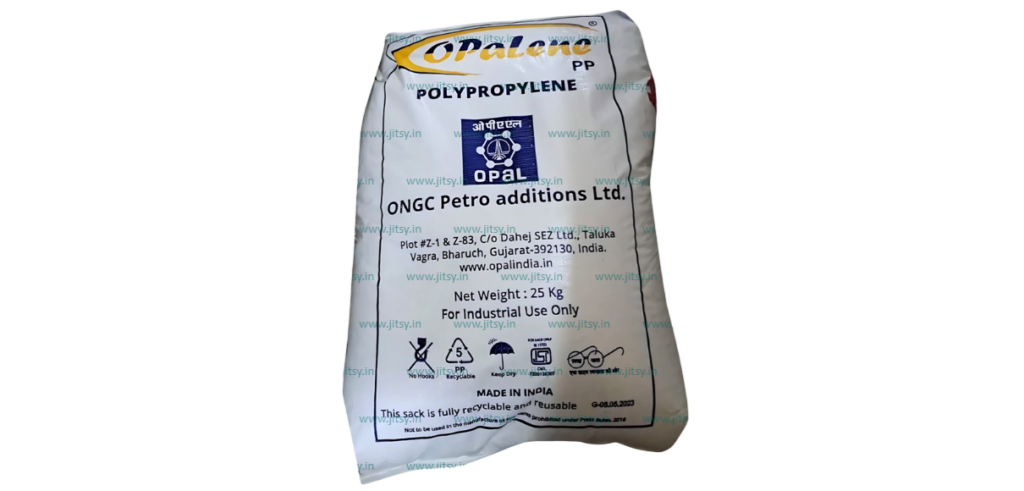
OPaL PPCP Opalene EI01N
Opalene EI01N is a nucleated, high-melt-strength polypropylene impact copolymer (PPCP) produced by ONGC Petro additions Ltd (OPaL) using advanced INEOS gas-phase technology. Engineered for extrusion and blow-moulding, EI01N delivers a unique balance of rigidity, impact strength, and melt strength—making it ideal for corrugated/twin-wall sheets, pipes, thermoformed trays, and blow-moulded containers. The grade is optimized for converters seeking high performance, dimensional stability, and process consistency.
Deep Technical Insights
Opalene EI01N’s heterophasic block copolymer structure, created via INEOS gas-phase polymerization, features a semi-crystalline PP matrix and a finely dispersed rubber phase. This architecture delivers high melt strength for stable extrusion and blow-moulding, while maintaining robust impact resistance and flexural modulus. Nucleation accelerates crystallization, reduces cycle times, and improves dimensional stability—crucial for multi-cavity extrusion lines and complex profiles. The grade’s low moisture absorption, stain resistance, and solvent resistance ensure reliable performance in industrial, agricultural, and packaging environments.Applications & Industry Use Cases
Corrugated / Twin-Wall Sheets: EI01N is ideal for PP hollow boards used in industrial packaging, logistics, signage, and construction. Its high melt strength supports stable sheet extrusion, while impact resistance protects against drops and stacking loads. Corrugated Pipes & Fittings: The grade’s stiffness and toughness enable durable pipes and fittings for drainage, cable ducts, and water management, withstanding burial, installation, and mechanical stress. Thermoformed Products & Blow-Moulded Containers: EI01N excels in rigid trays, industrial bottles, and containers formed by thermoforming or blow-moulding, offering lightweight designs with strong impact and stacking performance.Performance Advantages of Opalene EI01N PPCP
Opalene EI01N delivers superior melt strength for extrusion and blow-moulding, ensuring stable parison and sheet behaviour. Its impact resistance (150 J/m Izod) and flexural modulus (1,100 MPa) support load-bearing, stackable products. The grade’s nucleation reduces cycle times and warpage, while its chemical and stain resistance, low moisture uptake, and recyclability make it a sustainable, high-performance choice for converters and OEMs.
OPaL PPCP Opalene EI02N
Opalene EI02N is a high-stiffness polypropylene impact copolymer (PPCP) from ONGC Petro additions Ltd (OPaL), engineered for load-bearing, structurally demanding applications. Manufactured using advanced INEOS gas-phase technology at OPaL's Dahej complex, EI02N combines exceptional rigidity with impact resistance and light-weighting potential, making it ideal for crates, pallets, furniture frames, automotive housings, and industrial enclosures.
Deep Technical Insights
Opalene EI02N features a heterophasic polypropylene architecture—a semi-crystalline PP matrix with finely dispersed ethylene-propylene rubber phase—delivering high impact strength while maintaining structural rigidity. The INEOS gas-phase polymerization process ensures consistent melt flow index, tight morphological control, and minimal property variation across batches, supporting converters in high-cavity tooling and complex mould designs. EI02N's engineered stiffness-impact balance enables wall-thickness reduction and weight savings compared to homopolymer PP or lower-stiffness PPCP grades, while maintaining durability under stacking, drop impact, and repeated handling.Applications & Industry Use Cases
Crates, Pallets & Industrial Bins: EI02N is engineered for returnable transport packaging (RTP), industrial storage bins, and stackable crates where high stiffness prevents deflection under load and impact resistance resists drops and rough handling. Its chemical resistance supports use in detergent, food and agricultural logistics. Furniture & Load-Bearing Components: Ideal for chair frames, table legs, structural supports, and modular furniture systems requiring both rigidity and impact toughness. EI02N's light density enables thinner-wall designs without sacrificing strength. Automotive & Appliance Parts: Used in interior panels, protective housings, technical enclosures, and non-structural automotive components, EI02N delivers dimensional stability, thermal performance, and the impact resistance needed for long-term durability.Performance Advantages of Opalene EI02N PPCP
Opalene EI02N stands out for its exceptional stiffness-impact balance, enabling converters to design lighter, thinner-walled parts without compromising structural integrity. Its INEOS gas-phase pedigree ensures consistent mechanical properties, predictable cycle times, and excellent surface finish. EI02N's chemical resistance, moisture inertness, and recyclability position it as a sustainable choice for industrial, packaging, furniture, and automotive manufacturers seeking performance and environmental responsibility.
Opal PPCP Opalene MI03
Opal PPCP Opalene MI03 is a heterophasic polypropylene impact copolymer engineered for high-performance injection molding applications. Manufactured by OPaL using advanced Ineos Gas Phase polymerization, MI03 delivers a unique balance of toughness, flow, and processability. This grade is tailored for demanding automotive, furniture, and industrial components where impact strength, dimensional stability, and regulatory compliance are essential.
Deep Technical Insights
Opal MI03 features a two-phase microstructure with isotactic polypropylene matrix and finely dispersed ethylene-propylene rubber domains. The Ineos Gas Phase process ensures uniform particle morphology, batch-to-batch consistency, and minimal fines generation. This architecture enables simultaneous high stiffness and toughness, making MI03 ideal for applications requiring both structural rigidity and impact absorption. Compliance with IS 10910 and FDA standards ensures suitability for food contact and medical-grade uses.Applications & Industry Use Cases
Automotive: MI03 is widely used in interior and exterior components such as dashboard panels, door trims, bumpers, battery trays, and engine covers. Its high impact resistance and lightweight properties contribute to vehicle safety and fuel efficiency. Furniture: The grade is perfect for chair frames, table legs, storage containers, and outdoor furniture, offering durability, stackability, and excellent surface finish. Its natural color base allows for easy masterbatch colorant integration. Industrial Molding: MI03 excels in manufacturing industrial crates, paint pails, toolboxes, and chemical storage containers. Its chemical resistance and low shrinkage ensure precision and long-term performance in harsh environments.Technical Authority & Industry Leadership
Opal MI03 stands out through its advanced manufacturing technology, delivering superior consistency and morphological control versus conventional polymerization. The grade’s optimized injection molding parameters support rapid cycle times and excellent mold reproduction. Detailed compliance with Indian and global standards, including IS 10910 and FDA CFR Title 21, positions MI03 as a benchmark for quality and safety in the polypropylene copolymer market.
OPaL PPCP Opalene MI08N
OPaL Opalene MI08N is a heterophasic polypropylene (PP) block copolymer (PPCP), natural coloured and nucleated, produced using Ineos Gas Phase technology. MI08N offers faster moulding cycles thanks to nucleation, a robust impact–stiffness balance for long-lasting durability, and antistatic properties for clean processing and dust-resistant surfaces. It is engineered for injection moulding of crates, paint pails, luggage, and furniture, making it a top choice for OEMs and moulders in Delhi/NCR and across India seeking productivity and performance.
Specifications
Physical & Mechanical Properties
- Melt Flow Index: 8 g/10 min (230°C/2.16 kg)
- Density:90 g/cm³
- Flexural Modulus: 1200 MPa
- Notched Izod Impact (23°C): 120 J/m
- Heat Deflection Temperature: 90°C
Deep Technical Insights
- Nucleated morphology: Accelerates crystallization, enabling faster demoulding and higher productivity in multi-cavity tools.
- Antistatic agent: Reduces dust attraction, supporting clean painting and assembly—vital for furniture and packaging.
- Impact–stiffness synergy: 120 J/m impact and 1200 MPa modulus ensure products withstand drops, stacking, and daily handling.
- Ineos Gas Phase process: Delivers batch-to-batch consistency and reliable mechanicals for demanding OEM and industrial applications.
Applications
Crates & Paint Pails
MI08N is ideal for crates and stackable paint pails, providing the impact resistance and modulus needed to survive transport, stacking, and rough industrial use. The antistatic property helps keep surfaces clean and free from dust during storage and filling.Luggage
For injection-moulded luggage shells, MI08N’s impact–stiffness balance ensures robust protection against drops and knocks, while nucleation supports fast cycles and high-volume production.Furniture
Chairs, tables, and modular furniture benefit from MI08N’s structural strength and clean finish, with antistatic properties supporting painting and assembly in dust-prone environments.Processing
- Barrel temperature: 180–230°C
- Mould temperature: Standard for PP copolymers
- Processing tips: Medium flow and nucleation support efficient multi-cavity moulding and rapid demoulding; antistatic aids in dust-free production
- Cycle time: Optimized for productivity in high-volume furniture, crate, and pail moulding
Opal PPCP Opalene MI120X
Opalene MI120X is a polypropylene block copolymer (PPCP) impact grade from ONGC Petro-Additions Ltd (OPaL), produced using advanced Ineos gas-phase technology for injection moulding. As part of OPaL’s MI series, MI120X is a high-flow, nucleated PPCP granule, optimized for fast cycles, glossy finish, and balanced stiffness-impact performance. It’s engineered for demanding applications in appliances, furniture, automotive interiors, housewares, luggage, and industrial crates—where drop resistance, process speed, and premium appearance are essential. MI120X is a go-to choice for moulders seeking an OPaL alternative to Reliance Repol or Haldia Halene grades, with the added advantage of Delhi/NCR-based supply and technical support.
Specifications
Physical & Rheological Properties
- Melt Flow Index: ~12–20 g/10 min (230°C/2.16 kg) – high-flow for thin-wall, multi-cavity tools
- Density:90 g/cm³ – lightweight, ideal for consumer plastics
- HSN Code: 39023000 – Propylene copolymers in primary forms
- CAS Number: 9010-79-1 – Polypropylene block copolymer
Mechanical Properties
- Tensile Strength at Yield: ~27 MPa – strong for load-bearing and structural parts
- Flexural Modulus: ~1300 MPa – rigid yet tough, supports furniture and appliance housings
- Notched Izod Impact (23°C): ~120 J/m – superior impact resistance, minimizes breakage
- Rockwell Hardness: R80 – resists scratches, preserves glossy look
Thermal Properties
- Heat Deflection Temp (0.46 MPa): ~100°C – suitable for appliance housings, interiors
- Compliance: Meets IS 10910 (food/pharma contact), FDA 21 CFR 177.1520, IS 16738
Functional Features
Opalene MI120X is engineered for productivity, durability, and aesthetics. Its high-flow, nucleated morphology and balanced mechanics make it a versatile performer for high-output moulding and premium applications.Applications
Appliances & Housewares
MI120X is widely used for appliance housings, crates, carriers, and kitchenware. Its high flow enables thin-wall, multi-cavity moulding, while impact strength and gloss ensure products are both durable and attractive. Anti-static properties help keep surfaces cleaner.Furniture & Luggage
Ideal for chairs, tables, storage bins, and luggage shells, MI120X combines stiffness and impact resistance for long service life. Its processability supports rapid cycles and excellent surface finish, making it a favorite for premium and mass-market furniture.Automotive & Industrial
For automotive interiors, trims, and industrial bins, MI120X’s toughness and rigidity withstand vibration, drops, and daily handling. Its nucleated structure allows for faster production and consistent quality.Processing
- Barrel temperature: 180–220°C
- Mould temperature: 30–50°C
- High-speed injection: Leverage flow for thin-wall, complex parts
- Defect troubleshooting:
- Short shots: Increase speed/pressure
- Sink marks: Raise packing pressure
- Warpage: Ensure balanced cooling
Advantages
- Faster cycles: Nucleated morphology cuts cycle times by 10–20% vs standard PPCP
- Premium finish: Gloss and anti-static for consumer appeal
- Toughness: Outperforms homopolymers in impact, resists drops and cracks
- Versatility: Suitable for everything from kitchenware to automotive trims
- GEO advantage: Delhi/NCR supply, pan-India logistics, and technical support
OPaL PPCP Opalene MI12NX
ONGC PPCP Opalene MI12NX is a polypropylene impact copolymer (PPCP) developed by ONGC Petro additions (OPaL) for injection molding. This grade delivers robust impact strength and balanced mechanical properties, making it ideal for durable molded parts across appliance, automotive, and industrial sectors. Buyers include injection molders, OEMs, compounders, and traders seeking reliable B2B polymer supply for demanding applications.
Key Features & Benefits of Opalene MI12NX
- Good impact resistance for tough parts
- Balanced stiffness and flexibility
- Excellent processability for injection molding
- Consistent quality and batch traceability
- Versatile for industrial and appliance use
Technical Properties & Processing Guidelines
Material Properties of Opalene MI12NX
- Mechanical: Balanced impact and stiffness for durable, high-performance parts
- Thermal: Suitable for appliance, automotive, and industrial applications
- Rheological: Engineered for smooth flow and efficient molding cycles
- Compliance: Meets industry standards for B2B polymer supply (verify per application)
Recommended Processing Conditions
- Barrel temp: 180–230°C (typical)
- Mold temp: 30–60°C (typical)
- Store in dry, dust-free area below 50°C
- Refer to datasheet for machine/part-specific settings
Typical Applications of ONGC PPCP Opalene MI12NX
Opalene MI12NX is widely used in appliance components (such as washing machine parts, refrigerator bins), industrial products (containers, crates, housings), automotive accessories, and general injection-molded goods requiring impact resistance. Its balanced mechanical profile and reliable processability make it a preferred choice for manufacturers targeting quality, durability, and efficient production.
OPaL PPCP Opalene MI15
OPaL Opalene MI15 is a heterophasic polypropylene block copolymer (PPCP) engineered via Ineos gas-phase technology for demanding automotive exterior applications. MI15 delivers very high impact resistance, balanced stiffness, and high flow for easy processing—making it ideal for bumper fascia, air dams, exterior trim, and other high-impact auto parts. Its natural colour, anti-gas fading properties, and IS 10910 compliance add to its appeal for OEMs and Tier-1 suppliers in India. MI15 is optimized for fast cycles, complex moulds, and long-term durability in automotive environments.
Specifications
Physical Properties
- Melt Flow Index: 15 g/10 min (230°C/2.16 kg) – high flow for complex, thin-wall auto parts
- Density:90 g/cm³ – lightweight for automotive and exterior use
Mechanical Properties
- Tensile Strength at Yield: ~27 MPa – robust for structural and exterior applications
- Flexural Modulus: ~1200–1300 MPa – balanced stiffness for dimensional stability
- Notched Izod Impact (23°C): ~150+ J/m – very high impact for crash and drop resistance
Key Technical Insights
- Heterophasic morphology: Ensures toughness and low-temperature impact resistance
- Anti-gas fading: Maintains colour and properties under UV and exhaust exposure
- IS 10910 compliance: Suitable for food/pharma contact if required by the application
Automotive Applications
Opalene MI15 is purpose-built for automotive exterior parts where impact resistance and stiffness are non-negotiable. Its high MFI enables fast, uniform mould filling—crucial for large, complex bumper fascia and air dams. The grade’s toughness protects against low-temperature impacts, while its anti-gas fading ensures long-term colour and property retention in exposed environments. MI15 is also used for exterior trims and technical parts where both mechanical and cosmetic performance are essential. Its compliance with IS 10910 makes it a reliable choice for applications that may require regulatory documentation.Processing
- Barrel temperature: 180–240°C
- Mould temperature: 30–50°C
- Processing tips: High flow supports thin-wall and multi-cavity tools; optimize packing and cooling for best surface finish and dimensional accuracy
- Cycle time: Fast cycles possible with proper mould and machine setup
Deep Technical Insights
- Ineos gas-phase technology: Delivers reproducible heterophasic morphology for superior impact and stiffness
- Anti-gas fading: Prevents property loss and yellowing from exhaust/UV exposure
- OEM suitability: Balanced properties and compliance position MI15 as a strong candidate for automotive approval and use in global supply chains
OPaL PPCP Opalene MI44N
OPaL Opalene MI44N is provisionally described as a nucleated polypropylene impact copolymer (PPCP) with an estimated melt flow index in the 40–50 g/10 min range. Produced by ONGC Petro additions Ltd (OPaL), MI44N is engineered for injection moulding and compounding applications requiring high flow, medium impact strength, and dimensional stability. While official TDS and database listings for MI44N are limited, its designation and MFI band suggest suitability for appliance parts, automotive components, thin-wall injection moulded products, and masterbatch compounding. MI44N is typically supplied as natural granules in 25 kg bags, aligning with industry packaging standards.
Functional Features
Opalene MI44N is designed for converters and OEMs seeking high-flow processability, nucleated crystallisation for low warpage, and a balanced mechanical profile. Its reactor-grade consistency (inferred from OPaL’s product line) supports efficient, reliable production and traceability for B2B buyers.Detailed Technical Specifications (Provisional, Typical for 40–50 MFI PPCP)
- Melt Flow Index: ~44 g/10 min (estimated)
- Density: ~0.90 g/cm³
- Tensile Strength at Yield: ~25 MPa
- Elongation at Yield: ~7%
- Flexural Modulus: ~1150 MPa
- Notched Izod Impact (23°C): ~65 J/m
- Heat Deflection Temp (0.455 MPa): ~100°C
- Vicat Softening Point (10N): ~145°C
Applications & Industry Use Cases
Appliances & White Goods
MI44N is suitable for appliance housings, AC grills, washing machine internals, and other white goods components where high flow, dimensional stability, and moderate impact resistance are critical.Automotive
Automotive compounders and OEMs may use MI44N for interior and exterior trims, non-structural parts, and compounds where a balance of stiffness and impact is required.Thin-Wall Injection Moulding (TWIM)
The high MFI and nucleated structure support efficient thin-wall moulding of containers, tubs, and utility products, reducing cycle times and supporting complex geometries.Compounding
As a base resin for filler and masterbatch compounding, MI44N’s processability and reactor-grade uniformity support efficient dispersion and consistent mechanical properties.Performance Advantages
Compared to lower-MFI or non-nucleated PPCP, MI44N (provisionally) offers faster cycles, lower warpage, and superior thin-wall filling. Its technical profile is competitive with Repol B400MN (38 MFI), IOCL Propel 3400MN (40 MFI), and Haldia M340 (40 MFI) for thin-wall, appliance, and compounding uses.Compliance, Packaging & Storage
Food Contact Compliance: Assumed, but documentation should be requested for regulated uses. Packaging: Natural granules in 25 kg bags. Storage Guidelines: Store dry, below 50°C, away from sunlight and moisture.
OPaL PPCP Opalene MI70N
OPaL Opalene MI70N is a high-flow, nucleated polypropylene impact copolymer (PPCP) developed by ONGC Petro additions Ltd (OPaL) using advanced Ineos Gas Phase technology. Engineered as a 70 MFI heterophasic block copolymer, MI70N excels in thin-walled injection moulding (TWIM), compounding, and demanding industrial applications. Its nucleated formulation delivers low warpage, fast crystallisation, and excellent dimensional stability, while its natural-grade purity ensures compliance and performance for regulated markets. MI70N is supplied as natural granules in robust 25 kg bags, with recommended storage in dry, UV-protected environments to maintain optimal quality.
Functional Features (Industry Authority)
Opalene MI70N is designed for converters seeking exceptional processability and part performance. The high melt flow rate (70 g/10 min) enables rapid mould filling in thin-wall and complex geometries, reducing cycle times and energy consumption. Nucleation technology minimizes warpage and shrinkage, supporting precision in snap-fits and visible components. The grade’s balanced impact and stiffness profile, coupled with excellent electrical and alkali resistance, makes it ideal for automotive, appliance, and industrial applications. MI70N’s compliance with IS 10910, IS 16738:2018, and FDA CFR 21 177.1520 ensures regulatory confidence for food, pharma, and drinking water contact.Applications & Industry Insights
Thin-Walled Injection Moulding
MI70N’s high MFI and nucleation deliver outstanding performance in thin-walled containers, cups, and packaging, where rapid mould filling and high gloss are essential. The grade’s low warpage and dimensional accuracy ensure reliable snap-fits and consistent part quality, even in challenging geometries.Appliances & Consumer Durables
Appliance manufacturers rely on MI70N for housings, internal components, and covers that demand chemical resistance, low warpage, and robust impact performance. Its processability supports high-cavitation tooling and complex part designs, making it a preferred material for white goods and small appliances.Automotive & Industrial Parts
In automotive and industrial sectors, MI70N is valued for its electrical and alkali resistance, supporting the production of under-hood components, connectors, housings, and compounded parts. Its balance of stiffness and impact strength enables reliable performance in both functional and aesthetic applications.Compounding & Masterbatch
As a base resin for masterbatches and mineral-filled compounds, MI70N’s high flow supports efficient dispersion and process consistency, enabling the creation of custom PPCP blends for specialized requirements.Performance Advantages
Compared to lower-MFI PPCP grades, MI70N offers superior processability, faster cycle times, and reduced risk of short-shots in thin-wall and long-flow-path parts. Its nucleation delivers lower warpage and improved surface quality, which is especially valuable for visible and precision-moulded components. MI70N’s electrical and alkali resistance further differentiates it from competitor grades, making it suitable for applications where environmental durability is critical.Compliance & Documentation
Opalene MI70N is certified to IS 10910 for food, pharma, and drinking water contact, and aligns with IS 16738:2018 and FDA CFR 21 177.1520 standards. Each batch is supplied with a Technical Data Sheet (TDS), Safety Data Sheet (SDS), Certificate of Analysis (COA), and regulatory compliance letters upon request. This robust documentation supports regulatory submissions and quality assurance for converters and OEMs.Packaging & Storage
MI70N is delivered in strong 25 kg bags, designed for safe handling and storage. To preserve material quality, store bags in dry, covered spaces below 50°C, away from direct sunlight and moisture. JITSY provides pan-India logistics, rapid dispatch from regional warehouses, and export-ready documentation for international buyers.
OPaL PPRCP Opalene ER00V
OPaL Opalene ER00V is a state-of-the-art polypropylene random copolymer (PPRCP) engineered by ONGC Petro additions Limited for PPR pipe extrusion and thermoforming. With an MFI of 0.3 g/10 min, robust impact resistance, and ISO 15874/DIN 8077/IS 10910 compliance, ER00V delivers long-term hydrostatic strength, flexibility, and chemical resistance for hot and cold water piping systems. Its molecular design and processability make it a trusted choice for high-performance, corrosion-free plumbing and industrial piping.
ER00V’s random copolymer structure, incorporating ethylene into the propylene backbone, reduces crystallinity, enhances impact resistance, and lowers melting point for efficient processing. Its high flexibility (≥400% strain at break), 23 MPa tensile yield, and ≥55 kJ/m² Charpy impact rating ensure resilience under pressure and temperature cycling. The grade’s low thermal conductivity, smooth internal surface, and built-in thermal stabilizers guarantee energy efficiency, hygiene, and 50+ years of service life in demanding applications. Certified under IS 10910, ISO 15874, and DIN 8077/8078, ER00V meets global potable water and food contact safety standards.
Applications and Industry Use Cases
Hot & Cold Water Piping Systems
ER00V is the preferred resin for residential, commercial, and institutional hot and cold water plumbing. Its thermal stability (up to 95°C), pressure rating capability (PN10–PN25), and corrosion immunity make it ideal for long-lasting, leak-proof piping networks.Industrial Fluid Transport
The grade’s chemical resistance and dimensional stability support safe, efficient fluid handling in chemical, food, and pharmaceutical manufacturing plants, even under aggressive conditions.Sheet Thermoforming
ER00V’s balanced flow and thermal performance enable production of thermoformed sheets for packaging, laboratory ware, and industrial trays requiring clarity and impact resistance.Specialized Applications
It is also used in HVAC, radiant heating, and agricultural irrigation systems, where reliability, flexibility, and resistance to scaling and biofilm are critical.Comparable Alternatives: Analysis & Grade Rationale
- Borealis Borstar Grades: European benchmark for PPR pipes, premium pricing, advanced technical support. ER00V matches performance but offers local supply and cost efficiency.
- Hyosung Topilene R200P: Asian competitor with similar impact and service life; ER00V’s domestic production ensures shorter lead times and tailored technical support.
- Reliance AER003N: Comparable in MFI and pressure rating; ER00V offers enhanced flexibility and lower crystallinity for improved low-temp performance.
- Grade Rationale: ER00V’s grade assignment is based on its ultra-low MFI, high impact, and multi-standard compliance, making it ideal for critical piping and thermoforming applications in India and export markets.
OPal PPRCP OPaLene ER02N
OPaLene ER02N is a clarified, high-clarity polypropylene random copolymer (PP-RCP) manufactured by ONGC Petro additions Limited (OPaL) using advanced INEOS Gas Phase Polymerization Technology at Dahej, Gujarat. This food- and pharma-grade resin is engineered for blow molding and extrusion, offering outstanding transparency, balanced stiffness-impact properties, and anti-static performance. OPaL, a joint venture of ONGC, GAIL, and GSPC, is a government-backed leader in India’s polymer sector, ensuring supply reliability and consistent quality.
Deep Technical Insights: OPaLene ER02N Data Sheet
- Melt Flow Index (MFI):0 g/10 min (ASTM D1238)
- Density:90 g/cm³ (ASTM D1505)
- Tensile Strength at Yield: 32 MPa (ASTM D638)
- Elongation at Yield: 12% (ASTM D638)
- Flexural Modulus: 1400 MPa (ASTM D790A)
- Notched Izod Impact: 100 J/m (ASTM D256)
- Rockwell Hardness: R80 (ASTM D785)
- Heat Deflection Temp: 100°C (ASTM D648)
- Processing Temp Range: 180–230°C
- Appearance: Transparent, clarified granules
Applications & Industry Use Cases
Transparent Bottles & Containers
OPaLene ER02N is ideal for sports bottles, baby bottles, medical and cosmetic bottles, and dairy containers. Its clarity and drop-impact resistance make it perfect for premium packaging and consumer safety.Pharmaceutical & Medical Packaging
Trusted for pharmaceutical bottles, lab containers, and sterile packaging, ER02N combines chemical resistance, clarity, and sterilization capability, supporting regulatory compliance for healthcare applications.Food Contact Packaging
The grade’s food-safe certification, moisture barrier, and high clarity make it a top choice for edible oil bottles, beverage containers, and microwaveable trays, meeting modern consumer and regulatory demands.Thermoformed & Extruded Products
ER02N delivers excellent formability for thermoformed food trays, clamshells, and transparent sheets. It is widely used in POS displays, protective covers, and extruded profiles needing visual appeal and strength.Stationery & Consumer Goods
From transparent folders and pen barrels to storage boxes and display cases, ER02N is valued for its clarity, toughness, and anti-static properties in consumer and office products.Alternatives & Comparative Analysis
Comparable Grades:- Reliance Repol SR20NC (2.0 MFI, blow molding)
- IOCL Propel 2120MC (injection, higher MFI)
- Haldia Halene-P B202S (1.9 MFI, blow molding)
Opal PPRCP Opalene MR12C
Opal PPRCP Opalene MR12C is a clarified polypropylene random copolymer (PPRCP) manufactured by ONGC Petro additions Limited (OPaL) using INEOS gas-phase polymerisation technology at Dahej. MR12C delivers high clarity, balanced stiffness and impact, anti-static properties, and food-contact compliance (IS 10910). It is positioned for injection moulding and ISBM applications in premium packaging, houseware, and clear plastic goods.
MR12C is a flagship random copolymer in the Opalene MR series, offering converters a reliable, high-clarity, and process-friendly PPRCP for regulated packaging and household applications.
Technical Specifications and Material Properties
- Melt Flow Index: ~12 g/10 min (230°C/2.16 kg)
- Tensile Yield Strength: ~33 MPa
- Clarity/Gloss: High, clarified
- Stiffness–Impact Balance: Good modulus and toughness
- Processing: Injection/ISBM, typical barrel 190–250°C
- Anti-static: Yes
- Food-contact Compliance: IS 10910
Applications and Industry Use Cases
High-Clarity Rigid Containers and Houseware
MR12C is ideal for injection-moulded and ISBM rigid food containers, kitchenware, and household storage products demanding clarity, gloss, and safe food contact.ISBM Bottles and General Plastics
The grade excels in ISBM bottles and jars for food, personal care, and beverages, combining visual appeal with easy demoulding and anti-static finish for shelf hygiene.When to Prefer PPRCP Over PPCP/Homo PP
MR12C should be chosen over generic PP homopolymer or PPCP when high clarity, gloss, and safe food-contact compliance are required, especially for premium packaging and regulated applications.Alternative and Comparable PPRCP Grades in India
- Opalene MR12C (OPaL): High clarity, anti-static, IS 10910, injection + ISBM
- Reliance Repol SRX100: Ultra-high clarity, antistatic, houseware & ISBM
- Reliance Repol SRM100NC: High-clarity containers, syringes
- IOCL Propel 2120MC: Clarified random copolymer for containers & ISBM
- HMEL Polysure RM12CR: High-clarity containers, labware, ISBM, low cycle time
OPal PPRCP Opalene MR20K
OPalene MR20K by ONGC Petro additions Limited is a next-gen polypropylene random copolymer engineered for injection molding and ISBM. Designed for demanding food packaging, medical devices, and consumer goods, it delivers glass-like transparency, excellent rigidity, and anti-static properties. Its melt flow index of 12 g/10 min ensures fast cycle times and superior mold filling, making it the preferred choice for high-volume, high-clarity applications.
Manufactured using Spheripol II technology, MR20K’s random copolymer structure disrupts crystallinity, maximizing optical clarity and flexibility. The grade’s advanced nucleating agents deliver high gloss and uniform wall thickness, while anti-static properties reduce dust attraction. IS 10910 certification and FDA CFR 21.177.1520 compliance guarantee safe use in food, pharma, and drinking water applications. Chemical resistance, low moisture absorption, and robust dimensional stability make MR20K a leader among Indian and global PP-RCP grades.
