








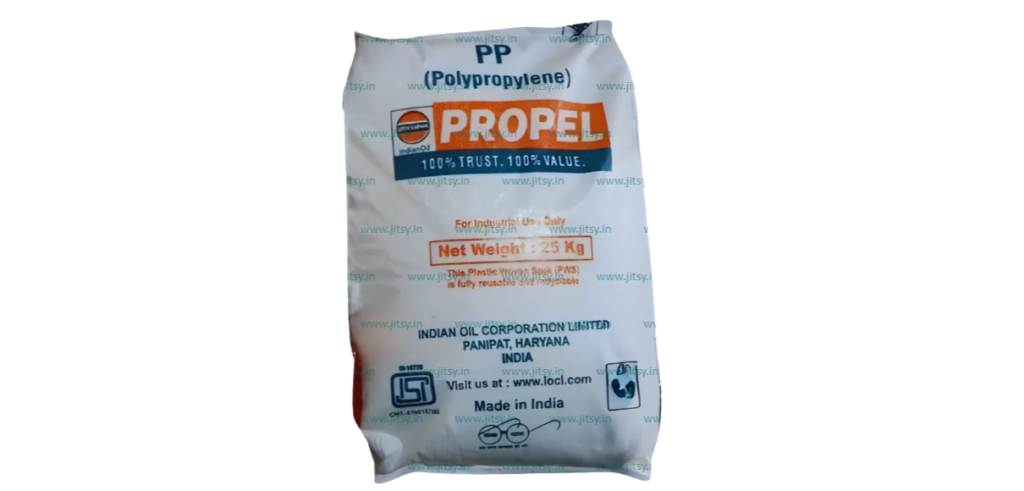
IOCL PPCP Propel 3030MG
Propel 3030MG is a medium-flow, high-impact polypropylene impact block copolymer (PPCP) from Indian Oil Corporation Ltd (IOCL), manufactured using Spheripol II technology. Designed for injection moulding, it delivers a reliable balance of impact strength and stiffness, making it ideal for automotive components, appliances, industrial parts, and caps & closures. As a prime, virgin PPCP 3.5 MFI grade, Propel 3030MG offers high-volume moulders repeatable performance, excellent surface finish, and consistent supply.
Technical Properties and Datasheet for Propel 3030MG
Typical Physical and Mechanical Properties
- Melt Flow Index (230°C/2.16kg):5 g/10 min
- Density:90 g/cm³
- Tensile strength at yield: 27 MPa
- Elongation at yield: 9%
- Flexural modulus: 1100 MPa
- Notched Izod impact (23°C): >150 J/m
- Heat deflection temp (0.46 N/mm²): 88°C
- Vicat softening point (10N): 150°C
Recommended Injection Moulding Conditions
- Melt temperature: 170–230°C
- Mold temperature: standard
- Storage: 25 kg bags, store below 50°C, process within 6 months for best results
Regulatory Information
Food-Contact and Regulatory Compliance
- Complies with IS 10910 (food, pharma, drinking water contact)
- Additives meet IS 10909 positive list
- Meets US FDA 21 CFR 177.1520 for specific food-contact applications
- Always confirm suitability for your process and end-use
Applications and Industry Use Cases of Propel 3030MG
Automotive Components and Under-Bonnet Parts
Propel 3030MG is trusted for interior trim, instrument-panel carriers, brackets, and fuse-box covers. Its >150 J/m impact and 1100 MPa modulus allow for stiff, impact-tolerant parts that withstand vibration and handling, while lightweight density helps reduce vehicle mass.Appliance and Consumer Product Housings
Used for housings and structural parts in washing machines, air-coolers, refrigerators, and vacuum cleaners, 3030MG’s chemical resistance and impact strength ensure durable, crack-resistant components that stand up to daily use and detergents.Industrial Components and Engineering Parts
Ideal for machine guards, technical mouldings, and brackets, Propel 3030MG’s flow and toughness support multi-cavity, complex part production with reliable snap-fit and hinge performance.Caps and Closures
Commonly used in beverage and personal-care caps, flip-tops, and threaded closures, 3030MG’s strength and stiffness support hinge designs and tamper-evident features, while PP’s chemical resistance allows safe use with a wide range of products.Performance Advantages of IOCL 3030MG vs Generic PPCP
- High impact resistance and useful stiffness for demanding parts
- Medium-flow MFI 3.5 for efficient processing and complex moulds
- Strong thermal performance with HDT 88°C and Vicat 150°C
- Excellent chemical resistance for appliance and industrial use
- Lightweight, recyclable, and batch-consistent for OEMs
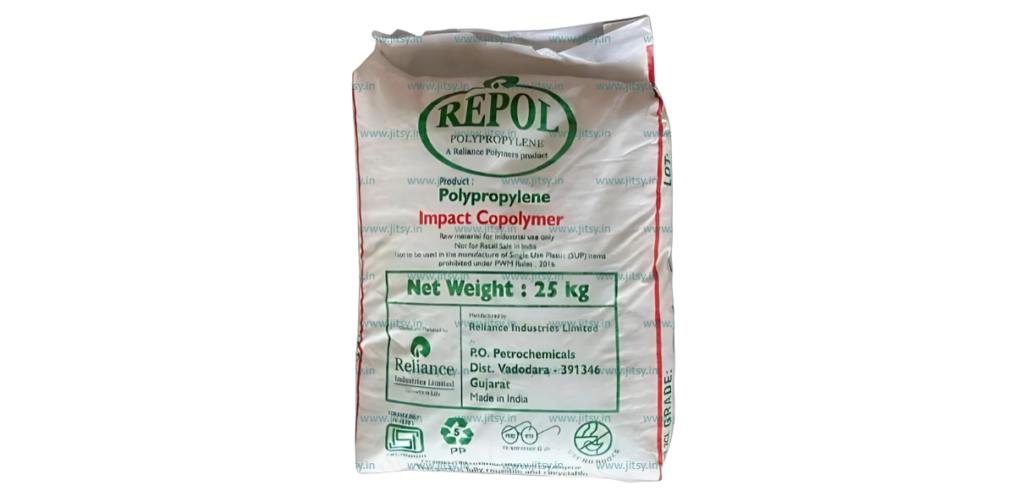
Reliance PP Repol H030SG
Reliance Repol H030SG is a polypropylene homopolymer raffia grade developed by Reliance Industries Limited for tape extrusion applications. It is recommended for making raffia tapes used in woven fabrics for sacking, carpet backing, industrial packaging and geotextile applications. For buyers searching for H030SG PP raffia grade, 3 MFI polypropylene homopolymer, or polypropylene raffia tape grade in India, this grade is positioned as a dependable option for converters that need stable extrusion, good tape strength and consistent woven fabric performance.
Manufactured under the Repol PP portfolio, H030SG is produced using the Unipol PP process, a gas-phase fluidised bed reactor technology known for consistent polymer quality and process stability. In practical terms, this matters to woven sack and raffia tape manufacturers because line consistency, low defect generation and predictable orientation behaviour directly affect output, tape quality and loom performance.
Manufacturer and Brand Background
Reliance Industries Limited is one of India’s largest polymer producers, and the Repol brand covers a wide range of polypropylene grades for raffia, injection moulding, fibre, film and extrusion applications. Within this portfolio, Repol H030SG is a dedicated raffia tape grade designed for converters that require reliable processing and balanced mechanical performance for woven fabric end uses. The grade is supplied as virgin polypropylene homopolymer granules and is widely referenced across the Indian raffia market for woven sacks, FIBC-related fabrics, carpet backing substrates and technical textile applications. Its market relevance comes from its established use in tape extrusion lines where processors value stable melt behaviour and efficient downstream handling.Technical Insights
From a technical standpoint, Repol H030SG combines a melt flow rate of 3.0 g/10 min with a density of 0.90 g/cc, making it suitable for raffia tape extrusion where controlled flow and orientation are important. The grade also shows 34 MPa tensile strength at yield, 10% elongation at yield, 1650 MPa flexural modulus, 70 Shore D hardness, 40 J/m notched Izod impact at 23°C, and 104°C HDT at 0.455 MPa.These values indicate a material profile built for stiffness, tape integrity and practical durability in woven structures. For manufacturers, the combination of moderate flow and solid mechanical balance supports tape formation, stretching and conversion into woven fabrics that need strength without sacrificing process consistency. The grade is also known for a low water carry-over additive package, which helps reduce moisture retention during water-bath cooling and supports cleaner, more efficient tape Production. Processing guidance commonly cited for H030SG includes melt temperatures of 240–280°C, water bath temperatures of 10–25°C, and chill roll temperatures of 20–40°C. This makes the grade especially relevant for processors looking for H030SG raffia processing guidance or a PP raffia grade for stable tape extrusion.Applications and Industry Use Cases
Woven Sacks and Sacking Fabrics
Repol H030SG is widely used in woven sack applications such as cement bags, flour bags, animal feed bags and other industrial sacking formats. Its raffia tape orientation behaviour and balanced strength profile help converters produce woven fabrics that can handle filling, stacking and transport demands in bulk packaging environments.FIBC and Industrial Packaging Fabrics
For industrial packaging, the grade is suitable for woven fabrics used in flexible intermediate bulk packaging and other heavy-duty wrapping structures. Processors prefer grades in this category when they need consistent tape extrusion, dependable weaving performance and fabric strength that supports demanding logistics and handling conditions.Carpet Backing
In carpet backing applications, H030SG is used to produce raffia tapes that contribute to dimensional stability and structural support in woven backing cloth. The grade’s stiffness and process consistency make it relevant for converters supplying primary or secondary carpet backing materials where uniform tape quality is important.Geotextiles
Geotextile manufacturers use raffia-based polypropylene grades for woven structures involved in soil stabilisation, separation and drainage-related applications. H030SG fits this use case because it is designed for woven fabric production and offers the kind of processing stability and mechanical balance needed in technical textile conversion.Tarpaulins and Utility Fabrics
The grade is also relevant for tarpaulins, wrapping fabrics and other utility woven products where processors need a polypropylene raffia material that runs smoothly on tape extrusion lines and supports durable woven output. This makes it a practical choice for converters serving agriculture, infrastructure and industrial packaging Sectors.Comparable Alternatives
In the Indian market, Repol H030SG is commonly compared with IOCL PP1030RG/H1030RG, HMEL R03RR, and MRPL HR003. These grades sit in a similar raffia-grade range, with melt flow values around 3 to 3.5, and are generally positioned for stretched tapes, woven sacks and related raffia applications. IOCL PP1030RG is considered a direct alternative because of its similar MFI and woven sack orientation. HMEL R03RR is another close comparison, especially for buyers evaluating raffia grades with low water carry-over and tape strength balance. MRPL HR003 also falls into the same practical selection band for converters focused on wovenfabric production. The rationale for choosing H030SG typically comes down to its established Reliance positioning in the raffia segment, its process consistency, and its suitability for woven sacks, carpet backing and geotextiles. Buyers comparing H030SG vs PP1030RG or H030SG vs HMEL R03RR are usually evaluating supplier preference, processing familiarity, line behaviour and end-use fabric performance rather than radically different polymer chemistry.
Reliance PP Repol H034SG
Reliance Repol H034SG is a polypropylene homopolymer BOPP film grade developed by Reliance Industries Limited for high-speed biaxially oriented polypropylene film production. Officially recommended for oriented film processes, this grade is especially suited for low-thickness films and is widely positioned for adhesive tapes, food packaging, cigarette and textile overwraps, synthetic paper, and plain or metallisable BOPP films. For processors looking for a reliable PP homopolymer for high-output BOPP lines, H034SG offers a balanced combination of flow, stiffness, orientation behaviour, and line productivity.
Reliance Industries is one of India’s largest polymer manufacturers, and the Repol PP portfolio includes specialised grades for film, raffia, fibre, and injection moulding applications. Within this portfolio, H034SG is a dedicated BOPP film homopolymer rather than a general-purpose extrusion grade. That matters because BOPP film lines demand a resin with stable processing behaviour, good orientation response, and the ability to support thin-gauge film production at commercial line speeds. For buyers searching for Reliance Repol H034SG supplier in India, BOPP film PP granules, or 3.4 MFI polypropylene homopolymer for adhesive tape and packaging films, this grade is a strong fit for technically demanding film conversion environments.
Deep Technical Insights
The key technical parameter for Repol H034SG is its melt flow rate of 3.4 g/10 min at 230 °C/2.16 kg as per ASTM D1238. This MFR range is well suited to BOPP film extrusion because it supports a useful balance between melt strength and processability. In practical terms, that helps film producers maintain stable extrusion, controlled orientation, and consistent performance on high-speed lines, especially when targeting low-thickness films. Typical property data associated with H034SG further supports its positioning as a BOPP film grade. The material is reported with density around 0.90 g/cc and Shore D hardness around 69 to 70, which aligns with the stiffness and surface durability expected in film applications such as tape base films and synthetic paper. Mechanical values commonly referenced for this grade include tensile strength at yield around 36 MPa, elongation at yield around 12%, flexural modulus around 1350 to 1400 MPa, and notched Izod impact around 40 J/m. Thermal performance is also relevant, with heat deflection temperature reported around 104 to 105 °C. These figures are typical values and should be treated as reference data rather than guaranteed specifications. For BOPP processors, the processing window is equally important. Public technical references indicate extrusion temperatures in the range of 220 to 260 °C, chill roll temperatures around 20 to 50 °C, MD stretching temperatures around 120 to 160 °C, and TD stretching temperatures around 150 to 170 °C, with typical stretch ratios of 4 to 8 in MD and 7 to 10 in TD. These ranges help explain why H034SG is preferred for high-speed oriented film lines, but actual settings should always be optimised based on line design, film structure, and target thickness.Applications and Industry Use Cases
Plain and Metallisable BOPP Films
Reliance Repol H034SG is primarily designed for plain and metallisable BOPP film production where stable orientation, consistent thickness control, and good downstream converting behaviour are essential. In these applications, the grade supports film structures used across packaging, lamination, and speciality film markets. Its balanced flow and stiffness profile make it suitable for processors aiming to run thin films at commercial speeds without compromising film integrity.Adhesive Tape Base Films
One of the most important application areas for H034SG is adhesive tape film. BOPP tape manufacturers need a polypropylene homopolymer that can deliver dimensional stability, surface consistency, and reliable orientation during film production. The stiffness and hardness profile of H034SG make it well aligned with tape base film requirements, where clean winding, stable film handling, and dependable converting performance matter.Food Packaging and Overwrap Films
H034SG is also relevant for food packaging films and overwrap applications such as confectionery, bakery, cigarette, and textile overwraps. In these segments, BOPP film producers value a grade that can support high-speed processing along with good film appearance and regulatory suitability. Public compliance references for food-contact-related standards further strengthen the grade’s relevance for packaging structures, subject to full application and structure validation.Synthetic Paper and Speciality Film Uses
Synthetic paper and related speciality film applications require a resin that can support stiffness, dimensional stability, and controlled orientation behaviour. H034SG fits well in this space because its property profile is aligned with film applications where printability, handling, and structural consistency are important. It is also useful in metallisable film structures where uniformity and downstream surface performance are commercially significant.Comparable Alternatives
Within the Indian BOPP film market, the closest comparable grades to Repol H034SG include IOCL F1030FG or F1030FG1 and MRPL F03RR or F03RR1. These grades are commonly mapped in comparison charts as BOPP film homopolymers for food packaging, lamination, metallisable films, and related applications. IOCL F1030FG is especially relevant as a practical alternative because its melt flow range is close to H034SG and it is positioned for a similar BOPP film processing window. The rationale behind choosing H034SG comes from its combination of verified BOPP-specific positioning, 3.4 MFR, suitability for low-thickness films, and acceptance across adhesive tape, packaging, overwrap, and synthetic paper applications. Compared with broader PP film grades, H034SG is more specifically aligned to oriented film lines rather than general cast film or extrusion use. Final substitution between H034SG and other Indian BOPP grades should always be validated through TDS review and plant trials, especially where film thickness, line speed, metallisation behaviour, or downstream converting performance are critical.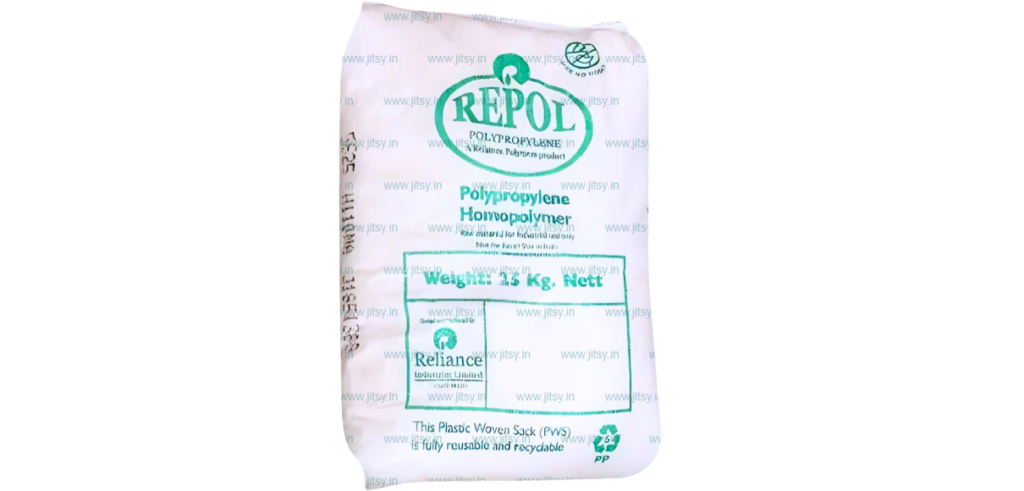
Reliance PP Repol H110MA
Reliance Repol H110MA, is a premium injection moulding polypropylene homopolymer from Reliance Industries Limited—India’s largest and most trusted polymers producer. This grade is engineered for high productivity and consistent quality, making it the industry benchmark for rigid packaging, housewares, thermoware, and furniture. A built-in antistatic additive ensures long-lasting surface aesthetics by minimizing dust pickup. Reliance’s Repol brand is synonymous with quality, regulatory compliance, and robust supply chain support, making H110MA a go-to solution for manufacturers seeking reliability and technical excellence.
Deep Technical Insights & Data Sheet Highlights
Repol H110MA features a high melt flow rate (MFR 11 g/10 min), enabling fast-cycle injection moulding and thin-wall part production. Its high flexural modulus ensures excellent stiffness and dimensional stability, while the Shore D hardness delivers superior surface durability. Balanced impact resistance and a heat deflection temperature (104°C) make it ideal for demanding applications. Reliance provides full batch traceability, technical documentation, and compliance with IS 10910, IS 16738:2018, and US FDA 21 CFR 177.1520 for food-contact use. Typical processing windows: melt temperature 210–260°C, mould temperature 30–50°C. These technical strengths give manufacturers confidence in processability, end-product quality, and compliance.Applications & Industry Use Cases
Rigid Packaging
Repol H110MA is widely adopted for injection-moulded containers, thin-wall tubs, lids, and caps. Its high flow and stiffness enable lightweight, rigid packaging solutions that maintain shape and integrity during filling, transport, and storage.Housewares and Thermoware
With outstanding rigidity and antistatic properties, H110MA is ideal for kitchenware, storage boxes, insulated containers, and household articles. Manufacturers benefit from easy moulding of complex shapes and long-lasting surface appearance.Furniture and Large Moulded Parts
The grade’s mechanical strength and stiffness support the production of durable furniture components such as chairs, stools, backs, and frames. Its processability allows for efficient manufacturing of both large and intricate parts, with reduced dust attraction for indoor use.Compounding and Masterbatch
As a homopolymer with controlled MFR, H110MA is a reliable carrier for masterbatches and filled compounds. It ensures uniform dispersion of additives and colorants, supporting high-performance end products in regulated applications.General Plastics & Job Shops
H110MA is a top choice for job shops producing consumer goods, packaging, and technical mouldings, thanks to its processing stability and broad regulatory acceptance.Comparable Alternatives – Technical Analysis
Key Indian alternatives to Repol H110MA include IOCL 1110MG, IOCL 1110MAS, HMEL M12RR, and OPaL MH13. Each is a PP homopolymer injection grade with a similar MFR (10–12 g/10 min), targeting rigid packaging, houseware, and furniture. IOCL 1110MG and 1110MAS match H110MA in flow and antistatic performance. HMEL M12RR and OPaL MH13 offer comparable stiffness and processability, making them suitable for converters seeking alternative sources or dual qualification. While all these grades meet industry standards for mechanical and thermal properties, Reliance Repol H110MA stands out for its traceability, regulatory documentation, and nationwide supply assurance—key for consistent, high-volume manufacturing.
Reliance PPCP Repol AMI035N
Reliance Repol AMI035N is a polypropylene impact copolymer (PPCP) engineered for injection moulding applications demanding exceptional stiffness–impact balance, dimensional stability, and long-term durability. Produced using advanced process technology, AMI035N features a low melt flow index (3 g/10 min), making it the ideal PPCP for automotive components, crates, rigid packaging, furniture, and industrial mouldings where structural integrity and impact resistance are non-negotiable. The grade’s mechanical and thermal profile ensures performance in both moderate and demanding service environments.
Technical specifications
Flow & physical properties
- Melt Flow Index: 3 g/10 min (230°C/2.16 kg) – low-MFI for maximum toughness and rigidity
- Density: ~0.90 g/cm³ – standard for PP IC
Mechanical & thermal properties
- Tensile strength at yield: ~27 MPa – robust for automotive and structural parts
- Elongation at yield: ~8% – supports resilience under load
- Flexural modulus: ~1100 MPa – high stiffness for crates, furniture, and packaging
- Notched Izod impact (23°C): ~160 J/m – excellent impact strength for drop and stacking resistance
- Vicat softening point (10 N): ~150°C – resists deformation under moderate heat
- Heat deflection temperature (HDT, 0.455 MPa): ~90°C – suitable for automotive interiors and logistics
Regulatory compliance
- Conforms to IS 10910 (food/pharma/drinking water contact) and IS 16738:2018 (positive list)
- Additives and formulation meet FDA and global standards for safe packaging and consumer use
Deep technical insights
- Low-MFI advantage: AMI035N’s 3 g/10 min MFI is ideal for moderate-wall, high-strength parts, maximizing impact and stiffness while minimizing warpage and brittleness.
- Mechanical synergy: 1100 MPa flexural modulus and 160 J/m impact provide the stiffness and toughness required in automotive, crate, and furniture applications.
- Thermal reliability: Vicat 150°C and HDT 90°C ensure shape retention and performance in warm or sun-exposed environments.
- Dimensional consistency: Reactor-grade dispersion and process stability support repeatability for OEM and high-volume production.
Applications
Automotive components
AMI035N is engineered for interior trims, semi-structural parts, and components where both rigidity and impact resistance are essential. Its thermal and mechanical profile supports performance in cabin and non-critical under-hood service.Crates & rigid packaging
High modulus and impact strength make AMI035N perfect for stackable crates, bins, and rigid packaging, supporting high stacking loads and repeated drops in logistics and warehousing.Furniture
For chairs, tables, and modular furniture, AMI035N delivers the load-bearing stiffness and drop resistance required in institutional and consumer settings.Industrial mouldings
The grade’s balance of strength and impact suits technical housings, machine guards, and industrial covers, providing ruggedness and dimensional stability for demanding uses.Processing guidelines
- Barrel temperature: 190–230°C (mid-range 200–220°C for most parts)
- Mould temperature: 30–40°C (cooler for cycle time, warmer for finish and warpage control)
- Packing pressure/time: Essential for ribs and thick sections to prevent sink marks
- Injection tips: Use moderate injection speeds, ensure uniform wall thickness, and optimize gate/rib design for best results
Reliance PPCP Repol B030MG
Reliance Repol B030MG is a polypropylene impact copolymer (PPCP) manufactured via the Unipol gas-phase process, designed for injection moulding where a balance of stiffness and medium impact strength is critical. This grade is ideal for industrial crates, furniture, automotive trims, textile components, and general technical mouldings. B030MG’s process stability, surface finish, and mechanical balance make it a trusted choice for OEMs and high-volume moulders.
Technical properties and datasheet
Physical and mechanical properties
- Melt flow rate: ~3.0–3.3 g/10 min (ASTM D1238)
- Density: ~0.90 g/cc (ASTM D792)
- Tensile strength at yield: ~26–27 MPa (ASTM D638)
- Elongation at yield: ~10% (ASTM D638)
- Flexural modulus: ~1,000 MPa (1% secant, ASTM D790)
- Notched Izod impact (23 °C): ~1.1 J/cm (≈150 J/m, ASTM D256)
- Heat deflection temp @ 0.46 MPa: ~95 °C (ASTM D648)
Typical processing conditions
- Melt temperature: 190–240 °C
- Mold temperature: 20–50 °C
- Parameters may vary by part design and machine; always refer to the manufacturer’s datasheet for best results.
Regulatory information
Food-contact and regulatory compliance
- Complies with US FDA 21 CFR 177.1520, IS 10910, IS 16738:2018, and EU 10/2011 food contact standards.
- Material Safety Data Sheet confirms low toxicity and safe handling under normal industrial conditions.
Applications and design guidance
Crates and industrial packaging
Repol B030MG is widely used in stackable crates, beverage bins, and logistics boxes, prized for its stiffness, impact resistance, and finish. For example, high-stack dairy crates benefit from its strength and surface gloss, ensuring durability and branding.Furniture and household components
This grade is chosen for chairs, stools, cabinets, and furniture parts where rigidity, toughness, and colourability are required. Unlike recycled blends, B030MG offers better surface finish and long-term stability.Automotive and engineering parts
B030MG supports interior trims, housings, and brackets that require dimensional stability and a clean finish. It is compatible with talc and modifiers for textured or grained finishes.Textile and general industrial products
Used in bobbins, cones, textile machine housings, and appliance components, B030MG delivers reliable processability and mechanical balance for technical mouldings.Performance advantages of Repol B030MG
- Stiffness–impact balance for demanding industrial and consumer parts
- Consistent processability and stable cycle times
- Thermal performance suitable for moderate heat exposure
- Excellent surface gloss for branding and aesthetics
- Batch-to-batch reliability and original Reliance documentation
Reliance PPCP Repol B120MA
Reliance’s PPCP Repol B120MA is a polypropylene impact copolymer (PPCP) engineered for injection moulding. It delivers a balanced combination of medium impact strength, stiffness, and antistatic properties. Repol B120MA is ideal for B2B buyers seeking high process reliability and consistent part quality. Typical users include OEMs, moulders, compounders, and procurement teams manufacturing housewares, thermowares, furniture, sanitary wares, and automotive/industrial components.
Key Features & Benefits of Repol B120MA
- Medium impact strength with reliable toughness
- Balanced stiffness–impact profile for robust parts
- Built-in antistatic agent for reduced dust pick-up
- Good surface gloss and consistent finish
- Designed for fast, efficient injection moulding
Technical Properties & Processing Guidelines
Material Properties of Repol Repol B120MA
- Mechanical: Medium impact, good stiffness, reliable dimensional stability
- Thermal: Suitable for housewares, industrial and automotive use
- Rheological: Medium MFI for efficient cycle times
- Compliance: Meets IS 10910 and positive list for food-contact (verify per application)
Recommended Processing Conditions (Injection Moulding)
- Barrel temp: 180–230°C (typical)
- Mould temp: 30–60°C (typical)
- Store bags in dry, dust-free area below 50°C
- Refer to datasheet for machine/part-specific tuning
Typical Applications of Reliance PPCP Repol B120MA
Reliance’s Repol B120MA is widely used for housewares (containers, thermowares, sanitary wares), furniture parts, and industrial/automotive mouldings. Its combination of impact strength, stiffness, and antistatic properties makes it suitable for robust, high-appearance parts. Repol B120MA is also selected by compounders for custom blends in automotive and general-purpose moulding.
Reliance PPCP Repol B220MN
Reliance Repol B220MN is a high-flow polypropylene (PP) impact copolymer (PPCP) granule engineered by Reliance Industries for demanding injection moulding applications. With a melt flow rate of 22 g/10 min and nucleated for fast cycles, B220MN is trusted by OEMs and moulders for rigid packaging, automotive components, housewares, and appliance parts. The grade’s balanced stiffness and impact strength, combined with reliable dimensional stability, make it a go-to PPCP for consumer and industrial plastics. B220MN is supplied as natural granules and is suitable for food-contact and regulated applications (per FDA 21 CFR 177.1520 and IS 10910).
Technical specifications of Reliance Repol B220MN
Flow & physical properties
- Melt Flow Rate (MFR): 22 g/10 min (230°C/2.16 kg) – enables rapid filling of thin sections, ribs, and complex moulds, reducing cycle times
- Density:90 g/cc – typical of PP impact copolymers, supporting lightweight design
Mechanical performance: stiffness & impact strength
- Tensile Strength at Yield: ~25 MPa – offers a solid balance between flexibility and strength
- Flexural Modulus: ~1.1 GPa – medium stiffness, good for load-bearing and structural parts
- Notched Izod Impact: High toughness at room temperature, much tougher than PP homopolymer – ideal for parts that face drops or repeated handling
Thermal properties & service temperature window
- Heat Deflection Temp (HDT): ~100°C (0.46 MPa) – suitable for room-temperature and moderately warm conditions, such as appliance interiors and automotive trims
- Vicat Softening Point: Typical of PP IC, supporting service up to 90–100°C
Functional Features
Reliance Repol B220MN brings together process efficiency, material reliability, and design flexibility. It’s nucleated for faster crystallisation and shorter cycles, helping you boost productivity. The grade’s impact-stiffness balance allows for robust, lightweight parts, and its food-contact compliance opens up regulated market opportunities.Applications and industry use cases
Household and consumer plastic products
B220MN is used in buckets, storage bins, kitchenware, furniture components, and other houseware items. Its high flow and toughness mean parts are lightweight, durable, and resistant to everyday drops and knocks.Appliances and electrical components
Appliance makers use B220MN for housings, control panels, knobs, and internal parts in fans, coolers, washing machines, and more. The grade’s impact and stiffness help these parts last, while its thermal profile is great for room-temperature and mildly warm areas.Automotive and industrial parts
For non-critical interior trims, battery cases, and light covers, B220MN’s toughness and processability shine. It handles vibration and moderate impacts better than standard PP, making it a cost-effective solution for automotive interiors and industrial covers.Rigid packaging, crates, caps & closures
B220MN is trusted for injection-moulded crates, pallets, rigid packaging, and closures that need to withstand logistics stress. Its high flow enables thinner walls and faster cycles, helping manufacturers cut weight and boost output.Processing guidelines for PPCP Repol B220MN
Recommended injection-moulding parameters
- Melt temperature: 190–240°C (lower for standard parts, higher for thin-wall or complex shapes)
- Mould temperature: 20–50°C (colder for speed, warmer for finish/stability)
- Injection speed & pressure: Use high speed to exploit flow; ensure packing to avoid sink in ribs/bosses
- Regrind usage: Clean, limited regrind is generally safe if contamination is controlled
Design tips for thin-wall and multi-cavity tools
- Use uniform wall thickness and rounded corners to reduce stress
- Gates and runners should be sized for high-flow PP IC to avoid short shots
- Thin-wall designs benefit from B220MN’s flowability and cycle-time reduction
Common PP injection-moulding defects and troubleshooting
- Warpage: May be caused by uneven cooling or mould temperature; adjust cooling and packing
- Flow lines: Increase injection speed or temperature; check gate location
- Short shots: Raise temperature or speed; ensure venting is adequate
Performance advantages vs other PP grades
B220MN vs PP homopolymer: Much higher impact strength, especially at low temperatures, but slightly less stiff and heat-resistant. B220MN vs random copolymer PP: Much tougher but opaque; perfect where clarity isn’t needed but durability is. B220MN vs engineering plastics (ABS, PC/ABS): Lower cost and density, good for non-high-heat parts, but less heat-resistant than engineering plastics. Why choose B220MN?- Faster cycles, thinner walls, and higher productivity than many other PP grades
- Balanced performance for a wide range of consumer, appliance, and automotive parts
Reliance PPCP Repol B250EG
Reliance Repol B250EG is a specialized, high-flow polypropylene (PP) impact copolymer (PPCP) engineered using the Unipol gas-phase process and a high-activity stereospecific catalyst. Its standout feature is a melt flow rate of 25 g/10 min, making it ideal for high-speed extrusion coating lines where uniform coating and process reliability are critical. B250EG is recommended for extrusion coating of PP woven fabrics—think woven sacks, tarpaulins, agro-textiles, and flexible packaging—where its flow, adhesion, and toughness ensure optimal product quality. This grade is trusted by woven sack manufacturers, laminators, packaging converters, and OEMs across India.
Technical specifications of Reliance Repol B250EG
Flow and physical properties
- Melt Flow Rate (MFR): 25 g/10 min (230°C/2.16 kg) – delivers excellent flow for thin, even coatings at high line speeds
- Density: 0.90 g/cm³ – standard for PP impact copolymers, supporting lightweight coatings
Mechanical performance of coated structures
- Tensile Strength at Yield: ~24 MPa – ensures coated fabrics retain strength and flexibility
- Flexural Modulus: ~0.9 GPa – provides a balance of stiffness and drapability
- Impact Resistance: Superior to PP homopolymer coatings, reducing cracking and improving durability under handling/folding
Thermal behaviour and service conditions
- Service Temperature Range: Suitable for moderate temperatures found in outdoor sacks, tarps, and packaging—not for continuous high-heat use
- Thermal Stability: Maintains coating integrity during high-speed extrusion and typical end-use conditions
Functional Features
B250EG is purpose-built for extrusion coating, delivering process efficiency, product durability, and surface quality. The grade’s high melt flow, impact copolymer matrix, and process consistency make it a top choice for converters seeking reliability and productivity gains.Applications and industry use cases
Coating of PP woven fabrics and sacks
B250EG is the preferred PPCP for extrusion coating of polypropylene woven sacks, FIBC fabrics, and tarpaulins. Its high flow enables thin, uniform coatings at high line speeds, improving moisture barrier, printability, and seam strength. This results in tough, reliable sacks and tarps for cement, fertiliser, and agro applications.Tarpaulins, agro-textiles, and industrial fabrics
For tarpaulins, ground covers, and agro-textiles, B250EG delivers abrasion resistance and flexibility, helping products withstand outdoor exposure and repeated handling. Its impact copolymer base reduces cracking and improves service life.Flexible packaging and paper-poly laminates
B250EG is widely used for extrusion-coated films, paper-poly laminates, and board coatings. The PP layer adds chemical and moisture resistance to cartons and flexible packs, with high line speed compatibility.Other extrusion-coating and lamination applications
Beyond woven fabrics, B250EG serves in general plastics, non-woven fabric coatings, and specialty laminates where high-flow, thin, and tough coatings are required.Processing guidelines for PPCP Repol B250EG in extrusion coating
Recommended extrusion-coating conditions
- Melt temperature: 220–260°C (adjust as per line and substrate)
- Line speed: High MFR supports faster lines and thinner coatings at stable screw loads
- Substrate prep: Ensure clean, dry woven fabric for optimal adhesion
Coating design and thickness optimisation
- Target uniform, thin coatings for cost efficiency and performance
- Monitor edge stability and neck-in—B250EG’s flow helps control neck-in for consistent coverage
- Screw design: Standard PP IC screw with proper L/D and mixing section recommended
Common coating defects and troubleshooting
- Orange peel: May result from low melt temperature or poor substrate prep—raise temp, improve cleaning
- Neck-in: Excessive line speed or insufficient die temp—adjust line and thermal settings
- Poor adhesion: Check substrate moisture and surface tension; optimise melt temp and pressure
Performance advantages vs alternative PP grades
B250EG vs PP homopolymer coating grades
B250EG offers much better impact and crack resistance, especially in thin coatings on woven fabrics. This means fewer failures during folding, stacking, and transport.B250EG vs lower-MFI PPCP grades
Its very high MFR enables higher throughput, thinner coatings, and better coverage—translating to productivity gains and material savings on modern extrusion lines.Why choose Repol B250EG for extrusion coating?
- Faster lines: High flow means higher speed and lower energy use per unit
- Lighter coatings: Enables downgauging without sacrificing coverage or durability
- Stronger fabrics: Impact copolymer matrix improves resistance to cracking and abrasion
- Consistent finish: Uniform coating and reduced defects for better printability and appearance
Reliance PPCP Repol B400MN
Reliance Repol B400MN is a high-flow, nucleated polypropylene impact copolymer (PPCP) engineered by Reliance Industries Ltd using Unipol PP gas-phase technology. With a melt flow rate of 38 g/10 min, B400MN combines excellent processability, medium impact strength, and dimensional stability, making it ideal for injection moulding of appliance parts, automotive components, grilled/thin-wall products, and compounding. The nucleating agent accelerates crystallisation, shortens cycle times, and enhances both stiffness and part gloss. B400MN is supplied as natural granules in 25 kg bags, and is fully compliant with IS 10910 for food, pharma, and drinking water contact, as well as FDA CFR 21 177.1520.
Functional Features
Repol B400MN stands out for its reactor-grade consistency, fast crystallization, and balanced mechanical properties. Its nucleated structure supports low warpage, reliable dimensional accuracy, and high-gloss surfaces. The grade’s medium impact and stiffness profile enable versatile use across appliances, automotive, and industrial sectors.Detailed Technical Specifications (Typical Values)
- Melt Flow Rate: 38 g/10 min (ASTM D1238, 230°C/2.16 kg)
- Density:90 g/cc (ASTM D792)
- Tensile Strength at Yield: 26 MPa (ASTM D638)
- Elongation at Yield: 7% (ASTM D638)
- Flexural Modulus: 1150 MPa (ASTM D790A)
- Notched Izod Impact (23°C): 70 J/m (ASTM D256)
- Heat Deflection Temp (455 kPa): 105°C (ASTM D648)
- Hardness: Shore D 68 (ASTM D2240)
Applications and Industry Use Cases
Appliances
B400MN is widely used for appliance parts such as washer internals, AC grills, and fan covers. Its high flow and nucleated stability enable precise, defect-free moulding of thin-walled and grilled components, while its gloss and dimensional stability support premium surface finishes.Automotive
Automotive compounders and OEMs use B400MN for interior and exterior components, compounds, and non-structural parts requiring a balance of stiffness and impact. The grade’s processability supports complex designs and high-volume manufacturing.Grilled/Thin-Wall Products
The high flow and nucleation of B400MN make it ideal for fan guards, vents, and thin-walled housings, where rapid mould filling and low warpage are critical for assembly and performance.Compounding
B400MN is an excellent base resin for masterbatch and mineral-filled PPCP compounds, supporting efficient dispersion and batch consistency.Performance Advantages
Compared to non-nucleated or lower-MFI PPCP grades, Repol B400MN delivers faster cycle times, enhanced dimensional control, and superior gloss in thin-wall and grilled applications. Its reactor-grade nucleation technology minimizes warpage and shrinkage, making it a preferred choice for high-output, precision moulding environments. B400MN is competitive with HMEL CM40NR (40 MFI), IOCL Propel 3650MN (65 MFI), and Haldia Halene M365 for thin-wall, appliance, and compounding applications.Compliance, Packaging, and Storage
Food Contact Compliance: Certified to IS 10910, IS 16738:2018, and FDA CFR 21 177.1520 (not for SUP-prohibited items). Packaging: Natural granules in 25 kg bags. Storage Guidelines: Store dry, below 50°C, away from direct sunlight and moisture to maintain material quality.
Reliance PPCP Repol B650MN
Reliance Repol B650MN is a premium polypropylene impact copolymer (PPCP) designed for demanding injection-moulded applications where high flow, reliable impact strength, and dimensional stability are critical. Engineered with a nucleating agent, B650MN offers a unique combination of rapid mould filling, moderate toughness, and excellent surface finish, making it the material of choice for manufacturers in automotive, appliance, and houseware sectors. Its high melt flow rate-approximately 70 grams per 10 minutes at 230°C-enables the production of intricate, thin-walled parts with reduced cycle times and lower injection pressures. This grade is supplied as natural-colour, virgin granules and is fully backed by Reliance’s stringent quality and compliance protocols.
At a glance, Repol B650MN delivers high-flow processing, medium impact strength, nucleation-enhanced stability, full food-contact compliance, and reliable pan-India supply.
Functional Features
Repol B650MN is cycle time optimized, enabling faster production and improved throughput on high-cavitation moulds. Its thin-wall capability makes it ideal for parts with complex geometries and long flow paths, such as appliance housings and automotive trim. The grade is regulatory ready, meeting Indian, US, and EU food-contact standards, and is supplied in consistent, traceable batches for maximum process control. Each lot is supported by technical documentation and batch-level traceability, ensuring peace of mind for OEMs and converters.Technical Specification Highlights
With a melt flow rate of around 70 g/10 min, Repol B650MN is classified as a very high-flow PPCP. Its density is typically 0.90 g/cc, aligning with industry standards for impact copolymers. The material delivers a flexural modulus of approximately 1300 MPa, balancing stiffness with flexibility for parts that require both rigidity and some give. Notched Izod impact strength at room temperature is about 70 J/m, offering robust resistance to everyday handling and minor impacts. The grade’s heat deflection temperature, measured at 455 kPa, is around 110°C, making it suitable for components exposed to moderate heat, such as under-the-hood automotive parts and appliance interiors. Surface hardness is rated at Shore D 68, ensuring a durable finish.Applications & Industry Use Cases
Automotive Components
Repol B650MN is widely adopted in the automotive sector for interior trims, HVAC ducts, fan shrouds, and non-structural covers. Its high-flow properties allow for the efficient moulding of large, complex parts with thin walls and intricate ribs, while its medium impact strength ensures durability in daily use. Automotive compounders also value B650MN as a base resin for producing filled and reinforced PPCP grades, especially where rapid cycle times and dimensional stability are priorities.Appliances & Consumer Durables
In the appliance industry, B650MN is the go-to choice for manufacturing air cooler and AC grills, fan guards, washing machine and dishwasher internal components, and refrigerator interior fittings. Its chemical resistance, dimensional integrity, and smooth surface finish make it ideal for parts exposed to detergents, temperature changes, and repeated use. The grade’s nucleated structure further enhances crystallization, reducing warpage and shrinkage in finished products.Houseware & Compounding
B650MN’s high flow makes it perfect for houseware items such as storage bins, crates, thin-wall buckets, and organizers, where complex designs and efficient production are essential. It is also extensively used by masterbatch and compound manufacturers as a base resin, thanks to its ease of dispersion and compatibility with a wide range of fillers and additives.Compliance, Approvals, & Safety
Reliance Repol B650MN stands out for its comprehensive regulatory approvals. It is certified under IS 10910 and IS 16738:2018 for safe use in food-contact, pharmaceutical, and drinking water applications in India. The grade also conforms to US FDA 21 CFR 177.1520 and EU Regulation 10/2011, ensuring global market access for converters and OEMs. Each batch is supported by a Technical Data Sheet (TDS), Safety Data Sheet (SDS), Certificate of Analysis (COA), and regulatory compliance letters, all available on request.Packaging, Storage & Logistics
B650MN is typically supplied in robust 25 kg polypropylene bags, shrink-wrapped on pallets for secure transportation. For best results, store the material in a dry, closed environment below 50°C and away from direct sunlight or UV exposure to prevent caking and degradation. JITSY offers fast, pan-India dispatch from strategically located warehouses in Delhi, Gujarat, Maharashtra, and Kolkata, with export-ready documentation for international buyers. Both partial truck loads and full container loads are supported, ensuring supply reliability for manufacturers of all sizes.
Reliance PPCP Repol C015EG
Reliance Repol C015EG is a polypropylene impact copolymer (PPCP) engineered for extrusion and blow-moulding applications. Manufactured using Reliance's advanced Unipol gas-phase technology, C015EG combines high impact strength with excellent rigidity, making it the ideal workhorse grade for rigid packaging, industrial containers, thermoformed products, and automotive trims. Its 1.8 MFI and balanced stiffness-impact profile deliver consistent performance across demanding converters' production lines.
Deep Technical Insights
Repol C015EG features a heterophasic polypropylene structure—a semi-crystalline PP matrix with finely dispersed ethylene-propylene rubber phase—delivering a 5–10x impact advantage over homopolymer grades. The 1.8 MFI is optimized for extrusion and blow-moulding, enabling stable line speeds, consistent wall thickness and minimal scrap. Its 1,000 MPa flexural modulus ensures structural rigidity for stacked containers and rigid sheets, while 200 J/m Izod impact provides toughness against drops and handling stress. HDT of 95°C supports hot-fill applications and warm service conditions. Unipol technology ensures batch-to-batch consistency, predictable properties, and the ability to fine-tune the impact-stiffness balance for specific converter needs.Applications & Industry Use Cases
Blow-Moulded Containers & Industrial Packaging: C015EG excels in detergent bottles, chemical containers, industrial drums, and rigid packaging where impact resistance and dimensional stability are critical. Its thermal performance supports hot-fill and warm storage for aggressive liquids. Extruded Sheets & Thermoformed Articles: Ideal for rigid PP sheets, trays, lids, industrial panels and thermoformed components. The balance of stiffness and impact allows converters to design lightweight yet durable products for food service, industrial storage and logistics. Corrugated Board & PP Hollow Sheets: C015EG delivers the strength needed for PP flute boards, agricultural crates and protective packaging, supporting both manual and automated handling with excellent stackability. Automotive Trims & Technical Components: Used in interior trims, protective panels and technical parts requiring impact resistance, thermal stability and consistent surface finish.Performance Advantages of Repol C015EG PPCP
Repol C015EG stands out for its stiffness-impact balance, thermal resistance up to 95°C HDT, and exceptional processability on high-speed extrusion and blow-moulding lines. Its food-contact compliance (IS 10910, IS 16738:2018, FDA 21 CFR 177.1520) and regulatory certifications reduce buyer risk. The grade's Unipol technology pedigree ensures supply reliability and consistent quality across batches, making it a trusted choice for converters across packaging, automotive and industrial sectors.
Reliance PPCP Repol C080MA
Reliance Repol C080MA is a polypropylene (PP) impact copolymer grade manufactured using the Unipol gas-phase process, designed for injection moulding applications where high impact strength and antistatic performance are critical. C080MA’s built-in antistatic agent reduces static charge buildup, making it ideal for dust-sensitive furniture production, industrial cleanrooms, and packaging environments. Its medium flow (MFI 9) supports the moulding of thick-walled, load-bearing furniture, multi-cavity industrial crates, and pails—delivering robust, durable, and clean-finished products for demanding OEMs and moulders in Delhi/NCR and pan-India.
Technical specifications
Physical properties (MFI, density)
- Melt Flow Rate: 9 g/10 min (230°C/2.16 kg) – supports medium/thick-wall parts, multi-cavity tools
- Density:90 g/cm³ – lightweight, standard for PP impact copolymers
Mechanical performance (impact, stiffness)
- Tensile Strength at Yield: 23 MPa – strong for structural furniture and crates
- Elongation at Yield: 7% – supports flexibility under load or impact
- Flexural Modulus: 1000 MPa – delivers load-bearing support for chairs/tables
- Notched Izod Impact (23°C): 150 J/m – high impact for drop resistance, stacking, and transport
Thermal properties & regulatory compliance
- Heat Deflection Temperature (66 psi / 455 kPa): 95°C – suitable for furniture and industrial products exposed to moderate heat
- Regulatory: IS 10910, IS 16738:2018, US FDA CFR Title 21, 177.1520
Applications & use cases
Furniture manufacturing
C080MA is the go-to PPCP for injection-moulded chairs, table legs, storage bins, and office furniture components. Its high impact strength ensures products resist drops and rough handling, while the antistatic property keeps surfaces clean during painting and assembly. The flexural modulus supports load-bearing parts, delivering durable and aesthetically pleasing consumer furniture.Industrial products & pails
For crates, toolboxes, protective housings, and pails (5L, 20L), C080MA offers the flexural strength for stacking, the impact toughness for transport, and the antistatic benefit for dust-free storage. IS 10910 compliance makes it suitable for chemical/food pails and regulated packaging.Processing guidelines
Recommended injection parameters
- Melt temperature: 190–250°C
- Mould temperature: 30–50°C
- Packing pressure: Essential for thick ribs/bosses in furniture to prevent sink marks
Antistatic processing benefits
- Reduces static buildup, facilitating demoulding and reducing dust attraction
- Improves surface quality and finish for painted or assembled parts
Troubleshooting common defects
- Flow marks: Increase injection speed
- Warpage: Use balanced cooling channels
- Sink marks: Increase packing pressure, especially in thick sections
Performance advantages
- Antistatic edge: Built-in agent prevents static-related defects and dust pickup—key for furniture and cleanroom applications
- High impact: 150 J/m notched Izod ensures drop/stacking resistance
- Balanced flow: MFI 9 enables processing of thick, structural parts without sacrificing toughness
- Regulatory breadth: IS 10910, IS 16738:2018, FDA compliance for food/chemical packaging and industrial use
Reliance PPCP Repol C080MT
Reliance Repol C080MT is a polypropylene impact copolymer (PPCP) engineered for injection moulding applications that demand high impact strength, long-term heat stabilisation (LTHS), and a balanced stiffness-impact profile. Specially formulated for battery containers, under-the-hood automotive components, and industrial products, C080MT delivers robust processability and durability in harsh, heat-exposed environments. Its compliance with IS 10910 and IS 16738:2018, combined with FDA and global food/pharma standards, makes it a reliable material for OEMs and component suppliers in Delhi/NCR and across India.
Specifications
Physical Properties
- Melt Flow Rate:5 g/10 min (230°C/2.16 kg) – medium flow for thick-section and structural parts
- Density:90 g/cm³ – standard for PP impact copolymers
Mechanical Properties
- Tensile Strength at Yield: 23 MPa – strong for battery and automotive applications
- Elongation at Yield: 7% – supports flexibility under load
- Flexural Modulus: 1000 MPa – provides structural stiffness
- Notched Izod Impact (23°C): 150 J/m – high impact for drop resistance
- Shore D Hardness: 68 – reliable surface durability
Thermal Properties
- Heat Deflection Temperature (455 kPa): 95°C – enables under-hood and battery use
- Long-term heat stabiliser: Ensures property retention in continuous heat cycles
Regulatory Compliance
- IS 10910 & IS 16738:2018 (food/pharma/drinking water)
- FDA 21 CFR 177.1520 and global standards
Applications
Battery containers
C080MT’s high impact strength and long-term heat stabilisation make it ideal for battery containers, providing drop resistance, dimensional stability, and retention of properties under repeated thermal cycling.Automotive under-hood components
Optimised for engine covers, manifolds, and other under-hood parts, C080MT withstands elevated temperatures and mechanical stress, ensuring long-lasting performance and safety.Industrial products
Suitable for crates, housings, and technical mouldings, C080MT delivers the toughness and processability needed for heavy-duty industrial environments.Processing
- Melt temperature: 190–250°C
- Mould temperature: 30–50°C
- Packing pressure: Essential for thick ribs and battery containers to avoid sink marks
- Optimisation: LTHS stabiliser enables use in continuous heat cycles; proper cooling and packing reduce warpage and surface defects
Deep Technical Insights
- LTHS additive: Provides resistance to property loss during long-term heat exposure, critical for under-hood and battery casing applications
- Balanced mechanics:5 MFI supports moulding of thick, structural parts while maintaining impact performance
- Regulatory versatility: Meets Indian and global standards for food, pharma, and drinking water, expanding application scope
Reliance PPCP Repol C120MN
Reliance PPCP Repol C120MN is a polypropylene impact copolymer (PPCP) engineered by Reliance Industries for injection molding applications. This grade delivers high impact strength, excellent low-temperature performance, and balanced stiffness, making it ideal for demanding molded parts. Repol C120MN is trusted by injection molders, OEMs, compounders, and procurement teams in automotive, appliances, packaging, and industrial sectors seeking reliable B2B polymer supply.
Key Features & Benefits
- High impact strength for robust parts
- Excellent low-temperature performance
- Balanced stiffness and flexibility
- Smooth processability for injection molding
- Consistent quality and batch traceability
Technical Properties & Processing
Material Properties
- Mechanical: High impact resistance, balanced stiffness, dimensional stability
- Thermal: Maintains properties at low temperatures; suitable for automotive and appliance use
- Rheological: Medium MFI for efficient cycle times
- Compliance: Meets relevant standards for automotive, appliance, and packaging applications (verify per end-use)
Recommended Processing Conditions
- Barrel temp: 180–230°C (typical)
- Mold temp: 30–60°C (typical)
- Store in a dry, dust-free area below 50°C
- Refer to datasheet for machine/part-specific settings
Typical Applications
Repol C120MN is widely used in automotive components (bumpers, trims, battery cases), appliance parts (refrigerator bins, washing machine housings), crates, containers, furniture, and general-purpose injection molded goods. Its high impact strength and processability make it a preferred choice for manufacturers targeting durability, regulatory compliance, and efficient production.
Reliance PPCP Repol C200MN
Reliance Repol C200MN is provisionally described as a nucleated polypropylene impact copolymer (PPCP) in the 20–30 melt flow index (MFI) range, manufactured by Reliance Industries Ltd. While no official TDS or database records are available for C200MN, its product code and family suggest it is designed for injection moulding and compounding applications requiring moderate to high flow, medium impact, and dimensional stability. Like other Repol nucleated PPCP grades, C200MN would be expected to offer accelerated crystallisation, reduced cycle times, and reliable processability for converters and OEMs. For critical or regulated projects, buyers are encouraged to verify the grade or use documented alternatives such as Repol C320MN or B400MN.
Functional Features
Repol C200MN is intended for converters seeking high-flow processability, nucleated stability, and balanced mechanical performance in appliances, automotive, packaging, and compounding. Reactor-grade consistency and food-contact compliance (inferred from the Repol PPCP range) support reliable, traceable production.Detailed Technical Specifications (Provisional, Typical for 20–30 MFI PPCP)
- Melt Flow Index: ~20–30 g/10 min (estimated)
- Density: ~0.90 g/cm³
- Tensile Strength at Yield: ~22 MPa
- Elongation at Yield: ~6%
- Flexural Modulus: ~1100 MPa
- Notched Izod Impact (23°C): ~70 J/m
- Heat Deflection Temp (0.455 MPa): ~95°C
- Vicat Softening Point (10N): ~140°C
Applications & Industry Use Cases
Appliances & White Goods
C200MN is suited for appliance housings, AC grills, washing machine internals, and white goods components where moderate flow, dimensional stability, and impact resistance are valued.Automotive
Automotive compounders and OEMs may use C200MN for interior/exterior trims, non-structural parts, and compounds where a balance of stiffness and impact is required.Packaging & Thin-Wall Injection Moulding
The moderate MFI and nucleated structure are appropriate for rigid packaging, containers, and thin-wall parts, supporting reliable, high-throughput production.Compounding
As a base resin for masterbatch and filler compounding, C200MN’s processability and reactor-grade uniformity support efficient dispersion and mechanical consistency.Performance Advantages
Compared to non-nucleated or lower-MFI PPCP, C200MN (provisionally) offers faster cycles, lower warpage, and good thin-wall filling. Its technical profile is competitive with Repol B220MN (22 MFI), C320MN (32 MFI), and B400MN (38 MFI) for appliance, automotive, and compounding uses.Compliance, Packaging & Storage
Food Contact Compliance: Assumed, but documentation should be requested for regulated uses. Packaging: Natural granules in 25 kg bags. Storage Guidelines: Store dry, below 50°C, away from sunlight and moisture.
Reliance PPCP Repol C320MN
Reliance Repol C320MN is a nucleated polypropylene impact copolymer (PPCP) engineered for high-flow, medium-impact injection moulding applications. Produced using advanced Unipol PP technology, C320MN combines a melt flow index of 32 g/10 min with balanced stiffness and impact, making it ideal for thin-walled, grilled, and complex moulded part. The nucleating agent enhances crystallisation and dimensional stability, resulting in faster cycle times, reduced warpage, and reliable part quality. Supplied as natural granules in 25 kg bags, C320MN is fully compliant with IS 10910 for food, pharma, and drinking water contact, as well as IS 16738:2018 and FDA CFR 21 177.1520.
Functional Features
Repol C320MN stands out for its high-flow processability, nucleated structure, and robust mechanical properties. The grade’s medium impact and flexural modulus support structural integrity in appliance, automotive, and compounding applications. Its nucleation technology ensures shorter cycles and improved dimensional accuracy, while food-contact compliance expands its use in regulated markets.Detailed Technical Specifications (Typical Values)
- Melt Flow Rate: 32 g/10 min (ASTM D1238, 230°C/2.16 kg)
- Density:90 g/cc (ASTM D792)
- Tensile Strength at Yield: 20 MPa (ASTM D638, 50 mm/min)
- Elongation at Yield: 5% (ASTM D638)
- Flexural Modulus: 1150 MPa (ASTM D790A)
- Notched Izod Impact (23°C): 150 J/m (ASTM D256)
- Heat Deflection Temp (455 kPa): 92°C (ASTM D648)
- Hardness: Shore D 68 (ASTM D2240)
Applications and Industry Use Cases
Appliances
Repol C320MN is widely used for appliance parts such as washer covers, AC grills, and internal brackets, where high flow and nucleated stability enable precise, defect-free moulding of thin-walled and grilled components. Its medium impact and thermal stability support everyday use and moderate heat exposure.Automotive
Automotive compounders and OEMs use C320MN for interior components, compounds, and non-structural parts requiring a balance of stiffness and impact. The grade’s processability supports complex designs and efficient mass production.Grilled/Thin-Walled Products
The high flow and nucleation of C320MN make it ideal for fan guards, vents, and thin-walled housings, where rapid mould filling and low warpage are critical for performance and assembly.Compounding
C320MN is an excellent base resin for masterbatch and mineral-filled PPCP compounds, supporting dispersion and batch consistency in colour and performance.Performance Advantages
Compared to non-nucleated or lower-MFI PPCP grades, Repol C320MN offers faster cycle times, better dimensional control, and superior thin-wall filling. Its nucleation technology minimizes warpage and shrinkage, making it a preferred choice for complex, high-output moulding environments. C320MN is competitive with HMEL CM40NR (40 MFI) and IOCL 3650MN (65 MFI) in applications where flow and dimensional stability are prioritized over extreme impact.
Reliance PPCP Repol D120MA
Reliance Repol D120MA is a polypropylene impact copolymer (PPCP) grade developed for injection moulding applications where high impact strength and antistatic performance are critical. Engineered with a built-in antistatic agent, D120MA reduces static charge buildup, making it ideal for automotive interiors, luggage shells, industrial housings, and compounding bases where dust, lint, or static-related defects must be minimized. Its medium-high flow (MFI 12) enables reliable moulding of complex, medium/thick-wall parts without sacrificing toughness—delivering robust, durable products for demanding environments.
Technical specifications
Physical properties (MFI, density)
- Melt Flow Rate: 12 g/10 min (230°C/2.16 kg) – supports good flow for complex shapes while retaining impact strength
- Density:90 g/cm³ – standard for PP impact copolymers
Mechanical performance (impact, stiffness)
- Tensile Strength at Yield: 19 MPa – delivers strength for structural and load-bearing parts
- Elongation at Yield: 10% – supports flexibility under load
- Flexural Modulus: 900 MPa – medium stiffness for automotive and luggage applications
- Notched Izod Impact (23°C): 550 J/m – outstanding toughness for drop and impact resistance
- Shore D Hardness: 66 – reliable rigidity and surface durability
Thermal & regulatory compliance
- Heat Deflection Temperature: 90°C (455 kPa) – suitable for automotive interiors and consumer goods
- Compliance: IS 10910:1984, IS 16738:2018 (food/pharma/drinking water contact); FDA 21 CFR 177.1520; EU 10/2011; BfR VII; Swiss SR 817.023.21; MERCOSUR GMC 56/92
Applications & use cases
Automotive components
D120MA is engineered for automotive bumpers, interior trims, battery boxes, and underbody shields. Its high notched impact strength (550 J/m) ensures drop resistance and durability, while the antistatic agent minimizes dust attraction and static-related defects—critical for painted or electroplated parts and assembly environments.Luggage shells
For hard-shell suitcases, trolley frames, and travel goods, D120MA’s toughness delivers long-lasting, crack-resistant products that withstand rough handling. The antistatic property keeps luggage surfaces cleaner and reduces lint pickup during storage and transport.Compounding base resin
D120MA is an ideal matrix for talc- or glass-filled automotive compounds, TPE blends, and weatherable formulations. Its antistatic feature reduces dust during handling and processing, and its high impact strength survives compounding shear, supporting demanding technical applications.Processing guidelines
- Melt temperature: 200–260°C
- Mould temperature: 15–50°C
- Injection speed: High speeds leverage antistatic flow; ensure proper packing to avoid sink marks in ribs and bosses
- Antistatic benefit: Reduces mould release issues and static-related defects in cleanroom or dust-sensitive production
- Troubleshooting:
- Flow marks: Increase injection speed
- Warpage: Use balanced cooling
- Short shots: Optimise gate size and melt temperature
Performance advantages
- Antistatic edge: Built-in antistatic agent reduces static charge, dust pickup, and static-related defects—outperforming standard PPCP grades in automotive, luggage, and industrial settings.
- Superior impact: 550 J/m notched Izod impact provides drop and crack resistance in demanding applications.
- Balanced flow: MFI 12 delivers processability for medium/thick-wall parts, unlike ultra-high MFI grades that may lose toughness.
- Regulatory breadth: Complies with major global and Indian food, pharma, and consumer goods standards.
- Versatile compounding: Excellent base for filled and blended technical compounds.
Reliance PPCP Repol MI3530
Reliance Repol MI3530 is a polypropylene impact copolymer (PPCP) designed for injection molding where medium impact strength, high stiffness, and dimensional stability are required. With a low melt flow index of 3 g/10 min, MI3530 is ideal for crates, furniture, textile components, automotive trims, and general industrial molding. Its medium-impact, medium-flow profile makes it a workhorse for thick-section, load-bearing parts where toughness and rigidity are both critical.
Technical specifications
Physical & mechanical properties
- Melt Flow Rate (230°C/2.16 kg): 3 g/10 min
- Density:90 g/cc
- Tensile strength at yield: 26 MPa
- Elongation at yield: 10–12%
- Flexural modulus (1% secant): 1100 MPa
- Notched Izod impact (23°C): ≈115 J/m
- Shore D Hardness: 69
Thermal properties
- Heat Deflection Temperature (0.455 MPa): ≈95°C
Regulatory & food contact
- Complies with IS 10910, IS 16738:2018, FDA 177.1520, EU 10/2011 and other global standards for food, pharma, and drinking water contact.
Deep technical insights
- Low-MFI advantage: MI3530’s 3 g/10 min MFI is engineered for moderate wall thickness parts, maximizing impact and rigidity while minimizing warpage and flow marks.
- Mechanical synergy: Flexural modulus of 1100 MPa and ≈115 J/m impact make MI3530 ideal for crates, bins, and furniture that must survive drops, stacking, and heavy loads.
- Thermal reliability: HDT ≈95°C ensures structural integrity in warm environments, such as logistics, automotive interiors, and industrial settings.
- Dimensional consistency: Reactor-grade dispersion and process stability deliver repeatable, batch-to-batch performance for OEM and high-volume production.
Applications
Crates & industrial packaging
MI3530 is the preferred grade for industrial crates, beverage crates, logistics bins, pallets, and boxes. Its stiffness and impact balance provide reliable stacking, drop resistance, and long-term durability in logistics and warehousing.Furniture
For chair shells, backs, arms, legs, bases, drawers, and fittings, MI3530 delivers the load-bearing stiffness and toughness needed for institutional and consumer furniture.Textile & textile support components
MI3530 is used for bobbins, cones, spools, and textile machine components, where dimensional stability and moderate impact are essential.Automotive components
Well-suited for interior and non-critical exterior trims, panels, and under-seat structures, MI3530 offers medium impact and high rigidity for automotive applications.General industrial molded parts
MI3530’s mechanical profile supports housings, covers, machine guards, and appliance sub-components, delivering ruggedness and dimensional stability.Processing guidelines
- Melt temperature: 190–240°C
- Mold temperature: 20–50°C
- Injection speed: Medium (prevents flow marks in thicker sections)
- Packing pressure: Standard for PP; ensure adequate holding time for ribs and bosses in crates and furniture
- Cooling time: Adjust vs wall thickness for best dimensional stability
- Design tip: MI3530’s low-MFI is best for thicker, high-strength parts. For thin-wall or ultra-short cycles, consider B220MN or high-MFI alternatives.
Performance advantages vs alternatives
- MI3530 vs higher-MFI grades: Superior for thick-walled crates, furniture, and textile components; better dimensional stability and lower risk of flow marks.
- MI3530 vs B030MG/B120MA/B220MN: MI3530 is the robust, medium-impact workhorse for crates/furniture; B220MN is optimized for thin-wall, high-cavity, and very short cycles.
- MI3530 vs competitors: Consistent mechanicals, regulatory compliance, and global RIL supply chain set MI3530 apart from generic trader-supplied PPCP.
Reliance PPCP Repol MI7035
Reliance Repol MI7035 is a polypropylene impact copolymer (PPCP) engineered for the high-speed extrusion compression moulding (ECM) process, making it the preferred material for moulded caps & closures where fast cycles, process reliability, and regulatory compliance are critical. MI7035 delivers the ideal combination of MFI (7 g/10 min), high flexural modulus (1300 MPa), robust impact strength (Izod 115 J/m), and thermal stability (HDT 115°C). Its natural colour and Shore D 68 hardness ensure both visual appeal and durability. MI7035 conforms to IS 10910, making it suitable for food and pharma contact applications.
Specifications
Physical & Mechanical Properties
- Melt Flow Index: 7 g/10 min (230°C/2.16 kg)
- Density:90 g/cm³
- Flexural Modulus: 1300 MPa
- Notched Izod Impact (23°C): 115 J/m
- Heat Deflection Temperature: 115°C
- Shore D Hardness: 68
Deep Technical Insights
- Optimized for ECM: MI7035’s MFI and modulus enable rapid filling, fast demoulding, and high output rates in extrusion compression moulding, minimizing cycle times and maximizing plant productivity.
- Impact–stiffness synergy: 115 J/m impact and 1300 MPa modulus ensure caps & closures withstand drop tests, capping torque, and transport without cracking.
- Thermal stability: HDT 115°C allows for reliable use in hot-fill, steam, or sterilization environments.
- Regulatory assurance: IS 10910 compliance means MI7035 is safe for food, beverage, and pharmaceutical packaging.
Applications
Caps & Closures
MI7035 is purpose-built for high-speed ECM production of caps and closures for bottles, jars, and containers. Its processability supports multi-cavity, high-throughput operations, while mechanical strength ensures closures maintain integrity during capping, shipping, and end-use.Food & Pharma Packaging
The grade’s regulatory compliance and clean natural colour make it suitable for closures used in food, beverage, and pharmaceutical bottles, providing peace of mind for safety and quality.Processing
- Barrel temperature: 180–240°C
- Mould temperature: Standard for ECM applications
- Processing tips: 7 MFI supports rapid filling and short cycles; ensure balanced cooling for dimensional accuracy and surface finish
- Cycle time: Optimized for high-speed, continuous ECM operations
