







Gail HDPE G Lene E45A003
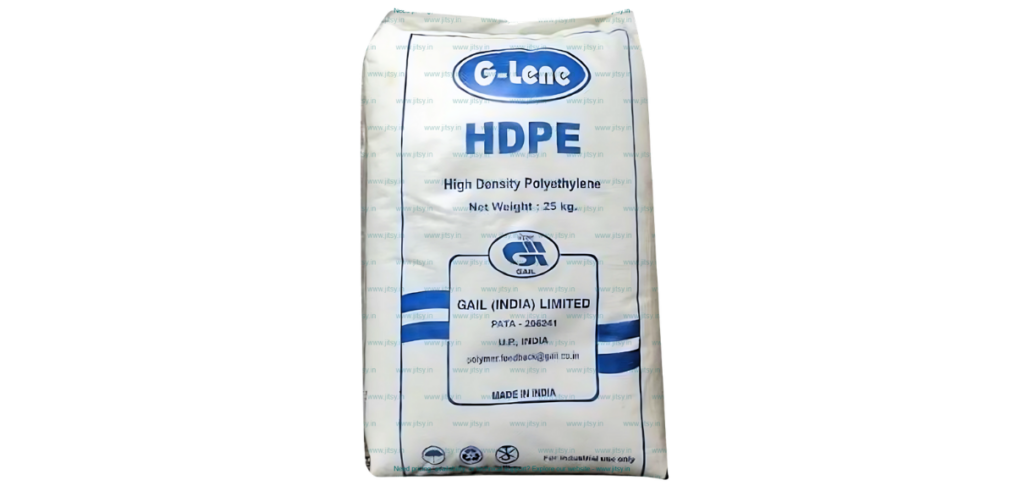
Gail HDPE G‑Lene E45A003 is a high‑density polyethylene (HDPE) resin from GAIL (India) Limited designed specifically for blown film extrusion as a blending component. GAIL positions this grade for use in blend with LDPE/LLDPE to produce co‑extruded laminated and non‑laminated films for a wide range of packaging and industrial film applications.
As an HDPE, E45A003 belongs to the linear polyethylene family, typically chosen when film converters need to add stiffness, strength, and load‑carrying capability compared to LDPE/LLDPE‑only structures. What makes E45A003 distinct is its low flow (low MFI) profile, which supports film strength and stiffness contribution while still being described as offering excellent processability with moderate stiffness when used in properly engineered blends.
For standards‑driven procurement, the manufacturer’s sheet states that E45A003 conforms to natural‑resin designation IS 7328‑3B‑FB‑DXDA of IS 7328:2020 (certificate available on request). This is useful when film producers must document resin designation alignment for internal QA or customer qualification.
Technical insights
Typical datasheet‑style properties
- Melt Flow Index (MFI, I2; 190°C/2.16 kg): 6 g/10 min (ASTM D1238)
- Density (23°C): 945 g/cm³ (ASTM D1505)
- Tensile strength at break (MD/TD): 400/350 kg/cm² (ASTM D882)
- Elongation at break (MD/TD): 750/900% (ASTM D882)
- Tear strength (MD/TD): 3/4 g (ASTM D1922)
What these properties indicate for film performance
MFI 0.6 (low flow): A low MFI HDPE typically contributes to higher melt strength and improved film strength/stiffness versus higher‑MFI film grades. In practice, this can help converters build tougher structures, but it also means processing and blend design matter to maintain stable bubble and output. Density 0.945: This density sits in the HDPE range and generally correlates with higher stiffness and better barrier contribution than lower‑density polyethylenes. In multilayer films, it’s often used to improve “body” and handling without over‑softening. MD/TD tensile and elongation: The tensile and elongation values (noted as typical on 40–50 µm blown films) indicate a balance of strength and ductility. This is relevant for packaging films that must resist tearing during handling while still stretching rather than cracking. MD/TD tear: Tear values highlight directional behaviour common in blown films. This is one reason E45A003 is positioned as a blending/co‑ex component—layer design and blend ratios are used to tune tear propagation and toughness. Important note on “typical” data: These are typical guidance values from the manufacturer sheet (not guaranteed limits). Final properties depend heavily on blend ratio, film thickness, blow‑up ratio, frost line height, and layer structure.Applications
Co‑extruded packaging films (laminated and non‑laminated)
E45A003 is recommended for co‑extruded blown film structures where converters blend HDPE with LDPE/LLDPE to balance stiffness, toughness, sealability, and process stability. It’s relevant for packaging films where better “hand feel” and strength are needed without losing the processing advantages of LD/LLDPE.Industrial wrap and protective films
For industrial wrapping films and protective packaging, adding a low‑flow HDPE component can improve load‑holding and puncture resistance in the final structure. E45A003 is typically considered when the film must stay firm during wrapping, stacking, and transit.Bag and liner structures (multi‑layer)
In bags, liners, and sack‑type films, E45A003 can be used as part of a multilayer recipe to increase stiffness and strength while LD/LLDPE layers contribute seal performance and toughness. This is especially useful when converters need a more rigid film without moving to a full HDPE monolayer design.Comparable alternatives
Comparable HDPE film grades exist, but E45A003 is specifically positioned as a blown‑film blending grade for LD/LLDPE co‑extrusion.- G‑Lene F45A003 (GAIL): Often referenced as a blown‑film HDPE grade around 45 MFI with similar density (~0.945 g/cm³). Relative to E45A003 (0.6 MFI), a lower MFI grade may contribute more stiffness/strength but can be less forgiving in processing. Use official TDS comparisons to confirm film mechanicals and intended use language.
- LLDPE blown‑film grades (e.g., G‑Lene LLDPE film grades): LLDPE‑dominant structures typically deliver better toughness and sealability, but can feel softer and less stiff. E45A003 is used when you want to “lift” stiffness/strength in a co‑ex structure while keeping LD/LLDPE benefits.
- Other supplier HDPE film components: Other manufacturers offer low‑flow HDPE film resins, but direct equivalence should only be claimed after matching MFI, density, and film mechanicals under similar test conditions (thickness, BUR, drawdown).
Common search variants
Also searched as: Gail E45A003 HDPE, E45A003 HDPE blown film, HDPE blown film granules, HDPE dana for film. Common variants/misspellings: G‑lene E45A003, E45A 003, E45A003A.
Gail HDPE G Lene I50A180
G‑Lene I50A180 is a high‑density polyethylene (HDPE) injection‑moulding grade from GAIL (India) Limited, designed for fast filling of thin‑wall household parts where surface finish and cycle time matter. In GAIL’s own technical sheet, the grade is positioned for household products such as buckets, mugs, and similar injection‑moulded items, highlighting excellent processability, low degree of warpage, and superior gloss.
As a very‑high‑flow HDPE (high MFI) with high density, I50A180 is typically selected by moulders who want a practical stiffness–toughness balance for everyday domestic containers and general rigid moulded goods—especially when the mould has thin sections, long flow lengths, or needs consistent appearance across high‑volume production runs. GAIL states the resin conforms to the natural‑resin designation IS 7328‑3B‑MB‑FXDE of IS 7328:2020 (certificate available on request), which is highly relevant for moulded household product applications in India.
Technical insights (what the key properties indicate)
Flow & mould filling (MFI)
With a typical Melt Flow Index (190°C/2.16 kg) of 20 g/10 min, I50A180 sits in the very‑high‑flow injection moulding class. Practically, this supports faster filling, easier processing of thin walls, and shorter cycle times—helpful for buckets, mugs, and toy parts where productivity and finish are critical.Stiffness & part rigidity (density and flexural modulus)
A typical density of 0.952 g/cm³ indicates a higher‑density HDPE structure that generally contributes to stiffness and dimensional stability. A flexural modulus around 9000 kg/cm² (as commonly mirrored by distributor listings) aligns with the “houseware rigidity” requirement—parts feel firm and hold shape under normal household loads.Strength & ductility (tensile and elongation)
Typical tensile strength at yield is 230 kg/cm² with elongation at yield of 10%, and elongation at break of 400% (on compression‑moulded specimens). This combination is commonly read by moulders as “stiff enough to hold form, but not brittle,” supporting everyday handling and drops typical in domestic use.Stress crack resistance (ESCR)
The ESCR value is listed as <10 hours (10% Igepal, ASTM D1693, F50), which signals that this is not a stress‑crack‑resistant packaging/industrial container grade. It’s better positioned as a standard household injection grade where high flow, gloss, and warpage control are prioritized over long‑term ESCR performance.Heat performance (Vicat)
A typical Vicat softening point of 122°C helps buyers assess heat tolerance for household environments (warm water exposure, general heat near kitchens, etc.), without positioning it as a high‑temperature engineering plastic.Processing guidance (from the datasheet)
GAIL’s processing guidance lists barrel temperature 200–280°C and mould temperature 25–40°C—useful guardrails for stable moulding, finish control, and warpage management in thin‑wall parts.Applications (industries & use cases)
Household containers and utility items: I50A180 is commonly specified for injection‑moulded buckets, mugs, and household containers where thin walls, good surface gloss, and low warpage are important. The very‑high‑flow nature supports clean filling and consistent appearance in high‑cavity or fast‑cycle production. Toys and general rigid moulded goods: For toy components and general‑purpose rigid injection parts, moulders often need a balance of stiffness, ductility, and processability. I50A180’s typical tensile/elongation profile and high flow make it suitable where the part geometry is complex or thin, and where visual finish matters. Thin‑wall injection moulding for mass production: When the priority is productivity—short cycle times, reliable filling, and stable dimensions—very‑high‑flow HDPE grades like I50A180 are often preferred over lower‑MFI options that may offer different mechanical emphasis but can be slower to fill in thin sections.Comparable alternatives (positioning vs similar grades)
GAIL I56A200U (similar flow class): I56A200U is often referenced as a comparable GAIL injection grade with similar high flow (commonly cited around 20 MFI) and slightly higher density positioning in some listings. Where confirmed by manufacturer sheets, moulders may compare these two for gloss/warpage behaviour and the stiffness “feel” of finished parts. Do not assume drop‑in equivalence unless the latest GAIL TDS values and IS designation match your requirement. GAIL I50A250 (higher flow): I50A250 is positioned as a higher‑flow option (commonly cited around 25 MFI). In general, higher flow can further improve thin‑wall filling and cycle time, but may shift the balance of mechanical performance depending on the exact grade design. Use manufacturer TDS comparison to validate performance targets (warpage, stiffness, impact). Lower‑MFI injection grades (e.g., crate/rigid emphasis): Compared with lower‑MFI HDPE injection grades, I50A180 is clearly positioned for thin‑wall houseware productivity and appearance (gloss, warpage control). If your application needs higher ESCR or different long‑term performance, a different HDPE family/grade selection may be more appropriate.Common search variants
Also searched as: “Gail I50A180 HDPE”, “G‑Lene I50A180 20 MFI”, “HDPE I50A180 injection moulding”, “I50A180 HDPE dana / granules”. Common variants/misspellings: “150A180”, “I50 A180”, “G Lene I50A180”, “Glen I50A180”.
Gail HDPE G Lene I50A250
Gail HDPE G‑Lene I50A250 is a high‑density polyethylene (HDPE) injection‑moulding grade from GAIL (India) Limited under the G‑Lene polymer range. It is positioned as a very‑high‑flow resin designed for medium‑to‑large household moulded parts where fast filling, good surface finish, and dimensional stability matter—such as buckets, flowerpots, and toys.
From a polymer‑engineering standpoint, HDPE is a linear polyolefin known for a strong stiffness‑to‑weight profile and practical impact resistance for everyday domestic products. In I50A250, the high flow supports easier mould filling for larger sections and complex geometries, while the grade is described as offering excellent processability, high gloss and flow, good mechanical properties, and a low degree of warpage—useful for moulders trying to balance cycle time, appearance, and part stability.
For buyers who need standards alignment for household moulded products, GAIL states the grade conforms to natural‑resin designation IS 7328‑3B‑MB‑FXDE of IS 7328:2020 (certificate available on request). This makes I50A250 a relevant option when procurement teams are filtering HDPE injection grades by Indian standard designation in addition to flow and density.
Technical insights
Typical datasheet‑style properties (from the provided manufacturer/brochure references)
- Melt Flow Index (MFI, I2; 190°C/2.16 kg): 25 g/10 min (ASTM D1238)
- Density (23°C): 952 g/cm³ (ASTM D1505)
What these properties indicate for performance
MFI (flow) — why it matters: A typical 25 MFI places I50A250 in the very‑high‑flow HDPE injection‑moulding class. Practically, this can help with faster cavity fill, easier gating, and shorter cycle times on medium‑to‑large parts (where thick sections and long flow lengths can otherwise slow production). Density — what it signals: A density around 0.952 g/cm³ is characteristic of HDPE grades built for stiffness and shape retention versus LDPE/LLDPE. For household containers and utility parts, this supports a more rigid feel and better dimensional control. Mechanical properties note (important): The provided excerpt does not include a full mechanical table (tensile, elongation, flexural modulus, etc.). For engineering sign‑off, confirm these values from the official GAIL datasheet or a distributor certificate before final material selection.Applications
Buckets and utility containers (houseware)
For HDPE bucket moulding and similar utility containers, I50A250 is selected when moulders want very high flow to fill larger sections quickly while still maintaining the stiffness expected from HDPE. The grade’s positioning around low warpage and good surface finish supports consistent part appearance across high‑volume production.Flowerpots and medium‑to‑large household items
In flowerpot moulding HDPE applications, flow and gloss are often prioritized because parts are large, visible, and commonly produced in multiple colours. I50A250’s high‑flow profile can help reduce fill‑related defects and improve productivity for medium‑to‑large moulds.Toys and general injection‑moulded components
For toy parts and general household injection moulding, the combination of HDPE stiffness with high flow can be useful for producing parts with good aesthetics and stable dimensions. As the grade is not described as UV‑stabilized in the provided inputs, outdoor exposure requirements should be evaluated case‑by‑case.Comparable alternatives
Within GAIL’s own G‑Lene portfolio, I50A250 is commonly positioned alongside I50A180 and I56A200U as household‑focused injection grades.- G‑Lene I50A180: Typically referenced at ~20 MFI with similar density (~0.952 g/cm³). Compared to I50A180, I50A250’s higher MFI (25) is positioned for easier flow and faster filling, especially helpful for medium‑to‑large The trade‑off in many polymer families is that higher flow can come with reduced toughness or ESCR versus lower‑flow counterparts—so confirm with official mechanical/ESCR data for your specific part.
- G‑Lene I56A200U: Also referenced around ~20 MFI, and described as UV‑stabilized in the provided inputs. If your application needs better outdoor durability, I56A200U may be considered; if your priority is maximum flow for large moulds, I50A250 is positioned as the higher‑flow choice.
Common search variants
Also searched as: HDPE I50A250, Gail I50A250 HDPE granules, I50A250 HDPE dana, HDPE injection moulding granules. Common variants/misspellings: G‑lene I50A250, I50A 250, GAIL I50A250.
Gail HDPE G Lene I56A200U
G‑Lene I56A200U is a UV‑stabilized high‑density polyethylene (HDPE) injection‑moulding grade from GAIL (India) Limited, developed for fast‑cycle production of thin‑wall household items where dimensional stability and appearance matter. In GAIL’s own technical sheet, the grade is recommended for household products such as buckets, mugs and toys, and is described as offering excellent processability with a low degree of warpage and good mechanical properties—making it a practical choice for high‑output moulders.
What differentiates I56A200U versus standard high‑flow houseware HDPE grades is the added UV stabilization. This helps reduce performance loss from indirect sunlight or outdoor exposure during use (for example, outdoor‑stored buckets, utility mugs in semi‑open areas, or toys that see sun exposure). The datasheet also states the resin conforms to the natural‑resin designation IS 7328‑3B‑MB‑FXDE of IS 7328:2020 (certificate available on request), aligning the grade with Indian standards language relevant to moulded household product applications.
Technical insights (what the key properties indicate)
Flow & fast cycling (MFI)
With a typical Melt Flow Index (190°C/2.16 kg) of 20 g/10 min, I56A200U is a very‑high‑flow HDPE injection grade. For moulders, this typically translates to easier filling of thin sections, better replication of details, and faster cycle times—especially useful in high‑cavity production of houseware parts.Stiffness & “bucket feel” (density and flexural modulus)
A typical density of 0.952 g/cm³ indicates a high‑density structure that supports rigidity and dimensional stability in finished parts. The flexural modulus (typical 9000 kg/cm²) reinforces its positioning for rigid household items that must hold shape under load, stacking, and daily handling.Strength at yield (tensile)
The tensile strength at yield is typically 260 kg/cm² (Type IV specimen), which is a key reason this grade is often positioned as a “stiffer / stronger” high‑flow houseware option. Buyers use this as a quick indicator of how well parts will resist permanent deformation under normal household stresses.Heat behaviour (Vicat)
A Vicat softening point of 123°C helps indicate the grade’s resistance to softening under heat. For household items, this supports confidence in everyday warm‑use environments (without claiming engineering‑plastic heat resistance).UV stabilization (what it does and what it doesn’t)
UV stabilization is intended to slow down UV‑driven degradation such as discoloration, surface chalking, and embrittlement over time. It doesn’t automatically mean “outdoor‑grade for years” in every design—final performance still depends on part thickness, pigment/additives, and exposure conditions.Applications (industries & use cases)
Thin‑wall household containers (buckets, mugs, utility items): I56A200U is recommended for injection‑moulded buckets, mugs, and similar houseware where high flow supports fast filling and low warpage supports consistent shape and stacking. This is a strong fit for moulders optimizing productivity while maintaining a clean surface finish. Toys and consumer moulded parts with sunlight exposure: For toy parts and general consumer mouldings that may see sunlight during use or storage, UV stabilization is a practical advantage. The grade’s high flow supports detailed mould filling, while its stiffness profile supports durable everyday handling. Fast‑cycle injection moulding for high‑volume production: When cycle time and throughput are key, very‑high‑flow HDPE grades are often preferred. I56A200U is positioned for fast cycling with good mechanical properties, making it suitable for moulders balancing output, finish, and part rigidity.Comparable alternatives (positioning vs similar grades)
G‑Lene I50A180 (non‑UV, similar flow): I50A180 is commonly compared because it is also a very‑high‑flow HDPE (typical MFI 20) with similar density positioning. The practical difference is that I56A200U adds UV stabilization and is typically cited with higher tensile strength at yield, making it a better fit when outdoor/indirect‑sun exposure is expected and when a stiffer “houseware feel” is desired. G‑Lene I50A250 (higher flow): I50A250 is positioned as a higher‑flow alternative (often cited around 25 MFI). Higher flow can improve thin‑wall filling and productivity, but moulders should validate whether the mechanical balance and warpage behaviour match the part requirement. Treat it as a processing‑driven alternative, not an automatic substitute. Other high‑flow HDPE injection grades in India: Comparable high‑flow injection‑moulding HDPE grades exist across Indian producers and import brands, but direct equivalence should only be claimed when MFI, density, tensile, flexural modulus, and any IS designation / additive package (like UV stabilization) match the manufacturer TDS requirements for the end‑use.Common search variants
Also searched as: “Gail I56A200U HDPE”, “G‑Lene I56A200U UV stabilized”, “HDPE I56A200U injection moulding granules”, “I56A200U HDPE dana”. Common variants/misspellings: “I56A200UA”, “I56 A200U”, “G Lene I56A200U”, “Glen I56A200U”, “I56A200 U”.
Gail HDPE G Lene I60A080
Gail HDPE G‑Lene I60A080 is a high‑density polyethylene (HDPE) resin designed for injection moulding where fast filling, clean surface finish, and consistent rigidity are required. Positioned as a high‑flow, high‑density grade, it is commonly selected for general‑purpose and industrial‑purpose crates, caps and closures, and rigid container‑type moulded parts.
This grade is manufactured by GAIL (India) Limited under its G‑Lene petrochemicals portfolio. In GAIL’s own technical sheet, I60A080 is described as an injection‑moulding HDPE made using G‑Lene swing‑plant technology (Sclairtech solution and Unipol gas‑phase processes). For buyers, that translates into a resin family built for repeatable processing, high‑cycle moulding, and dependable part performance in day‑to‑day industrial handling.
A key trust signal for procurement and quality teams: GAIL states that I60A080 conforms to IS 7328:2020 with natural‑resin designation IS 7328‑3‑MB‑GXDD (certificate available on request), supporting standardization for moulded product manufacturing.
Technical insights
I60A080 is typically evaluated by moulders on flow, stiffness, surface, and impact balance: Flow and cycle‑time behavior: With a typical Melt Flow Index (MFI, I2 at 190°C/2.16 kg) of 8.0 g/10 min, this is a high‑flow HDPE suited to faster filling of thin‑wall or complex‑geometry moulds (common in crates and closure designs). Higher flow often supports shorter cycle times and easier mould filling, especially when running multi‑cavity tools. Stiffness and dimensional stability: A typical density of 0.960 g/cm³ places I60A080 firmly in the high‑density class, generally associated with higher stiffness and better load‑bearing behavior in rigid parts. Combined with a typical flexural modulus of 9500 kg/cm², it is positioned for crates and rigid moulded components where shape retention matters. Strength, toughness, and handling durability: Typical tensile strength at yield of 255 kg/cm² indicates solid load resistance for everyday industrial use. Typical elongation at yield of 10% and elongation at break >350% reflect a material that can deform before failing—useful in parts that see drops, stacking, and repeated handling. Surface and heat resistance indicators: Typical Shore D hardness of 67 supports a “hard, rigid feel” expected in crates and closures. Typical Vicat softening point (10 N) of 124°C is a practical indicator for heat‑related dimensional stability (e.g., warm filling environments, storage in hot conditions), while still requiring process‑appropriate design and testing.Applications
Injection‑moulded crates (general‑purpose and industrial)
G‑Lene I60A080 is widely positioned for injection‑moulded crates where moulders need a high‑flow HDPE that fills quickly and produces stiff, durable parts. Typical use cases include beverage crates, industrial transport crates, and handling boxes where low warpage and consistent rigidity help maintain stackability and dimensional control.Caps and closures
For caps and closures, the grade’s high flow supports high‑cavity moulds and fast cycle times, while the high density contributes to rigidity and thread integrity. It is a practical choice for closure‑type parts where consistent mould filling and repeatable part dimensions are critical.Rigid moulded parts (luggage shells, helmets, container‑type parts)
GAIL also positions I60A080 for rigid moulded parts such as luggage shells and helmets. In these applications, moulders often want a balance of stiffness, surface appearance, and impact tolerance—especially when parts must hold shape while still resisting cracking under handling stress.Comparable alternatives
Comparable HDPE injection‑moulding grades exist in India, including other GAIL G‑Lene injection grades such as I60U080 (UV‑stabilized) and I62A080U. However, direct equivalence should not be assumed unless the manufacturer technical data sheets match on key parameters such as MFI (flow), density (stiffness), tensile at yield, impact (Izod), and warpage behavior under similar test methods. Positioning‑wise, I60A080 is best treated as a standard (non‑UV) high‑flow crate/cap grade. If your application involves outdoor exposure and long sunlight resistance requirements, UV‑stabilized variants may be more appropriate—validate via the specific grade’s manufacturer sheet and your part testing.Common search variants
Also searched as: Gail HDPE I60A080, G‑Lene I60A080 granules, HDPE I60A080 injection moulding dana, I60A080 MFI 8. Common variants: I60A 080, I60A80, G Lene I60A080.
Gail HDPE G Lene I60U080
Gail HDPE G‑Lene I60U080 is a UV‑stabilized high‑density polyethylene (HDPE) resin designed for injection moulding of crates and rigid moulded parts that see outdoor exposure. It is positioned for applications like soft‑drink and milk crates, fishing crates, and helmets—where converters need high flow for fast filling, low warpage for dimensional control, and weatherability to handle sunlight‑driven ageing.
This grade is manufactured by GAIL (India) Limited under the G‑Lene petrochemicals portfolio. GAIL describes I60U080 as an injection‑moulding HDPE produced via G‑Lene swing‑plant technology (Sclairtech solution and Unipol gas‑phase routes) and supplied in UV‑stabilized form (the “U” suffix). For buyers, this means a resin intended to keep parts tougher and more stable in real‑world outdoor handling—stacking, drops, moisture, and repeated sunlight exposure.
For specification and QA: the GAIL technical sheet explicitly states that I60U080 conforms to IS 7328:2020 with natural‑resin designation IS 7328‑3‑MD‑GXDD (certificate available on request). This is a strong compliance anchor for moulded product raw‑material standardization.
Technical insights
I60U080 is typically evaluated by moulders on flow, stiffness/shape retention, impact balance, and outdoor durability: Flow and cycle‑time performance: With a typical Melt Flow Index (MFI, I2 at 190°C/2.16 kg) of 8.0 g/10 min, I60U080 sits in the high‑flow injection‑moulding class. High flow generally supports easier filling of thin walls, ribs, and complex crate geometries—often enabling shorter cycle times and more consistent part replication across cavities. Stiffness and stacking behavior: A typical density of 0.960 g/cm³ indicates a high‑density structure associated with higher stiffness in rigid parts. The typical flexural modulus of 9500 kg/cm² supports the grade’s positioning for crates that must hold shape under stacking and transport loads. Strength and impact balance for handling crates: Typical tensile strength at yield of 255 kg/cm² indicates solid load‑bearing capability for routine handling. Typical elongation at yield of 10% and elongation at break >350% suggest the resin can deform before failing—useful in crates and helmets that face repeated knocks. Surface hardness and heat‑softening indicator: Typical Shore D hardness of 67 aligns with the rigid feel expected in crates and protective rigid parts. Typical Vicat softening point (10 N) of 124°C is a practical indicator for resistance to softening at elevated temperatures during storage/transport. ESCR and what it means in practice: The grade includes an ESCR value (ASTM D1693, 10% Igepal, F50) reported as <24 hours in the provided inputs. ESCR is relevant when parts see detergents, surfactants, or stress + chemical exposure; for crate applications, validate ESCR needs against your end‑use environment and cleaning chemicals. UV stabilization (outdoor weatherability): UV stabilization is intended to improve resistance to sunlight‑driven degradation such as embrittlement, surface cracking, and discoloration. For beverage and dairy crates stored outdoors, this is often the key differentiator versus non‑UV injection grades.Applications
Outdoor soft‑drink and milk crates
G‑Lene I60U080 is recommended for soft‑drink and milk crates used in outdoor distribution cycles—loading bays, open trucks, and yard storage. High flow supports high‑throughput moulding, while UV stabilization helps maintain durability and appearance over repeated sunlight exposure.Fishing crates and outdoor handling baskets
Fishing crates and outdoor handling baskets often face wet conditions, sunlight, and rough handling. I60U080’s combination of stiffness, impact balance, and weatherability makes it a practical candidate for rigid crate designs that must stay stackable and crack‑resistant.Helmets and rigid moulded protective parts
GAIL also positions I60U080 for helmets. In rigid protective parts, converters typically value consistent mould filling, good surface finish, and a balance of stiffness and toughness—while UV stabilization can help when products are stored or used in outdoor environments.Comparable alternatives
Comparable HDPE injection‑moulding grades exist in India, including other GAIL G‑Lene grades such as I60A080 (non‑UV) and I62A080U (UV‑stabilized, higher stiffness). However, direct interchangeability should not be assumed unless manufacturer data sheets align on key parameters like MFI (flow), density (stiffness), tensile at yield, flexural modulus, impact (Izod), ESCR, and the presence/type of UV stabilization. Positioning‑wise, I60U080 can be treated as a UV‑stabilized version of a high‑flow crate grade: it targets outdoor‑exposed crates without fundamentally moving away from the high‑flow, production‑friendly processing window. If you need higher stiffness for stacking, a higher‑modulus UV crate grade may be evaluated; if the application is indoor, a non‑UV high‑flow grade may be sufficient—confirm via mould trials.Common search variants
Also searched as: Gail HDPE I60U080, G‑Lene I60U080 UV stabilized, HDPE crate grade UV, I60U080 MFI 8, HDPE dana injection moulding. Common variants: I60U 080, I60U080A, G Lene I60U080, Gail I60 U080.
Gail HDPE G Lene I62A080U
Gail HDPE G‑Lene I62A080U is a UV‑stabilized high‑density polyethylene (HDPE) resin engineered for injection moulding of general‑purpose crates and other rigid moulded parts where high stiffness, dimensional stability, and good surface gloss are required. It is positioned for converters who need a high‑flow HDPE that can run efficiently in production while helping reduce warpage in large, flat, ribbed crate geometries.
This grade is manufactured by GAIL (India) Limited under the G‑Lene petrochemicals portfolio. In GAIL’s own technical sheet, I62A080U is described as an HDPE produced via G‑Lene swing‑plant technology (Sclairtech solution and Unipol gas‑phase routes) and supplied in UV‑stabilized form (the “U” suffix), making it better suited for applications that may see outdoor exposure or prolonged light‑induced aging compared with non‑UV grades.
For procurement and QA teams, the key compliance anchor is explicit: GAIL states that I62A080U conforms to IS 7328:2020 with natural‑resin designation IS 7328‑3‑MB‑HXDD (certificate available on request). This supports standardization when specifying polyethylene raw material for moulded products.
Technical insights
I62A080U is typically assessed by moulders on flow (fill), stiffness (stacking/load), strength, and heat/shape stability: Flow and mould filling: A typical Melt Flow Index (MFI, I2 at 190°C/2.16 kg) of 8.2 g/10 min places this grade in the high‑flow injection‑moulding class. In practical terms, high flow helps fill thin sections, ribs, and complex crate features more easily—often supporting shorter cycle times and smoother processing in multi‑cavity or large‑part tools. Stiffness and stacking performance: A typical density of 0.963 g/cm³ indicates a high‑density structure that generally correlates with higher stiffness and better creep resistance in rigid parts. This is reinforced by the typical flexural modulus of 14000 kg/cm², which signals a very stiff material—useful for crates and industrial containers where stackability and shape retention are critical. Strength and dimensional stability balance: Typical tensile strength at yield of 310 kg/cm² supports load resistance in handling and transport use. Typical elongation at yield of 7% suggests a stiffer, more “shape‑holding” behavior at yield compared with softer grades—often aligned with low‑warpage, high‑stiffness crate positioning. Heat‑related softening indicator: A typical Vicat softening point (10 N) of 128°C is a helpful indicator for resistance to softening under elevated temperatures (e.g., hot storage/transport conditions). It does not replace part‑level testing, but it’s a useful screening metric for rigid moulded applications. UV stabilization (why the “U” matters): UV stabilization is intended to improve resistance to sunlight‑driven degradation such as embrittlement, cracking, and discoloration over time. For crates that sit outdoors (yards, loading bays, agriculture, open trucks), UV stabilization is often a key differentiator versus standard injection grades.Applications
General‑purpose injection‑moulded crates
G‑Lene I62A080U is designed for general‑purpose crates where converters want a combination of high stiffness, good gloss, and low warpage. Typical use cases include beverage and dairy distribution crates, retail logistics crates, and reusable handling crates where stacking strength and dimensional control matter.Industrial containers, totes, and handling boxes
For industrial material handling, the grade’s high stiffness and dimensional stability support rigid containers and totes used in warehouses and factories. UV stabilization can be valuable when containers are stored in semi‑open areas or frequently transported outdoors.Outdoor‑exposed rigid moulded parts
Beyond crates, I62A080U can be used for rigid injection‑moulded parts that see intermittent to prolonged outdoor exposure. The UV‑stabilized formulation helps maintain mechanical integrity and appearance longer than non‑UV variants, subject to part design and exposure conditions.Comparable alternatives
Comparable HDPE injection‑moulding grades exist in India, including other GAIL G‑Lene injection grades such as I60A080 (non‑UV) and I60U080 (UV‑stabilized). However, direct interchangeability should not be assumed unless manufacturer technical sheets align on key performance drivers like MFI (flow), density (stiffness), tensile at yield, flexural modulus, and the presence/type of UV stabilization. Based on the provided data, I62A080U is positioned as the stiffer, UV‑stabilized crate grade: it combines high flow (MFI ~8) with higher density and notably higher flexural modulus, making it a strong fit when stacking rigidity and outdoor durability are prioritized. If your application is purely indoor and cost‑sensitive, non‑UV high‑flow grades may be evaluated—but confirm warpage, cycle time, and long‑term performance through mould trials.Common search variants
Also searched as: Gail HDPE I62A080U, G‑Lene I62A080U granules, UV stabilized HDPE crate grade, HDPE injection moulding dana. Common variants: I62A 080U, I62A080 U, G Lene I62A080U, I62A080U MFI 8.2.
Gail HDPE G Lene I62U080U
Gail HDPE G‑Lene I62U080U is a UV‑stabilized high‑density polyethylene (HDPE) resin positioned for injection moulding of outdoor‑exposed crates and rigid parts that must hold shape under stacking loads and maintain performance under sunlight and weather. It is commonly referenced for soft‑drink crates, milk crates, fishing crates, vegetable crates, and helmets—applications where converters want high stiffness, low warpage, and excellent weatherability.
The grade belongs to GAIL (India) Limited’s G‑Lene HDPE portfolio and is produced via G‑Lene swing‑plant technology (Sclairtech solution and Unipol gas‑phase routes) as described across GAIL’s G‑Lene materials. The “U” designation indicates UV stabilization, intended to improve resistance to sunlight‑driven ageing such as embrittlement and discoloration during outdoor storage and transport cycles.
Compliance positioning is an important part of the spec story: based on the inputs provided, I62U080U is stated to conform to IS 7328:2020 with natural‑resin designation IS 7328‑3‑MD‑HXDD. Where your internal compliance language must be strict, keep this phrasing tied to the GAIL‑linked grade listing/brochure references used for this grade.
Technical insights
Because I62U080U is primarily referenced through GAIL‑linked grade listings and brochure‑style material (rather than a standalone, openly accessible TDS in the inputs), it’s best to present key numbers as typical/indicative and keep the page focused on what buyers evaluate in crate‑grade HDPE: Flow for injection moulding (thin walls, ribs, fast cycles): The grade is positioned as a high‑flow injection resin, with typical MFI (I2) around 8.2 g/10 min in the referenced listings. High flow generally supports easier filling of large crate geometries with ribs and handles, and can help reduce short shots and improve cycle efficiency in high‑throughput moulding. Density and stiffness (stacking and creep resistance): Listings indicate a typical density around 0.963 g/cm³, consistent with a high‑density structure that generally correlates with higher stiffness and better creep resistance in rigid parts. For crates, this matters for stack stability, dimensional control, and resistance to deformation under load. Low warpage and dimensional stability (why converters choose it): I62U080U is repeatedly positioned for low warpage and dimensional stability—critical for crates that must nest/stack correctly and maintain consistent geometry across production batches. In practice, warpage performance depends on tool design, cooling balance, and processing window, so mould trials remain the final proof. UV stabilization and outdoor service life: UV stabilization is the core differentiator versus non‑UV crate grades. It is intended to slow sunlight‑driven degradation, helping crates and helmets retain toughness and appearance longer during outdoor storage, transport, and repeated handling.Applications
Soft‑drink and milk crates (outdoor distribution cycles)
Soft‑drink and milk crates often spend significant time outdoors—loading bays, open trucks, and yard stacking. I62U080U is positioned for these use cases because UV stabilization supports weatherability, while the high‑stiffness profile supports stacking strength and dimensional stability over repeated cycles.Fishing and vegetable crates (wet handling + sunlight exposure)
Fishing and vegetable crates see wet conditions, repeated impacts, and prolonged sunlight exposure in real‑world logistics. This grade is referenced for such crates where converters want a rigid, stack‑resistant part that maintains service life without early embrittlement or discoloration.Helmets and rigid moulded protective parts
I62U080U is also positioned for helmets and similar rigid moulded parts. In these applications, moulders typically value consistent mould filling, surface finish (gloss), and a stiffness‑toughness balance—while UV stabilization can be relevant for storage and outdoor use conditions.Comparable alternatives
Comparable HDPE injection‑moulding grades exist in India, including other GAIL G‑Lene crate grades such as I60U080 (UV‑stabilized, high‑flow) and I62A080U (UV‑stabilized, high‑stiffness). Based on the provided inputs, I62U080U is best positioned as a UV‑stabilized, higher‑stiffness outdoor crate grade (typical MFI ~8.2 and density ~0.963). In contrast, I60U080 is typically referenced as a UV‑stabilized outdoor crate grade with a slightly lower density profile, while I62A080U is a well‑documented UV‑stabilized high‑stiffness injection grade with a standalone TDS.Common search variants
Also searched as: Gail HDPE I62U080U, G‑Lene I62U080U UV stabilized, HDPE UV crate grade, HDPE dana for crates. Common variants: I62U 080U, I62U080UA, G Lene I62U080U, Gail I62 U080U.
Gail HDPE G Lex B52A003
Gail HDPE G‑Lex B52A003 (and the related B52A003N) is a high‑density polyethylene (HDPE) blow‑moulding resin from GAIL (India) Limited developed for small‑ to medium‑size blow‑moulded containers. It is positioned for packaging that needs a dependable balance of stiffness, impact resistance, and environmental stress crack resistance (ESCR)—especially in applications where bottles are dropped, squeezed, stacked, or exposed to oils, detergents, and household/industrial chemicals.
GAIL describes this grade as having good processability with a medium melt flow index, enabling stable mould filling and cycle control for everyday container formats. Across the G‑Lex HDPE family, GAIL references CX slurry process technology as a platform associated with mechanical strength, impact performance, and ESCR.
For standards alignment, the datasheet notes conformance to natural‑resin designation IS 7328‑3B‑BB‑FXDA of IS 7328:2020 (polyethylene raw material for moulding/extrusion for blow‑moulded products). The resin is supplied as natural/white pellets, typically in 25 kg woven sacks, with standard storage guidance: keep material dry, store below 50 °C, and avoid contamination.
Technical insights
- Melt Flow Index (I2, 190 °C/2.16 kg): 0.42 g/10 min (typical): A medium MFI helps balance mould filling and parison control for blow moulding—supporting productivity without sacrificing container strength.
- Density (23 °C): 0.954 g/cm³ (typical): A density in this range supports stiffness and top‑load strength, which is important for stackable bottles and cans.
- Tensile strength at yield: 240 kg/cm² (typical): Indicates the resin’s ability to resist deformation under load—useful for bottles that must hold shape during handling and storage.
- Elongation at yield: 10% (typical): Suggests controlled ductility at yield; for blow‑moulded packaging, this helps balance stiffness with practical toughness.
- Flexural modulus: 10000 kg/cm² (typical): Higher modulus generally correlates with rigidity, helping containers feel firm and resist paneling.
- Izod impact strength: 120 J/m (typical): Supports drop resistance, especially relevant for edible‑oil and lube‑oil bottles that face rough handling.
- Shore D hardness: 62 (typical): Indicates surface hardness and scratch resistance—useful for consumer packaging aesthetics and handling.
- ESCR (10% Igepal): >500 hours (typical): A key selection factor for blow‑moulded containers; higher ESCR helps reduce cracking in contact with surfactants, oils, and stress‑concentrated areas (handles, corners, base).
Applications
Edible‑oil and ghee bottles (food packaging): B52A003 is positioned for edible‑oil and ghee containers where stiffness and drop resistance matter, and where packaging must hold shape during transport, stacking, and retail handling. Lube‑oil and automotive fluid containers: For lube‑oil bottles and small jerrycans, ESCR and chemical resistance become critical. This grade is relevant where containers face long storage times, temperature changes, and exposure to oils and additives. Toiletries and cosmetics bottles: In personal care packaging, converters need clean moulding, good stiffness, and impact resistance for daily‑use bottles. B52A003’s medium‑flow blow‑moulding positioning fits common toiletry formats. Pharmaceutical and healthcare packaging (non‑sterile containers): The grade is referenced for pharma‑type bottles where consistent moulding and crack resistance are important. Final suitability depends on the specific product, regulatory requirements, and the converter’s compliance program.Comparable alternatives
B52A003 is a purpose‑built blow‑moulding HDPE grade, so comparisons should be made against other container‑grade HDPEs—not pipe or film grades.- B52A003N: Typically treated as the closest alternative within the same family. Substitution should be validated against the latest manufacturer documentation (and COA) to confirm any stabilizer/additive differences.
- General film or pipe grades (e.g., E52A003/E52A003N, P52A003): These are positioned for different processing methods and performance targets (film/pipe). Even if some base properties look similar, they are not direct substitutes for blow‑moulded container production without trials and datasheet matching.
Common search variants
Also searched as: HDPE blow moulding granules, bottle grade HDPE dana, edible oil bottle HDPE, lube oil container HDPE. Common variants/misspellings: B52AOO3, B52A003N, G Lex B52A003, GAIL B52A003 HDPE.
Gail HDPE G Lex B52A003N
Gail HDPE G‑Lex B52A003N is a UV‑stabilized high‑density polyethylene (HDPE) blow‑moulding grade from GAIL (India) Limited. It is positioned for small‑ to medium‑size containers up to about 5 litres, especially where buyers need a dependable balance of toughness, environmental stress‑cracking resistance (ESCR), and processability.
In practical packaging terms, B52A003N is selected for blow‑moulded bottles, cans and small jerrycans that must handle drop impact, longer shelf storage, and contact with oils, detergents, and cosmetic‑type formulations without premature cracking around high‑stress areas (base, handle, shoulder, neck). The “N” variant adds UV stabilization, supporting better handling and storage stability versus the non‑UV grade.
As per the manufacturer’s datasheet positioning, the grade conforms to natural‑resin designation IS 7328‑3B‑BB‑FXDA of IS 7328:2020 for polyethylene used in moulding/extrusion for blow‑moulded products.
Technical insights
- Melt Flow Index (I2) ~0.42 g/10 min (190°C/2.16 kg): A medium‑flow blow‑moulding MFI that supports stable parison formation and good processability for small‑to‑mid container sizes, while still maintaining stiffness and ESCR.
- Density ~0.954 g/cm³: Typical of HDPE grades designed for higher stiffness and strength—useful for bottles that must retain shape, stack well, and resist paneling.
- Tensile strength at yield ~240 kg/cm² & elongation at yield ~10%: Indicates a strength‑first profile with controlled ductility—helpful for dimensional stability while still resisting brittle failure.
- Flexural modulus ~10000 kg/cm²: Signals higher rigidity, supporting better top‑load performance and “firm” bottle feel.
- Izod impact strength ~120 J/m: Supports toughness for handling and drop events during packing, transport and use.
- Shore D hardness ~62: A balanced surface hardness for scuff resistance and handling without becoming overly brittle.
- ESCR (10% Igepal) >500 hours: A key decision metric for detergent, toiletry, lube‑oil and chemical‑adjacent packaging—helps reduce stress‑crack risk over time.
- Vicat softening point ~123°C: Useful for understanding heat resistance during storage/handling and for setting expectations in warm environments.
Applications
Edible‑oil and ghee bottles (up to ~5 L): B52A003N is commonly specified for HDPE edible‑oil packaging where manufacturers want a stiff, tough bottle with strong ESCR to reduce cracking at the base and shoulder during filling, capping, transport and shelf life. Lube‑oil and automotive fluid containers: For lubricant packs, the combination of rigidity, impact strength and ESCR helps containers withstand handling abuse and long storage without stress‑cracking—especially important around handles and neck finishes. Toiletries and cosmetics bottles: Toiletry and cosmetic formulations can be aggressive to plastics over time. This UV‑stabilized HDPE blow‑moulding grade is used when converters need consistent bottle performance, good stiffness and better resistance to formulation‑related stress cracking. Pharmaceutical and healthcare packaging (non‑sterile bottles/containers): For pharma‑type bottles where robust handling, reliable mechanical performance and clean, consistent processing matter, B52A003N is positioned as a practical HDPE blow‑moulding option—subject to the converter’s compliance validation for the intended end use.Comparable alternatives
- GAIL G‑Lex B52A003 (non‑UV): Closest internal alternative when UV stabilization is not required. B52A003N is typically preferred when storage/handling conditions call for added UV stability.
- Other HDPE blow‑moulding grades in India (similar class): Comparable products are generally evaluated by matching MFI (~0.42 range), density (~0.954), ESCR (>500 h), stiffness (flexural modulus), and impact. If any of these shift materially, converters may see changes in parison stability, cycle time, bottle rigidity, or stress‑crack performance.
- E52A003/E52A003N (not a direct equivalent): While sometimes discussed alongside B‑series grades in market summaries, equivalence should not be assumed unless your team matches the full TDS cluster and validates performance on your moulds and end‑use conditions.
Common search variants
Also searched as: Gail B52A003N, G‑Lex B52A003N HDPE, B52A003N dana, HDPE blow moulding granules. Common misspellings: B52AOO3N, B52A003M, Glex B52A003N.
Gail HDPE G Lex B55HM0003
Gail HDPE G‑Lex B55HM0003 is a high‑molecular‑weight (HMW), bi‑modal high‑density polyethylene (HDPE) blow‑moulding grade from GAIL (India) Limited. It is positioned for medium‑ to large‑bulk containers (up to about 120 litres) mainly used for chemicals and oils, where converters need an optimum combination of environmental stress‑crack resistance (ESCR), stiffness, and creep strength.
This grade is typically selected for heavy‑duty blow‑moulded packaging such as industrial chemical drums, jerrycans, open‑top barrels, and wide‑mouth containers. The HMW + bi‑modal molecular‑weight distribution positioning is relevant for blow moulders because it supports strong mechanical performance while maintaining practical processing behavior for thick‑wall, large‑volume parts.
As per the manufacturer positioning, B55HM0003/B55HM0003N conforms to natural‑resin designation IS 7328‑3B‑BB‑FXDA of IS 7328:2020 for polyethylene used in moulding/extrusion for blow‑moulded products.
Technical insights
- Melt Flow Index (I2) ~0.15 g/10 min (190°C/2.16 kg): A very low MFI indicates a high‑molecular‑weight blow‑moulding class. This supports melt strength for large parisons and helps deliver tough, thick‑wall containers, though it can require higher extrusion torque and careful temperature control.
- Density ~0.954 g/cm³: A typical HDPE density that supports a strong stiffness‑to‑toughness balance for industrial packaging.
- Tensile strength at yield ~250 kg/cm² & elongation at yield ~11%: Indicates a strength‑forward resin with controlled ductility—useful for containers that must resist handling abuse without brittle cracking.
- Flexural modulus ~10000 kg/cm²: Signals a stiffness level suitable for stackable drums and jerrycans while still maintaining toughness.
- Izod impact strength ~230 J/m: Supports impact resistance for drops and shocks during filling, warehousing and transport.
- Shore D hardness ~62: A balanced surface hardness for handling durability and scuff resistance.
- ESCR (10% Igepal) >1000 hours: A key differentiator for chemical/oil packaging—helps reduce stress‑crack risk over long service life, especially around high‑stress zones (base, handle, shoulder, weld lines).
- Vicat softening point ~124°C: Useful for setting expectations on heat resistance during storage and handling.
Applications
Industrial chemical drums and containers (up to ~120 L): B55HM0003 is positioned for blow‑moulded chemical packaging where high ESCR and creep strength matter. It is used when containers must tolerate long‑term contact with aggressive fluids and still maintain structural integrity under storage and transport conditions. Oil and lubricant containers (large formats): For oils and lubricants in larger pack sizes, converters often prioritize stress‑crack resistance, stiffness, and durability. The low‑MFI HMW profile supports thick‑wall containers designed to survive handling shocks and long shelf/storage time. Open‑top / wide‑mouth barrels and heavy‑duty jerrycans: This grade is commonly evaluated for packaging that needs shape retention under stacking loads and resistance to deformation over time (creep), especially in industrial supply chains.Comparable alternatives
- GAIL G‑Lex B55HM0003N: The closest alternative within the same family when UV stabilization is required for the supply chain. Confirm the exact positioning and typical values on the corresponding datasheet.
- Smaller‑container blow‑moulding grades (e.g., B52A003/B52A003N): These are positioned for small containers (~5 L) and typically run at higher MFI for faster processing of smaller parts. B55HM0003 is positioned for much larger containers (up to ~120 L) and emphasizes ESCR/creep strength for industrial duty.
- Other HM blow‑moulding HDPE grades in India: Comparable grades should be screened by matching the full decision cluster—MFI (~0.15), ESCR (>1000 h), density (~0.954), stiffness, impact, and the target container size range. Direct equivalence should not be assumed without mould trials and end‑use chemical compatibility testing.
Common search variants
Also searched as: Gail B55HM0003 HDPE, G‑Lex B55HM0003 HM blow moulding, B55HM0003 dana, HDPE chemical drum grade. Common misspellings: B55HMOOO3, B55HM0003N grade, Glex B55HM0003.
Gail HDPE G Lex B55HM0003N
Gail HDPE G‑Lex B55HM0003N is a UV‑stabilized, high‑molecular‑weight, bi‑modal HDPE blow‑moulding grade manufactured by GAIL (India) Limited. It is recommended for medium‑ to large‑bulk containers (up to about 120 litres) used mainly for industrial chemicals and oils—applications where the container must resist slow crack growth, handling impacts, and long‑term stacking/creep loads.
The grade is designed to deliver an optimum balance of environmental stress‑crack resistance (ESCR), stiffness, and creep strength. In practical terms, this helps blow‑moulders produce drums, barrels, and jerry cans that stay dimensionally stable in storage and transport, while reducing the risk of stress cracking when exposed to aggressive liquids, detergents, or oils.
GAIL positions the G‑Lex HDPE range as offering strong mechanical performance and processability; for B55HM0003N specifically, the combination of very low melt flow and high density signals a resin engineered for heavy‑duty blow‑moulded packaging rather than thin‑wall parts.
Technical insights
- Melt Flow Index (I2, 190°C/2.16 kg): 0.15 g/10 min (typical). A very low MFI generally indicates high molecular weight, supporting higher ESCR and better creep/stacking performance in large containers. It can also mean higher extrusion torque and slower flow versus higher‑MFI blow grades.
- Density (23°C): 0.954 g/cm³ (typical). Higher density HDPE typically supports stiffness and chemical resistance, useful for drums and industrial chemical packaging.
- Tensile strength at yield: 250 kg/cm² (typical). Indicates the resin’s ability to withstand load before yielding—relevant for handling, palletization, and stacking.
- Flexural modulus: 10,000 kg/cm² (typical). A stiffness indicator; helps containers maintain shape and resist paneling under load.
- ESCR (10% Igepal): >1000 hours (typical). A key selection criterion for chemical/oil packaging; higher ESCR generally means better resistance to stress cracking in aggressive environments.
- Izod impact strength: 230 J/m (typical). Supports resistance to drops and handling shocks, especially valuable in industrial logistics.
- Shore D hardness: 62 (typical). A quick indicator of surface hardness and rigidity.
- Vicat softening point: 124°C (typical). Helps indicate thermal softening behavior during service and handling.
- Processing guidance (typical): Barrel 180–220°C, die 210–225°C, mould cooling water 25–30°C. Use these as starting points and tune to parison control, part thickness, and machine capability.
Applications
Industrial chemical drums and open‑top/mouth barrels (medium to large size). B55HM0003N is commonly selected for blow‑moulded containers that must tolerate long‑term contact with industrial chemicals, where ESCR and creep strength are critical for safe storage and transport. Oil, lubricant, and specialty fluid containers (up to ~120 L). For oils and similar fluids, the grade’s stiffness and crack resistance support robust packaging that performs under stacking loads and repetitive handling in warehouses and distribution. Heavy‑duty jerry cans and bulk handling containers. When manufacturers need a UV‑stabilized HM blow‑moulding HDPE for outdoor exposure and tough logistics, B55HM0003N is positioned as a dependable choice for thicker‑wall blow‑moulded parts.Comparable alternatives
Within GAIL’s portfolio, B55HM0003 is the closest related grade name to B55HM0003N; however, treat interchangeability as application‑ and compliance‑dependent (UV package, end‑use requirements, and processing window should be confirmed against the manufacturer’s documentation). GAIL’s B52A003/B52A003N is positioned differently—commonly referenced for small containers (up to ~5 L) and applications such as food and lube oil packaging—whereas B55HM0003/B55HM0003N is positioned for medium‑ to large‑bulk containers (up to ~120 L) mainly for industrial chemicals and oils. Across India, multiple suppliers offer HM blow‑moulding HDPE grades with similar intent (chemical drums, jerry cans, large containers). Still, direct equivalence should not be assumed unless MFI, density, ESCR, stiffness, and impact are matched on manufacturer technical data sheets and validated on your moulds (parison stability, cycle time, and drop/ESCR testing can differ meaningfully).Common search variants
Also searched as: Gail B55HM0003N, G‑Lex B55HM0003N HDPE, B55HM0003N blow moulding granules, B55HM0003N HM blow molding grade, B55HM0003N UV stabilized HDPE.
Gail HDPE G Lex B63A003
Gail HDPE G‑Lex B63A003 is a high‑density polyethylene (HDPE) blow‑moulding grade from GAIL (India) Limited. It is positioned for medium‑size containers up to about 15 litres, mainly for foodstuffs such as edible oil and ghee, where converters need an optimized balance of toughness, stiffness, stackability, and processability.
In packaging terms, B63A003 is typically chosen for rigid, stack‑stable blow‑moulded jerrycans, cans and bottles in the 5–15 L range. The grade’s higher density and stiffness profile supports containers that must hold shape under top‑load/stack load, resist deformation during transport, and remain durable through repeated handling in distribution.
The manufacturer datasheet positioning states that the material conforms to natural‑resin designation IS 7328‑3‑BB‑HXDA of IS 7328:2020 for polyethylene raw material used in moulding and extrusion for blow‑moulded products.
Technical insights
- Melt Flow Index (I2) ~0.35 g/10 min (190°C/2.16 kg): A medium‑flow blow‑moulding MFI that supports stable parison control for larger, thicker‑wall containers while still offering practical processing on standard blow‑moulding lines.
- Density ~0.963 g/cm³: Higher density generally correlates with higher stiffness—helpful for stackability and dimensional stability in medium‑size jerrycans.
- Tensile strength at yield ~280 kg/cm² & elongation at yield ~9%: Indicates a strength‑forward resin with controlled ductility—supporting rigid packs that still tolerate handling stresses.
- Flexural modulus ~12000 kg/cm²: A key indicator of rigidity; higher modulus supports better top‑load performance and reduced paneling in larger containers.
- Izod impact strength ~350 J/m: Suggests strong toughness for drops and knocks during filling, warehousing and transport.
- Shore D hardness ~67: A firmer surface feel that supports scuff resistance and handling durability.
- ESCR (10% Igepal) >24 hours: A stress‑crack resistance reference point for typical packaging exposures; always validate against your formulation, wall thickness and design stress points.
- Vicat softening point ~125°C: Useful for understanding heat resistance expectations (e.g., warm storage, transport conditions, and general thermal stability).
Applications
Edible‑oil jerrycans and cans (5–15 L): B63A003 is positioned for blow‑moulded edible‑oil containers where stiffness and stackability are critical. The high‑stiffness profile helps packs stay upright and resist crushing in stacked storage and long‑distance logistics. Ghee and vanaspati containers: For semi‑solid foodstuffs and ghee‑type products, converters often prioritize rigidity, toughness, and dimensional stability to prevent deformation during handling and to maintain consistent pack appearance on shelf. General medium‑size foodstuff containers: Where a manufacturer needs a high‑stiffness HDPE blow‑moulding grade for medium‑volume packs, B63A003 is used to balance processability with container strength—subject to the converter’s compliance validation for the intended food‑contact application.Comparable alternatives
- GAIL G‑Lex B63A003N: If your application requires UV stabilization (e.g., longer outdoor storage or UV exposure in the supply chain), the “N” variant is typically evaluated. Confirm the exact positioning and typical values on the corresponding datasheet.
- GAIL G‑Lex B52A003 / B52A003N (smaller container class): Often positioned for smaller containers up to ~5 L. Compared with B52A003‑class grades, B63A003’s higher density (~0.963 vs ~0.954) and higher flexural modulus (~12000 vs ~10000 kg/cm²) support better stack stiffness for medium‑size packs.
- Other HDPE blow‑moulding grades in India: Comparable grades should be screened by matching the full decision cluster—MFI (~0.35), density (~0.963), stiffness (flexural modulus), impact, ESCR, and the target container size range. Direct equivalence should not be assumed without mould trials and end‑use validation.
Common search variants
Also searched as: Gail B63A003 HDPE, G‑Lex B63A003 blow moulding, B63A003 dana, HDPE jerrycan grade. Common misspellings: B63AOO3, B63A003N/A, Glex B63A003.
Gail HDPE G Lex B63A003N
Gail HDPE G‑Lex B63A003N is a UV‑stabilized high‑density polyethylene (HDPE) blow‑moulding grade from GAIL (India) Limited. It is recommended for medium‑size containers up to about 15 litres, mainly for foodstuffs such as edible oil and ghee, where manufacturers need an optimum balance of toughness, stiffness, stackability, and processability.
In real‑world blow moulding, B63A003N is used for rigid, stack‑stable jerrycans, cans and bottles in the 5–15 L range. The grade is positioned to help converters make containers that withstand repeated filling, stack loads in storage, and shipping shocks, while maintaining shape and handling durability. The “N” variant adds UV stabilization, which supports improved robustness during handling and storage versus the non‑UV grade.
As per the manufacturer positioning, B63A003/B63A003N conforms to natural‑resin designation IS 7328‑3‑BB‑HXDA of IS 7328:2020 for polyethylene used in moulding/extrusion for blow‑moulded products.
Technical insights
- Melt Flow Index (I2) ~0.35 g/10 min (190°C/2.16 kg): Indicates a medium‑flow blow‑moulding grade suited to thicker‑wall, medium‑size containers.
- Density ~0.963 g/cm³: A higher density HDPE typically supports higher stiffness—important for stackability and dimensional stability in 10–15 L packs.
- Tensile strength at yield ~280 kg/cm² & elongation at yield ~9%: Suggests a strength‑forward resin with controlled ductility—supporting rigid packs that still tolerate handling stress.
- Flexural modulus ~12000 kg/cm²: A key stiffness metric; higher modulus supports better top‑load performance and reduced paneling in larger blow‑moulded containers.
- Izod impact strength ~350 J/m: Supports toughness for drops and knocks during filling, warehousing and transport.
- Shore D hardness ~67: A firmer surface feel that supports scuff resistance and handling durability.
- ESCR (10% Igepal) >24 hours: A reference point for stress‑crack resistance; validate against your formulation, wall thickness, and high‑stress design zones (base/handle/neck).
- Vicat softening point ~125°C: Helps set expectations for thermal performance during storage and handling in warm supply chains.
Applications
Edible‑oil jerrycans and cans (5–15 L): B63A003N is positioned for HDPE blow‑moulded edible‑oil containers where high stiffness and stackability matter. The resin profile supports containers that resist crushing in stacked storage and maintain shape through distribution. Ghee and vanaspati containers: For ghee‑type and vanaspati packaging, converters often prioritize rigidity, toughness, and dimensional stability to prevent deformation during handling and to keep pack appearance consistent on shelf. Medium‑size foodstuff containers requiring UV stability: When the supply chain includes exposure to light (storage yards, transport, or longer warehousing), the UV‑stabilized positioning of B63A003N can be a deciding factor—alongside the grade’s stiffness and processability.Comparable alternatives
- GAIL G‑Lex B63A003 (non‑UV): Closest alternative when UV stabilization is not required. B63A003N is typically evaluated when UV stability is desired for handling/storage conditions.
- GAIL G‑Lex B52A003 / B52A003N (smaller container class): Often positioned for smaller containers up to ~5 L. Compared with B52A003‑class grades, B63A003N’s higher density (~0.963) and higher stiffness profile are aligned with medium‑size, stack‑stiff jerrycans.
- Other HDPE blow‑moulding grades in India: Comparable grades should be screened by matching the decision cluster—MFI (~0.35), density (~0.963), stiffness (flexural modulus), impact, ESCR, and target container size. Direct equivalence should not be assumed without mould trials and end‑use validation.
Common search variants
Also searched as: Gail B63A003N HDPE, G‑Lex B63A003N blow moulding, B63A003N dana, HDPE jerrycan grade. Common misspellings: B63AOO3N, B63A003 N, Glex B63A003N.
Gail HDPE G Lex E52A003
Gail HDPE G‑Lex E52A003 (also referenced alongside E52A003N) is a high‑density polyethylene (HDPE) resin positioned as a dual‑purpose pipe/film extrusion grade. GAIL recommends it for PE‑63 class pipe applications such as potable‑water, sprinkler, effluent, and waste‑water systems, and for film applications including carry bags, shopping bags, and liners.
This is a practical “balance grade” for converters who want one HDPE that can run both pressure‑pipe extrusion and commodity blown‑film lines. It sits between very low‑MFI pipe resins (optimized only for high‑pressure pipe) and very high‑MFI film grades (optimized only for thin film), offering a workable blend of stiffness, toughness, processability, and stress‑crack resistance.
From a standards and approvals perspective, the manufacturer datasheet positions E52A003/E52A003N as meeting hydrostatic strength requirements as per IS 4984:2016 for PE‑63 material. GAIL also describes the broader G‑Lex technology platform as delivering excellent mechanical strength, high impact strength, easy processability, good low‑temperature impact resistance, high stiffness, and superior ESCR.
Technical insights
- PE‑63 positioning (IS 4984:2016): The grade is recommended for potable‑water and effluent/waste‑water pipe systems and positioned to meet hydrostatic strength requirements for PE‑63 material. This helps procurement teams align resin selection with common PE‑63 pipe specifications.
- Melt Flow Index (I2, 190°C/2.16 kg): 0.26 g/10 minA medium‑flow level that supports pipe extrusion stability while remaining processable for film applications. It’s often used as a quick indicator of output rate vs. melt strength.
- Melt Flow Index (I5, 190°C/5 kg): 1.0 g/10 minA complementary flow point that many processors use for comparing extrusion behavior across grades. (Value provided from a mirror source; confirm against your controlled datasheet copy if needed.)
- Density @ 23°C: 0.954 g/cm³Higher density HDPE typically correlates with higher stiffness, which supports pipe rigidity and film “body” (feel) in carry‑bag applications.
- Tensile Strength at Yield: 240 kg/cm²A practical indicator of resistance to deformation under load—relevant for pipe handling, installation, and general mechanical robustness.
- Elongation at Yield: 10%Indicates controlled yield behavior, useful for maintaining integrity under stress before permanent deformation.
- Elongation at Break: >600%A toughness indicator that supports resistance to tearing/impact in film and resilience in pipe applications.
- Flexural Modulus: 10000 kg/cm²A stiffness indicator relevant to pipe rigidity and film strength/handling.
- Shore D Hardness: 62A quick reference for surface hardness and resistance to indentation/handling damage.
- ESCR (10% Igepal): >500 hoursESCR is a key selection factor for pipe systems exposed to stress and environmental agents. Higher ESCR generally supports better long‑term crack resistance.
- Heat Deflection Temperature (45 g/mm²): 67°CHelps indicate shape retention under elevated temperatures that may occur in storage or service environments.
- Vicat Softening Point: 123°CProvides a reference for softening behavior at higher temperatures relevant to processing and end‑use exposure.
- Thermal Stability (OIT): >45 minutesA practical indicator of oxidative stability, supporting resistance to thermal/oxidative aging.
Applications
PE‑63 potable‑water and sprinkler pipes: E52A003 is recommended for water‑carrying pipe systems where PE‑63 class performance is specified. Its medium flow supports stable extrusion and consistent dimensions, while stiffness and crack resistance help support installation reliability. Effluent and waste‑water pipe systems: For drainage, effluent, and waste‑water applications, buyers typically prioritize durability, ESCR, and long‑term performance under stress. The grade’s ESCR positioning and typical mechanical property bundle support these use cases. Film extrusion for carry bags, shopping bags, and liners: E52A003 is also recommended for blown‑film applications such as carry bags and shopping bags, where processors need a balance of stiffness (for bag “body”), toughness (tear resistance), and stable processing. Blending component with LD/LLDPE in laminated films: The grade is positioned for use as a blending component with LDPE/LLDPE in laminated film structures, where HDPE can contribute stiffness and strength while the blend is tuned for sealability and toughness.Comparable alternatives
Comparable HDPE grades exist in India for both pipe and film extrusion, but direct equivalence should not be assumed unless you match manufacturer datasheet values and the same standards positioning. Within GAIL’s portfolio, E52A003/E52A003N is positioned as a PE‑63 pipe + film grade, while grades such as P52A003 are positioned differently (commonly referenced as higher‑class pipe grades in market materials). When comparing alternatives, the most decision‑relevant checkpoints are:- MFI and density: to match extrusion behavior and stiffness.
- ESCR and OIT: to support long‑term crack resistance and aging stability.
- Target class (PE‑63 vs higher MRS classes): to ensure the resin aligns with the pipe standard and pressure class.
- End‑use priority: a dual‑use grade can be convenient for multi‑product plants, while dedicated pipe or dedicated film grades may optimize one line at the expense of the other.
Common search variants
Also searched as: HDPE PE‑63 pipe grade, HDPE for potable water pipe, HDPE for effluent pipe, HDPE for carry bag film, HDPE dana for pipe and film. Common variants/misspellings: G Lex E52A003, GAIL E52A003 HDPE, E52A003 granules, E52A003N HDPE.
Gail HDPE G Lex E52U003N
Gail HDPE G‑Lex E52U003N is a UV‑stabilized high-density polyethylene (HDPE) resin formulated for telecom-duct extrusionspecifically PLB (permanently lubricated) HDPE telecom ducts used as underground optical fiber cable (OFC) conduits, and DWC (double-walled corrugated) HDPE ducts.
This grade is positioned for duct performance needs rather than pressure-pipe service: stable extrusion, stiffness for shape retention, toughness for installation abuse, and long-life resistance to cracking and oxidative aging. GAIL describes the resin as a bimodal molecular-weight HDPE produced via its G‑Lex CX slurry-process technology, supporting a balance of mechanical strength, impact strength, easy processability, low-temperature impact resistance, high stiffness, and superior ESCR.
For compliance-driven buyers, E52U003N is anchored by manufacturer documentation that explicitly references telecom-duct generic requirements and a natural-resin designation under IS 7328:2020. In practical procurement terms, that means you can build RFQs and technical approvals around a clear, manufacturer-stated application scope and typical-property bundle.
Technical insights
- Telecom-duct standards alignment: The datasheet states conformity to TEC/GR/FA/CDS‑008/04/AUG‑2019 (PLB ducts for underground OFC conduits) and TEC/GR/FA/DWC‑034/02/AUG‑2019 (DWC ducts). It also states conformance to natural-resin designation IS 7328‑3B‑PD‑FXTA of IS 7328:2020.
- Melt Flow Index (I5, 190C/5 kg): 0.95 g/10 minThis flow level is commonly associated with extrusion-friendly behavior for duct profiles, helping balance output rate with melt strength and dimensional control.
- Density @ 23�b0C: 0.954 g/cm�b3Higher density HDPE typically correlates with higher stiffness, supporting ring stiffness and shape retention in PLB and DWC duct geometries.
- Tensile Strength at Yield: 240 kg/cm�b2Indicates resistance to deformation under load during handling and installation (pulling, bending, and site movement).
- Elongation at Yield: 10%Suggests controlled yield behavior, useful for maintaining duct integrity under installation stresses.
- Elongation at Break: >600%A toughness indicator: higher elongation at break generally supports better survivability under impact and sudden strain.
- Flexural Modulus: 10000 kg/cm�b2A stiffness indicator relevant to duct rigidity and resistance to ovality/flattening.
- Izod Impact Strength: 120 J/mSupports impact robustness during transport, trenching, and on-site handling.
- Shore D Hardness: 62A quick reference for surface hardness and resistance to indentation/handling damage.
- ESCR (10% Igepal): >500 hoursA key differentiator for long-life duct applications, indicating resistance to stress cracking under aggressive environments.
- Heat Deflection Temperature (45 g/mm�b2): 67�b0CHelps indicate shape retention under elevated temperatures that may occur in storage yards or during installation.
- Vicat Softening Point: 123�b0CProvides a reference for softening behavior at higher temperatures relevant to processing and end-use exposure.
- Thermal Stability (OIT): >45 minutesA practical indicator of oxidative stability, supporting long-term aging resistance in telecom infrastructure.
Packaging and storage (from manufacturer guidance)
Supplied in natural-colour pellets in 25 kg woven sacks. Store dry, below 50�b0C, and protect from UV light.Applications
PLB HDPE telecom ducts for underground optical fiber cable conduits: E52U003N is recommended for permanently lubricated HDPE telecom ducts where low-friction cable pulling and consistent duct geometry support faster OFC installation and reduced cable damage risk. UV stabilization supports outdoor handling and staged deployment at project sites. DWC (double-walled corrugated) HDPE ducts for telecom and utility conduit networks: For DWC duct manufacturers, the grades stiffness-toughness balance and crack-resistance positioning support corrugated duct structures that must tolerate installation impacts, soil loads, and long service life in buried conditions. Telecom duct extrusion where ESCR and long-life stability are selection drivers: Buyers often specify ESCR and OIT performance when ducts must resist stress cracking, thermal aging, and handling exposure. E52U003N is positioned for these long-life infrastructure requirements with a documented typical-property bundle.Comparable alternatives
Comparable HDPE telecom-duct grades are available in India through multiple suppliers and distribution channels, but direct equivalence should not be assumed unless you match the manufacturer TDS values and the same compliance requirements. Within GAILs own documentation, E52U003 and E52U003N are listed together for PLB/DWC duct applications; however, a strict drop-in equivalent statement is not confirmed here beyond the paired listing. If you are considering alternatives or substitutions, the most decision-relevant comparison points are:- Flow vs stiffness: MFI (I5) around 0.95 and density around 0.954 for duct extrusion stability and rigidity.
- Crack resistance: ESCR performance (e.g., >500 h) as a key long-life differentiator.
- Aging stability: OIT and UV stabilization expectations for storage and service life.
- Standards language: explicit references to TEC generic requirements and IS 7328 designation in the manufacturer documentation.
Common search variants
Also searched as: HDPE telecom duct granules, OFC duct HDPE, PLB duct resin, DWC duct resin, HDPE dana for telecom ducts. Common variants/misspellings: G Lex E52U003N, GAIL E52U003N, E52U003N HDPE, E52U003N 0.95 MFI.
Gail HDPE G Lex F55HM0003
Gail HDPE G‑Lex F55HM0003 (and the related F55HM0003N) is a high‑density polyethylene (HDPE) blown‑film grade from GAIL (India) Limited engineered for thin‑gauge, high‑strength film. GAIL positions this resin as a high molecular weight HDPE with a bimodal molecular‑weight distribution, designed to deliver a strong balance of mechanical robustness and processing stability on blown‑film lines.
In practical converting terms, F55HM0003 is chosen when film producers need high load‑carrying capacity, puncture/tear resistance, and stable drawdown for bag and liner production. The combination of high strength and drawdownability helps reduce film breaks, supports gauge control, and enables downgauging in applications where performance matters more than ultra‑high clarity.
GAIL manufactures the G‑Lex HDPE family using CX slurry process technology (often referenced as the G‑Lex platform), which is commonly associated in GAIL’s product literature with strength, impact performance, and processability. The grade is supplied as natural‑colour pellets, typically in 25 kg woven sacks, with standard storage guidance: keep material dry, store below 50 °C, and protect from direct sunlight/UV during storage.
Technical insights
- Melt Flow Index (I2, 190 °C/2.16 kg): 0.09 g/10 min (typical): Very low MFI indicates high molecular weight, which generally supports higher melt strength and toughness in film—useful for thin‑gauge bags that must carry load without tearing.
- Density (23 °C): 0.955 g/cm³ (typical): A higher HDPE density supports stiffness and strength, which helps bags feel “crisp” and improves load-bearing performance versus lower-density polyethylenes.
- Bimodal molecular‑weight distribution: Typically used to combine processability with mechanical performance—helping film converters achieve stable extrusion while maintaining strength and puncture resistance.
- Thin‑gauge drawdownability (positioning): GAIL highlights drawdownability as a key benefit; in production this usually translates to improved gauge stability and fewer breaks when running thinner films.
- Conformance identifier (as stated): Conforms to natural‑resin designation IS 7328‑3B‑FBE‑FXDA of IS 7328:2020 for film-type products.
- Mechanical property cluster: The full datasheet family references mechanical properties for evaluation; where specific tensile/impact numbers are not available in the visible excerpt, treat them as available in the official GAIL datasheet and confirm with the latest COA/TDS for your lot.
Applications
Carry bags and shopping bags (thin‑gauge, high‑strength): F55HM0003 is commonly specified for retail carry bags and shopping bags where converters want higher strength at lower gauge. It suits applications where bag failure (handle tear, puncture, split) creates customer complaints and returns. Grocery bags and trash bags: The grade is positioned for grocery and trash bag production where toughness and tear resistance matter. Film producers typically use HM HDPE grades like this to improve bag integrity under variable loading and handling. Industrial liners and heavy‑duty packaging film: For industrial liners and packaging where puncture and tear resistance are critical, F55HM0003’s high molecular weight profile is relevant—especially when downgauging is a production target without sacrificing performance.Comparable alternatives
Comparable HDPE film grades exist, but they are not automatically interchangeable—especially when MFI is very low and the grade is positioned as HM blown‑film.- F55HM0003N: Often treated as the closest comparable within the same family (natural variants). Substitution should still be validated against the latest manufacturer documentation and availability.
- GAIL E45A003 (higher MFI film grade, commonly used for blends): Typically positioned for film applications with a much higher MFI (often used in blends with LD/LLDPE). Compared to F55HM0003, it may process differently and may not deliver the same HM thin‑gauge strength profile.
Common search variants
Also searched as: HDPE HM blown film granules, carry bag HDPE dana, shopping bag HDPE grade, industrial liner HDPE resin. Common variants/misspellings: F55HM003, F55HM0003N, G Lex F55HM0003, GAIL F55HM0003 HDPE.
Gail HDPE G Lex F55HM0003N
Gail HDPE G‑Lex F55HM0003N is a high‑density polyethylene (HDPE) blown‑film resin from GAIL (India) Limited engineered for thin‑gauge, high‑strength film. It is positioned as a high molecular weight grade with a bimodal molecular‑weight distribution, designed to combine excellent mechanical performance with better processability on blown‑film extrusion lines.
This “N” variant is commonly referenced in the market as the UV‑stabilized option within the F55HM0003 family, making it relevant for converters who expect outdoor storage/handling of film rolls, printed film, or finished bags before dispatch. In production, the value proposition is straightforward: high strength + strong drawdownability, enabling converters to run thinner gauges with fewer breaks while maintaining load‑carrying performance.
GAIL’s G‑Lex HDPE grades are associated with CX slurry process technology, and F55HM0003N is supplied as natural/off‑white pellets, typically packed in 25 kg woven sacks. Standard resin handling applies; keep material dry, store below 50 °C, and protect from direct sunlight/UV during storage.
Technical insights
- Melt Flow Index (I2, 190 °C/2.16 kg): 0.09 g/10 min (typical): Very low MFI indicates high molecular weight, which generally supports toughness, melt strength, and resistance to tearing/puncture in thin films.
- Density (23 °C): 0.955 g/cm³ (typical): Higher HDPE density supports stiffness and strength, often preferred for crisp, strong bag structures and heavy‑duty liners.
- Bimodal molecular‑weight distribution: Typically used to balance processability (stable extrusion and drawdown) with mechanical performance (strength and toughness).
- Drawdownability (positioning): The grade is positioned for excellent drawdown; for converters, this usually means better gauge stability and fewer line interruptions when running thin‑gauge film.
- UV stabilization (variant positioning): UV stabilization helps reduce degradation risk during outdoor exposure in storage/handling stages, supporting more consistent bag performance.
- Conformance identifier (as stated): Conforms to natural‑resin designation IS 7328‑3B‑FBE‑FXDA of IS 7328:2020 for film-type products.
- Mechanical property cluster: Where specific tensile/impact values are not visible in the accessible datasheet excerpt, treat them as available in the official GAIL datasheet/COA and confirm for your lot and test conditions.
Applications
Thin‑gauge carry bags and shopping bags: F55HM0003N is used for blown‑film production where bag makers want higher strength at lower gauge. It fits retail packaging where puncture/tear failures create customer complaints and rework. Grocery bags, trash bags, and daily‑use utility bags: The grade is positioned for bags that face variable loading and handling. HM HDPE film grades are typically chosen to improve toughness and reduce splitting in thin films. Industrial liners and heavy‑duty packaging film: For industrial liners and protective packaging, the combination of high molecular weight and higher density supports puncture resistance and stiffness. UV stabilization can be useful when liners or film rolls are stored or transported in outdoor conditions.Comparable alternatives
Comparable HDPE blown‑film grades exist, but direct substitution should be validated with datasheets and trials because HM grades can behave differently on blown‑film lines.- GAIL F55HM0003 (non‑UV variant family): Often treated as the closest alternative when UV stabilization is not required. If your supply chain includes outdoor exposure, F55HM0003N is typically preferred.
- GAIL E45A003 (higher MFI film grade, often used in blends): Typically positioned for general film/blend applications with higher MFI. Compared to F55HM0003N, it may offer easier flow but may not deliver the same HM thin‑gauge strength and drawdown profile.
Common search variants
Also searched as: HDPE HM blown film granules, UV stabilized HDPE film grade, carry bag HDPE dana, industrial liner HDPE resin. Common variants/misspellings: F55HM003N, F55HM0003 NA, G Lex F55HM0003N, GAIL F55HM0003N HDPE.
Gail HDPE G Lex P52A003
Gail HDPE G‑Lex P52A003 is a virgin high‑density polyethylene (HDPE) resin from GAIL (India) Limited designed specifically for pressure pipe extrusion. It is positioned as a PE‑100 grade for high‑pressure potable‑water pipes, aligned to the hydrostatic strength requirements referenced for IS 4984:2016 applications and classified with MRS 10 MPa under ISO 9080, designated PE‑100 under ISO 12162.
This grade is UV‑stabilized and engineered with a bimodal molecular‑weight distribution, a structure commonly selected in PE‑100 pipe materials to balance long‑term hydrostatic performance with extrusion stability. In practical terms, buyers choose P52A003 when the priority is long service life, creep resistance, and slow crack growth resistance for water networks—rather than general-purpose molding or film performance.
GAIL markets the G‑Lex HDPE family as being produced via its G‑Lex CX slurry process technology, emphasizing mechanical strength, stiffness, impact performance, and ESCR across the range. P52A003 is supplied as natural pellets (typically 25 kg woven sacks) with standard resin handling guidance: keep material dry, store below 50 °C, and protect from direct UV exposure during storage.
Technical insights
- PE‑100 / MRS 10 MPa (ISO 9080; ISO 12162 designation): Indicates the material class used for high-pressure pipe design, where long-term hydrostatic strength is a key acceptance criterion for potable-water and industrial-water pipelines.
- Melt Flow Index (I5, 190 °C/5 kg): 0.25 g/10 min (typical): A very low MFI suggests high molecular weight, supporting creep resistance and crack resistance needed in pressure pipes, particularly thicker-wall and larger-diameter pipe extrusion.
- Density (23 °C): 0.952 g/cm³ (typical): A density in this range supports the stiffness and strength profile expected from HDPE pressure pipe compounds.
- Bimodal molecular-weight distribution: Typically chosen for pipe grades to support both processing stability (extrudability, melt strength) and long-term performance (slow crack growth, ESCR).
- UV-stabilized formulation: Helps reduce degradation risk during outdoor handling, storage, and pre-installation exposure—useful for pipe yards and project sites.
- Conformance identifiers (as stated in references): Includes IS 4984:2016 positioning for PE‑100 pipe applications and a natural-resin designation referenced as IS 7328‑3B‑PB‑FXTA (IS 7328:2020) for pipe-type products.
Applications
High-pressure potable-water pipes (IS 4984:2016 systems): P52A003 is selected for municipal and urban water supply lines where long-term hydrostatic life, fatigue resistance, and crack resistance are critical. It is relevant for drinking-water trunk lines and distribution networks that require PE‑100 class performance. Industrial water distribution and process-water pipelines: For factories and industrial estates, PE‑100 pipe grades are commonly specified for reliable pressure performance and durability under continuous service. P52A003 fits projects where engineers want a PE‑100 grade HDPE resin with UV stabilization for site handling. Infrastructure networks with soil/traffic loading: Underground pipe installations must tolerate sustained loads and stress over time. A PE‑100 bimodal HDPE pipe compound is often used where slow crack growth resistance and creep performance are prioritized for long service life.Comparable alternatives
Within GAIL’s pipe-grade lineup, buyers often compare P52A003 against grades positioned at different pressure classes:- GAIL P54A001 / P54A001N (PE‑80, UV-stabilized): Typically positioned for lower pressure rating than PE‑100. If the project specification calls for PE‑80 (or cost/pressure requirements are lower), these may be considered; however, they are not direct substitutes for PE‑100 unless the design and compliance requirements match.
- GAIL E52A003 / E52A003N (often positioned as PE‑63 in market references): Generally referenced as a lower MRS class than PE‑100. These can be considered for applications where PE‑63 is acceptable, but they are not equivalent to P52A003 for high-pressure potable-water networks.
Common search variants
Also searched as: HDPE PE‑100 pipe granules, HDPE dana for water pipe, GAIL HDPE pipe grade, PE100 HDPE resin. Common variants/misspellings: P52A003A, G Lex P52A003, GAIL P52A003 HDPE.
Gail HDPE G Lex W52A009
Gail HDPE G‑Lex W52A009 is a high‑density polyethylene (HDPE) grade from GAIL (India) Limited developed for tape/raffia (stretched tape) extrusion and related woven applications. GAIL positions W52A009/W52A009N as “High Density Polyethylene for Tape/Monofilament Extrusion,” widely used for medium‑tenacity stretched tape in woven sacks (including flour packaging and industrial packaging) and tarpaulin, combining excellent processability with good elongation.
In practical terms, this grade is chosen when processors need an HDPE that runs smoothly on tape lines and supports orientation and stretching without excessive tape breaks. The objective is a tape that is strong enough for handling, filling, stacking, and transport, while still retaining sufficient extensibility for weaving and stitching operations.
W52A009 can also be used in medium‑tenacity monofilament products such as fishing nets, but its core fit is tape/raffia and woven‑sack performance.
The datasheet states conformity to IS 7328‑3B‑TB‑FXDA of IS 7328:2020 (natural resin designation) for tape and related products. The grade is supplied in natural‑colour pellets, typically packed in 25 kg woven sacks.
Technical insights
- Melt Flow Index (I2, 190°C/2.16 kg): 0.9 g/10 min (typical). A medium‑flow MFI helps tape lines maintain stable output and draw, supporting consistent tape thickness and orientation behavior.
- Density (23°C): 0.952 g/cm³ (typical). This HDPE density level supports stiffness and strength needed for woven sacks and tarpaulin tapes, while still enabling workable elongation during stretching.
- Tensile strength at yield: 240 kg/cm² (typical). Indicates the tape’s ability to resist permanent deformation under load—important for sack integrity during filling, stacking, and transport.
- Elongation at yield: 11% (typical) and elongation at break: >600% (typical). This strength‑plus‑elongation balance is a key reason processors select W52A009 for stretched tape: it helps reduce brittle breaks during orientation and supports durability in woven structures.
- Flexural modulus: 9500 kg/cm² (typical). Reflects stiffness; contributes to better “body” and handling in woven sacks and tarpaulin fabrics.
- Vicat softening point: 123°C (typical). Suggests good heat resistance for many packaging and outdoor cover use cases, supporting performance in warm storage and transport conditions.
- Processing guidance (barrel temperature): 210–270°C. Typical temperature window provided for tape/monofilament extrusion; final settings depend on extruder, die design, draw ratio, quench conditions, and target tape denier.
