






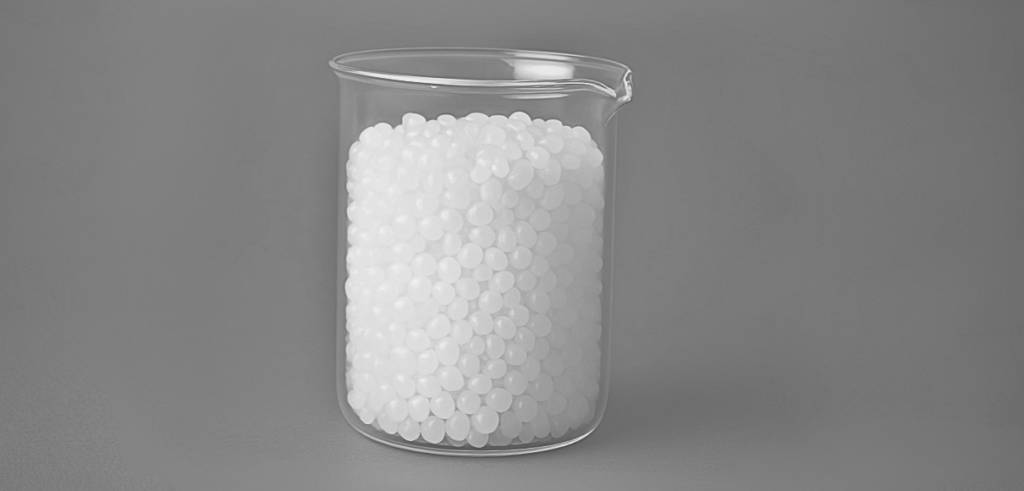



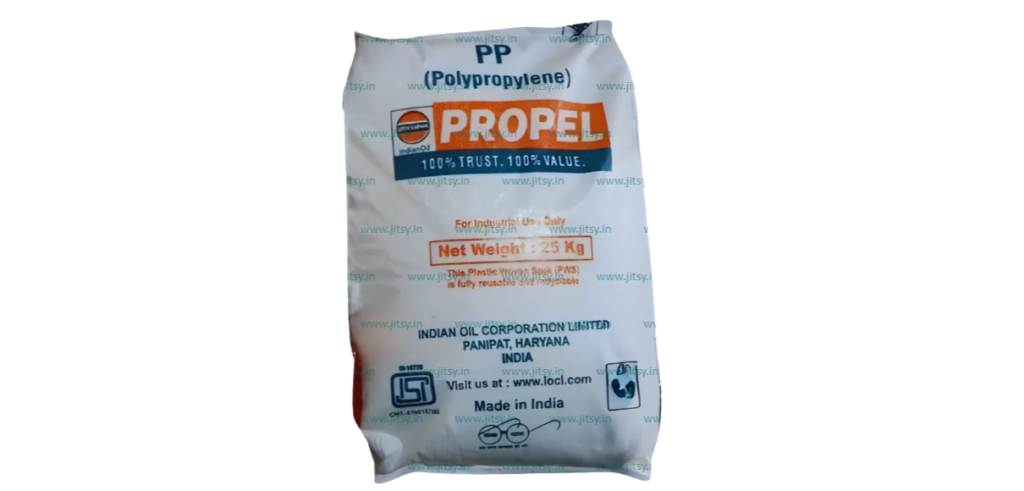
IOCL PPCP Propel 3030MG
Propel 3030MG is a medium-flow, high-impact polypropylene impact block copolymer (PPCP) from Indian Oil Corporation Ltd (IOCL), manufactured using Spheripol II technology. Designed for injection moulding, it delivers a reliable balance of impact strength and stiffness, making it ideal for automotive components, appliances, industrial parts, and caps & closures. As a prime, virgin PPCP 3.5 MFI grade, Propel 3030MG offers high-volume moulders repeatable performance, excellent surface finish, and consistent supply.
Technical Properties and Datasheet for Propel 3030MG
Typical Physical and Mechanical Properties
- Melt Flow Index (230°C/2.16kg):5 g/10 min
- Density:90 g/cm³
- Tensile strength at yield: 27 MPa
- Elongation at yield: 9%
- Flexural modulus: 1100 MPa
- Notched Izod impact (23°C): >150 J/m
- Heat deflection temp (0.46 N/mm²): 88°C
- Vicat softening point (10N): 150°C
Recommended Injection Moulding Conditions
- Melt temperature: 170–230°C
- Mold temperature: standard
- Storage: 25 kg bags, store below 50°C, process within 6 months for best results
Regulatory Information
Food-Contact and Regulatory Compliance
- Complies with IS 10910 (food, pharma, drinking water contact)
- Additives meet IS 10909 positive list
- Meets US FDA 21 CFR 177.1520 for specific food-contact applications
- Always confirm suitability for your process and end-use
Applications and Industry Use Cases of Propel 3030MG
Automotive Components and Under-Bonnet Parts
Propel 3030MG is trusted for interior trim, instrument-panel carriers, brackets, and fuse-box covers. Its >150 J/m impact and 1100 MPa modulus allow for stiff, impact-tolerant parts that withstand vibration and handling, while lightweight density helps reduce vehicle mass.Appliance and Consumer Product Housings
Used for housings and structural parts in washing machines, air-coolers, refrigerators, and vacuum cleaners, 3030MG’s chemical resistance and impact strength ensure durable, crack-resistant components that stand up to daily use and detergents.Industrial Components and Engineering Parts
Ideal for machine guards, technical mouldings, and brackets, Propel 3030MG’s flow and toughness support multi-cavity, complex part production with reliable snap-fit and hinge performance.Caps and Closures
Commonly used in beverage and personal-care caps, flip-tops, and threaded closures, 3030MG’s strength and stiffness support hinge designs and tamper-evident features, while PP’s chemical resistance allows safe use with a wide range of products.Performance Advantages of IOCL 3030MG vs Generic PPCP
- High impact resistance and useful stiffness for demanding parts
- Medium-flow MFI 3.5 for efficient processing and complex moulds
- Strong thermal performance with HDT 88°C and Vicat 150°C
- Excellent chemical resistance for appliance and industrial use
- Lightweight, recyclable, and batch-consistent for OEMs
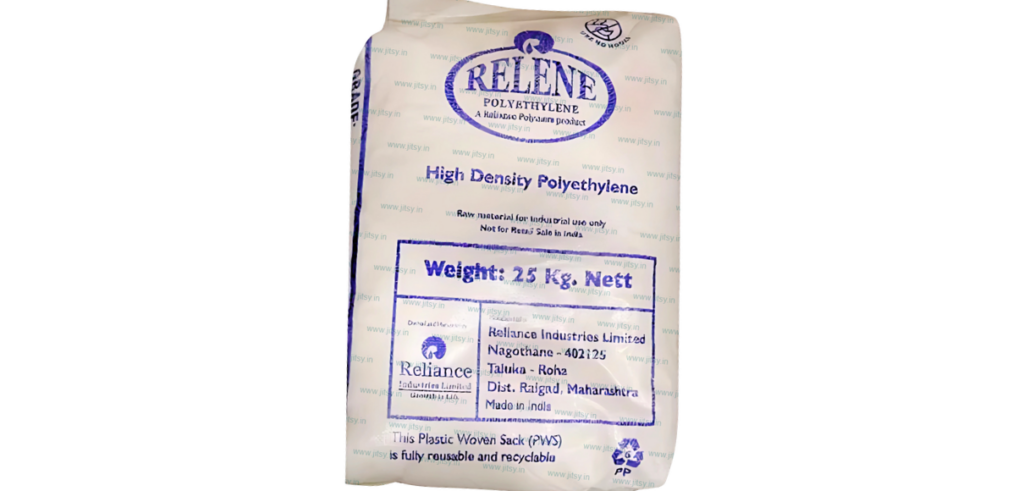
Reliance HDPE Relene 46GB012
Reliance HDPE Relene 46GB012 is a high density polyethylene blow moulding grade developed by Reliance Industries Limited for small volume rigid packaging applications that require strong toughness, good crack resistance, and dependable processing on standard HDPE blow moulding lines. Produced using advanced slurry process technology and designed with bimodal molecular weight distribution, this grade is suitable for small blow moulded containers used in toiletries, cosmetics, lubricants, food products, and health and medicinal aid packaging.
Reliance Industries Limited is one of India’s leading polymer manufacturers, and the Relene HDPE range is widely used across blow moulding, film, raffia, pipe, and injection moulding applications. Within the Reliance blow moulding portfolio, 46GB012 is positioned for smaller container formats where processors need a practical combination of flow, toughness, and ESCR without shifting into larger-capacity jerry can or industrial drum grades. This makes it especially relevant for packaging manufacturers producing compact containers for consumer products, lubricants, food-contact packs, and healthcare-related applications.
Technical Specifications and Deep Technical Insights
Reliance HDPE Relene 46GB012 has a melt flow index of 1.2 g/10 min at 190°C/5 kg, which places it in the easy-processing HDPE blow moulding category for small volume containers. Based on portfolio alignment, the grade is associated with a density around 0.954 g/cm³, supporting the rigidity expected in small rigid packaging while maintaining practical blow moulding performance. The most important technical strengths highlighted for this grade are its bimodal molecular weight distribution, high impact strength, good ESCR, and good processability. For processors, this means the resin is designed to support stable extrusion behavior, good parison control, and dependable container formation on most HDPE blow moulding lines. In end-use terms, it helps manufacturers produce containers that can better withstand handling, transport, filling stress, and shelf-life demands. Because this grade is intended for small volume packaging, its property profile is especially relevant where container durability and crack resistance matter more than extreme stiffness for larger packs. The combination of toughness and processability makes it suitable for repeat production of compact bottles and containers used in personal care, lubricants, food, and medicinal packaging segments. Reliance 46GB012 can readily be processed on most HDPE blow moulding lines and is typically supplied in standard 25 kg industrial packaging.Applications
Toiletries and Cosmetics Packaging
Reliance HDPE Relene 46GB012 is highly suitable for toiletries and cosmetics packaging where manufacturers need small blow moulded containers with good appearance, practical toughness, and reliable processability. It is relevant for bottles and packs used for shampoos, lotions, creams, and similar personal care products where consistent container quality matters.Lubricant Containers
For lubricant packaging, 46GB012 offers the impact strength and ESCR needed for containers that may face handling stress, storage pressure, and contact with demanding contents. This makes it a practical choice for small lubricant bottles and related packaging formats where durability is important.Food Products Packaging
This grade is also suitable for food product packaging where processors need a rigid HDPE blow moulding resin with dependable performance and food-contact relevance. Its processability and toughness make it useful for small containers that must hold shape and remain reliable through filling, transport, and retail handling.Health and Medicinal Aid Packaging
In health and medicinal aid applications, Reliance 46GB012 is relevant for compact blow moulded containers that require consistency, toughness, and regulatory suitability. It is a practical option for packaging formats where product safety, container integrity, and repeatable production quality are important.Small Volume Blow Moulded Containers
More broadly, 46GB012 is designed for small volume blow moulded containers across consumer and industrial packaging segments. Its balanced profile makes it suitable where manufacturers want a dependable HDPE grade for compact containers rather than larger jerry cans or heavy-duty industrial packs.Comparable Alternatives and Grade Analysis
Within the Reliance blow moulding portfolio, 46GB012 is positioned for smaller container applications, while 54GB012 is more strongly aligned to containers up to 20 litres where higher stiffness and larger pack performance are more important. Although both grades have an MFI of 1.2, 46GB012 is better associated with small volume packaging for cosmetics, toiletries, lubricants, food products, and medicinal aids. Compared with 52GB010, which is also used for smaller containers up to 5 litres, 46GB012 stands out more clearly on the basis of high impact strength, good ESCR, and its positioning for compact specialty packaging. Against cross-manufacturer options, IOCL 012DB54 is another small-container blow moulding grade and may be considered where processors prefer IOCL sourcing or a slightly different portfolio fit. The rationale behind assigning 46GB012 to small volume blow moulded packaging is its combination of bimodal processability, high impact toughness, and good ESCR, which together support durable compact containers for consumer-facing and regulated packaging segments rather than larger industrial blow moulding applications.
Reliance HDPE Relene 46GP003
Reliance HDPE Relene 46GP003 is a bimodal high density polyethylene PE100 pipe grade developed by Reliance Industries Limited for high-performance pressure pipe extrusion. This grade is designed for demanding pipe applications where long-term hydrostatic strength, crack resistance, extrusion stability and mechanical reliability are critical. Manufactured using advanced slurry process technology, Relene 46GP003 is widely relevant for processors producing HDPE pressure pipes for water supply, gas distribution, irrigation, sewerage and industrial piping systems.
For buyers searching Reliance HDPE Relene 46GP003, 46GP003 PE100 pipe grade, HDPE PE100 raw material, PE100 pipe extrusion grade India and HDPE pressure pipe material, this grade offers a strong technical and commercial fit. Its bimodal structure supports excellent processability while also delivering the long-term strength profile expected from PE100 compounds used in critical infrastructure applications.
Technical Description and Performance Insights
Reliance HDPE Relene 46GP003 combines a melt flow rate of 0.30 g/10 min with a density of 0.945 g/cm³, creating a balanced rheology profile for pressure pipe extrusion. This combination supports stable melt behavior, good output control and reliable pipe formation across standard extrusion lines. The bimodal molecular structure is especially important because it helps deliver both processability and long-term mechanical performance, which are essential in PE100 pipe manufacturing. The grade provides tensile stress at yield of at least 28 MPa and elongation at break of at least 600%, showing that it is engineered for both strength and ductility. A flexural modulus of 850 MPa supports pipe stiffness without making the material overly brittle. The notched Izod impact result of no break at -30°C demonstrates strong low-temperature impact resistance, which is valuable during pipe handling, transportation and installation in demanding field conditions. Long-term performance is one of the most important selection criteria for PE100 pipe grades, and Relene 46GP003 is built around that requirement. It passes hydrostatic strength requirements for PE100 applications and is aligned with standards such as ISO 4427 and IS 4984. The grade also offers outstanding slow crack growth resistance and rapid crack propagation resistance, both of which are critical for long service life in pressure pipe systems. Thermal stability with oxidation induction time above 30 minutes further supports processing reliability and material durability. From a processing standpoint, the recommended extrusion temperature range of 190°C to 240°C gives converters a practical operating window. The grade’s bimodal design helps maintain extrusion consistency, dimensional control and overall pipe quality, making it suitable for manufacturers targeting high-performance water, gas and infrastructure pipe segments.Applications and Industry Use Cases
Potable Water Supply Pipes
Relene 46GP003 is highly suitable for potable water supply pipes where long-term pressure resistance, crack resistance and consistent pipe quality are essential. PE100 classification makes it relevant for municipal water infrastructure, building services and regional pipeline networks that demand dependable performance over extended service life.Gas Distribution Pipes
Gas distribution systems require pipe materials with strong hydrostatic performance, excellent crack resistance and dependable installation durability. Relene 46GP003 is well positioned for HDPE gas pipe extrusion because its PE100 profile, impact resistance and slow crack growth resistance support safety and long-term reliability in pressure applications.Irrigation Pipe Systems
In agricultural and irrigation networks, processors need pipe grades that combine processability with durability under outdoor and field-use conditions. Relene 46GP003 is suitable for irrigation pipes where pressure handling, installation toughness and long-term service performance are important for efficient water distribution systems.Sewerage and Drainage Pressure Pipes
For sewerage and drainage pressure pipe applications, this grade offers a useful balance of stiffness, toughness and crack resistance. Pipe manufacturers serving infrastructure and utility sectors can use Relene 46GP003 where dependable extrusion behavior and long operational life are required.Industrial Piping Applications
Industrial piping systems often demand materials that can handle pressure, mechanical stress and continuous service conditions. Relene 46GP003 is relevant for industrial HDPE pipe production where processors need a PE100 grade with strong mechanical properties, stable extrusion and recognized standards alignment.Comparable Alternatives
Within the Reliance portfolio, Relene 46GP003 is positioned as a PE100 pipe grade, while grades such as 45GP004 are associated with PE80 pipe applications. This distinction matters because PE100 grades are selected when higher long-term pressure performance and stronger hydrostatic classification are required. For pipe manufacturers supplying demanding infrastructure projects, 46GP003 offers a more advanced performance profile for pressure applications. Compared with cross-manufacturer alternatives such as IOCL 004DP44 and HMEL P100B005, Relene 46GP003 is competitively positioned through its bimodal structure, MFR 0.30, density 0.945 and clear PE100 classification. Some alternative grades may differ slightly in flow behavior or density, but 46GP003 stands out for its combination of extrusion ease, strong hydrostatic performance, low-temperature impact resistance and crack growth resistance. The rationale behind this grade assignment is its suitability for pressure pipe systems where long service life, installation toughness and standards compliance are central to material selection.
Reliance HDPE Relene 46GP009
Reliance HDPE Relene 46GP009 is a bimodal high density polyethylene pipe grade developed by Reliance Industries Limited for PE63 pipe extrusion applications. This grade is designed for processors who need dependable extrusion performance, good mechanical strength, high environmental stress crack resistance and stable long-term processing behavior in water pipe and irrigation pipe manufacturing. It is especially relevant for buyers searching for Reliance HDPE Relene 46GP009, 46GP009 PE63 pipe grade, HDPE water pipe raw material, PE63 HDPE extrusion grade India and HDPE irrigation pipe material.
Relene 46GP009 combines practical flow behavior with strong durability characteristics, making it suitable for pipe manufacturers focused on consistent production and reliable end-use performance. Its bimodal structure supports smooth extrusion while maintaining the balance of stiffness, toughness and crack resistance needed in PE63 pressure pipe applications.
Technical Description and Performance Insights
Reliance HDPE Relene 46GP009 offers a melt flow rate in the range of 1.0 to 1.3 g/10 min and density between 0.946 and 0.948 g/cm³, giving processors a practical balance between flow behavior and structural performance. This property profile supports efficient pipe extrusion while maintaining the stiffness and toughness needed for PE63 water pipe applications. The grade provides tensile strength at yield of at least 24 MPa, elongation at yield of at least 11 percent and elongation at break of at least 600 percent. This indicates a useful combination of strength and ductility for pipe systems that must withstand installation stress and long-term service conditions. A flexural modulus of 800 MPa contributes to pipe stiffness while still supporting workable processing and handling performance. One of the most important strengths of Relene 46GP009 is its environmental stress crack resistance, with ESCR F50 above 1000 hours. This is highly relevant for pipe manufacturers and end users because crack resistance directly affects service life and reliability in field conditions. Thermal stability is also strong, with oxidation induction time above 30 minutes at 200°C, helping processors maintain stable extrusion performance and reduce the risk of thermal degradation during production. Its bimodal molecular structure improves processability and supports smooth extrusion behavior, making it suitable for commercial pipe manufacturing where output consistency and dimensional control are important. For processors comparing PE63 grades, this combination of flow, crack resistance and thermal stability is a key reason why Relene 46GP009 remains a relevant option.Applications and Industry Use Cases
Potable Water Supply Pipes
Relene 46GP009 is highly suitable for potable water supply pipes where dependable extrusion, good pressure performance and long-term durability are required. Its PE63 classification and compliance with IS 4984 make it relevant for municipal water distribution, local supply networks and general water conveyance applications.Irrigation Pipe Systems
In irrigation systems, pipe manufacturers need materials that process smoothly and perform reliably in outdoor service conditions. Relene 46GP009 is a practical choice for HDPE irrigation pipes because it combines good extrusion behavior with strong ESCR and mechanical balance, helping support long service life in agricultural water distribution.Drainage and Utility Pipe Applications
This grade can also serve drainage and utility pipe applications where processors need a dependable HDPE extrusion material with stable performance and good toughness. Its balanced property profile makes it useful in pipe segments where crack resistance and process consistency are important buying factors.Small Pesticide and Agrochemical Bottles
Beyond pipe extrusion, Relene 46GP009 is also relevant for pesticide and herbicide bottles up to 1 liter under the cited standard category. This expands its usefulness for processors serving agricultural packaging applications where chemical resistance, durability and stable processing are important.Comparable Alternatives
Within the Reliance pipe portfolio, Relene 46GP009 is positioned as a PE63 grade, while grades such as 45GP004 and 46GP003 serve PE80 and PE100 applications respectively. This portfolio placement matters because PE63 is selected where the performance requirement is aligned with that pressure class, while PE80 and PE100 are chosen for more demanding long-term pressure applications. For converters targeting standard water supply and irrigation pipe segments, 46GP009 offers a practical and commercially relevant balance. Compared with cross-manufacturer alternatives such as IOCL 010DP45 and HMEL P063B010, Relene 46GP009 is competitively positioned through its bimodal structure, MFR range of 1.0 to 1.3, density around 0.946 to 0.948 and strong ESCR profile. Some alternatives may show similar flow ranges, but 46GP009 stands out because of its combination of high crack resistance, thermal stability and recognized applicability across water pipes, irrigation systems and select small bottle applications. The rationale behind this grade assignment is its suitability for processors who need a PE63 material that is easy to run and dependable in service.
Reliance HDPE Relene 50GF003
Reliance HDPE Relene 50GF003 is a general purpose high density polyethylene film grade developed by Reliance Industries Limited for blown film extrusion applications. It is designed for processors looking for a dependable HDPE film raw material that combines good processability, balanced mechanical performance, useful optical properties and practical toughness for everyday film production. This grade is especially relevant for manufacturers searching for Reliance HDPE Relene 50GF003, 50GF003 blown film grade, HDPE shopping bag raw material, HDPE liner film grade India and general purpose HDPE film resin.
Relene 50GF003 is positioned for converters producing commodity and utility films where stable extrusion, good bubble behavior and reliable finished-film performance are important. In high-volume film operations, processors often need a grade that runs smoothly across standard blown film lines while still delivering the strength and toughness required for bag and liner applications. That is where 50GF003 fits well within the HDPE film category.
Technical Description and Performance Insights
Reliance HDPE Relene 50GF003 has a melt flow index of 3.0 g/10 min, which places it in a practical range for general purpose blown film extrusion. This flow profile supports good processability and helps converters maintain stable output on commercial film lines. For manufacturers producing shopping bags, garbage bags, liner films and agricultural films, this kind of melt behavior is important because it supports easier processing without compromising the basic strength expected from HDPE film structures. A key strength of Relene 50GF003 is its balance between processability and end-use performance. The grade is recognized for good optical properties, which is useful in applications where film appearance matters, even in utility packaging. At the same time, it offers good mechanical strength and toughness, helping films resist handling stress, puncture risk and routine use conditions. These characteristics make it suitable for processors who need dependable film performance across a broad range of standard packaging and carry-bag applications. The grade is also associated with good bubble stability during blown film extrusion. For film manufacturers, bubble stability directly affects gauge consistency, output control and line efficiency. A stable bubble helps reduce process variation and supports smoother production, especially in high-volume commodity film manufacturing. This is one of the reasons why 50GF003 remains a commercially relevant HDPE film grade for general purpose applications.Applications and Industry Use Cases
Shopping Bags
Relene 50GF003 is well suited for shopping bag manufacturing where processors need a general purpose HDPE film grade with good toughness, acceptable optics and stable extrusion behavior. It supports the production of carry bags used in retail, grocery and general merchandise packaging, where cost-effective performance and reliable line running are both important.Garbage Bags
For garbage bag applications, this grade offers the toughness and mechanical balance needed for everyday waste handling films. Manufacturers producing utility bags can benefit from its good processability and practical film strength, which help support consistent production and dependable end-use performance in routine disposal applications.Liner Films
Liner films require a combination of process consistency, film integrity and workable toughness. Relene 50GF003 is relevant for liner film extrusion where processors need a dependable HDPE grade for protective, industrial or packaging liner applications. Its balanced performance profile makes it suitable for multiple liner film formats.Agricultural Films
In agricultural film applications, processors often need a resin that can be extruded efficiently while maintaining useful strength and handling performance. Relene 50GF003 is applicable in general agricultural film segments where converters prioritize stable blown film processing and practical toughness for field-use film products.Comparable Alternatives
Within the Indian HDPE film market, Relene 50GF003 is positioned as a general purpose blown film grade for commodity and utility film applications. Compared with similar grades such as IOCL F0095D and GAIL 20F003, it competes in the same broad category of HDPE film resins used for shopping bags, liners and related packaging films. The comparable melt flow index of 3.0 places it in a familiar processing window for converters seeking standard blown film performance. What differentiates Relene 50GF003 is its balanced positioning around processability, optical properties, mechanical strength and toughness. Some competing grades may be selected for narrower application niches, but 50GF003 is assigned as a versatile general purpose film grade for manufacturers who need a practical and commercially scalable resin. The rationale behind this grade assignment is its suitability for high-volume blown film operations where stable processing and dependable finished-film behavior matter more than highly specialized performance claims.
Reliance HDPE Relene 52GB001
Reliance HDPE Relene 52GB001 is a high molecular weight high density polyethylene blow moulding grade developed by Reliance Industries Limited for large volume rigid packaging applications where processors need strong impact performance, high stiffness, good environmental stress crack resistance, and dependable machine processability. Produced using advanced slurry process technology, this HMHDPE grade is designed for large blow moulded containers such as drums, barrels, and industrial packaging containers.
Reliance Industries Limited is one of India’s largest polymer manufacturers, and the Relene HDPE portfolio covers film, pipe, raffia, injection, and blow moulding applications across industrial and packaging sectors. Within the Reliance blow moulding range, 52GB001 is positioned for larger container formats where processors need a resin that can support structural strength, impact durability, and stable blow moulding performance for heavy-duty end uses. Its HMHDPE profile and medium molecular weight distribution make it especially relevant for industrial container manufacturers looking for a practical balance of toughness, stiffness, and production efficiency.
Technical Specifications and Deep Technical Insights
Reliance HDPE Relene 52GB001 has a melt flow index of 2.3 g/10 min at 190°C/21.6 kg and a density of 0.952 g/cm³, placing it in the HMHDPE blow moulding category for large rigid containers. This testing condition is important because it reflects the grade’s suitability for heavy-duty blow moulding applications where melt behavior, swell, and parison control directly affect final container quality. The grade delivers tensile strength at yield of 30 MPa, elongation at yield of 10%, flexural modulus of 1100 MPa, Vicat softening temperature of 126°C, and notched Izod impact performance reported as no break. These values indicate a strong stiffness-toughness balance for industrial packaging. In practical terms, this means the resin can support shape retention, stacking performance, and handling durability in large containers that must withstand transport, storage, and demanding service conditions. A key technical advantage of 52GB001 is its combination of very good impact strength, good ESCR, very good swell, and easy processability. For blow moulders, very good swell is especially useful in large-part production because it helps with parison behavior and container formation. The medium molecular weight distribution also supports practical processing while maintaining the mechanical strength required for drums, barrels, and industrial packaging formats.Applications
Drums and Barrels
Reliance HDPE Relene 52GB001 is highly suitable for blow moulded drums and barrels where manufacturers need a resin with strong impact performance, good stiffness, and reliable crack resistance. It is relevant for heavy-duty packaging formats that must remain structurally stable during filling, stacking, transport, and long storage cycles.Industrial Containers
For industrial containers, 52GB001 offers the toughness and rigidity needed for large rigid packaging used across chemicals, process industries, and bulk handling applications. Its HMHDPE profile makes it a practical option where container durability and dimensional stability are more important than lightweight consumer-packaging performance.Chemical Packaging
In chemical packaging applications, this grade is relevant because good ESCR and impact strength help containers perform better under stress and demanding storage conditions. It is suitable for blow moulded packs where long-term crack resistance and handling reliability are important for packaging safety.Large Volume Blow Moulded Containers
More broadly, Reliance 52GB001 is designed for large volume blow moulded containers where processors need a resin that can run efficiently while still delivering strong end-use performance. It is particularly useful for applications where large part formation, swell behavior, and structural integrity are critical to production success.Comparable Alternatives
Within the Reliance blow moulding portfolio, 52GB001 is positioned for large container applications, while 52GB002 is also associated with around 100 litre blow moulded containers and 52GB003 is more suited to medium container formats. Compared with 52GB003 at lower MFI, 52GB001 stands out with its emphasis on very good impact strength, very good swell, and suitability for larger heavy-duty packaging. Compared with 52GB002, 52GB001 is differentiated by its processing behavior and property positioning for large industrial blow moulding where swell and easy processability are important. Against cross-manufacturer alternatives, IOCL 002DP48 is relevant in the large blow moulding segment, but 52GB001 offers a strong Reliance portfolio option for processors seeking HMHDPE performance with a practical stiffness-impact balance. The rationale behind assigning 52GB001 to drums, barrels, and industrial containers is its combination of high stiffness, good ESCR, very good impact strength, and very good swell, which together make it more suitable for large heavy-duty blow moulded parts than smaller consumer packaging applications.
Reliance HDPE Relene 52GB002
Reliance HDPE Relene 52GB002 is a high molecular weight high density polyethylene blow moulding grade developed by Reliance Industries Limited for large container applications requiring structural strength, process consistency and dependable end-use performance. Manufactured using advanced slurry process technology, this HMHDPE grade is designed for blow moulded containers of around 100 liter capacity where stiffness, impact resistance and environmental stress crack resistance must work together.
Relene 52GB002 is positioned for processors looking for a reliable HDPE drum grade with balanced mechanical properties, good swell and broad molecular weight distribution. These characteristics help converters achieve better parison control, stable processing and durable finished containers for industrial and chemical handling environments. For buyers searching terms like Reliance HDPE Relene 52GB002, 52GB002 blow moulding grade, HDPE 100 liter container material and HMHDPE drum grade India, this grade stands out as a practical and technically credible option.
Technical Description and Performance Insights
Reliance HDPE Relene 52GB002 combines a melt flow index of 0.8 g/10 min with a density of 0.952 g/cm³, giving it a balanced profile for large blow moulded articles that need both rigidity and processability. The grade delivers tensile strength at yield of 25 MPa and elongation at yield of 12%, supporting dimensional integrity and dependable mechanical performance in demanding industrial packaging applications. A flexural modulus of 1050 MPa contributes to the stiffness needed in larger containers where wall stability, stackability and handling strength are important. The notched Izod impact result of no break indicates strong resistance to impact under test conditions, which is valuable for drums and containers exposed to transport, loading and routine industrial movement. The Vicat softening point of 126°C further supports thermal stability during service and processing. From a processing perspective, the broad molecular weight distribution helps provide a useful balance between melt strength and flow behavior. Good swell supports better parison formation in blow moulding operations, especially for larger part geometries. This makes Relene 52GB002 suitable for processors seeking stable output on HDPE blow moulding machines while maintaining container strength and shape consistency.Applications and Industry Use Cases
100 Liter Blow Moulded Containers
Relene 52GB002 is primarily recommended for blow moulded containers of approximately 100 liters capacity. This makes it highly suitable for manufacturers producing large industrial containers that require stiffness, dimensional stability and dependable wall strength. The grade supports consistent processing for larger formats where parison behavior and structural balance are critical.Industrial Drums and Barrels
For industrial drums and barrels, this grade offers the combination of rigidity, impact performance and process stability needed for storage and transport applications. Manufacturers serving lubricant, additive, process chemical and industrial liquid markets can use Relene 52GB002 where container durability and handling reliability are essential.Chemical Storage Containers
Chemical storage applications demand materials with good ESCR and strong mechanical balance. Relene 52GB002 is well positioned for blow moulded chemical containers where resistance to cracking, shape retention and long service life matter. Its property balance makes it relevant for industrial packaging converters supplying agriculture, specialty chemicals, cleaning chemicals and allied sectors.Comparable Alternatives
Within the Reliance portfolio, Relene 52GB002 sits between other blow moulding grades that serve adjacent container formats and processing windows. Compared with Relene 52GB001, which is associated with large drum applications at a higher melt flow index, 52GB002 offers a profile better aligned with around 100 liter containers where a specific balance of stiffness, swell and impact behavior is needed. Compared with Relene 52GB003, which is positioned for medium container applications at lower melt flow, 52GB002 offers a more targeted fit for processors focused on 100 liter packaging output. Against cross-manufacturer alternatives such as IOCL 002DP48 and GAIL 20H012, Relene 52GB002 stands out through its combination of 0.8 MFI, 0.952 density and application-specific positioning for large blow moulded containers. Lower flow alternatives may suit different parison strength or container requirements, but 52GB002 is assigned for converters seeking a balanced HMHDPE grade with strong stiffness, good impact strength and practical processing ease for large industrial packaging. The rationale behind this grade assignment lies in its ability to support container shape, handling durability and repeatable production performance without overcomplicating processing.Compliance and Suitability
Relene 52GB002 complies with FDA CFR Title 21, 177.1520 for olefin polymers. This adds confidence for applications where regulatory alignment and material documentation are important. For industrial buyers, this compliance profile supports broader acceptability in packaging environments where food-contact suitability or chemical-contact relevance may be part of procurement evaluation.
Reliance HDPE Relene 52GF004
Reliance HDPE Relene 52GF004 is a high molecular weight high density polyethylene blown film grade developed by Reliance Industries Limited for heavy duty film applications. This HMHDPE grade is designed for converters who need stronger film performance than standard general purpose HDPE film grades, especially in applications where dart impact strength, toughness, load-bearing ability and bubble stability are critical. For buyers searching Reliance HDPE Relene 52GF004, 52GF004 HMHDPE film grade, heavy duty HDPE blown film resin, HMHDPE bag grade India and HDPE industrial packaging film material, this grade offers a strong technical and commercial fit.
Relene 52GF004 is positioned for blown film processors producing heavy duty carrier bags, shopping bags, garbage bags, industrial packaging films and related utility films. Its broad molecular weight distribution supports stable blown film processing, while its high molecular weight profile helps improve film toughness and impact performance. This makes it especially relevant for manufacturers who need a dependable HMHDPE film grade for demanding packaging and bag applications.
Technical Description and Performance Insights
Reliance HDPE Relene 52GF004 has a melt flow index of 0.45 g/10 min and a density of 0.952 g/cm³, giving it a property profile that supports heavy duty blown film extrusion. The lower melt flow compared with general purpose HDPE film grades helps provide stronger melt strength and improved film toughness, which are important in applications where the finished film must carry more load or resist puncture and impact during use. A major technical advantage of Relene 52GF004 is its broad or bimodal molecular weight distribution. In blown film processing, this helps provide a better balance between processability and strength. Converters benefit from good bubble stability, smoother line running and the ability to maintain higher output rates without sacrificing film integrity. This is particularly valuable in commercial blown film operations where consistency, gauge control and production efficiency directly affect profitability. The grade is also recognized for superior dart impact strength, good tensile properties and overall toughness. These characteristics are highly relevant in heavy duty bags and industrial packaging films because they help the film withstand handling stress, puncture risk and load-bearing conditions. Reported tensile modulus values of 50 MPa in the longitudinal direction and 48 MPa in the transverse direction further support its balanced film performance profile. For processors comparing HMHDPE film grades, this combination of melt strength, bubble stability and impact-focused performance is a key reason why 52GF004 is assigned to heavy duty film applications.Applications and Industry Use Cases
Heavy Duty Carrier Bags
Relene 52GF004 is highly suitable for heavy duty carrier bags where film strength, puncture resistance and toughness are more important than in standard commodity bag applications. Its HMHDPE profile helps manufacturers produce bags that can handle higher loads and tougher handling conditions in retail, wholesale and industrial use.Shopping Bags
For shopping bag production, this grade is relevant where converters want a stronger HDPE film structure with better impact performance and improved durability. It is especially useful in applications where bag failure under load is a concern and a tougher film grade is preferred over a basic general purpose resin.Garbage Bags
Garbage bags require a combination of toughness, puncture resistance and dependable blown film processing. Relene 52GF004 is well positioned for this segment because its heavy duty film profile supports stronger bag performance in waste handling and disposal applications.Industrial Packaging Films
Industrial packaging films often need better mechanical performance than standard utility films, especially when used for bundling, protection or transport packaging. Relene 52GF004 offers the strength, toughness and process stability needed for these applications, making it relevant for converters serving industrial and commercial packaging markets.Shrink and Utility Film Applications
This grade can also be considered for selected shrink and utility film applications where stronger film behavior and stable processing are required. Its broad molecular weight distribution and impact-focused performance make it useful in film segments that demand more than basic commodity-grade output.Comparable Alternatives
Within the Reliance film portfolio, Relene 52GF004 is positioned above general purpose grades such as 50GF003 when stronger film performance is required. While 50GF003 is suited for common blown film applications with a higher melt flow of 3.0, 52GF004 is assigned to heavier duty film uses because its lower MFI and HMHDPE structure support better melt strength, improved toughness and stronger impact behavior. This makes the grade more suitable for converters targeting load-bearing and industrial packaging applications. Compared with cross-manufacturer alternatives such as IOCL 003DF49 and GAIL 20H012, Relene 52GF004 competes in the heavy duty HMHDPE blown film category where lower MFI grades are selected for stronger film performance. Some alternatives may offer similar heavy duty positioning, but 52GF004 stands out through its combination of broad molecular weight distribution, superior dart impact, good tensile properties and stable blown film processing. The rationale behind this grade assignment is its suitability for converters who need a commercially practical HMHDPE film resin for tougher bag and industrial packaging applications.
Reliance HDPE Relene 54GB012
Reliance HDPE Relene 54GB012 is a high density polyethylene blow moulding grade developed by Reliance Industries Limited for rigid packaging applications that require stronger stiffness, dependable impact performance, and good environmental stress crack resistance. Produced using advanced slurry process technology and designed with bimodal molecular weight distribution, this grade is suitable for blow moulded containers up to 20 litres used in edible oil packaging, cosmetics, personal care products, jerry cans, and general purpose industrial containers.
Reliance Industries Limited is one of India’s leading polymer manufacturers, and the Relene HDPE portfolio is widely used across blow moulding, film, raffia, pipe, and injection applications. Within the Reliance blow moulding range, 54GB012 is positioned for medium-capacity rigid packaging where processors need easier flow than heavier-duty large-container grades, but higher density and stiffness than smaller-container grades. This makes it especially relevant for manufacturers producing jerry cans, edible oil packs, and durable packaging containers that must retain shape, stack well, and resist cracking during storage and transport.
Technical Specifications and Deep Technical Insights
Reliance HDPE Relene 54GB012 has a melt flow index of 1.2 g/10 min at 190°C/5 kg and a density of 0.954 g/cm³, placing it in the HDPE blow moulding category for rigid containers that require a stiffer structure and commercially efficient processing. The higher density profile supports better rigidity and dimensional stability, while the MFI level helps processors maintain practical flow behavior on standard HDPE blow moulding lines. The grade provides tensile strength at yield of 27 MPa, elongation at yield of 11%, flexural modulus of 900 MPa, Vicat softening point of 127°C, and notched Izod impact performance reported as no break. These values show that 54GB012 is engineered for a balanced combination of stiffness, toughness, and processability rather than only one extreme property. In practical terms, this means the resin can support container shape retention, handling durability, and reliable performance in packaging applications where drop resistance and structural consistency matter. One of the key technical strengths of this grade is its bimodal molecular weight distribution, which helps deliver easier processing together with useful mechanical performance. For blow moulders, this translates into smoother extrusion behavior, stable parison formation, and more consistent container output. The grade is also recognized for good ESCR, which is important in applications such as edible oil, personal care, and chemical-sensitive packaging where long-term crack resistance can affect product reliability. Reliance 54GB012 can readily be processed on most HDPE blow moulding lines and is typically supplied in 25 kg bags for industrial packaging operations.Applications
Edible Oil Containers
Reliance HDPE Relene 54GB012 is highly suitable for edible oil container manufacturing where processors need a rigid blow moulding grade with good crack resistance and dependable shape retention. Its stiffness and ESCR profile make it a practical choice for edible oil packs that must remain durable during filling, warehousing, transport, and retail handling.Jerry Cans
For jerry can applications up to 20 litres, 54GB012 offers the structural strength and rigidity needed for stable container performance. Its combination of higher density, good flow, and impact resistance supports production of containers that can withstand handling stress while maintaining dimensional consistency.Cosmetics and Personal Care Packaging
In cosmetics and personal care packaging, this grade is relevant for rigid bottles and containers that require a clean finish, practical toughness, and reliable blow moulding processability. It is suitable for packaging formats where appearance, handling strength, and repeatable production quality all matter.General Purpose Containers
Reliance 54GB012 is also used for general purpose blow moulded containers across industrial and commercial packaging segments. Its balanced property profile makes it useful where manufacturers need a versatile HDPE blow moulding resin for medium-capacity containers with good stiffness and dependable service performance.Comparable Alternatives
Within the Reliance blow moulding portfolio, 54GB012 is positioned above 52GB010 in terms of container size window and stiffness-oriented application profile. While 52GB010 with MFI 1.0 and density 0.952 is better suited for containers up to 5 litres, 54GB012 with MFI 1.2 and density 0.954 is more appropriate for jerry cans and containers up to 20 litres where higher density and stronger rigidity are more important. Compared with 52GB003, which is positioned for medium blow moulding and some corrugated pipe applications, 54GB012 is more clearly aligned to packaging containers requiring good ESCR and easier processing on standard lines. Against cross-manufacturer options, IOCL 012DB54 can be considered for smaller blow moulded containers, but 54GB012 is better matched to the 20 litre packaging window. HMEL B0206D is also relevant for blow moulding up to 20 litres, though with a higher MFI profile that may shift its processing and end-use behavior depending on the application. The rationale behind assigning 54GB012 to edible oil packs, jerry cans, and medium-capacity rigid packaging is its combination of higher density, good stiffness, impact strength, ESCR, and bimodal processability, which together support durable blow moulded containers with commercial production efficiency.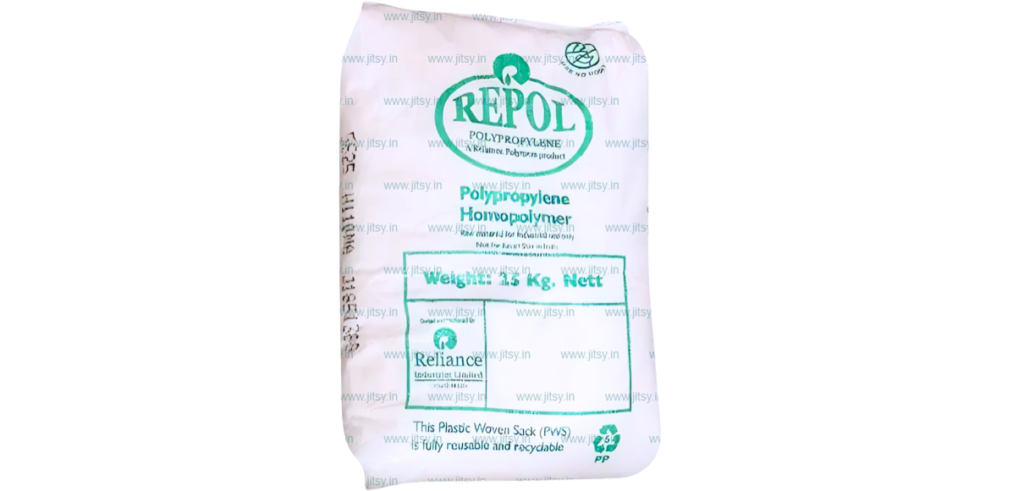
Reliance PP Repol AM120N
Reliance PP Repol AM120N is a general-purpose polypropylene homopolymer developed by Reliance Industries Limited for injection moulded products that require a practical balance of flow, stiffness, toughness, processability, and regulatory suitability. Positioned within the Repol polypropylene portfolio, AM120N is widely used for industrial mouldings, furniture compounds, houseware, rigid utility products, and other medium-to-thick wall injection applications where consistent molding behavior and dependable mechanical performance are important.
This grade is manufactured by Reliance Industries Limited, one of India’s largest polymer producers, using advanced Unipol polypropylene technology at its Gujarat facilities. Under the Repol brand, Reliance supplies a broad range of polypropylene homopolymers, random copolymers, and impact copolymers for packaging, industrial, consumer, and automotive sectors. Within that range, AM120N is positioned as a dependable PP homopolymer injection moulding grade for converters looking for a clean, versatile resin that performs well across general-purpose applications and also works effectively as a compounding and blending base for furniture and household plastic products.
About Manufacturer
Reliance Industries Limited has a strong reputation in polypropylene manufacturing, with large-scale supply capability across India and export markets. The Repol brand is well established in the polymer industry for serving processors in injection moulding, extrusion, blow moulding, film, fibre, and compounding applications. That brand strength matters commercially because buyers are not only selecting a polymer grade, but also supply consistency, technical support credibility, and portfolio continuity. AM120N fits into the Repol homopolymer family as a medium-flow injection moulding grade intended for broad industrial usability. It is not positioned as a narrow specialty grade; instead, it is designed to be commercially flexible and technically stable across multiple end-use segments. That makes it especially relevant for manufacturers who need one reliable PP homopolymer grade for recurring production across furniture, crates, bins, containers, and houseware.Technical Insights and Material Performance
Reliance PP Repol AM120N has a melt flow rate of 12 g/10 min at 230°C/2.16 kg, which places it in a highly usable range for general-purpose injection moulding. This MFI level supports good cavity filling without becoming overly thin-flowing, making it suitable for medium-to-thick wall mouldings, practical production cycles, and a wide range of molded geometries. For processors, this means AM120N offers a strong balance between flow efficiency and part integrity. The density is approximately 0.90 g/cm³, consistent with polypropylene homopolymer materials. Typical mechanical values include tensile strength at yield of 37 MPa, elongation at yield of 12 percent, flexural modulus of 1450 MPa, notched Izod impact strength of 30 J/m at 23°C, and heat deflection temperature of 105°C at 455 kPa. Together, these values position AM120N as a rigid, general-purpose PP injection grade with enough toughness for routine industrial and consumer applications, while still maintaining the stiffness needed for furniture components, storage products, and molded utility items. From a material selection perspective, the technical strength of AM120N lies in its balance rather than extremity. It is not a very low-flow heavy-duty grade, nor a very high-flow thin-wall specialty grade. Instead, it occupies a commercially valuable middle ground. The 12 MFI flow profile supports smooth processing, the 1450 MPa flexural modulus provides useful structural rigidity, and the 30 J/m impact level helps prevent the grade from becoming too brittle in practical use. The HDT of 105°C also gives it added relevance for molded products exposed to moderate heat during service.Processing Characteristics
AM120N is recommended for injection moulding and is suited to general-purpose molded products across furniture, industrial, and houseware sectors. Reliance’s guidance indicates a melt temperature range of 210°C to 260°C and a mould temperature range of 30°C to 50°C. These conditions are practical for standard PP injection moulding setups and allow processors to optimize flow, cooling, surface finish, and cycle stability depending on part design and tooling. In production, the grade’s medium-flow nature helps maintain a good balance between fill performance and dimensional control. Compared with lower-flow grades, AM120N can fill molds more easily and support better productivity in multi-cavity or moderately complex parts. Compared with higher-flow grades, it offers better control in thicker sections and can reduce the risk of excessive flash or over-fluid behavior in certain applications. This makes it a dependable choice for processors who need a stable, repeatable PP homopolymer for varied product lines.Applications and Industry Use Cases
General-Purpose Industrial Mouldings
Reliance PP Repol AM120N is well suited for industrial mouldings such as crates, bins, pallets, totes, storage containers, and utility handling products. These applications require a practical mix of stiffness, toughness, and processability, especially where production volumes are high and part geometry must remain consistent. Its balanced MFI and mechanical profile make it a strong option for manufacturers producing durable molded items for logistics, warehousing, and industrial handling.Furniture Compounds and Molded Furniture Components
AM120N is particularly relevant to the furniture industry because it is suitable both as a direct injection moulding resin and as a compounding base or blending material for furniture compounds. It can be used in molded furniture parts such as chair backs, armrests, table components, organizers, and storage structures. For furniture processors, the grade offers a useful balance of rigidity and process consistency, while also supporting color, filler, and additive incorporation in compound formulations.Houseware and Consumer Utility Products
The grade is widely applicable in houseware products such as buckets, basins, tubs, kitchen utility items, organizers, and general household molded articles. In these applications, manufacturers typically need a resin that can process smoothly, maintain acceptable stiffness, and deliver dependable part quality without requiring specialty-grade economics. AM120N fits that need well, making it a practical PP homopolymer choice for everyday consumer plastic goods.Rigid Containers and Utility Packaging
AM120N can also be used in rigid containers and non-flexible packaging components where the emphasis is on molded shape retention, processability, and regulatory suitability. Its food-contact aligned compliance profile adds value for packaging and utility applications where safe-use standards are important. For converters making molded packaging or storage articles, this grade offers a reliable balance of mechanical performance and commercial versatility.Masterbatch, Filler and Compounding Base Resin
A major advantage of AM120N is its suitability as a base resin for compounding, filler loading, and masterbatch blending. Processors in the furniture and household plastics sectors often need a polypropylene homopolymer with stable rheology and broad compatibility for formulation work. AM120N serves that role effectively, making it attractive not only to direct molders but also to compounders supplying downstream plastic manufacturers.Performance Advantages of Reliance PP Repol AM120N
One of the main advantages of AM120N is its balanced 12 MFI flow profile. This gives processors enough flow for efficient injection moulding while still maintaining control in medium and thicker wall sections. It is a practical middle-ground grade for manufacturers who do not want the slower fill of lower-MFI homopolymers or the overly high flow of thin-wall oriented grades. Its mechanical balance is another strength. With 37 MPa tensile strength, 1450 MPa flexural modulus, and 30 J/m impact strength, the grade performs well in applications that need rigidity without becoming too fragile for routine use. This makes it especially suitable for furniture compounds, industrial molded products, and houseware where both structure and day-to-day durability matter. The grade also offers a commercial advantage through regulatory readiness. Compliance references such as IS 10910, IS 16738:2018, and FDA 21 CFR 177.1520 support its use in food-contact and regulated molded applications, subject to final article testing. For converters, this can simplify qualification for certain packaging and utility end uses.Alternatives and Comparable Grades
Within the Reliance Repol portfolio, AM650N is a relevant alternative when higher flow is needed for thinner-wall parts or faster filling requirements. However, for general-purpose industrial mouldings and furniture compounds, AM120N often provides a better balance between flow and section control. AM010N sits at the lower-flow end and is more suitable where thicker sections or different processing priorities matter, rather than standard injection moulding versatility. Compared with H110MA, AM120N is also a useful benchmark. Both are PP homopolymer injection grades, but AM120N is positioned more clearly as a broad general-purpose grade and compounding base, while H110MA is often associated with rigid containers, thermoware, and specific molded product categories. Buyers selecting between the two should consider whether they need a more general industrial/furniture-oriented resin base or a grade aligned more closely with specific molded article performance. Against comparable PP homopolymer injection grades from HMEL, IOCL, and OPaL, AM120N competes well on its combination of balanced MFI, broad application range, compounding suitability, and food-contact aligned compliance. Many competing grades may offer similar flow ranges, but AM120N is especially attractive when the buyer wants a versatile, mainstream Reliance grade that can serve both direct moulding and compound-based production programs. The rationale behind the assigned grade is straightforward: AM120N is best selected where a manufacturer needs a stable, medium-flow PP homopolymer for general injection moulding, furniture compounds, industrial products, and houseware without moving into narrow specialty grades. It is a practical production resin built for flexibility, repeatability, and broad commercial relevance.
Reliance PP Repol AM650N
Reliance PP Repol AM650N is a high-flow polypropylene homopolymer developed by Reliance Industries Limited for high-speed injection moulding applications that demand rapid cavity filling, stable processing, and efficient output in thin-wall and multi-cavity production environments. Positioned within the Repol homopolymer portfolio, AM650N is especially suited for TWIM containers, intricate long-flow-path parts, appliance components, automotive mouldings, and masterbatch or compounding applications where very high melt flow is commercially valuable.
Manufactured by Reliance Industries Limited using Unipol polypropylene process technology, Repol AM650N is designed for processors who need faster fill, shorter cycle potential, and better productivity than standard medium-flow PP homopolymer grades can offer. For buyers searching for Reliance AM650N, high-flow PP homopolymer injection grade, PP for thin-wall injection moulding, or polypropylene for multi-cavity moulding in India, this grade is one of the most relevant choices in the Reliance injection moulding range.
The commercial significance of AM650N lies in its very high melt flow rate and antistatic formulation. It is not intended as a general-purpose rigid moulding grade for thicker sections. Instead, it is assigned to applications where fast mould filling, repeatable cavity performance, and efficient compounding behavior matter more than maximum structural rigidity. That makes it highly suitable for thin-wall packaging, rapid-cycle moulding, and masterbatch manufacturing.
Manufacturer and Brand Background
Reliance Industries Limited is one of India’s largest integrated petrochemical producers and a major supplier of polypropylene to domestic and export markets. The company’s Repol brand covers a wide range of polypropylene homopolymers, random copolymers, impact copolymers, and specialty grades for injection moulding, fibre, film, extrusion, and technical applications. Within this portfolio, AM650N occupies a specialized position as a high-flow PP homopolymer for injection moulding and compounding. It is designed for processors who run high-output lines, thin-wall moulds, and multi-cavity tools, and for compounders who need a base resin with strong flow behavior for pigment, filler, and additive incorporation. This positioning makes it distinct from lower-flow grades such as AM120N or H110MA and more production-oriented than standard general-purpose injection resins.Technical Insights and Material Performance
Reliance PP Repol AM650N has a melt flow rate of 65 g/10 min at 230°C/2.16 kg, which places it firmly in the high-flow category for polypropylene homopolymer injection moulding. This is the defining technical characteristic of the grade. Such a high MFI enables the melt to travel quickly through thin sections, long flow paths, and multi-cavity moulds, supporting fast filling and reduced resistance during injection. For TWIM containers and high-output moulding operations, this can translate into shorter cycle potential and improved productivity. The density is approximately 0.90 g/cm³. Typical mechanical performance includes tensile strength at yield of 35 MPa, elongation at yield of 12 percent, flexural modulus of 1350 MPa, notched Izod impact strength of 25 J/m at 23°C, heat deflection temperature of 105°C at 455 kPa, and Shore D hardness of 70. These values show that although AM650N is a very high-flow grade, it still maintains a useful balance of rigidity, strength, and handling toughness for thin-wall and technical molded products. A key functional advantage is the antistatic additive package. Static charge build-up can create dust attraction and handling issues in molded parts, especially in appliance, automotive, packaging, and compounded applications. By reducing static accumulation, AM650N helps improve part cleanliness and handling quality in downstream operations. From a grade-selection perspective, the technical strength of AM650N is not about maximum stiffness or impact resistance. Its real value is its ability to combine very high flow with acceptable mechanical performance and antistatic functionality. That makes it especially effective in rapid-cycle injection moulding, long-flow-path parts, and masterbatch production where process efficiency is a major priority.Processing Characteristics and Injection Moulding Window
AM650N is recommended for injection moulding and is particularly suitable for thin-wall injection moulded containers, multi-cavity tools, and intricate molded parts. A typical processing window includes melt temperatures around 210°C to 260°C and mould temperatures around 20°C to 40°C, depending on tool design, wall thickness, cycle requirements, and machine setup. Its high MFI allows the resin to fill cavities quickly and efficiently, which is especially useful in TWIM applications where short cycle times and rapid mould filling are critical. In multi-cavity moulding, the grade helps reduce filling resistance and supports more uniform cavity performance. In compounding and masterbatch production, the same high-flow behavior supports good dispersion and mixing of pigments, fillers, and additives. Because of its flow level, AM650N is best chosen where filling speed and productivity are more important than the higher stiffness associated with lower-flow PP homopolymer grades. It is a process-driven grade designed for output-focused manufacturing.Applications and Industry Use Cases
TWIM Containers and Thin-Wall Packaging
Reliance PP Repol AM650N is highly suitable for thin-wall injection moulded containers used in food packaging, consumer packaging, and utility storage applications. Its very high flow helps fill thin sections quickly and cleanly, making it ideal for fast-cycle moulding where productivity and part consistency are essential. For manufacturers of cups, tubs, boxes, and lightweight rigid packaging, this grade offers a strong process advantage.Multi-Cavity Injection Moulding
AM650N performs especially well in multi-cavity moulds where balanced filling and repeatable production are critical. Small parts, closures, lids, and technical components produced in high-cavity tools benefit from its rapid flow behavior, which supports efficient filling across cavities and helps maintain output in high-volume manufacturing environments.Intricate Long-Flow-Path Parts
For molded articles with narrow sections, detailed geometry, or longer flow lengths, AM650N offers a clear advantage over lower-flow PP homopolymers. It can move through complex mould paths more easily, which helps reduce filling-related issues in technical injection mouldings, appliance parts, and automotive components.Appliance and Automotive Components
The grade is relevant for selected appliance and automotive injection moulded parts where fast production, clean surfaces, and good dimensional repeatability are important. It can be used in components such as trim parts, fittings, small housings, clips, and utility mouldings that benefit from high flow and antistatic performance during handling and assembly.Masterbatch and Compounding Base Resin
AM650N is also a strong base resin for masterbatch and compounding applications. Its high MFI supports efficient shear mixing with pigments, fillers, and additives, making it useful for color concentrates, additive compounds, and specialty formulations. For compounders, this grade offers a practical balance of processability, consistency, and regulatory alignment.Performance Advantages
The biggest advantage of AM650N is its exceptional flow. With an MFI of 65, it is far better suited to TWIM and high-speed multi-cavity moulding than lower-flow grades such as AM120N or H200MA. This makes it highly attractive for processors focused on fast fill, reduced cycle time potential, and high-volume output. Its antistatic additive package adds another practical benefit. In molded packaging, appliance parts, and compounded materials, reduced static build-up can improve handling, reduce dust attraction, and support cleaner finished parts. This is especially useful where appearance and downstream processing matter. AM650N also offers a useful mechanical balance for a high-flow grade. While it is not intended for heavy-duty structural applications, its tensile strength, flexural modulus, and HDT remain strong enough for many thin-wall and technical molded products. This balance is what makes it commercially valuable: it delivers speed without becoming too weak for practical use.Alternatives and Comparable Grades
Within the Reliance Repol portfolio, AM120N is a much lower-flow alternative positioned for general-purpose injection moulding, furniture compounds, and industrial molded products. It offers better suitability for medium-to-thick wall applications but cannot match the filling speed and rapid-cycle potential of AM650N. Buyers should choose AM650N when thin-wall moulding and high-speed output are the main priorities. H200MA is another internal comparison, with an MFI of 20 and antistatic functionality. It is suitable for thin-wall containers and multi-cavity moulding, but it operates in a more moderate flow range. AM650N is the stronger choice when the mould demands much faster filling, longer flow capability, or more aggressive cycle optimization. H200MK also has an MFI of 20, but it is clarified and antistatic, making it more suitable for syringes, clear rigid articles, and applications where visual clarity matters. AM650N is not a clarity-focused grade; it is a speed- and process-focused grade for TWIM, multi-cavity, and compounding applications. Compared with high-flow PP homopolymer grades from HMEL, IOCL, and OPaL, AM650N competes strongly because it combines very high flow, antistatic performance, food-contact aligned compliance, and masterbatch suitability within the Reliance portfolio. The rationale behind the assigned grade is clear: AM650N is selected when the processor needs a high-flow PP homopolymer optimized for rapid filling, thin-wall injection moulding, and compounding efficiency rather than a lower-flow general-purpose resin.
Reliance PP Repol AS030N
Reliance Repol AS030N is a polypropylene homopolymer raffia grade developed by Reliance Industries Limited for raffia tape extrusion applications used in plastic woven sacks, monofilaments, carpet backing, industrial packaging and geotextiles. For buyers searching for Reliance Repol AS030N, AS030N PP raffia grade, or 3 MFI polypropylene homopolymer for woven sacks, this grade is positioned as a dependable option for converters that need stable processing, strong tape performance and consistent woven fabric output.
According to the Reliance TDS, Repol AS030N is recommended for raffia tapes used in plastics woven sack and is designed with a low water carry-over additive package. This is important in raffia processing because reduced water carry-over can improve drying efficiency after the water bath, support cleaner downstream handling and help maintain more stable tape quality during continuous production.
Reliance Industries Limited is one of India’s largest polymer manufacturers, and the Repol PP portfolio includes raffia, fibre, BOPP film, injection moulding and compounding grades used across industrial applications. Within this range, AS030N belongs to the raffia and monofilament family, where processors need a practical balance of processability, mechanical strength and consistency for woven fabric conversion. The grade is supplied as virgin polypropylene homopolymer granules and carries BIS Designation Code IS 10951-1-TB-A. In the Indian market, it is relevant for woven sack manufacturers, raffia tape extrusion units, monofilament processors, carpet backing converters and technical textile manufacturers looking for a proven Reliance raffia grade with reliable line behaviour.
Technical Insights
Repol AS030N combines a melt flow rate of 3 g/10 min with a density of 0.90 g/cc, making it suitable for tape extrusion where controlled melt flow and orientation are important. The grade also shows 35 MPa tensile strength at yield, 12% elongation at yield, 1400 MPa flexural modulus, 70 Shore D hardness, 44 J/m notched Izod impact at 23°C, and 105°C heat deflection temperature at 0.455 MPa. This property profile makes AS030N a practical choice for processors that want good tape strength, stable woven fabric performance and dependable conversion across sack and technical textile applications. The tensile and modulus values support stiffness and dimensional stability, while the impact performance helps maintain practical toughnessin woven end-use structures. Reliance also provides indicative processing guidance for raffia tape extrusion, including extrusion temperatures of 220–260°C, water bath temperatures of 30–50°C, and stretching temperatures around 155°C. These reference conditions make AS030N relevant for buyers looking for AS030N raffia processing guidance, PP homopolymer for tape extrusion, or polypropylene raffia grade for woven sack manufacturing.Applications and Industry Use Cases
Plastic Woven Sacks
Repol AS030N is primarily recommended for plastic woven sacks, where raffia tapes are converted into fabrics used for packaging cement, fertilisers, grains, animal feed and other bulk materials. Its combination of processability and mechanical strength helps manufacturers produce woven sack fabrics that perform reliably during filling, stacking, transport and storage.Monofilaments and Raffia Conversion
The grade is also suitable for monofilament-related conversion where processors need a polypropylene homopolymer with stable extrusion behaviour and consistent downstream handling. This makes AS030N relevant for applications where orientation control, line consistency and balanced mechanical output are important to finished product quality.Carpet Backing
In carpet backing applications, AS030N supports the production of raffia tapes used in woven backing structures that provide dimensional support and structural integrity. For converters supplying carpet backing materials, the grade offers a useful balance of stiffness, process consistency and woven fabric performance.Industrial Packaging Fabrics
Industrial packaging applications such as wrapping fabrics, utility woven materials and heavy-duty packaging structures also align well with AS030N. Processors in this segment typically need a raffia grade that can run efficiently on tape extrusion lines while delivering woven fabrics with practical strength and durability.Geotextiles
AS030N is relevant for woven geotextile applications used in soil stabilisation, separation and civil engineering support layers. Because the grade is designed for raffia tape extrusion and woven fabric production, it fits technical textile applications where process consistency and mechanical reliability are important.Comparable Alternatives and Grade Positioning
In the Indian raffia market, Repol AS030N is commonly compared with Reliance Repol H030SG, Reliance Repol SS35N, IOCL PP1030RG, and HMEL R03RR. All of these grades fall within a similar melt flow range and are positioned for raffia tapes, woven sacks and related woven fabric applications. Within the Reliance portfolio, H030SG and SS35N are the closest comparisons because they also sit around 3.0 MFI and serve overlapping raffia applications. Buyers comparing AS030N with these grades are usually evaluating processing familiarity, supply preference and subtle differences in end-use fit rather than major differences in polymer family. IOCL PP1030RG is a direct market alternative with a slightly higher MFI around 3.3, making it relevant for converters comparing line behaviour and tape orientation performance. HMEL R03RR is another practical alternative in the same selection bandfor woven sack and raffia applications. The rationale for selecting AS030N usually comes from its Reliance positioning, low water carry-over design, and suitability for both woven sacks and monofilament-oriented conversion.
Reliance PP Repol H030SG
Reliance Repol H030SG is a polypropylene homopolymer raffia grade developed by Reliance Industries Limited for tape extrusion applications. It is recommended for making raffia tapes used in woven fabrics for sacking, carpet backing, industrial packaging and geotextile applications. For buyers searching for H030SG PP raffia grade, 3 MFI polypropylene homopolymer, or polypropylene raffia tape grade in India, this grade is positioned as a dependable option for converters that need stable extrusion, good tape strength and consistent woven fabric performance.
Manufactured under the Repol PP portfolio, H030SG is produced using the Unipol PP process, a gas-phase fluidised bed reactor technology known for consistent polymer quality and process stability. In practical terms, this matters to woven sack and raffia tape manufacturers because line consistency, low defect generation and predictable orientation behaviour directly affect output, tape quality and loom performance.
Manufacturer and Brand Background
Reliance Industries Limited is one of India’s largest polymer producers, and the Repol brand covers a wide range of polypropylene grades for raffia, injection moulding, fibre, film and extrusion applications. Within this portfolio, Repol H030SG is a dedicated raffia tape grade designed for converters that require reliable processing and balanced mechanical performance for woven fabric end uses. The grade is supplied as virgin polypropylene homopolymer granules and is widely referenced across the Indian raffia market for woven sacks, FIBC-related fabrics, carpet backing substrates and technical textile applications. Its market relevance comes from its established use in tape extrusion lines where processors value stable melt behaviour and efficient downstream handling.Technical Insights
From a technical standpoint, Repol H030SG combines a melt flow rate of 3.0 g/10 min with a density of 0.90 g/cc, making it suitable for raffia tape extrusion where controlled flow and orientation are important. The grade also shows 34 MPa tensile strength at yield, 10% elongation at yield, 1650 MPa flexural modulus, 70 Shore D hardness, 40 J/m notched Izod impact at 23°C, and 104°C HDT at 0.455 MPa.These values indicate a material profile built for stiffness, tape integrity and practical durability in woven structures. For manufacturers, the combination of moderate flow and solid mechanical balance supports tape formation, stretching and conversion into woven fabrics that need strength without sacrificing process consistency. The grade is also known for a low water carry-over additive package, which helps reduce moisture retention during water-bath cooling and supports cleaner, more efficient tape Production. Processing guidance commonly cited for H030SG includes melt temperatures of 240–280°C, water bath temperatures of 10–25°C, and chill roll temperatures of 20–40°C. This makes the grade especially relevant for processors looking for H030SG raffia processing guidance or a PP raffia grade for stable tape extrusion.Applications and Industry Use Cases
Woven Sacks and Sacking Fabrics
Repol H030SG is widely used in woven sack applications such as cement bags, flour bags, animal feed bags and other industrial sacking formats. Its raffia tape orientation behaviour and balanced strength profile help converters produce woven fabrics that can handle filling, stacking and transport demands in bulk packaging environments.FIBC and Industrial Packaging Fabrics
For industrial packaging, the grade is suitable for woven fabrics used in flexible intermediate bulk packaging and other heavy-duty wrapping structures. Processors prefer grades in this category when they need consistent tape extrusion, dependable weaving performance and fabric strength that supports demanding logistics and handling conditions.Carpet Backing
In carpet backing applications, H030SG is used to produce raffia tapes that contribute to dimensional stability and structural support in woven backing cloth. The grade’s stiffness and process consistency make it relevant for converters supplying primary or secondary carpet backing materials where uniform tape quality is important.Geotextiles
Geotextile manufacturers use raffia-based polypropylene grades for woven structures involved in soil stabilisation, separation and drainage-related applications. H030SG fits this use case because it is designed for woven fabric production and offers the kind of processing stability and mechanical balance needed in technical textile conversion.Tarpaulins and Utility Fabrics
The grade is also relevant for tarpaulins, wrapping fabrics and other utility woven products where processors need a polypropylene raffia material that runs smoothly on tape extrusion lines and supports durable woven output. This makes it a practical choice for converters serving agriculture, infrastructure and industrial packaging Sectors.Comparable Alternatives
In the Indian market, Repol H030SG is commonly compared with IOCL PP1030RG/H1030RG, HMEL R03RR, and MRPL HR003. These grades sit in a similar raffia-grade range, with melt flow values around 3 to 3.5, and are generally positioned for stretched tapes, woven sacks and related raffia applications. IOCL PP1030RG is considered a direct alternative because of its similar MFI and woven sack orientation. HMEL R03RR is another close comparison, especially for buyers evaluating raffia grades with low water carry-over and tape strength balance. MRPL HR003 also falls into the same practical selection band for converters focused on wovenfabric production. The rationale for choosing H030SG typically comes down to its established Reliance positioning in the raffia segment, its process consistency, and its suitability for woven sacks, carpet backing and geotextiles. Buyers comparing H030SG vs PP1030RG or H030SG vs HMEL R03RR are usually evaluating supplier preference, processing familiarity, line behaviour and end-use fabric performance rather than radically different polymer chemistry.
Reliance PP Repol H034SG
Reliance Repol H034SG is a polypropylene homopolymer BOPP film grade developed by Reliance Industries Limited for high-speed biaxially oriented polypropylene film production. Officially recommended for oriented film processes, this grade is especially suited for low-thickness films and is widely positioned for adhesive tapes, food packaging, cigarette and textile overwraps, synthetic paper, and plain or metallisable BOPP films. For processors looking for a reliable PP homopolymer for high-output BOPP lines, H034SG offers a balanced combination of flow, stiffness, orientation behaviour, and line productivity.
Reliance Industries is one of India’s largest polymer manufacturers, and the Repol PP portfolio includes specialised grades for film, raffia, fibre, and injection moulding applications. Within this portfolio, H034SG is a dedicated BOPP film homopolymer rather than a general-purpose extrusion grade. That matters because BOPP film lines demand a resin with stable processing behaviour, good orientation response, and the ability to support thin-gauge film production at commercial line speeds. For buyers searching for Reliance Repol H034SG supplier in India, BOPP film PP granules, or 3.4 MFI polypropylene homopolymer for adhesive tape and packaging films, this grade is a strong fit for technically demanding film conversion environments.
Deep Technical Insights
The key technical parameter for Repol H034SG is its melt flow rate of 3.4 g/10 min at 230 °C/2.16 kg as per ASTM D1238. This MFR range is well suited to BOPP film extrusion because it supports a useful balance between melt strength and processability. In practical terms, that helps film producers maintain stable extrusion, controlled orientation, and consistent performance on high-speed lines, especially when targeting low-thickness films. Typical property data associated with H034SG further supports its positioning as a BOPP film grade. The material is reported with density around 0.90 g/cc and Shore D hardness around 69 to 70, which aligns with the stiffness and surface durability expected in film applications such as tape base films and synthetic paper. Mechanical values commonly referenced for this grade include tensile strength at yield around 36 MPa, elongation at yield around 12%, flexural modulus around 1350 to 1400 MPa, and notched Izod impact around 40 J/m. Thermal performance is also relevant, with heat deflection temperature reported around 104 to 105 °C. These figures are typical values and should be treated as reference data rather than guaranteed specifications. For BOPP processors, the processing window is equally important. Public technical references indicate extrusion temperatures in the range of 220 to 260 °C, chill roll temperatures around 20 to 50 °C, MD stretching temperatures around 120 to 160 °C, and TD stretching temperatures around 150 to 170 °C, with typical stretch ratios of 4 to 8 in MD and 7 to 10 in TD. These ranges help explain why H034SG is preferred for high-speed oriented film lines, but actual settings should always be optimised based on line design, film structure, and target thickness.Applications and Industry Use Cases
Plain and Metallisable BOPP Films
Reliance Repol H034SG is primarily designed for plain and metallisable BOPP film production where stable orientation, consistent thickness control, and good downstream converting behaviour are essential. In these applications, the grade supports film structures used across packaging, lamination, and speciality film markets. Its balanced flow and stiffness profile make it suitable for processors aiming to run thin films at commercial speeds without compromising film integrity.Adhesive Tape Base Films
One of the most important application areas for H034SG is adhesive tape film. BOPP tape manufacturers need a polypropylene homopolymer that can deliver dimensional stability, surface consistency, and reliable orientation during film production. The stiffness and hardness profile of H034SG make it well aligned with tape base film requirements, where clean winding, stable film handling, and dependable converting performance matter.Food Packaging and Overwrap Films
H034SG is also relevant for food packaging films and overwrap applications such as confectionery, bakery, cigarette, and textile overwraps. In these segments, BOPP film producers value a grade that can support high-speed processing along with good film appearance and regulatory suitability. Public compliance references for food-contact-related standards further strengthen the grade’s relevance for packaging structures, subject to full application and structure validation.Synthetic Paper and Speciality Film Uses
Synthetic paper and related speciality film applications require a resin that can support stiffness, dimensional stability, and controlled orientation behaviour. H034SG fits well in this space because its property profile is aligned with film applications where printability, handling, and structural consistency are important. It is also useful in metallisable film structures where uniformity and downstream surface performance are commercially significant.Comparable Alternatives
Within the Indian BOPP film market, the closest comparable grades to Repol H034SG include IOCL F1030FG or F1030FG1 and MRPL F03RR or F03RR1. These grades are commonly mapped in comparison charts as BOPP film homopolymers for food packaging, lamination, metallisable films, and related applications. IOCL F1030FG is especially relevant as a practical alternative because its melt flow range is close to H034SG and it is positioned for a similar BOPP film processing window. The rationale behind choosing H034SG comes from its combination of verified BOPP-specific positioning, 3.4 MFR, suitability for low-thickness films, and acceptance across adhesive tape, packaging, overwrap, and synthetic paper applications. Compared with broader PP film grades, H034SG is more specifically aligned to oriented film lines rather than general cast film or extrusion use. Final substitution between H034SG and other Indian BOPP grades should always be validated through TDS review and plant trials, especially where film thickness, line speed, metallisation behaviour, or downstream converting performance are critical.
Reliance PP Repol H050MN
Reliance Repol H050MN is a polypropylene homopolymer grade developed by Reliance Industries Limited for injection moulding, sheet extrusion and thermoforming applications. It is recommended for rigid containers, houseware, thermoware, furniture compounds and compounding base applications where processors need a balanced combination of stiffness, process consistency and production efficiency. For buyers searching for Reliance Repol H050MN, H050MN PP nucleated grade, or 5 MFI PP homopolymer for injection moulding, this grade is positioned as a practical solution for moulders and sheet processors that need rigidity with smooth processing. What makes H050MN commercially important is its additive package. Reliance formulates this grade with a nucleating agent for high rigidity and reduced cycle time, along with an antistatic agent that helps reduce static charge build-up on finished products. In real processing environments, that means faster crystallisation, quicker demoulding, cleaner handling and lower dust pickup, which can directly support better productivity and more consistent finished-part appearance.
Reliance Industries Limited is one of India’s largest polymer manufacturers, and the Repol PP portfolio includes raffia, fibre, BOPP film, injection moulding, extrusion and compounding grades used across industrial sectors. Repol H050MN is part of the injection and thermoforming family within this portfolio and is manufactured using the Unipol PP process, a gas-phase fluidised bed technology known for stable rheology and consistent polymer quality.
Within the Indian market, H050MN is relevant for processors making rigid containers, household products, furniture-related compounds and thermoformed sheets. It is also positioned as a compounding base and blending material, especially where rigidity and processing efficiency are key selection factors.
Technical Insights
Repol H050MN combines a melt flow rate of 5.0 g/10 min with a density of 0.90 g/cc, making it suitable for injection moulding and sheet extrusion where balanced flow and part stiffness are important. The grade also shows 36 MPa tensile strength at yield, 10% elongation at yield, 1750 MPa flexural modulus, 70 Shore D hardness, 35 J/m notched Izod impact at 23°C, and 110°C heat deflection temperature at 0.46 MPa. This property profile indicates a material designed for rigid moulded and thermoformed products rather than soft or impact-dominant applications. The relatively high flexuralmodulus and nucleated formulation support stiffness and dimensional stability, while the 5 MFI flow profile gives processors workable filling performance without moving too far into very high-flow territory. For manufacturers, this makes H050MN attractive when the goal is to balance mouldability, rigidity and productivity. Reliance also provides indicative processing guidance. For injection moulding, typical melt temperatures are 220–260°C with mould temperatures of 20–50°C. For sheet extrusion and thermoforming, the recommended melt temperature range is 220–260°C. These reference conditions make H050MN relevant for buyers looking for PP homopolymer for rigid containers, nucleated polypropylene for thermoforming, or antistatic PP injection grade in India.Applications and Industry Use Cases
Injection Moulded Rigid Containers
Repol H050MN is well suited for rigid containers where processors need good stiffness, dimensional stability and repeatable moulding performance. The nucleated formulation helps reduce cycle time, which is valuable in high-volume container production where output efficiency directly affects cost competitiveness.Houseware and Thermoware
The grade is also recommended for houseware and thermoware products that require a rigid feel, clean surface appearance and practical handling performance. Its antistatic package can help reduce static-related dust pickup, which is useful in consumer-facing products where appearance matters.Sheet Extrusion and Thermoforming
In sheet extrusion and thermoforming, H050MN offers a useful balance of flow, rigidity and thermal performance. Processors making trays, formed sheets or rigid utility components often prefer grades in this category when they need sheet stiffness along with stable extrusion behaviour.Furniture Compounds and Blending
H050MN is positioned as an ideal compounding base and blending material in furniture compounds. This makes it relevant for processors formulating custom PP systems where stiffness, process consistency and compatibility with additive packages are Important.General Rigid Utility Products
Beyond the core listed uses, the grade fits a wider range of rigid utility products where moulders want a polypropylene homopolymer with dependable flow, high rigidity and efficient processing. This includes applications where cycle time and part handling are as important as final mechanical performance.Comparable Alternatives
In the Indian PP homopolymer market, Repol H050MN is commonly compared with Reliance Repol H110MA, IOCL P1110MG, and HMEL M12RR. These grades are all relevant to injection moulding and rigid product manufacturing, but they differ in melt flow and application emphasis. Within the Reliance portfolio, H110MA is a higher-flow alternative with 11 MFI, making it more suitable where processors need faster cavity filling, thinner sections or shorter flow paths in injection moulding. By contrast, H050MN at 5 MFI is better positioned where a processor wants more balanced flow with stronger rigidity support and use across both moulding and sheet extrusion. IOCL P1110MG and HMEL M12RR also sit in the higher-flow injection homopolymercategory, generally around 11–12 MFI. These may be preferred for fast-filling moulded parts, while H050MN remains more differentiated as a nucleated, antistatic grade that also serves thermoforming and compounding-base applications. The rationale for selecting H050MN usually comes down to its stiffness profile, reduced cycle-time benefit and broader utility across injection, sheet and blending applications.
Reliance PP Repol H070SG
Reliance Repol H070SG is a polypropylene homopolymer cast film grade developed by Reliance Industries Limited for manufacturing cast films with very good transparency and stiffness. It is recommended for general purpose and metallised films used in food packaging, lamination, textile packaging and stationery applications. For buyers searching for Reliance Repol H070SG, H070SG PP cast film grade, or 7 MFI polypropylene homopolymer film grade, this material is positioned as a practical choice for film processors that need optical clarity, stiffness and stable cast film line Performance.
What makes H070SG commercially relevant is its balance of transparency, gloss and film strength. Reliance has developed this grade specifically for cast film processing, which means it is not just a general PP homopolymer being adapted for film use. It is intended for converters that want clear, stiff films suitable for packaging structures, lamination layers and metallised applications where appearance and handling both Matter.
Manufacturer and Brand Background
Reliance Industries Limited is one of India’s largest polymer manufacturers, and the Repol PP portfolio includes cast film, BOPP, raffia, fibre, injection moulding and extrusion grades used across industrial and packaging sectors. Within this portfolio, H070SG is positioned as a cast film homopolymer grade optimised for transparency and stiffness on cast film lines. In the Indian packaging market, this grade is relevant for processors making food packaging films, lamination films, textile packaging films and stationery films. Its positioning within the Repol range makes it useful for converters who need a proven Reliance film grade with dependable optical performance and practical processability.Technical Insights and Film Data Highlights
Repol H070SG combines a melt flow rate of 7.0 g/10 min with a density of 0.90 g/cc, making it suitable for cast film extrusion where controlled melt flow, film formation and optical quality are important. In cast film form, the grade shows tensile strength at break of 42 MPa in MD and 38 MPa in TD, along with elongation at break of 500% in MD and 550% in TD. From an optical standpoint, H070SG is especially strong. The grade delivers haze values of 0.7% at 20 micron and 1.3% at 40 micron, along with gloss of 90 GU, which supports high film clarity and attractive visual appearance. It also shows a coefficient of frictionabove 0.7, which can be useful in applications where film handling and stack stability Matter. For film processors, this property profile means H070SG is designed to deliver a combination of clarity, stiffness and practical mechanical integrity. The 7 MFI flow level supports cast film processing, while the optical values make it relevant for packaging structures where transparency and presentation are important. Reliance recommends extrusion temperatures of 210–250°C as reference guidance for cast film processing.Applications and Industry Use Cases
Food Packaging Films
Repol H070SG is well suited for food packaging cast films where transparency, gloss and stiffness are important to both product presentation and handling. Clear films help improve shelf visibility, while stiffness supports better machinability and pack appearance in finished packaging structures.Lamination Films
In lamination applications, H070SG can be used where processors need a cast PP film with good optical quality and practical mechanical balance. Its clarity and gloss make it suitable for structures where visual finish matters, while its stiffness supports conversion and downstream performance.Metallised Films
The grade is also positioned for metallised film applications. For converters, this is important because metallised structures often require a consistent base film with good surface appearance and stable processing behaviour to support downstream coating or metallising operations.Textile Packaging Films
Textile packaging applications benefit from films that offer clean appearance, transparency and enough stiffness for neat presentation and handling. H070SG fits this use case well because it is designed for cast film production where visual quality and practical packaging performance need to work together.Stationery and General Purpose Films
H070SG is also relevant for stationery and general purpose cast film applications where processors need a polypropylene homopolymer film grade with good clarity, gloss and usable strength. This makes it a practical option for converters serving a broad range of flexible packaging and utility film requirements.Comparable Alternatives
In the Indian PP film market, Repol H070SG is commonly compared with Reliance Repol H034SG and IOCL F1030FG. These grades are all relevant to film applications, but they differ in processing route, melt flow and end-use orientation. Within the Reliance portfolio, H034SG is a lower-flow 3.4 MFI grade designed for BOPP film applications rather than cast film. That makes it more suitable for biaxially oriented film lines, while H070SG at 7 MFI is more directly aligned with cast film extrusion where transparency and stiffness are key priorities. IOCL F1030FG is another comparable film-grade option used in packaging film applications. However, H070SG remains differentiated by its clear cast-film positioning, strong optical values and suitability for both general purpose and metallised films. The rationale for selecting H070SG usually comes down to cast film line compatibility, desired transparency, gloss requirements and the need for a stiff, presentation-friendly PP film.
Reliance PP Repol H100EY
Reliance Repol H100EY is a polypropylene homopolymer film grade developed by Reliance Industries Limited for TQ (Tubular Water Quench) film and cast film applications. It contains slip and antiblock additives, making it especially suitable for packaging films where smooth handling, roll release and non-blocking performance are important. For buyers searching for Reliance Repol H100EY, H100EY PP TQ film grade, or 11 MFI PP homopolymer with slip and antiblock, this grade is positioned as a practical packaging resin for flexible film converters serving textile, garment, food and grocery Markets.
What makes H100EY commercially useful is its combination of processability, film optics and built-in additive support. Instead of requiring a plain homopolymer film resin plus separate handling additives, processors get a grade already tailored for packaging film production. That makes H100EY relevant for converters looking for reliable film output, better machinability and cleaner film separation in day-to-day operations.
Manufacturer and Brand Background
Reliance Industries Limited is one of India’s largest polymer producers, and the Repol PP portfolio covers film, raffia, fibre, injection moulding and specialty polypropylene grades used across packaging and industrial sectors. Within this broader range, H100EY is positioned as a film-grade PP homopolymer for TQ film and cast film processing, with slip and antiblock additives incorporated to support packaging performance. This grade is particularly relevant in the Indian flexible packaging market, where film processors need dependable raw materials for garment bags, textile overwraps, snack packaging and general-purpose packaging films. Its placement in the Repol range reflects a converter-focused design approach, balancing processing ease, optical quality and practical film handling.Technical Insights
Repol H100EY has a melt flow rate of 11 g/10 min and a density of 0.90 g/cc, giving it a flow profile suited to TQ film and cast film extrusion. In mechanical terms, the grade shows tensile strength at yield of 35 MPa, elongation at yield of 10%, and a flexural modulus of 1600 MPa, indicating a useful balance of stiffness and structural integrity for packaging film applications. Impact performance is also relevant for processors evaluating handling toughness, with notched Izod impact at 23°C of 26 J/m. On the film-performance side, H100EY delivers acoefficient of friction of 0.25 static and 0.20 kinetic, which reflects the effect of its slip additive package and supports smoother film movement during conversion and packaging operations. Optically, the grade offers haze of 3% at 20 micron and 7% at 40 micron, along with gloss of 70 GU, making it suitable for packaging films where clarity and appearance matter but where handling performance is equally important. Reliance recommends extrusion temperatures of 200–240°C and cooling water temperature of 15–25°C as reference processing guidance for TQ film and related film production.Applications and Industry Use Cases
Textile Overwraps
Repol H100EY is widely suited for textile overwrap films where processors need a combination of clarity, slip and anti-blocking behaviour. In textile packaging, films must open cleanly, run smoothly on packing lines and maintain a neat finished appearance, which makes this grade a practical fit for overwrap structures.Garment Packaging
For readymade garment packaging and garment bags, H100EY offers useful optical quality with improved film handling. The slip and antiblock additives help reduce sticking between film layers, which is important in converting, bag making and packing operations where speed and consistency matter.Snack Food Packaging
In snack food packaging, this grade is relevant for general-purpose film structures where appearance, processability and packaging line performance all matter. Its food-contact-related compliance positioning and balanced film properties make it suitable for converters serving dry food and retail packaging applications.Grocery and Utility Packaging
H100EY is also a practical option for grocery and general-purpose packaging films. These applications often require a resin that processes reliably, gives acceptable clarity and supports easy film handling in roll form, bag conversion and final use.General Purpose TQ and Cast Films
Beyond specific packaging segments, H100EY works well in TQ film and cast film applications where processors want a PP homopolymer grade with built-in slip and antiblock support. This makes it useful for converters producing utility films, overwrap films and packaging films across multiple end-use categories.Comparable Alternatives
In the Reliance and broader Indian PP film market, Repol H100EY is commonly compared with Repol H070SG and IOCL F1030FG. While all three are relevant to film applications, their processing orientation and flow profile are different, which affects where each grade fits best. Within the Reliance portfolio, H070SG is a 7 MFI cast film grade focused more strongly on transparency and stiffness for cast film, lamination and metallised film applications. By contrast, H100EY at 11 MFI is more directly aligned with TQ film and cast film packaging applications where slip and antiblock additives are important for film handling and packaging efficiency. IOCL F1030FG is a lower-flow film grade associated with BOPP and some packaging film uses. Compared with that, H100EY is more specifically positioned for non-oriented TQ and cast film processing where additive-assisted handling, packaging convenience and general-purpose film utility are key decision factors. The rationale for choosing H100EYusually comes down to film line compatibility, need for slip and antiblock performance, and suitability for textile, garment, snack and grocery packaging.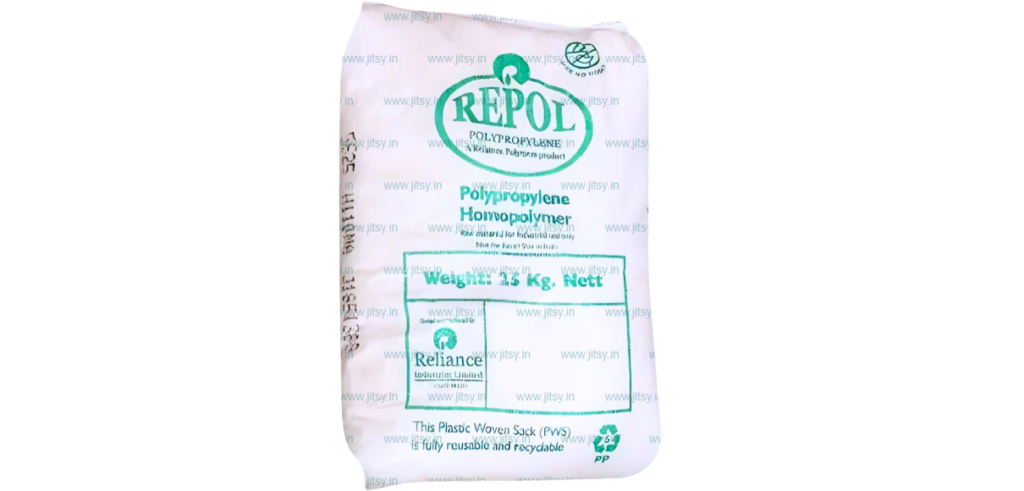
Reliance PP Repol H110MA
Reliance Repol H110MA, is a premium injection moulding polypropylene homopolymer from Reliance Industries Limited—India’s largest and most trusted polymers producer. This grade is engineered for high productivity and consistent quality, making it the industry benchmark for rigid packaging, housewares, thermoware, and furniture. A built-in antistatic additive ensures long-lasting surface aesthetics by minimizing dust pickup. Reliance’s Repol brand is synonymous with quality, regulatory compliance, and robust supply chain support, making H110MA a go-to solution for manufacturers seeking reliability and technical excellence.
Deep Technical Insights & Data Sheet Highlights
Repol H110MA features a high melt flow rate (MFR 11 g/10 min), enabling fast-cycle injection moulding and thin-wall part production. Its high flexural modulus ensures excellent stiffness and dimensional stability, while the Shore D hardness delivers superior surface durability. Balanced impact resistance and a heat deflection temperature (104°C) make it ideal for demanding applications. Reliance provides full batch traceability, technical documentation, and compliance with IS 10910, IS 16738:2018, and US FDA 21 CFR 177.1520 for food-contact use. Typical processing windows: melt temperature 210–260°C, mould temperature 30–50°C. These technical strengths give manufacturers confidence in processability, end-product quality, and compliance.Applications & Industry Use Cases
Rigid Packaging
Repol H110MA is widely adopted for injection-moulded containers, thin-wall tubs, lids, and caps. Its high flow and stiffness enable lightweight, rigid packaging solutions that maintain shape and integrity during filling, transport, and storage.Housewares and Thermoware
With outstanding rigidity and antistatic properties, H110MA is ideal for kitchenware, storage boxes, insulated containers, and household articles. Manufacturers benefit from easy moulding of complex shapes and long-lasting surface appearance.Furniture and Large Moulded Parts
The grade’s mechanical strength and stiffness support the production of durable furniture components such as chairs, stools, backs, and frames. Its processability allows for efficient manufacturing of both large and intricate parts, with reduced dust attraction for indoor use.Compounding and Masterbatch
As a homopolymer with controlled MFR, H110MA is a reliable carrier for masterbatches and filled compounds. It ensures uniform dispersion of additives and colorants, supporting high-performance end products in regulated applications.General Plastics & Job Shops
H110MA is a top choice for job shops producing consumer goods, packaging, and technical mouldings, thanks to its processing stability and broad regulatory acceptance.Comparable Alternatives – Technical Analysis
Key Indian alternatives to Repol H110MA include IOCL 1110MG, IOCL 1110MAS, HMEL M12RR, and OPaL MH13. Each is a PP homopolymer injection grade with a similar MFR (10–12 g/10 min), targeting rigid packaging, houseware, and furniture. IOCL 1110MG and 1110MAS match H110MA in flow and antistatic performance. HMEL M12RR and OPaL MH13 offer comparable stiffness and processability, making them suitable for converters seeking alternative sources or dual qualification. While all these grades meet industry standards for mechanical and thermal properties, Reliance Repol H110MA stands out for its traceability, regulatory documentation, and nationwide supply assurance—key for consistent, high-volume manufacturing.
Reliance PP Repol H110MAS
Reliance PP Repol H110MAS is a nucleated polypropylene homopolymer developed by Reliance Industries Limited under the Repol brand for injection moulded products requiring higher stiffness, better surface finish, faster cycle times, and improved dimensional stability. It is designed for processors making rigid packaging, furniture parts, houseware items, and other molded articles where warpage control, gloss, and production efficiency are important. For buyers searching for Reliance H110MAS TDS, nucleated PP homopolymer injection grade, or polypropylene for rigid packaging and furniture moulding, this grade is a technically strong and commercially relevant option.
Manufactured by Reliance Industries Limited, one of India’s leading petrochemical producers, Repol H110MAS belongs to the polypropylene homopolymer injection moulding family but stands apart because of its nucleated design. Compared with standard non-nucleated PP homopolymer grades, H110MAS is engineered to crystallize faster and more uniformly, which helps reduce cooling time, improve stiffness, and minimize common moulding defects such as warpage and sink marks.
Manufacturer and Brand Background
Reliance Industries Limited is a major producer of polypropylene for domestic and export markets, with a broad polymer portfolio serving packaging, automotive, furniture, houseware, industrial, and consumer goods sectors. Its Repol brand includes polypropylene homopolymers, random copolymers, impact copolymers, and specialty grades tailored to specific processing methods and end-use industries. Within this portfolio, Repol H110MAS is positioned as a premium injection moulding homopolymer for rigid applications where aesthetics and dimensional control matter. It is especially suitable for moulders who want the stiffness and productivity of PP homopolymer while also improving cycle time and reducing rejection caused by part distortion.Nucleated Design and Processing Advantage
The key technical differentiator of H110MAS is nucleation. The nucleating additive increases crystallization rate and supports a higher crystallization temperature, which allows molded parts to set faster during cooling. In practical production terms, this can improve throughput, shorten cycle time, and support more efficient moulding operations. Nucleation also helps create more isotropic shrinkage, meaning shrinkage is more balanced in different directions. This is important for large flat parts, visible furniture components, and rigid packaging articles where uneven shrinkage can lead to warpage, dimensional inconsistency, and poor fit. In addition, H110MAS is known for higher surface gloss and a cleaner molded appearance, which makes it attractive for visible consumer and household products.Technical Properties and Material Performance
Reliance PP Repol H110MAS is associated with a melt flow index of about 11 g/10 min at 230°C/2.16 kg, placing it in the medium-flow range commonly used for injection moulding of rigid parts. This MFI level provides a balanced combination of flow and structural performance, making it suitable for a wide range of molded articles from containers and lids to furniture and utility products. The density is approximately 0.90 g/cm³, which is standard for polypropylene homopolymer. Mechanical data associated with the grade indicates tensile strength at yield of around 38 MPa, elongation at yield of about 10 percent, flexural modulus of 1650 MPa, and notched Izod impact at 23°C of approximately 30 J/m. These values reflect a rigid PP homopolymer profile with good stiffness, useful strength, and sufficient toughness for many general-purpose injection moulded applications. From a technical selection standpoint, the most important strength of H110MAS is not only its mechanical profile but the way nucleation improves practical moulding behavior. Faster crystallization supports shorter cooling cycles, while isotropic shrinkage helps improve dimensional stability. This makes the grade especially useful for moulders looking to increase productivity without compromising part quality.Processing Guidance
H110MAS is recommended for injection moulding applications. In practical terms, processors can expect a moulding behavior similar to other medium-flow PP homopolymer grades, with melt temperatures generally in the range of about 210°C to 260°C and mould temperatures commonly around 30°C to 50°C, depending on part geometry, wall thickness, mould design, and machine setup. The grade’s higher crystallization temperature helps parts solidify faster, which can reduce cooling time and improve cycle efficiency. Its balanced shrinkage behavior also helps reduce warpage and sink marks, especially in parts with broader surfaces or more demanding dimensional requirements. Actual processing conditions should always be optimized according to the mould, machine, and final product design.Applications and Industry Use Cases
Rigid Packaging Containers and Lids
Reliance PP Repol H110MAS is highly suitable for rigid packaging applications such as food containers, storage boxes, jars, lids, and utility packaging components. Its stiffness and dimensional stability help maintain part shape and fit, while its improved gloss supports a cleaner and more premium finished appearance. For packaging manufacturers, this grade offers a strong balance between processability, rigidity, and visual quality.Furniture Components
H110MAS is a strong choice for injection moulded furniture parts such as chair shells, stool components, backs, arms, and structural household fittings. In these applications, isotropic shrinkage and reduced warpage are especially valuable because large visible parts must retain shape and appearance after moulding. The nucleated structure also helps improve production efficiency in high-volume furniture manufacturing.Houseware and Utility Products
The grade is widely relevant for houseware applications including buckets, basins, kitchenware, utility containers, thermoware outer parts, and other molded household products. These applications benefit from its stiffness, surface finish, and reduced moulding defects. For manufacturers producing consumer-facing plastic goods, H110MAS offers both practical processing advantages and better visual presentation.Compounding and Household Plastic Industry
H110MAS can also be used in compounding, masterbatch, and filler-modified applications serving the household plastics and furniture industries. Its stable homopolymer base and rigid performance profile make it suitable for converters looking to create customized formulations while maintaining good mouldability and part quality.Performance Advantages
The biggest advantage of H110MAS over standard PP homopolymer injection grades is its nucleated design. This improves crystallization behavior, which can reduce cooling time and increase production speed. For moulders running high-volume lines, this can translate into better machine utilization and lower cycle-related inefficiencies. Another major benefit is isotropic shrinkage. Standard PP homopolymer grades can sometimes show uneven shrinkage that leads to warpage, especially in larger or flatter molded parts. H110MAS is designed to reduce that issue, making it a more reliable choice for visible furniture components, rigid packaging, and houseware products where dimensional consistency matters. The grade also offers a better surface appearance than many non-nucleated alternatives. Higher gloss and cleaner molded surfaces make it more attractive for consumer-facing applications where part aesthetics are important alongside mechanical performance.Comparable Alternatives
Within the Reliance Repol range, H110MA is the closest comparison. Both grades belong to the same 11 MFI PP homopolymer family and are used in injection moulding, but H110MAS is the nucleated version designed for faster crystallization, improved gloss, and better warpage control. H110MA remains a good general-purpose option, but H110MAS is the stronger choice when part appearance, dimensional stability, and cycle time are more important. H200MA and other higher-flow PP homopolymer injection grades may be considered where easier filling or thinner-wall part geometry is the main requirement. However, these alternatives may not deliver the same nucleation-driven benefits in stiffness, shrinkage balance, and surface finish. For moulders focused on rigid packaging, furniture, and houseware, H110MAS provides a more specialized performance profile. Compared with competing PP homopolymer injection grades from HMEL, IOCL, and OPaL, H110MAS stands out because of its nucleated structure and isotropic shrinkage behavior. Many competing grades in the 10 to 12 MFI range are suitable for general injection moulding, but H110MAS is better positioned for converters who want premium molded appearance, reduced warpage, and improved production efficiency rather than only basic flow and stiffness. The rationale behind H110MAS is clear: it is assigned to applications where moulding speed, dimensional control, surface gloss, and rigid part performance matter more than the broader general-purpose balance offered by standard non-nucleated PP homopolymer grades.
Reliance PP Repol H200FG
Reliance PP Repol H200FG is a polypropylene homopolymer fiber grade developed by Reliance Industries Limited under its Repol portfolio. Manufactured using advanced Unipol PP process technology, this grade is engineered for stable melt behavior, consistent output, and reliable performance in high-speed fiber spinning applications. It is widely used for multifilament yarn, staple fiber, non-woven fabrics, and extrusion coating where processors need a balanced combination of flow, strength, color stability, and production efficiency.
Repol H200FG is positioned as a specialty PP homopolymer for converters looking for dependable spinnability without sacrificing end-use mechanical performance. Its fiber-focused additive package, including process stabilizers and anti-gas fading support, makes it especially suitable for white, natural, and appearance-sensitive fiber applications. For buyers searching for Reliance H200FG TDS, PP homopolymer for fiber spinning, or gas-fading resistant polypropylene fiber grade in India, this grade stands out as a proven and commercially relevant option.
