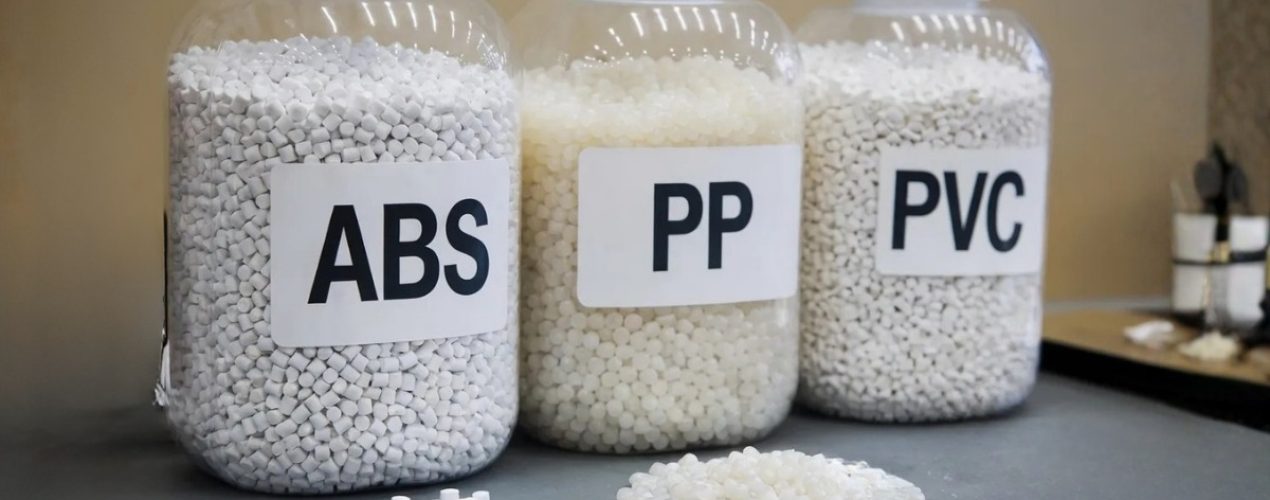
Confusion is common when manufacturers are considering ABS vs PP vs PVC. Different polymers are suitable for different applications, with specific pros and cons. If a manufacturer makes a poor choice, it can lead to wasted time and material and the loss of thousands of rupees.
This guide focuses on the three most commonly compared polymers in manufacturing: ABS (Acrylonitrile Butadiene Styrene), PP (Polypropylene), and PVC (Polyvinyl Chloride). Understanding their differences can help manufacturers avoid costly errors and help manufacturers make the right selections in the shortest time possible.
Overview Table
| Material/Environmental Impact |
ABS |
PP |
PVC |
| Environmental Impact |
Limited recycling |
Recyclable |
Limited recycling |
| Strength-to-Density Ratio |
High |
Moderate |
Moderate |
| Strength of Material |
Excellent |
Durable |
Durable |
| Heat Resistance |
Fair |
Good |
Good |
| Chemical Resistance |
Good |
Excellent |
Good |
| Cost |
Moderate |
Low |
Lowest |
| Durability |
Very Durable |
Durable |
Durable |
Material by Material Breakdown
ABS (Acrylonitrile Butadiene Styrene) offers exceptional impact strength and surface finish quality, making it ideal for consumer products and automotive components. However, limited recyclability and moderate UV resistance present environmental challenges.
PP (Polypropylene) delivers outstanding chemical resistance at the lowest cost among the three. Its high recyclability appeals to environmentally conscious manufacturers, though poor ageing characteristics mean strength degradation after prolonged exposure.
PVC (Polyvinyl Chloride) provides the most economical option with good dimensional stability. Despite excellent weatherability, environmental concerns regarding additives and limited recycling infrastructure have reduced its appeal in certain applications.
Typical Manufacturing Scenarios And Polymers That Best Fit
In India, the multiple uses of polymers in manufacturing entail careful consideration of design and functional parameters. For instance, the design and impact-resistant requirements of automotive dashboards and electronic enclosures make ABS suitable.
Due to its chemical resistance and non-toxicity attributes, PP is suggested for food and pharmaceutical products, and for the storage and transport of chemicals. If the environmental cost is constrained for the construction application, PVC is optimal for plumbing and window framing.
Mistake #4: Lack of Documentation and Compliance Rigor
Your Business’ Shield Between Growth and Litigation
Indian manufacturers tend to use trust and verbal agreements. This fails when scaling. Without proper GST documentation, quality certifications, and well-structured contracts, you will run into legal issues. Without a solid paper trail, disputes become costly as you grow.
Common Errors in Judging Polymers
Focusing on price alone shows a lack of understanding that is bound to lead to greater costs in the future due to performance failures.
Environmental non-compliance is expensive and can lead to serious recall problems.
Ignoring the industrial plastics guide’s principles means there are some applications where heat exposure is a concern and heat resistance is critical.
Brand image may be damaged, and environmentally conscious customers may be lost by selecting non-recyclable materials when there are recyclable alternatives.
The absence of sample testing can lead to the inefficient use of materials and adversely impact the overall lead time of production.
The absence of datasheets will result in poor decisions. The same polymer family may perform differently, and this may result in production and quality problems.
The Bottom Line: Comparing Polymers is Only the Beginning
That polymer comparison is the first step in learning about polymers, which is true, but the most important is testing. In the end, the most appropriate alternatives will be determined by your particular manufacturing requirements. Testing and collaborating with suppliers is necessary.